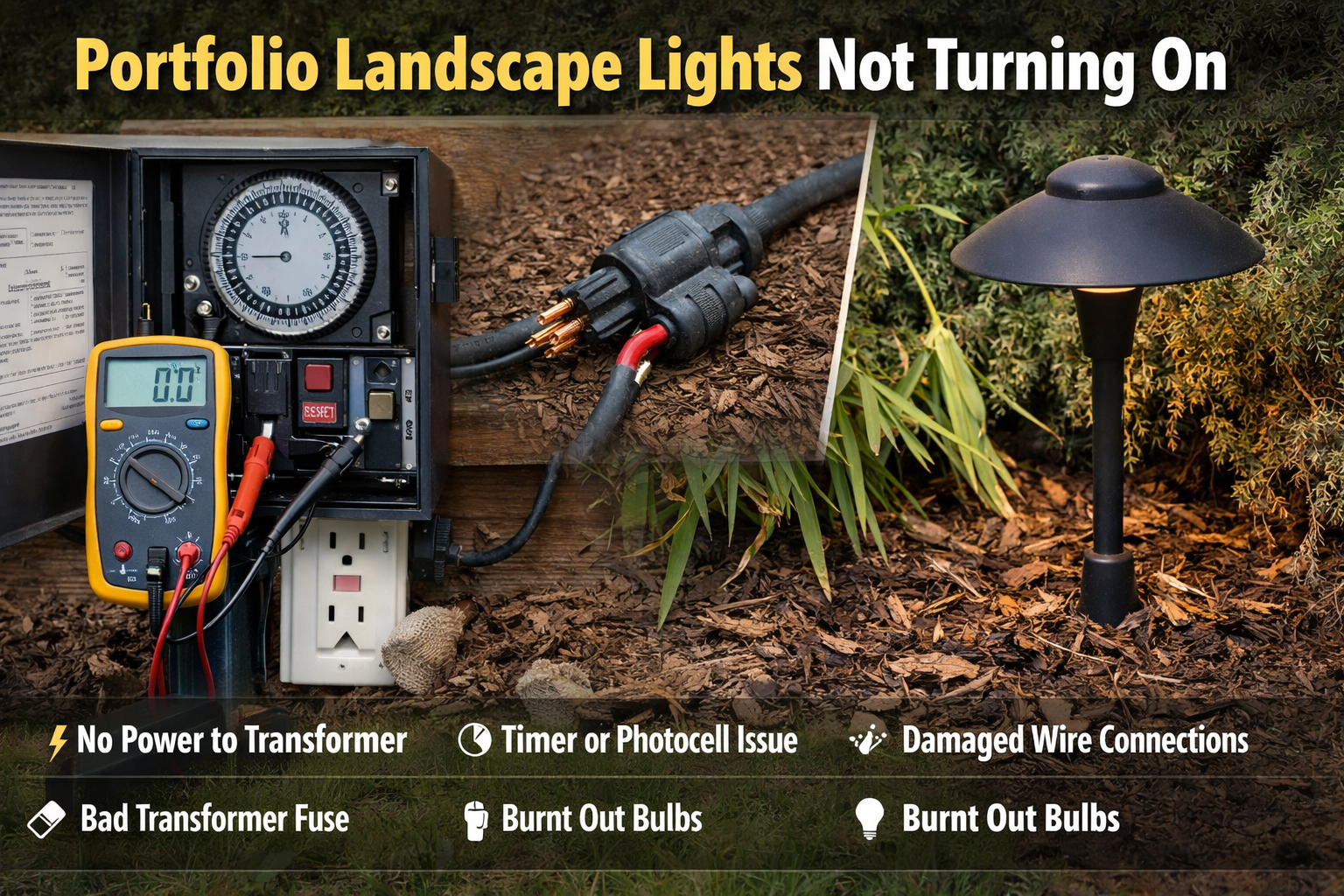
If your Portfolio landscape lights are not turning on, the issue is usually related to the transformer, timer settings, photocell sensors, or damaged wiring. Low-voltage landscape lighting systems depend on several components working together, so diagnosing the problem step by step is the best way to restore your outdoor lighting.
Many homeowners assume the fixtures themselves are the problem, but a dark landscape lighting system often points back to power delivery or control settings first. That is why a structured troubleshooting approach works much better than replacing random parts.
Quick Checklist Before Troubleshooting
Before you get deep into diagnostics, run through these fast checks. This simple list catches a surprising number of landscape lighting failures:
- Check that the transformer is plugged in securely.
- Reset the GFCI outlet if the transformer plugs into one.
- Confirm the wall outlet actually has power.
- Check whether the breaker has tripped.
- Inspect the timer settings and make sure it is not in the wrong mode.
- Inspect the photocell sensor for dirt, obstruction, or bright nearby light.
- Test a single bulb or one known working fixture.
- Check for loose low-voltage wire connectors near the transformer or first fixture.
Most Common Causes of Landscape Lights Not Turning On
Transformer Not Receiving Power
One of the most common reasons the entire landscape lighting system stays dark is that the transformer is not receiving power at all. That may happen because the outlet has tripped, the GFCI needs to be reset, the breaker has flipped, or the transformer plug has loosened over time. In this situation, the fixtures may all be fine, but none of them can operate because the system never gets started.
If the transformer looks completely dead, start with Portfolio lighting transformer not working before assuming the cable or fixtures are bad.
Timer or Photocell Preventing Lights From Turning On
Sometimes the transformer has power, but the control side of the system is stopping activation. Timers can reset after a power outage, drift out of schedule, or fail electronically. Photocell sensors can misread daylight if they are dirty, damaged, or exposed to nearby artificial light that confuses the sensor. In both cases, the system may appear dead even though power is technically available.
If you think the controls are the issue, compare landscape lighting timer setup and how to replace Portfolio photocell.
Blown Transformer Fuse
Some Portfolio transformers include replaceable fuses. If that fuse blows, the transformer may stop delivering power even though the unit is plugged in and the outlet is working. This is easy to overlook because the transformer can still look normal from the outside. A blown fuse often points to overload, shorting, or internal transformer stress.
For that kind of issue, use Portfolio lighting transformer troubleshooting.
Loose or Damaged Wiring
Low voltage landscape cable lives outdoors, which means it deals with moisture, soil movement, roots, digging, edging, pets, and general wear. Connections can come loose underground or at fixtures. Cable can get nicked or crushed. When that happens near the beginning of the run, it can make a big section of the system stop working all at once.
If you are tracing the cable path or trying to understand the wire setup better, use landscape lighting cable guide.
Burnt Out Bulbs
Bulbs are not always the first thing to check when the whole system is dark, but they still matter. If you have an older setup with several aging lamps, multiple bulb failures can make it look like a system-wide problem. That is especially true if you mainly notice the issue after a season change or after the system has been running for a long time without maintenance.
If you suspect the lamps themselves, compare your setup with Portfolio lighting bulb replacement.
How to Diagnose Landscape Lighting That Won’t Turn On
The goal here is to isolate the problem instead of guessing. Work through these steps in order so you can figure out whether the failure is at the transformer, the control system, the fixtures, or the cable.
Step 1: Check Transformer Power
Start by confirming that the transformer is actually receiving power. Make sure it is plugged in firmly, then test the outlet. An outlet tester is helpful because it tells you quickly whether the power source is live. If the outlet is GFCI protected, reset it and retest. If the transformer has indicator lights, check whether they are on. If the unit has a fuse, inspect that as well.
Step 2: Inspect Timer Settings
Timers often cause confusion because they may still appear functional while being set incorrectly. Check whether the timer is programmed correctly, whether it is stuck in manual mode, and whether a recent power outage cleared the schedule. If the timer has battery backup, that battery may also be part of the problem.
Step 3: Test One Fixture
Instead of trying to test the whole yard at once, focus on one fixture near the beginning of the run. Remove the bulb, inspect the socket, and try a known working lamp if the fixture uses replaceable bulbs. This helps you tell the difference between a general system failure and a fixture-specific issue.
Step 4: Inspect Cable Connections
Look closely at the wire connectors near the transformer and at the first few fixtures. Loose or corroded connectors are common failure points in outdoor systems. If a connector is poorly seated or has let moisture in, it may interrupt the circuit. This is where low voltage wire connectors for landscape lighting becomes especially useful.
When the Transformer Is the Problem
The transformer is the heart of the system, so when it fails, the entire yard can go dark. Common signs of a transformer problem include lights not turning on at all, no obvious output voltage, a silent transformer that no longer shows normal signs of operation, or repeated fuse problems. Some transformers fail suddenly. Others fade into unreliable behavior before stopping entirely.
A transformer problem is more likely when every fixture is dark, the outlet is confirmed live, and the timer settings are correct. At that point, measuring the output voltage with a multimeter becomes one of the best ways to confirm what is happening. If there is no usable output, repair or replacement becomes the next step.
For more support, compare Portfolio lighting transformer troubleshooting with Portfolio lighting transformer replacement.
Outdoor Conditions That Cause Lights Not to Turn On
Outdoor lighting systems live in an environment that is tough on every component. Heavy rain can let moisture into weak connectors or compromised transformer housings. Soil movement can pull on cable runs and slowly loosen fixture connections. Winter freezing and thawing can stress wires, housings, and splices. Landscaping work can slice into buried cable without anyone realizing it until the lights stop working later.
This is one reason a system may work well for months and then suddenly fail after a storm, hard freeze, or yard project. In many cases, the lights themselves are not the real problem. The outdoor conditions have damaged the wiring path or one of the control components that the system depends on.
If the failure seemed to happen right after bad weather or ground disturbance, focus extra attention on exposed cable areas, splice points, and the transformer enclosure.
Preventing Landscape Lights From Failing to Turn On
The best way to avoid this problem in the future is to treat the landscape lighting system like something that needs light annual maintenance. Most total system failures do not come out of nowhere. They build up over time through moisture exposure, weak connectors, overloaded transformers, or ignored cable damage.
- Use weatherproof connectors instead of makeshift splices.
- Bury cables properly so they are less likely to be cut or pulled loose.
- Inspect the transformer once a year for corrosion, heat damage, and fuse condition.
- Clean or inspect photocell sensors so they are not blocked or confused by nearby light.
- Replace aging bulbs before multiple failures make diagnosis harder.
- Walk the system occasionally after storms or landscaping work.
If you want to improve long-run reliability, compare this advice with landscape lighting voltage drop and how to wire landscape lighting.
When It’s Time to Replace the System
Sometimes repair is the right move. Sometimes it is not. If you are dealing with multiple failed fixtures, widespread cable damage, an outdated transformer, repeated connection issues, or old discontinued parts that are getting harder to match, replacement may be the smarter long-term choice. That is especially true if the system has become unreliable enough that you are constantly revisiting the same problem.
A newer low voltage lighting system can give you better efficiency, more dependable LED performance, and easier future maintenance. If the current setup is a patchwork of old fixtures, aging bulbs, and questionable splices, replacing the core system can actually save time and frustration.
If you are reaching that point, compare modern options with Portfolio lighting alternatives.
Final Thoughts on Portfolio Landscape Lights Not Turning On
When your landscape lights refuse to turn on, it helps to remember that the issue is usually not random. Most failures trace back to a short list of causes: the transformer is not getting power, the timer or photocell is blocking activation, the fuse has failed, the cable path has been damaged, or the lamps themselves are overdue for replacement. Once you work through those possibilities in order, the system usually starts to make a lot more sense.
The real key is to diagnose before replacing parts. Start at the transformer, confirm the controls, test one fixture, and inspect the cable connections. That method is usually faster, cheaper, and much less frustrating than guessing.
Portfolio Landscape Lights Not Turning On FAQ
Why are my landscape lights not turning on?
Most landscape lighting systems fail due to transformer power issues, timer problems, or damaged wiring.
Can a bad transformer cause lights not to turn on?
Yes. If the transformer fails, the system cannot deliver the low voltage power required for landscape lighting fixtures.
Do landscape lighting timers reset after power outages?
Many timers reset after outages and must be reprogrammed before the lights will turn on automatically again.
How do I test a landscape lighting transformer?
A multimeter can confirm whether the transformer is delivering the correct voltage output.
Portfolio landscape lights not turning on, low voltage landscape lighting troubleshooting, Portfolio transformer not working, landscape lighting timer problem, photocell issue, damaged wiring, and outdoor lighting system repair.