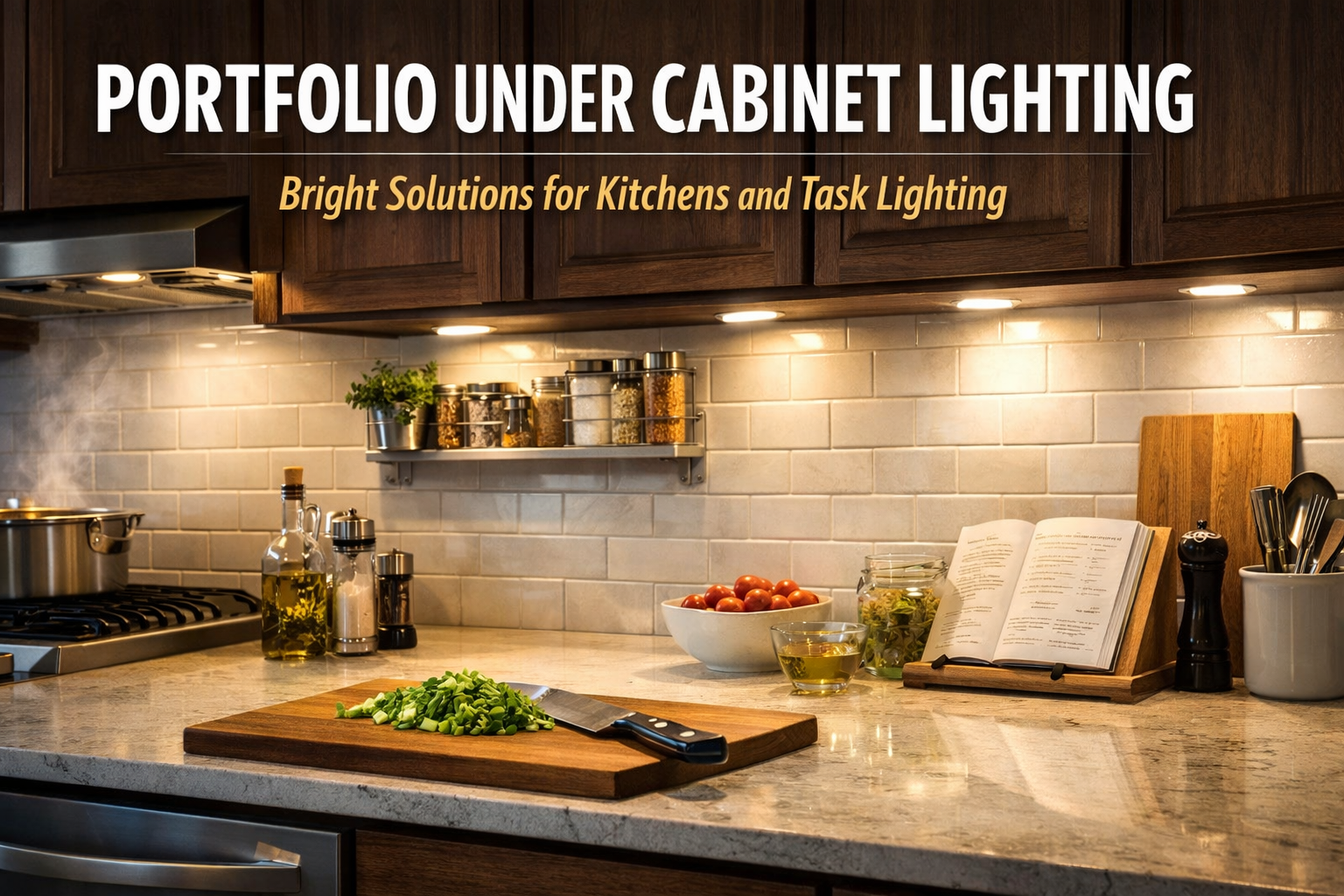
Under cabinet lighting solves a common problem in kitchens and work areas: overhead lighting often leaves the counter in shadow just when better light is needed most. Portfolio under cabinet lighting helps fill that gap by placing light closer to the surface, which improves everyday tasks like food prep, reading labels, measuring ingredients, and cleaning up.
It also connects naturally with nearby categories such as task lighting, puck lighting, strip lighting, LED lighting, and wireless lighting. For many homeowners, under cabinet lighting is where practical lighting design and everyday convenience meet.
Why Portfolio Under Cabinet Lighting Matters
A well-lit counter changes how a kitchen or work area feels and functions. Overhead ceiling fixtures often throw light from behind the person standing at the counter, which creates shadows exactly where cutting, reading, sorting, or assembling happens. Portfolio under cabinet lighting improves that experience by putting light lower and closer to the work surface.
In practical terms, this means cleaner visibility for prep work, safer knife use, easier reading of recipes and labels, and a more comfortable surface for detail-heavy tasks. Even simple daily routines such as making coffee, packing lunches, or cleaning a counter become easier when the lighting is directed where it is actually needed. This is why under cabinet lighting belongs firmly in the broader conversation around task lighting.
There is also a design benefit. Good under cabinet lighting adds depth to a room, highlights backsplash materials, and gives cabinetry a more finished, intentional appearance. In many kitchens, it creates a higher-end look without requiring a major renovation. That mix of utility and visual improvement is one reason under cabinet lighting stays popular in both new projects and simple lighting upgrades.
Best Uses for Under Cabinet Task Lighting
The strongest Portfolio under cabinet lighting setups are built around real use. Kitchens are the most obvious example, but this type of lighting works well in several spaces around the home.
Kitchens and Food Prep Areas
This is the classic use case. Under cabinet lights brighten countertops where chopping, mixing, reading labels, and cleaning happen. If the goal is practical everyday performance, it helps to think of the lighting first as a task tool and second as décor.
Pantries and Storage Zones
Shelving and cabinet-style storage areas often benefit from lower-mounted lighting because it makes labels, cans, spices, and small tools easier to see. This is especially helpful in deep cabinets or pantry areas with limited overhead coverage.
Laundry Rooms and Utility Work Surfaces
Folding counters, work benches, and small utility zones often need directed light but do not always have enough overhead illumination. Under cabinet lighting can make these spaces easier to use without adding bulky fixtures.
Home Office and Hobby Spaces
Cabinet-mounted lights also work well above desks, craft counters, and hobby benches where glare from a ceiling light may not be ideal. In those cases, under cabinet lighting becomes part of a broader layered system that may also include picture lighting, linear lighting, or LED lighting.
Common Installation Options for Portfolio Under Cabinet Lighting
Installation style makes a big difference in both appearance and long-term convenience. The best choice depends on how permanent the setup should be, how clean the wiring needs to look, and whether the lighting is meant as a quick upgrade or part of a more finished remodel.
| Installation Option | Best For | Main Advantage |
|---|---|---|
| Hardwired | Permanent kitchen upgrades and remodels | Clean, built-in appearance with no exposed plug |
| Plug-in | Faster installation and easier replacement | Simple setup with less electrical work |
| Battery-operated | Small cabinets, rentals, and low-use areas | No hard wiring needed |
| Linkable light bars | Long cabinet runs and multiple sections | More continuous, even illumination |
| Puck-style fixtures | Focused task zones or accent lighting | Targeted pools of light |
Choosing the Right Installation Path
A hardwired system usually makes the most sense when the goal is a clean, finished kitchen with minimal visible wiring. This is often the preferred approach in a remodel or when cabinets are already being updated. Hardwired under cabinet lighting tends to look more integrated, and it usually feels more permanent.
Plug-in systems are practical when simplicity matters more. They are easier to add after the fact, and they can be a better fit for homeowners who want the benefits of under cabinet lighting without turning the project into a larger electrical job. For many people, this is the sweet spot between function and convenience.
Battery-operated or more wireless-style options can work well in smaller areas, rentals, or spots where wiring is inconvenient. These solutions may not always provide the same continuous output as a hardwired setup, but they can still be useful in pantries, utility spaces, and lower-use work zones. Related categories like Portfolio wireless lighting and battery operated lighting often overlap with this kind of choice.
Light Types, Layout, and Everyday Performance
Portfolio under cabinet lighting can take several forms, and the best type depends on the goal. If the priority is smooth, even illumination across a long counter, linear bars or strip-style systems often make the most sense. They spread light more consistently and reduce the patchy effect that can happen when fixtures are spaced too far apart.
If the goal is to highlight specific prep zones or create small pools of focused light, puck-style fixtures may be a better fit. This is where Portfolio puck lighting becomes especially relevant. Puck lights can look attractive under cabinets, but they should be placed thoughtfully so the counter does not end up with bright circles and dark gaps between them.
Strip and linear options, including Portfolio strip lighting and Portfolio linear lighting, tend to work especially well in kitchens where the whole run needs to feel bright and usable. LED-based systems are often favored because they give good light output with low energy use and longer life, which is why Portfolio LED lighting is another natural supporting category here.
Good layout matters as much as the fixture type. Under cabinet lighting should be installed so the light lands on the work surface rather than just the backsplash. The goal is useful coverage, not wasted brightness hidden too far back under the cabinet lip.
Replacement Parts Guidance for Portfolio Under Cabinet Lighting
Not every under cabinet lighting problem calls for a full replacement. In many cases, one failed part is the real issue. A bulb may have burned out. A driver may have weakened. A switch or connector may have failed. A diffuser or lens may be cracked or missing. For that reason, it is smart to think about serviceability before replacing an entire fixture line.
The first place to look is often Portfolio lighting parts and accessories. That page can help narrow down whether the lighting issue is really a fixture-body problem or something simpler. If the unit uses replaceable components, it may also be worth checking bulb replacement, replacement diffusers, replacement hardware, and LED modules and drivers.
This matters for both budget and consistency. If the existing lighting matches the space well and only one part has failed, repairing the system can be more practical than starting over. On the other hand, if multiple fixtures are failing, brightness is inconsistent, or the old system no longer suits how the counter is used, a fuller upgrade may be the better long-term move.
When Under Cabinet Lighting Should Be Replaced Instead of Repaired
Repair makes sense when the fixture still suits the space, the cabinet run is well lit, and the issue is clearly isolated to one replaceable component. Replacement becomes more appealing when the lighting is uneven, outdated, too dim for modern kitchen use, or awkward to service. Many older systems still technically work but no longer perform the way homeowners want.
A replacement is often worth considering when the goal is better task lighting, less visible wiring, lower maintenance, or a cleaner overall cabinet appearance. It can also make sense when switching from isolated puck-style lighting to a smoother linear system or when adding more coverage to long counters that were never lit evenly in the first place.
Buyers who are evaluating replacement options may also find it helpful to compare related categories like Portfolio track lighting, task lighting, and Portfolio lighting alternatives if they are deciding whether to stay with the same style or move in a different direction.
Why Portfolio Under Cabinet Lighting Is a Strong SEO Topic
Portfolio under cabinet lighting is a valuable search topic because it sits at the intersection of practical home improvement and clear buyer intent. Visitors searching this phrase are often not casually browsing. They are usually trying to solve a real lighting problem in a kitchen, pantry, utility room, or work area. They want better task lighting, easier installation, a cleaner cabinet look, or help replacing an older fixture.
That means a strong page on this topic should do more than repeat the phrase. It should explain how under cabinet lighting improves visibility, compare installation options, show how light type affects performance, and help users decide whether to repair or replace what they already have. It should also connect naturally to related pages across the site, which is why internal links to puck lights, strip lights, LED lighting, replacement parts, and troubleshooting are so important.
When a page covers all of those angles in a natural way, it becomes more useful to readers and more complete in the eyes of search engines. That is what helps move a category page from average to genuinely strong.
Portfolio Under Cabinet Lighting FAQ
What is Portfolio under cabinet lighting best used for?
It is best used for kitchen counters, pantry shelves, utility work surfaces, and other areas where direct task lighting improves visibility.
Are puck lights or linear lights better under cabinets?
It depends on the goal. Puck lights create focused pools of light, while linear or strip-style fixtures usually provide more even illumination across longer counter runs.
Can under cabinet lighting be installed without hardwiring?
Yes. Plug-in, battery-operated, and some wireless-style options can work well, especially for easier retrofits or lower-use spaces.
Should a failed under cabinet light be repaired or replaced?
If the problem is limited to a bulb, diffuser, driver, switch, or other serviceable part, repair may make sense. If the whole system is outdated or uneven, replacement may be the better long-term choice.
More Portfolio Kitchen, Task, and Replacement Guides
Portfolio Task Lighting
Helpful if the main goal is better work-surface lighting and everyday visibility.
Read the guidePortfolio Puck Lighting
Useful when comparing focused under cabinet fixture styles and layout options.
Read the guidePortfolio Strip Lighting
A strong next step for visitors comparing smooth linear light to more focused fixture types.
Read the guidePortfolio LED Lighting
Useful for efficiency, brightness, and longer-life under cabinet lighting decisions.
Read the guidePortfolio Lighting Parts and Accessories
Helpful when the right answer may be replacing one part instead of a full fixture run.
Read the guidePortfolio Lighting Alternatives
Useful when comparing under cabinet and task-lighting replacement directions.
Read the guide