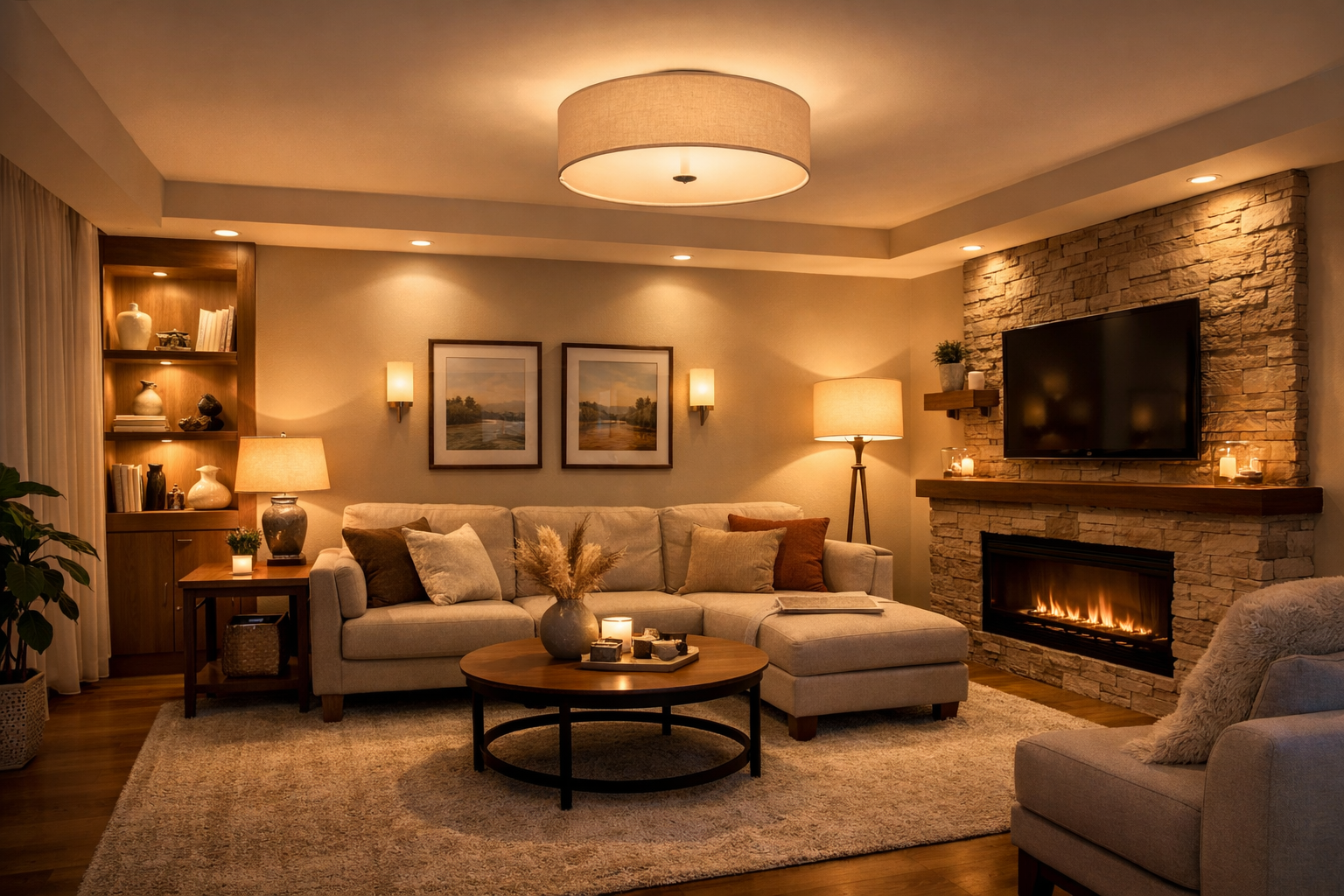
Ambient lighting is the light layer most people live with every day. It should make a room feel naturally usable, comfortable, and visually balanced before you add stronger task light or more decorative accents.
This page works naturally alongside Portfolio mood lighting, Portfolio LED lighting, Portfolio wall lighting, Portfolio floor lamps, Portfolio flush mount lighting, and Portfolio recessed lighting. If mood lighting is about the emotional tone of the room, ambient lighting is about getting the room’s base glow right first.
What Ambient Lighting Really Is
Ambient lighting is the room’s general layer of light. It is what lets a space feel comfortably lit overall without depending on one narrow beam or one highly focused fixture. If a room feels usable, balanced, and naturally visible before you turn on specialty lights, that usually means the ambient lighting is doing its job.
In many homes, this is the lighting layer people notice least when it works well and notice first when it does not. A room with poor ambient lighting can feel gloomy, uneven, or strangely harsh even if it has plenty of fixtures. That happens because ambient lighting is not only about brightness. It is about distribution, softness, and how the light spreads through the room.
Ambient lighting is also the reason some rooms feel easier to live in at night. It supports the normal use of the room without demanding attention. In a living room, it helps the space feel settled and welcoming. In a bedroom, it creates a gentle visual base that supports rest. In halls, sitting rooms, and common spaces, it keeps the room from feeling patchy or underlit.
Ambient Lighting vs Mood Lighting
Ambient lighting and mood lighting overlap, but they are not exactly the same thing. Ambient lighting is the room’s overall base glow. Mood lighting is more about emotional tone and atmosphere. You often need good ambient lighting before mood lighting can work well.
For example, a bedroom may have mood lighting through bedside lamps, warm accent light, and soft wall glow. But if the room’s ambient lighting is poor, the space may still feel awkward or uneven the rest of the time. The same is true in a living room. Mood lighting may make the space feel cozy, but ambient lighting makes the room feel comfortably usable without forcing you to rely on one bright ceiling light.
| Lighting Type | Main Goal | How It Feels in the Room |
|---|---|---|
| Ambient lighting | Create balanced overall room light | Comfortable, usable, even, supportive |
| Mood lighting | Shape atmosphere and emotional tone | Cozy, soft, warm, intimate |
| Task lighting | Support reading, working, grooming, or focused activity | Brighter, more direct, more functional |
| Accent lighting | Highlight a feature, wall, shelf, or display area | Layered, selective, decorative |
For the atmosphere-focused companion page, see Portfolio mood lighting. For the more functional side of room illumination, compare Portfolio task lighting.
Ambient Lighting Ideas for a Bedroom
Bedroom ambient lighting should feel calm, broad, and easy on the eyes. It should not make the room feel flat or overexposed, but it also should not leave you dependent on tiny accent lights for basic visibility. A bedroom’s ambient layer often works best when it is soft enough for comfort and strong enough for normal evening use.
In many bedrooms, the problem is not lack of fixtures. It is poor balance. A single overhead fixture may be technically bright enough, but still make the room feel too sharp at night. Ambient bedroom lighting improves when you think in terms of soft distribution rather than direct intensity.
Ceiling fixtures can still play an important role, especially flush mounts or recessed lighting used thoughtfully. But many bedrooms feel better when that base layer is supported by softer wall lighting, floor lamps, or LED accent glow that spreads light more gently across the room.
Bedroom ambient-lighting ideas that usually work well
- use softer ceiling light as a base instead of harsh direct brightness
- support the room with wall or bedside lighting so the ambient layer feels more balanced
- let LED accent glow help the room feel deeper and calmer at night
- keep the strongest light away from direct bed-level sightlines when possible
- avoid making one corner bright and the rest of the room empty
Supporting fixture pages that can help here include Portfolio flush mount lighting, Portfolio sconces lighting, Portfolio floor lamps, and Portfolio LED lighting.
Ambient Lighting Ideas for a Living Room
Living room ambient lighting has to do more than bedroom ambient lighting because the room usually serves more than one purpose. It may host conversations, TV time, reading, family time, and quieter evening use. That means the ambient layer should be broad enough to support the room while still leaving space for accent and mood lighting to matter.
The most common living room problem is overdependence on one central fixture. The room may technically be bright, but it does not feel balanced. Good ambient lighting usually comes from spreading the light more naturally through the room, often by using a mix of ceiling support, floor lamps, wall lighting, and softer LED sources that reduce harsh contrast.
This is also where ambient lighting becomes the bridge between functional room light and mood lighting. If the living room has a good ambient layer, it is much easier to make it feel cozy later with softer accents. Without that foundation, the room often swings between too dark and too bright.
Ambient lighting often includes decorative fixtures that help set the overall mood of a room. In addition to ceiling lights and wall fixtures, many homeowners use accent lamps to create a relaxed atmosphere. One popular decorative option is the lava lamp, which produces soft light and slow moving wax patterns that add visual interest to a space. If you want to learn more about how these lamps work or how to keep them operating properly, visit our guide to Portfolio lava lamp lighting for helpful tips and maintenance advice.
If your living room needs a stronger fixture comparison, also review Portfolio floor lamps, Portfolio wall lighting, Portfolio flush mount lighting, and Portfolio recessed lighting.
How LED Ambient Lighting Fits Indoors
LED ambient lighting works well indoors when it is used to support the room’s overall glow instead of creating hard, direct brightness. This matters because some people still associate LED with cold or clinical light. But in a well-planned room, LED lighting can be one of the easiest ways to create clean, consistent, and flexible ambient light.
LED is especially useful when the room needs subtle support from shelves, under-surfaces, wall edges, built-ins, or soft indirect glow. That is one reason LED ambient lighting often overlaps with pages like Portfolio strip lighting, Portfolio puck lighting, and Portfolio linear lighting. Those fixtures can help shape the ambient layer quietly without turning into the main visual focus of the room.
Portfolio Fixture Types That Support Ambient Lighting
Ambient lighting is not one fixture category. It is usually the result of using several fixture types well. That is why this page should connect naturally to the rest of your indoor cluster. The visitor often starts with the room problem, not the exact product type. They know the room feels off. Then they need help deciding which fixtures can fix the ambient layer.
Ceiling-Based Base Light
Flush mounts and recessed lighting can help establish the room’s main ambient layer when used with restraint and good placement.
See Flush Mount LightingSofter Side-Layer Support
Wall lighting and sconces help rooms feel broader and less dependent on harsh overhead-only light.
See SconcesQuiet LED Ambient Glow
Strip, linear, and puck lighting can help rooms feel deeper and more balanced without visually dominating the space.
See Strip LightingOther helpful pages in this lighting group to assist in your room ambience include Portfolio floor lamps, Portfolio wall lighting, Portfolio LED lighting, and Portfolio specialty lighting.
Common Ambient-Lighting Mistakes to Avoid
Most ambient-lighting mistakes come from confusing brightness with balance. A room can be bright and still feel unpleasant. It can also be stylish and still feel poorly lit. Ambient lighting succeeds when the room feels naturally usable and visually comfortable without drawing attention to the lighting first.
Common mistakes include:
- relying on one ceiling fixture to do all the work
- making the room bright without making it feel balanced
- ignoring how light spreads across walls and furniture
- using accent lights without fixing the weak ambient base
- placing fixtures where glare reaches seating or bed height directly
- creating sharp bright spots with no comfortable room-wide support
Another mistake is assuming ambient lighting and mood lighting are the same page. They support each other, but they solve different search intent. This page should help visitors fix the room’s base glow. The Portfolio mood lighting page should help visitors shape the emotional tone once that foundation is in place.
Final Thoughts on Portfolio Ambient Lighting
Portfolio ambient lighting is about making rooms feel naturally livable. It is the layer that supports daily use, evening comfort, and the overall balance of the room before more decorative or more focused lighting ever enters the picture.
When ambient lighting is handled well, bedrooms feel calmer, living rooms feel more settled, and indoor spaces feel easier to enjoy. That is why it deserves its own page and its own SEO role. It is not just mood lighting by another name. It is the base layer that helps every other lighting decision work better.
Whether your next step is flush mount lighting, recessed lighting, sconces, floor lamps, or LED accent support, the goal stays the same: create a room that feels comfortably lit overall, not just bright in the middle.
Portfolio Ambient Lighting FAQ
What is ambient lighting?
Ambient lighting is the general layer of light that makes a room feel comfortably lit overall. It is the base lighting that supports everyday use before task lighting and accent lighting are added.
How is ambient lighting different from mood lighting?
Ambient lighting is the overall room glow that makes a space feel usable and balanced. Mood lighting is more about atmosphere and emotional feel. Ambient lighting is usually the base layer, while mood lighting is the softer effect created by layered light.
What is the best ambient lighting for a living room?
The best living room ambient lighting usually comes from layered fixtures such as floor lamps, wall lighting, softer ceiling light, and LED glow that make the room feel comfortable without harsh overhead brightness.
Can LED lighting work for ambient lighting?
Yes. LED lighting can work very well for ambient lighting when the fixture type, placement, and overall room balance support a soft, even indoor glow instead of harsh direct light.
Portfolio ambient lighting, ambient lighting ideas, soft indoor lighting, bedroom ambient lighting, living room ambient lighting, LED ambient lighting, and layered indoor room-lighting help.