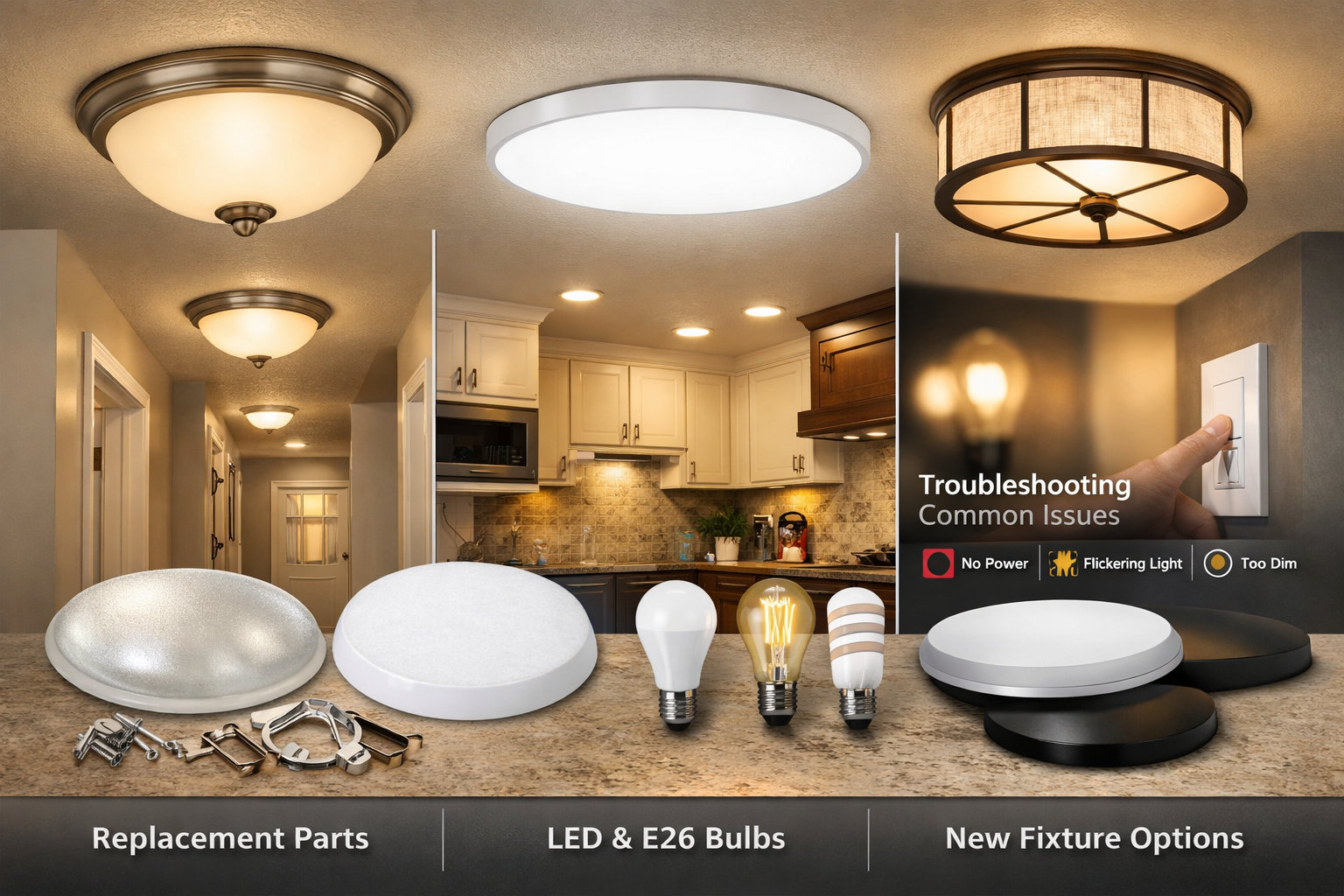
Portfolio flush mount lights were simple, practical ceiling fixtures used in everyday rooms where you wanted reliable general lighting without a hanging fixture taking up visual space.
If you are here because you need a bulb, glass cover, diffuser, hardware, or replacement fixture, the goal of this guide is to help you quickly figure out what you have, what usually goes wrong, and what makes the most sense to do next.
What Is Flush Mount Lighting?
Flush mount lighting is a ceiling fixture that sits directly against the ceiling rather than hanging down. That makes it a very common choice in rooms with lower ceilings or in areas where you want clean, simple overhead lighting without a fixture dropping into the room. Hallways, closets, bedrooms, kitchens, bathrooms, laundry rooms, and smaller entry areas are all common places for a flush mount light.
The job of a flush mount fixture is usually general room lighting. It is meant to spread light across the room rather than spotlight one small area. That is why these fixtures are so common in everyday homes. They are practical, easy to live with, and usually easier to replace than more specialized lighting categories.
Compared with a semi-flush mount fixture, a flush mount sits tighter to the ceiling and has less visual depth. Compared with Portfolio recessed lighting, it is more visible and usually easier to service because you can access the bulbs or diffuser without opening the ceiling. Compared with Portfolio pendant lighting, it is lower profile and generally better for spaces where headroom matters.
Types of Portfolio Flush Mount Lights
Portfolio sold several flush mount styles because homeowners use ceiling lights differently depending on the room. Some fixtures were plain and practical. Others leaned more decorative. Some used standard replaceable bulbs, while newer versions moved toward integrated LED designs.
Traditional Dome Flush Mount Lights
The most familiar style is the traditional dome flush mount. This is the classic ceiling light with a frosted glass dome and a metal trim ring or center finial holding the glass in place. You saw these all over hallways, bedrooms, closets, kitchens, and bathrooms because they were affordable, simple, and easy to match with many home styles.
These fixtures are also the ones most likely to need replacement glass or mounting hardware over time. The good news is that many of them used very standard bulb formats and simple hardware arrangements, which makes them easier to keep in service.
LED Flush Mount Fixtures
Portfolio also sold LED flush mount fixtures designed around lower energy use and longer lifespan. Some of these still used a diffuser with a low-profile housing, but the light source was an integrated LED module rather than a normal screw-in bulb. These fixtures were appealing because they ran efficiently and gave a cleaner modern look.
The tradeoff is serviceability. If the issue is inside the LED driver or integrated light engine, the repair path is different than simply installing a fresh bulb. If your fixture seems newer and does not have a standard bulb socket, compare it with Portfolio LED lighting.
Decorative Flush Mount Fixtures
Some Portfolio flush mount lights were more style-driven. These included drum style ceiling lights, decorative glass fixtures, brushed nickel or bronze finishes, and models with patterned glass or more visible trim details. Decorative flush mount lights are common in entry areas, dining nooks, bedrooms, and updated hallways where homeowners want the light to feel like part of the room design instead of just a utility fixture.
If you are replacing this type, pay attention to diameter, finish, and shade style so the new fixture feels intentional with the rest of the room.
Bulb Types Used in Portfolio Flush Mount Lights
This is one of the most important questions because many homeowners are trying to relamp an older ceiling light without the original box or paperwork. In many Portfolio flush mount fixtures, the most common bulb type was the E26 medium base bulb. That is the same general screw-in format used by many household bulbs, so these fixtures often work with LED bulbs, older incandescent bulbs, and CFL bulbs depending on the fixture label and wattage limit.
E26 Medium Base Bulbs
If your flush mount light has a normal socket, E26 is the first thing to check for. These bulbs are common, easy to find, and available in many brightness levels and color temperatures. Today, most homeowners switch these fixtures to LED bulbs because they use less energy, run cooler, and last longer than older incandescent options.
Just make sure the bulb shape actually fits inside the glass shade or diffuser. A bulb can be electrically compatible and still be too tall or too wide for the cover to install properly.
Integrated LED Modules
Newer flush mount fixtures sometimes used built-in LEDs rather than replaceable bulbs. In those fixtures, the light source is part of the fixture itself and may rely on an LED driver module. That can be efficient and clean-looking, but it also changes how you troubleshoot and repair the light.
If your fixture does not have a visible bulb socket, compare it with Portfolio integrated LED lighting. That page is useful when you are trying to tell the difference between a bulb issue and an internal LED or driver issue.
Replacement Parts for Portfolio Flush Mount Lighting
This is where many discontinued Portfolio fixtures can still be saved. A ceiling light often fails in a very ordinary way. The glass breaks. The diffuser yellows or cracks. A trim ring gets lost. Mounting hardware disappears during a repaint or remodel. Those are all fixable problems if you can identify what part you need.
Replacement Glass Covers
Broken or missing glass is one of the most common flush mount problems. Many Portfolio fixtures used removable glass domes held in place by screws, clips, or a center finial. If the rest of the fixture still works, replacing the glass is often much cheaper than replacing the whole light. Start with Portfolio lighting replacement glass if your main issue is a broken or missing glass cover.
Replacement Diffusers
Some ceiling lights used plastic or acrylic diffusers instead of glass. Over time, these can discolor, crack, warp, or become brittle. If your fixture is still producing light but the cover looks aged or damaged, a replacement diffuser can improve both appearance and light output. Use Portfolio lighting replacement diffusers for help matching that type of part.
Mounting Hardware
Hardware matters more than people think. A flush mount fixture depends on screws, brackets, trim rings, clips, and mounting plates to sit safely against the ceiling. If one of those parts is bent, missing, or mismatched, the light may hang crooked, rattle, or fail to secure correctly after a bulb change. That is where Portfolio lighting replacement hardware becomes useful.
For a broader view of compatible parts, compare this section with Portfolio lighting parts and accessories.
Common Problems With Portfolio Flush Mount Lights
Light Not Turning On
If the light will not turn on at all, start with the simplest possibility first. Try a known working bulb if the fixture uses replaceable bulbs. Then check the wall switch and make sure the breaker is not tripped. If the bulb and switch are fine, the problem may be in the socket, internal wiring, or LED driver.
- Burnt bulb
- Faulty wall switch
- Loose or failed socket
- Wiring issue in the fixture or ceiling box
For broader diagnostic help, use Portfolio lighting troubleshooting.
Light Flickering
Flickering is often caused by something minor, but not always. A loose bulb can do it. So can an LED bulb that is not fully compatible with the fixture, dimmer, or older socket setup. In integrated LED models, an aging driver can also create flicker or intermittent performance.
- Loose bulb
- Incompatible LED bulb
- Failing socket contact
- Aging driver in LED fixtures
If that sounds familiar, compare this page with Portfolio LED lights flickering.
Fixture Too Dim
A flush mount light that feels dim is not always broken. Sometimes the problem is simply a low-lumen bulb in a room that needs more output. In other cases, the diffuser or glass cover blocks more light than it used to because it has yellowed, fogged, or collected dust. An aging LED module can also lose performance over time.
- Low lumen bulb choice
- Aging integrated LED
- Dirty or yellowed diffuser
- Output loss caused by driver or module wear
If your light is working but underperforming, use Portfolio lighting too dim for more guidance.
How to Identify Your Portfolio Ceiling Light Model
If you want the right glass, diffuser, or hardware the first time, model identification matters. Start by turning off power and removing the glass or diffuser carefully. Look inside the metal housing, on the mounting plate, and near the socket area for a sticker or stamped code. In some fixtures, the model number is printed on a label hidden above the glass cover or on the back side of the mounting plate.
You may also find useful information on the fixture label such as item number, manufacturer code, voltage, bulb type, and maximum wattage. Even if you cannot find a complete model number, a partial number plus the fixture diameter and glass style can still help narrow things down.
For more help matching old numbers and labels, use Portfolio lighting model number lookup.
Replacement Options for Portfolio Flush Mount Lights
Since Portfolio lighting was discontinued, many homeowners eventually reach the point where replacing the whole fixture makes more sense than continuing to hunt for a specific original part. That does not have to be a bad thing. Flush mount ceiling lights are one of the easiest fixture categories to replace because there are so many modern options with similar size, function, and appearance.
If you want a simple update, modern LED flush mount lights are usually the easiest move. They offer better efficiency, cleaner light output, and lower maintenance. If you want something with a little more style, modern drum lights can provide a decorative look while still keeping a close-to-ceiling profile. If your room has limited headroom, low profile ceiling fixtures are often the safest and cleanest replacement direction.
For a broader comparison of replacement brands and styles, use Portfolio lighting alternatives and discontinued Portfolio lighting.
Choosing a Replacement Flush Mount Fixture
If you are replacing an older Portfolio ceiling light, start with function before style. Think about how bright the room needs to be, how low the ceiling is, and whether the existing fixture felt too dim, too dated, or too bulky. Brightness is best measured in lumens, not just watts. A kitchen, laundry room, or bathroom usually needs more useful light than a small hallway or closet.
Ceiling height matters because one of the main reasons people choose flush mount lighting is to keep the fixture tight to the ceiling. If the room is already low, stay with a genuinely low-profile design instead of accidentally moving into a deeper semi-flush style. LED usually makes more sense than incandescent now because it uses less energy, runs cooler, and lasts longer. Fixture diameter matters too. A replacement that is much smaller than the old light can look lost on the ceiling, while one that is too large may feel crowded or expose paint lines from the old canopy.
| What to Consider | Why It Matters |
|---|---|
| Brightness (lumens) | Determines whether the fixture actually lights the room well enough |
| Ceiling height | Helps you decide between low-profile flush mount and deeper fixtures |
| LED vs incandescent | Affects energy use, heat, maintenance, and bulb replacement needs |
| Fixture diameter | Helps the new light fit the room visually and cover the old ceiling footprint |
Portfolio Flush Mount Lighting FAQ
Are Portfolio flush mount lights discontinued?
Portfolio lighting fixtures were discontinued, but replacement bulbs and parts are still available in some cases through online sellers and compatible lighting suppliers.
What bulb do Portfolio flush mount lights use?
Most models use E26 medium base bulbs, though newer fixtures use integrated LED modules instead of a standard replaceable bulb.
Can you replace the glass on a Portfolio ceiling light?
Yes. Many flush mount fixtures use removable glass covers that can be replaced if you match the size, mounting method, and fitter style correctly.
Where can I buy Portfolio replacement parts?
Replacement parts may be found online, through compatible lighting suppliers, and on parts pages that help you match glass covers, diffusers, and mounting hardware.
Portfolio flush mount lighting, Portfolio flush mount ceiling light, Portfolio replacement glass cover, Portfolio replacement diffuser, Portfolio ceiling light parts, discontinued Portfolio lighting, and Portfolio ceiling light model number.