
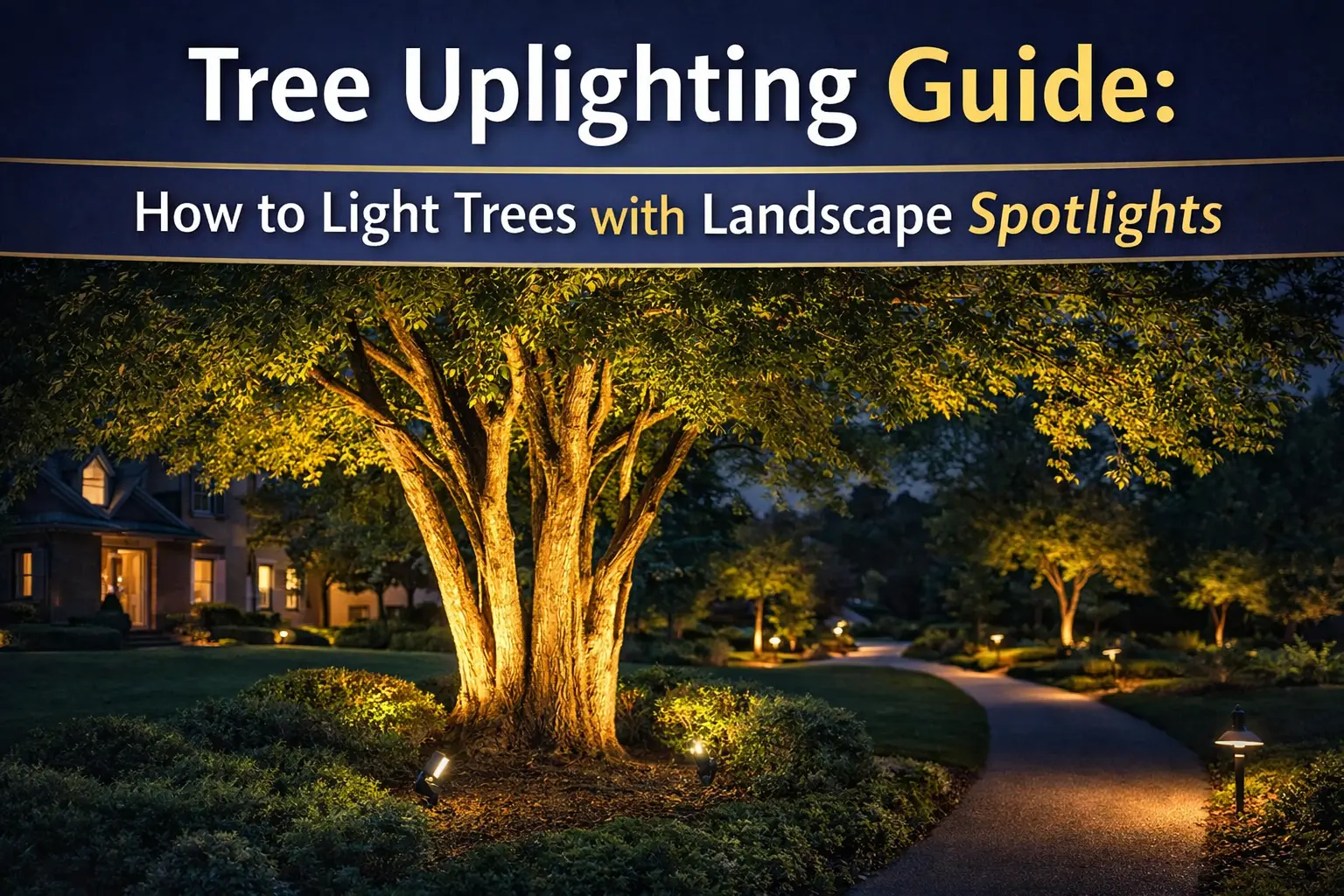
Tree uplighting is one of the strongest techniques in landscape lighting because it adds vertical interest to the yard. Path lights and step lights handle safety and navigation, but uplighting trees creates the visual drama most homeowners actually notice from the street, the driveway, and the patio.
A good tree lighting plan does more than point a spotlight at the trunk. The real goal is to shape the view. You want the eye to travel upward, read the branching structure clearly, and feel that the lighting belongs to the landscape rather than sitting awkwardly on top of it. Done correctly, tree uplighting can make a small front yard feel more layered and can make a larger backyard feel more finished, more intentional, and far more usable at night.
This page focuses specifically on how to uplight trees, but the strongest results come when tree lighting is integrated with a full low-voltage plan. That is why this guide naturally connects with your layout decisions, fixture spacing, wire sizing, and transformer planning.
Tree uplighting becomes much more effective when it is planned as part of a complete outdoor lighting design. Our Complete Landscape Lighting Guide explains how uplighting works alongside path lights, layout planning, lighting zones, wiring, and transformers to create a balanced landscape lighting system.
Why Tree Uplighting is One of the Best Landscape Lighting Techniques
Tree uplighting works because trees already have the kind of structure that light can dramatize. Trunks, bark texture, low limbs, branch splits, and canopies all respond differently to upward light. That gives you depth, contrast, and natural shadow without forcing the yard to rely only on decorative fixtures for visual interest.
It also creates scale. During the day, a tree may feel like background landscaping. At night, the same tree can become an anchor point that organizes the whole scene. This is especially useful in front yards where one or two illuminated trees can make the property feel larger and more finished, and in backyards where trees help define seating areas, pools, outdoor kitchens, and patios after dark.
From a design standpoint, tree uplighting helps break the flatness that can happen when all of the light stays low to the ground. Path lights, bollards, and step lights are important, but they do not usually create that sense of vertical layering on their own. Tree lighting gives the eye something to climb. That is one reason it belongs inside a complete landscape lighting design guide and should be coordinated with the broader landscape lighting layout of the yard.
Best Types of Trees for Uplighting
Large Canopy Trees
Large canopy trees often create the most dramatic results. Oaks, maples, elms, and similarly structured shade trees can look impressive when light reaches up through the trunk and lower scaffold branches into the canopy. These trees often need either a wider beam or multiple fixtures because a single narrow spotlight may only light a small vertical slice rather than the overall mass of the tree.
Ornamental Trees
Ornamental trees are often ideal for homeowners who want a clean focal point without needing several fixtures. Japanese maples, dogwoods, crape myrtles, and smaller flowering trees can often be lit effectively with one carefully aimed spotlight. Because they are usually smaller and lower, they are easier to control and less likely to need high output.
Multi-Trunk Trees
Multi-trunk trees are especially attractive for uplighting because the branching structure itself becomes part of the design. Instead of focusing on a single trunk, the light can reveal negative space between trunks and create more sculptural shadow patterns. These trees often benefit from cross-lighting with two fixtures from different angles.
Palm Trees
Palm trees respond well to narrow beam uplighting because the strong vertical trunk gives the beam a clear path. In many cases the goal is to carry light up the trunk and into the crown for a clean, dramatic look. The spacing and beam angle need to be controlled carefully so the light feels intentional rather than glaring.
Evergreen Trees
Evergreen trees can be beautiful at night, but they are denser and often absorb more light than deciduous trees. A tight narrow beam may disappear into heavy foliage, so these trees often need broader coverage, stronger output, or multiple fixtures placed strategically.
The larger point is that the tree type changes the lighting plan. Tree size, canopy density, trunk structure, and viewing distance all affect fixture selection, spacing, and aiming. That is why tree lighting fits best within a broader landscape lighting guide rather than being treated like a one-size-fits-all technique.
Best Landscape Lights for Uplighting Trees
The best fixture for tree uplighting depends on what you want the light to reveal. If the goal is to emphasize height and trunk structure, a spotlight is usually the first choice. If the goal is to wash a wide canopy or soften the overall effect, a broader flood-style beam may work better. If the tree sits in a high-visibility area such as an entry bed or patio edge, in-grade fixtures may also be considered for a cleaner look.
Spotlights
Spotlights are the classic tree uplighting fixture because they allow precise beam control. They work especially well for trunks, medium trees, multi-trunk forms, and dramatic accent lighting. See Portfolio landscape spotlights if you want fixtures that align naturally with the rest of your Portfolio landscape cluster.
Flood Lights
Flood lights spread light over a broader area. They are useful when a tree canopy is wide, when the tree sits farther away from the viewer, or when you want a softer and less theatrical effect. For related fixture ideas, compare Portfolio flood lighting.
In-Grade Lights
In-grade lights can create a very clean visual presentation because the fixture body is recessed into the ground. They are most appropriate when the installation area allows proper drainage and when the viewing angle would otherwise expose a traditional spotlight housing. Learn more from Portfolio in-grade lighting.
LED Landscape Fixtures
Modern LED landscape lighting is often the best long-term choice for tree uplighting because it offers efficient output, long lifespan, and low system draw. The right LED spotlight can create strong uplighting effects without forcing the transformer and cable runs to carry the same load older halogen systems once required. For related options, see Portfolio LED landscape lighting and Portfolio low-voltage lighting.
Where to Place Landscape Lights When Uplighting Trees
Placement is the part that makes or breaks tree uplighting. Even a good fixture can produce a poor result if it sits in the wrong location. The key question is not just how bright the light is, but where the beam begins and how it travels through the tree.
As a practical starting point, many installations follow a simple distance rule based on tree size:
- Small trees: place the light about 1 to 2 feet from the trunk
- Medium trees: place the light about 2 to 4 feet from the trunk
- Large trees: place the light about 4 to 6 feet from the trunk
These are not hard laws, but they are strong starting positions. Moving the fixture closer creates a tighter, more dramatic vertical effect and often reveals bark texture strongly. Moving it farther out broadens the beam across more of the trunk and canopy. The right choice depends on the tree form and on what the viewer sees from the driveway, street, patio, or main windows.
Placement also needs to consider mowing, edging, mulch beds, and sightlines. A fixture hidden too deeply in planting can become difficult to aim or service. A fixture placed too openly can produce glare. That is why tree lighting should coordinate with your broader landscape lighting spacing, path light placement, and overall lighting layout.
For many homeowners, the smartest approach is to place the fixture temporarily, test the nighttime effect, and then adjust before final burial or permanent fastening. A small shift in position can completely change the result.
Beam Angle Guide for Tree Lighting
| Beam Type | Angle | Best Use |
|---|---|---|
| Narrow | 10-25° | Tall trees, strong trunk emphasis, focused vertical drama |
| Medium | 30-40° | Medium trees, balanced trunk and lower canopy lighting |
| Wide | 60°+ | Large canopies, softer wash effects, broader branch coverage |
Beam angle controls how the tree reads at night. A narrow beam feels dramatic and directional. A wider beam feels softer and fuller. The right choice depends on whether you are trying to spotlight a trunk, reveal branch architecture, or wash a broad canopy with a gentler effect.
This is one reason beam planning belongs inside a broader landscape lighting design guide. Beam angle is not just a fixture spec. It changes the visual language of the whole yard.
How Many Lights Should You Use on a Tree?
The number of fixtures depends on tree size, viewing angle, and how complete you want the effect to feel. A small ornamental tree may only need one light. A medium-size tree often looks more balanced with two. A large canopy tree may need three or more fixtures if you want the trunk, major limbs, and canopy mass to read clearly at night.
Typical Starting Point
A simple planning guideline looks like this:
- Small tree: 1 light
- Medium tree: 2 lights
- Large tree: 3 or more lights
Cross-Lighting Technique
Cross-lighting is one of the best techniques for trees that cast hard shadows or have interesting branching on multiple sides. Instead of using a single light from one direction, two fixtures are staggered from different angles. That reduces harsh dark zones and gives the tree a more dimensional appearance.
This technique is especially useful for large trunks, multi-trunk trees, and trees that are meant to be viewed from more than one side. It also pairs well with a thoughtful layout plan because cross-lighting affects cable routing, spacing, and transformer load.
How to Avoid Harsh Shadows When Lighting Trees
Harsh shadows usually happen for predictable reasons. The fixture sits too close to the trunk, the beam is too narrow for the canopy, the light is aimed too steeply, or the design relies on a single fixture when the tree really needs two or more sources.
The fix is usually not “use more power.” The fix is better placement and better beam control. Moving the light slightly away from the trunk can spread the beam more naturally. Switching from one narrow light to two staggered medium beams can make a tree look far more refined. In some cases, simply aiming the fixture differently changes the visual result immediately.
A good layout should make the light feel natural, not theatrical unless that drama is the deliberate goal. For related planning ideas, compare the layout guide and design guide.
Wiring and Power Requirements for Tree Lighting
Good tree lighting still depends on good system planning. Even the best spotlight cannot perform correctly if the transformer is undersized, the cable run is too long for the wire gauge, or voltage drop is causing weak output at the fixture.
Tree uplighting often uses accent fixtures that are grouped with path lights, spotlights, or other feature lighting across the yard. That means the electrical side of the system matters. You need enough transformer capacity, the right low-voltage cable, and a layout that does not create excessive voltage loss by the time power reaches the farthest fixture.
Before finalizing the installation, compare: landscape lighting wire gauge, voltage drop in landscape lighting, landscape lighting transformer guide, and how to wire landscape lighting.
If your system already exists and the tree lights look weaker than expected, the issue may not be the fixture itself. It could be related to dim landscape lights, flickering landscape lights, or transformer problems.
Common Tree Uplighting Mistakes
Most weak tree lighting results are caused by a few repeat mistakes. Knowing them ahead of time can save a lot of time, money, and frustration.
Lights Placed Too Close to the Trunk
This creates a bright hot spot and often turns the tree into a narrow vertical stripe instead of a balanced focal point.
Wrong Beam Spread
A tight beam on a broad canopy often looks underlit. A beam that is too wide on a slender ornamental tree can look washed out and undefined.
Over-Lighting the Tree
More brightness is not always better. Too much output can make the tree look artificial and can overpower nearby path lights, façade accents, or planting bed lighting.
Glare From Exposed Fixtures
If the source is visible from a walkway, driveway, or seating area, the effect can feel uncomfortable even when the tree itself is lit properly. Shielding, aiming, and fixture position all matter.
Ignoring the Rest of the System
Tree uplighting should not be designed in isolation. It needs to work with the rest of the landscape, including your path lighting, transformer zones, and wire layout.
If you already have issues in the yard, review landscape lighting troubleshooting, landscape lights not working, landscape lights dim, and landscape lights flickering.
Example Tree Lighting Layout (Diagram Section)
In a complete low-voltage system, tree uplighting usually sits on the same transformer as path lights, area accents, or façade features, though some larger properties may split zones for better load control. The tree fixtures connect into the main cable run, branch off through connectors, and draw power according to fixture type, wire length, and system design.
That is why it helps to understand how tree lighting fits into the larger system instead of seeing it as a single isolated spotlight in the mulch. If you want a clean visual explanation of how the transformer, cable, fixtures, and connectors work together, see the landscape lighting system diagram.
For a complete cluster view, tree uplighting also pairs naturally with layout planning, spacing decisions, and path light placement so the yard feels consistent rather than pieced together.
Best Portfolio Landscape Lights for Tree Uplighting
This page is part of your broader design and landscape cluster, but it also supports your Portfolio brand authority. If you are building around Portfolio fixtures or want the tree lighting page to strengthen topical relevance for the rest of the site, tree uplighting should naturally connect back to the core Portfolio landscape pages.
Start with Portfolio landscape lighting as the broader category page. Then compare Portfolio landscape spotlights for focused uplighting applications and Portfolio low-voltage lighting for system-level context. If you are evaluating LED fixture options, also review Portfolio LED landscape lighting.
For buyers who are ready to compare fixtures or look for current options, the natural next step is buy Portfolio lighting.
Tree Uplighting FAQ
How far should uplights be from a tree?
Small trees are often lit from 1 to 2 feet away, medium trees from 2 to 4 feet away, and large trees from 4 to 6 feet away. The exact distance depends on tree size, beam spread, and whether you want to emphasize the trunk, lower branching, or the full canopy.
What beam angle is best for tree uplighting?
Narrow beams around 10 to 25 degrees work well for tall trees and strong vertical effects. Medium beams around 30 to 40 degrees work well on many medium-size trees. Wide beams of 60 degrees or more are better for large canopies and softer wash effects.
Should you use one or two lights on a tree?
A small ornamental tree may only need one fixture. Medium trees often look better with two fixtures, especially when you want more balanced coverage and fewer harsh shadows. Large trees may need three or more fixtures for a full effect.
What wattage is best for uplighting trees?
The right wattage depends on fixture efficiency, beam spread, tree size, and desired brightness. In modern systems, it is often better to think in terms of beam control, lumens, and transformer load instead of relying only on old halogen wattage habits.
Can LED lights uplight tall trees?
Yes. LED landscape spotlights can uplight tall trees very effectively when they have the right output and beam angle. The key is using a true accent or spotlight fixture rather than a low-output path light or an overly broad flood intended for a different purpose.