

Portfolio low voltage lighting is one of the most practical outdoor lighting options because it balances safety, flexibility, and easier installation. When the transformer, wiring, and fixture layout are planned well, these systems can make walkways, gardens, patios, and entry areas look better and work more reliably after dark.
This page acts as a main hub for low voltage Portfolio systems. Use it to understand how the system works, what parts matter most, how to spot common problems, and which related transformer, wiring, installation, and troubleshooting guides can help next.
Low-voltage lighting systems rely on transformers, wiring, connectors, and control devices working together. If your control schedule is not behaving correctly, visit our Landscape Lighting Timer Not Working guide to troubleshoot timer failures in outdoor low-voltage lighting systems.
Many low-voltage Portfolio lighting systems rely on photocells to control when outdoor lights turn on and off automatically. If your system no longer responds correctly to daylight conditions, our Portfolio Lighting Replacement Photocell guide explains how to identify a failed sensor, what to check before buying, and how to find a compatible replacement for your setup.
Low voltage lighting systems are one part of a larger residential lighting setup that may include indoor lighting fixtures, outdoor lighting, landscape lighting design, and LED technology. If you want a complete overview of how lighting systems work together throughout a home, start with the complete lighting guide. It covers indoor lighting, outdoor lighting systems, installation principles, troubleshooting, and replacement parts used in modern lighting setups.
How Portfolio Low Voltage Lighting Works
A Portfolio low voltage lighting system usually begins with a transformer connected to a standard outdoor electrical outlet. The transformer reduces regular household voltage to a lower voltage level suitable for outdoor landscape fixtures. From there, low voltage cable carries power from the transformer to the lights installed around the yard.
This design is one of the main reasons low voltage lighting is so popular. It allows outdoor lights to be placed more flexibly around paths, gardens, trees, patios, and decks without the complexity of a full traditional electrical lighting system.
If your main interest is not just low voltage wiring or transformers but specifically how LED fixtures fit into a full outdoor yard layout, read our Portfolio LED landscape lighting page. It explains how LED path lights, spotlights, and other landscape fixtures work within low voltage systems, why many homeowners upgrade older outdoor lights to LED, and how to plan a more efficient landscape-lighting setup without overcomplicating the project.
Every low voltage landscape lighting system depends on the transformer supplying enough power to run all connected fixtures. Path lights, spotlights, deck lighting, and step lights all add to the total electrical load. If the transformer is undersized, lights may appear dim or inconsistent and expanding the system later becomes difficult. For a deeper explanation of how to estimate fixture load and select the correct transformer capacity, see this Portfolio lighting transformer wattage guide, which explains how to size transformers for reliable outdoor lighting systems.
If you are new to outdoor lighting, it helps to see how every part of the system connects together. The low voltage landscape lighting system diagram shows how the transformer, cable, connectors, and fixtures work together in a typical 12-volt landscape lighting layout. Many homeowners find that seeing the full diagram makes installation and troubleshooting much easier to understand.
Why Homeowners Choose Portfolio Low Voltage Lighting
Homeowners often prefer low voltage landscape lighting because it combines safety, convenience, and appearance. A good low voltage setup can transform a yard at night while still being practical and energy efficient.
| Benefit | Why It Matters | Best Use |
|---|---|---|
| Easier installation | Low voltage systems are simpler to plan and expand | Paths, gardens, patios, decks |
| Safer outdoor power setup | Reduced voltage is widely used for landscape lighting | Family yards and walkways |
| Flexible fixture placement | Lights can be arranged to highlight specific features | Trees, shrubs, entries, walls |
| Improved curb appeal | Lighting adds structure and beauty after dark | Front walks and home exteriors |
| Expandable system design | Many low voltage layouts can be extended later | Growing outdoor lighting plans |
Best Uses for Portfolio Low Voltage Outdoor Lighting
Low voltage lighting is one of the most flexible outdoor lighting categories because it can be used for many different purposes around the home. Some homeowners want more safety along walkways, while others want to highlight landscaping or create a more inviting outdoor living space.
Path and Walkway Lighting
Path lights are one of the most common Portfolio low voltage applications. They help guide movement safely at night and make driveways, front walks, and garden paths easier to navigate.
Garden and Landscape Accent Lighting
Low voltage spotlights and accent lights can highlight trees, shrubs, decorative walls, stone features, and flower beds. This kind of lighting adds depth to the yard and gives the landscape more presence after dark.
Most low voltage lighting systems rely on a timer or photocell to automatically turn the lights on at dusk and off later in the evening. Setting up these controls correctly can make your outdoor lighting system much easier to manage while also reducing energy use. If you want to understand how landscape lighting timers work, how to program them, and what options are available for automation, visit our Portfolio low voltage lighting timer guide. This guide explains the different types of timers commonly used with low voltage transformers and shows how to configure them so your lights operate reliably every night.
Deck, Patio, and Outdoor Living Spaces
Deck lights and surrounding landscape lights make patios and entertainment areas feel more complete. These fixtures can improve both safety and atmosphere in backyard gathering spaces.
Architectural and Entry Lighting
Low voltage outdoor lighting is also useful around entryways, columns, front steps, and accent walls where a little extra light can improve both design and visibility.
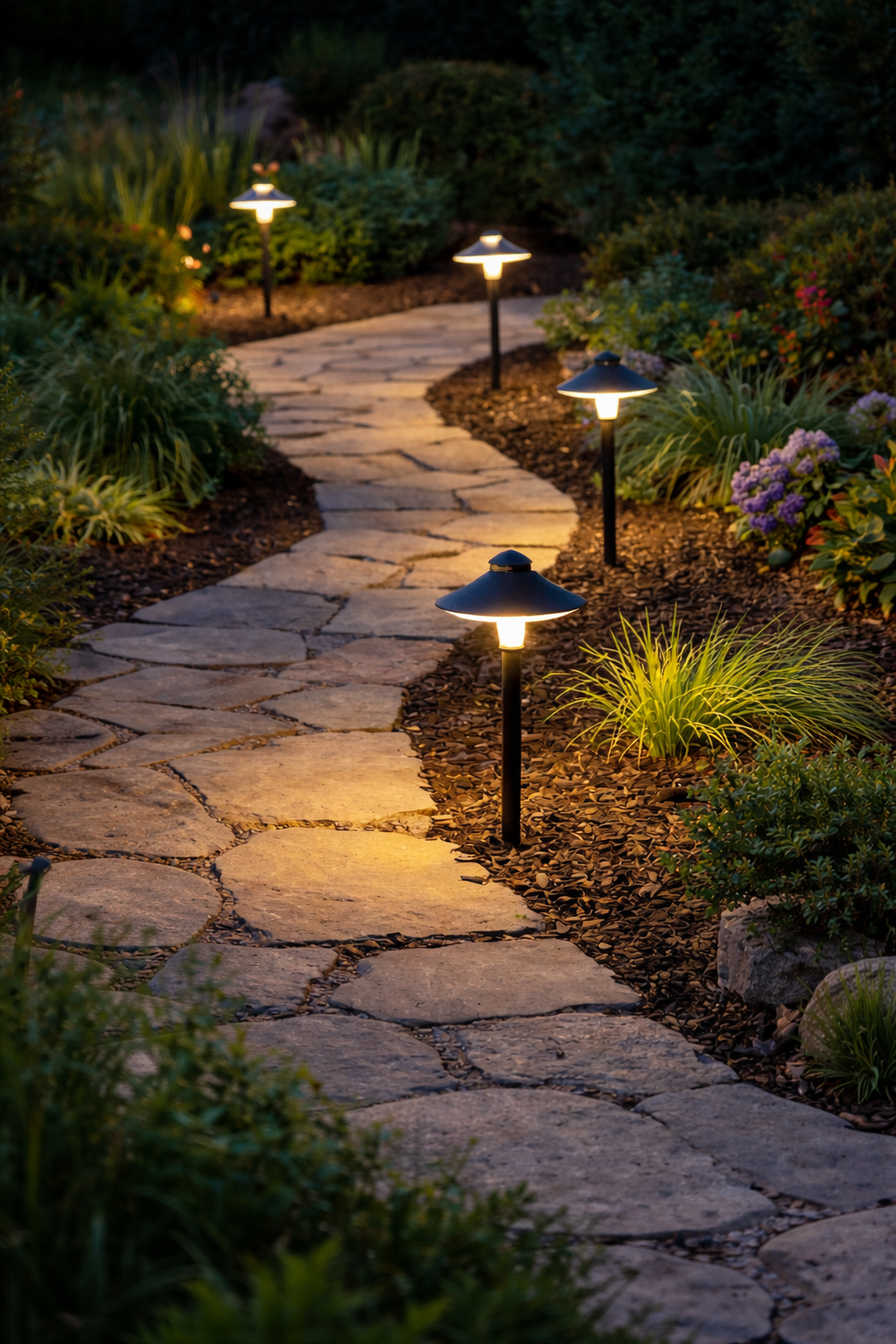
Walkway Lighting
Path lights help guide guests safely while creating a cleaner, more inviting outdoor look.
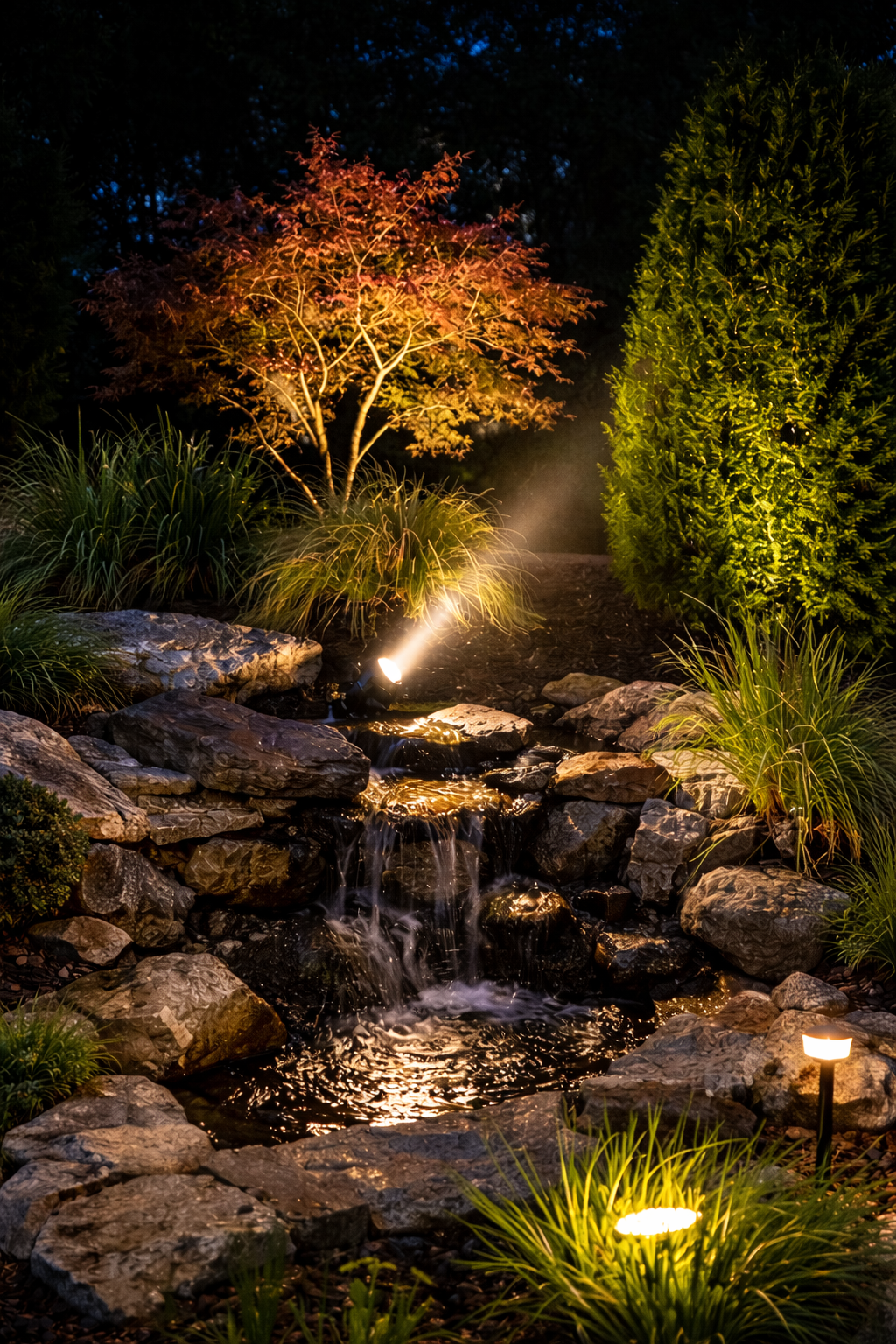
Landscape Accents
Spotlights bring attention to trees, gardens, and focal points that might otherwise disappear after dark.
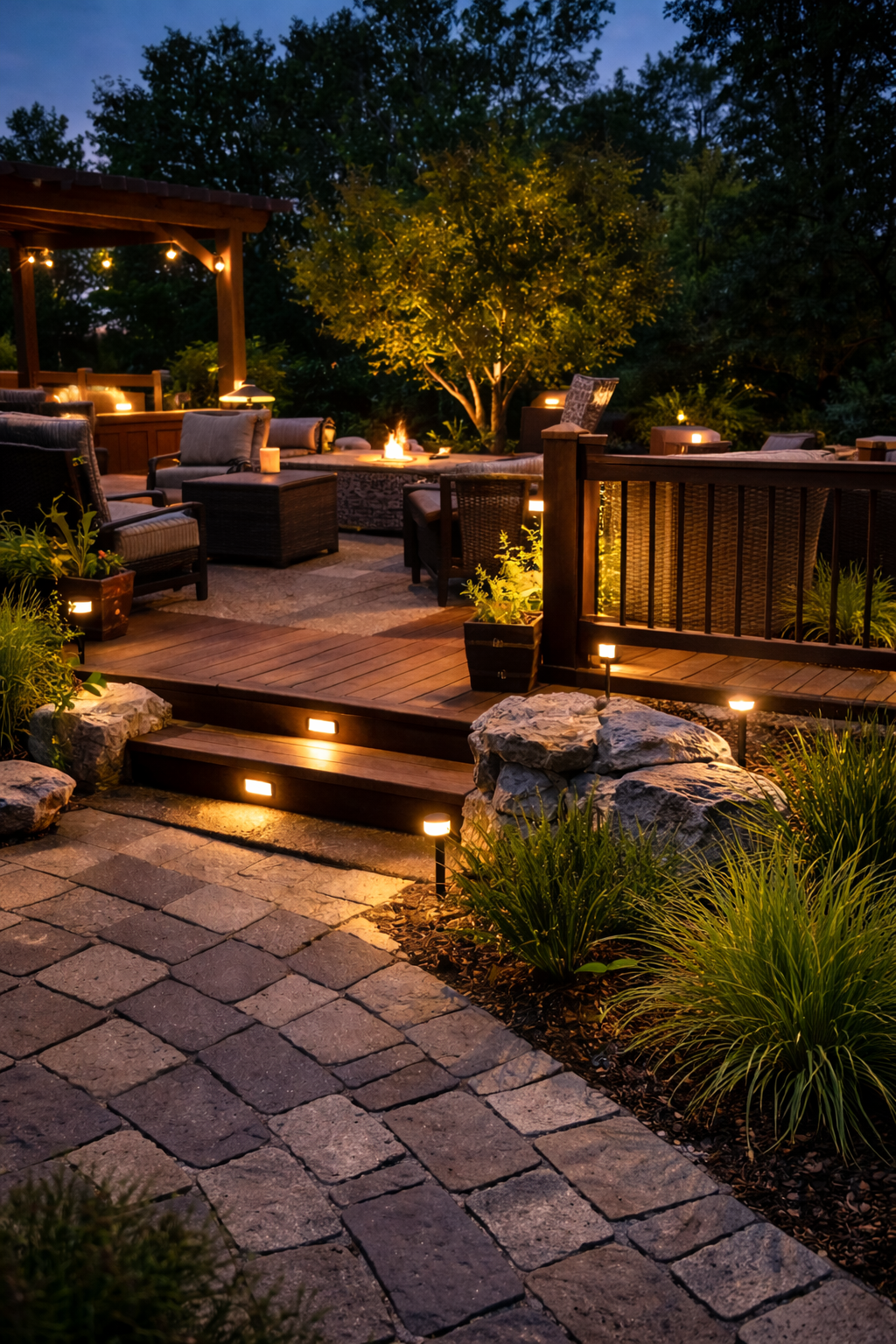
Deck and Patio Spaces
Low voltage fixtures make outdoor living spaces feel safer, brighter, and more welcoming.
Low voltage lighting is a strong fit for structures like gazebos because it gives homeowners a flexible way to add overhead light, accent light, and nearby path illumination without overcomplicating the system. If you want a page focused specifically on that application, see Portfolio gazebo lighting.
Portfolio Low Voltage Lighting Installation Basics
A basic low voltage lighting installation usually includes three main parts: the transformer, the low voltage cable, and the fixtures. The transformer connects to the outlet, the cable runs through the landscape, and the fixtures connect into the wiring at the planned lighting points.
Careful spacing, smart transformer placement, and solid wire connections make a major difference in how well the system performs. Testing the layout before finalizing the installation is one of the easiest ways to avoid common mistakes.
- place the transformer near a suitable outdoor outlet
- plan cable runs before final installation
- space path lights evenly for a natural look
- aim spotlights carefully to avoid glare
- test the full system before considering the job complete
If you are still deciding how to route the wiring or where the transformer should go, compare the Portfolio landscape lighting installation guide and Portfolio landscape lighting wiring guide before buying more fixtures.
As low voltage lighting systems grow, it becomes important to divide the fixtures into separate lighting runs rather than connecting every light to a single cable. These runs are commonly referred to as lighting zones, and they help balance power distribution, reduce voltage drop, and improve overall brightness across the yard. If you want to understand how zones work and how to divide your lighting system into multiple circuits, see our guide to low voltage landscape lighting zones, which explains how zones are planned and when additional zones should be added to a landscape lighting system.
Wiring and Transformer Considerations
In most Portfolio low voltage systems, wiring layout matters just as much as fixture choice. Cable that runs too far, poor connectors, or a transformer that is too small for the load can all create dim lights, uneven brightness, or sections of the system that stop working correctly.
This is also why transformer health matters so much in low voltage lighting. If the transformer is overloaded, buzzing, not turning on, or not following the timer schedule, the entire system can be affected.
One of the biggest decisions in any low-voltage system is whether to use traditional halogen bulbs or switch to LED. For a practical breakdown of cost, light quality, and outdoor performance, read our LED vs halogen landscape lighting comparison.
Use a Landscape Lighting System Diagram to Understand the Full Setup
If you are trying to understand how a low voltage landscape lighting system is supposed to connect and operate, a visual layout can make troubleshooting much easier. Our landscape lighting system diagram page helps explain how transformers, wiring runs, connectors, fixtures, and system branches work together. This resource is especially helpful for homeowners who are adding lights, replacing parts, or tracing a problem through the system. Instead of guessing how the pieces connect, the diagram page gives a clearer framework for installation, expansion, and repair.
Common Portfolio Low Voltage Lighting Problems
Even strong outdoor lighting systems can run into problems over time. Weather, moisture, wiring wear, damaged connectors, overloaded transformers, and bad bulbs are some of the most common reasons a low voltage system starts acting up.
| Problem | Likely Cause | What to Check First |
|---|---|---|
| Lights do not turn on | No outlet power, bad transformer, timer issue | Outlet, GFCI, transformer settings |
| Only some lights work | Loose connector or damaged cable | First fixture in the dead section |
| Lights are dim | Voltage drop, poor wiring, loose bulb | Wiring layout and fixture connections |
| Lights flicker | Bad connection or unstable transformer output | Transformer terminals and cable connectors |
| Timer is not working | Wrong settings, manual override, photocell issue | Timer mode and programmed schedule |
What to Look For Before Buying Portfolio Low Voltage Lighting
Before choosing fixtures, it helps to decide what the lighting should accomplish. Some yards need better safety around paths and steps, while others need more decorative accent lighting around gardens, walls, and outdoor living spaces.
- choose the right transformer size
- compare fixture brightness and lumen output
- consider finish color and outdoor style
- plan for future expansion if needed
- make sure replacement parts are easy to find later
If you already know you may need replacement connectors, bulbs, transformers, or stakes later, it helps to review Portfolio lighting parts and accessories before choosing a full system.
The transformer is the central power source for a low voltage landscape lighting system, so when it fails, the entire system can stop working at once. In many cases, the best solution is not just replacing the transformer alone, but upgrading to a complete kit that includes modern controls and an easier connection setup. If you are comparing options for a full replacement, see our Portfolio landscape lighting transformer replacement kits page for a detailed guide to kit components, transformer sizing, and choosing a compatible replacement for an existing Portfolio lighting system.
Because most Portfolio landscape lighting systems use standard low-voltage wiring, homeowners are often able to upgrade to newer fixtures without replacing the entire electrical layout. Volt is one of the brands most often considered for this kind of upgrade because many of its fixtures are designed for durable outdoor performance and work well in low-voltage lighting systems. If you want to compare the two brands more closely, visit our Volt vs Portfolio landscape lighting guide.
Low-voltage landscape lighting systems often rely on both timers and photocell sensors to control when lights turn on and off. When the system stops responding properly, the problem may be in the control sensor rather than the transformer or fixtures themselves. Our Landscape Lighting Photocell Not Working guide explains how photocells work in outdoor lighting systems, what causes them to fail, and how to troubleshoot common sensor problems before replacing other components.
Low voltage landscape lighting works best when the wiring plan is matched to the size of the system and the distance between fixtures. For a more detailed look at cable routing, transformer connections, and common wiring layouts, read our landscape lighting wiring guide to see how homeowners can build a cleaner and more reliable outdoor lighting setup.
Portfolio Low Voltage Lighting FAQ
What is Portfolio low voltage lighting used for?
It is commonly used for landscape lights, path lights, garden accents, deck lighting, and other outdoor lighting around the home.
Do low voltage lights need a transformer?
Yes. In most cases a transformer is required to reduce household voltage to the lower voltage used by the lighting system.
Why are my low voltage lights dim?
Dim lights are often caused by voltage drop, bad wiring connections, poor transformer performance, or loose bulbs.
Can I expand a Portfolio low voltage lighting system later?
Many systems can be expanded, but it is important to make sure the transformer and wiring layout can handle the added load.
Final Thoughts on Portfolio Low Voltage Lighting
Portfolio low voltage lighting remains a strong choice for homeowners who want outdoor lighting that is attractive, flexible, and easier to manage than many traditional systems. From path lights and garden accents to deck lighting and entryway highlights, low voltage fixtures can make a yard safer and more visually appealing after dark.
The best results come from choosing the right transformer, planning the wiring carefully, spacing the fixtures thoughtfully, and keeping the system maintained over time. When those pieces come together, low voltage landscape lighting can make a dramatic difference in how a home looks and feels at night.
The transformer is one of the most important parts of any low voltage landscape lighting system because it converts household power into the safe low-voltage output used by the fixtures. When an older transformer fails, many homeowners do not need an exact Portfolio replacement to get the system working again. In most cases, a compatible modern transformer can power the same wiring and fixtures with no major redesign. Our Portfolio lighting transformer alternatives guide explains how to compare replacement options and choose a transformer that matches your current system.
More Portfolio Low Voltage and Landscape Lighting Guides
Portfolio Landscape Lighting
Explore outdoor lighting ideas, fixture types, and landscape lighting layouts for paths, gardens, and living spaces.
Read the guidePortfolio Landscape Lighting Installation Guide
Learn how to install low voltage outdoor lights with help for transformers, path lights, and fixture placement.
Read the guidePortfolio Landscape Lighting Wiring Guide
Understand low voltage cable layout, transformer wiring, and outdoor lighting connections.
Read the guidePortfolio Landscape Lighting Troubleshooting
Fix common problems with outdoor lights, bad connections, dim fixtures, and transformer-related issues.
Read the guidePortfolio Outdoor Transformer Lighting
Learn more about transformer-based outdoor systems and how transformer performance affects low voltage lighting.
Read the guidePortfolio Path Lights
See ideas and fixture types for walkway lighting, front paths, and safer nighttime navigation.
Read the guideExplore Our Low Voltage Landscape Lighting Guides
If you are building, fixing, or upgrading a low voltage outdoor lighting system, these guides walk you through the most important parts of the process. Start with the topic that matches what you need help with most, whether that is choosing the right transformer, wiring the system correctly, solving voltage drop problems, or troubleshooting lights that are not working.
| Priority | Guide | Main Topic | Why It Matters |
|---|---|---|---|
| 1 | Landscape Lighting Transformer Guide | Landscape lighting transformer | Transformers are the heart of every low voltage lighting system. This guide helps you size, compare, and understand them correctly. |
| 2 | How to Wire Low Voltage Landscape Lighting | Landscape lighting wiring | Useful when installing or expanding your low voltage lighting system. |
| 3 | Landscape Lighting Voltage Drop Explained | Landscape lighting voltage drop | Helps solve dim or uneven lighting issues and supports the transformer and wiring guides. |
| 4 | Landscape Lighting Timer Setup Guide | Landscape lighting timer | Helpful if you want automated lighting control with a more DIY-friendly setup. |
| 5 | Landscape Lighting Cable Guide | Landscape lighting cable | Supports installation planning, wire sizing, and preventing performance problems later. |
| 6 | Landscape Lighting Layout Design Guide | Landscape lighting layout | Helps plan fixture placement, balance runs, and build a low voltage system that performs better overall. |
| 7 | Landscape Lighting Troubleshooting Guide | Landscape lights not working | Helps diagnose the most common problems associated with low voltage lighting systems. |
These guides are designed to work together. If you are just getting started, begin with the Landscape Lighting Transformer Guide or How to Wire Low Voltage Landscape Lighting page. If your system is already installed and something is off, jump to Landscape Lighting Voltage Drop Explained or the Landscape Lighting Troubleshooting Guide.