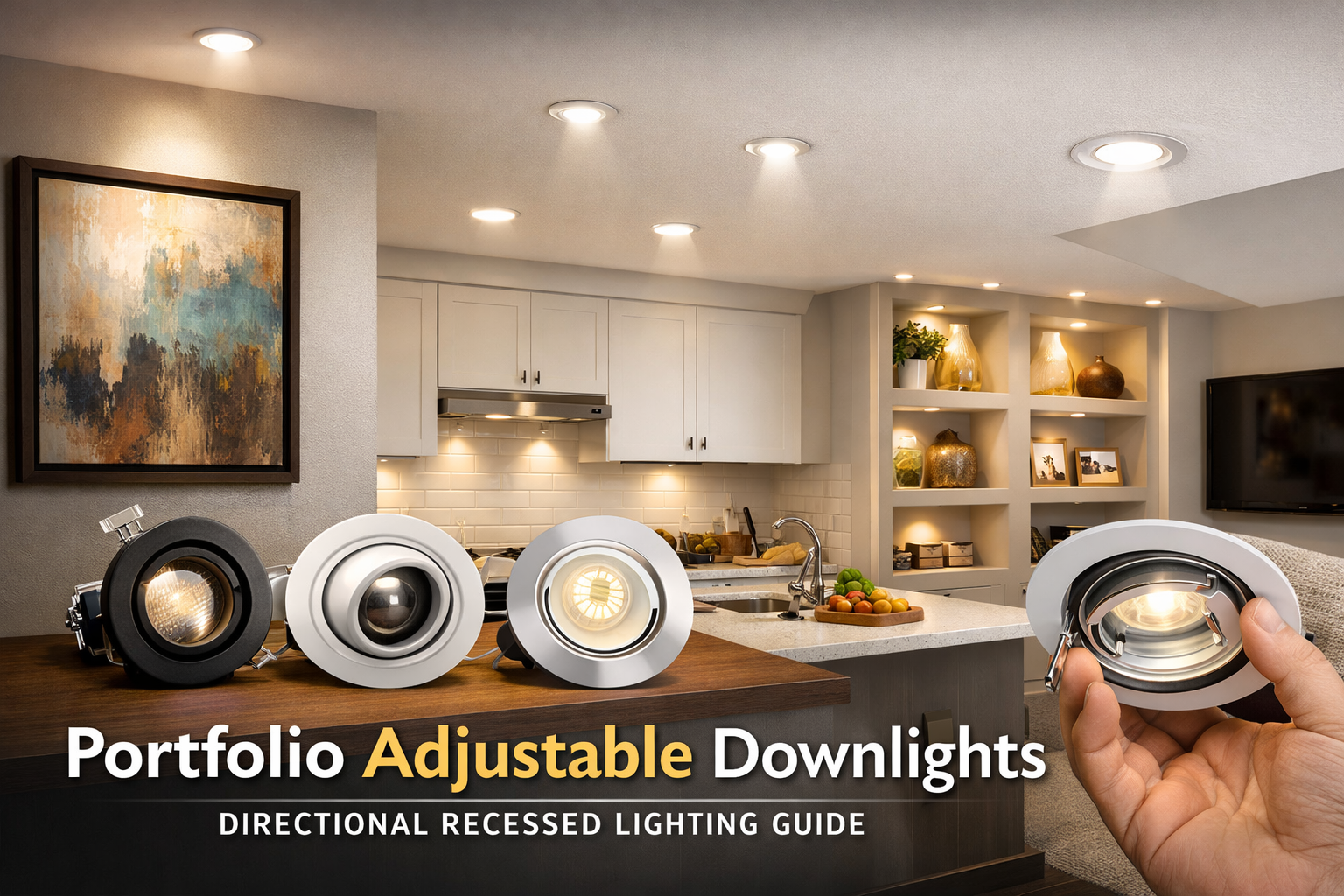
Adjustable downlights are recessed ceiling fixtures designed to direct light toward a specific target instead of pointing only straight down.
If you want more control over where the beam lands, this style can be much more useful than a basic recessed light. It is especially helpful when you want to add accent lighting without switching to track lighting or hanging fixtures.
What Are Adjustable Downlights?
Adjustable downlights are recessed fixtures that allow the light source to tilt, rotate, or both. Instead of throwing light in only one fixed direction, they let you point the beam where it actually helps the room. That is why they are sometimes called gimbal lights, eyeball recessed lights, or directional downlights.
The big advantage is flexibility. If you want to highlight a piece of artwork, wash light down a textured wall, brighten a countertop, or aim attention at a shelf or display area, an adjustable downlight gives you more control than a fixed recessed can. This makes the room feel more intentional because the lighting is doing more than just filling the ceiling with generic overhead light.
Adjustable downlights also help improve visual focus. In a kitchen, that can mean better task lighting. In a living room, it can mean drawing attention toward a media wall, built-in shelves, or a feature piece. In a hallway or gallery-style space, it can mean adding subtle drama without needing visible track heads or hanging fixtures.
Types of Portfolio Adjustable Downlights
Gimbal Recessed Downlights
Gimbal recessed downlights are the most common adjustable design. They usually have a rotating inner ring that holds the lamp or light engine and allows the beam to tilt away from straight down. This gives you directional beam control without making the fixture look bulky. Gimbal styles are often used for highlighting artwork, adding accent lighting to walls, or directing light toward kitchen counters and islands.
Many homeowners prefer gimbal trims because they look cleaner than older eyeball fixtures while still giving useful aimability.
Eyeball Downlights
Eyeball recessed lights are older but still common in many homes. These usually have a more visible spherical or rounded inner housing that pivots inside the trim. They offer wide beam adjustment and can be very practical when you need to redirect light aggressively. They are not always as sleek-looking as newer gimbal options, but they still work well in many accent-lighting situations.
If your home has older directional recessed fixtures, this is often the style you are dealing with.
LED Adjustable Downlights
Modern adjustable downlights increasingly use integrated LED modules instead of traditional replaceable bulbs. These fixtures are popular because they are energy efficient, run cooler, and generally last longer. They can also be slimmer, which helps in ceilings where space is limited.
The tradeoff is that repair can be different. If the module or driver fails, you may need to replace more than just a bulb. If your fixture seems newer or has no obvious lamp socket, compare it with Portfolio integrated LED lighting.
Where Adjustable Downlights Work Best
Accent Lighting
Adjustable downlights are especially useful for accent lighting. You can aim them toward artwork, architectural details, decorative walls, niches, textured surfaces, or statement pieces that deserve more attention than the rest of the room. This is one of the easiest ways to make a space feel more designed without adding extra floor lamps or visible track systems.
Kitchen Lighting
In kitchens, directional recessed lighting works well when you want task light to land where you actually work. That usually means countertops, sinks, prep spaces, and islands. A standard overhead light may leave shadows in the wrong places, especially when cabinets and body position block the beam. An adjustable downlight lets you push light toward the work surface instead of leaving it centered in the aisle.
If you are thinking about task-oriented lighting in general, compare this page with Portfolio task lighting.
Living Room Lighting
In living rooms, adjustable downlights are helpful for display shelves, entertainment walls, fireplaces, decorative corners, and collections that deserve focused light. They can also help balance a room when general ceiling light feels too flat. Instead of making the whole room equally bright, you can layer light and create more depth.
For broader room-lighting strategy, it also helps to compare with Portfolio ambient lighting.
Adjustable Downlights vs Recessed Downlights
This is an easy point of confusion because adjustable downlights are a type of recessed lighting. The difference is how the beam behaves. A standard recessed downlight is fixed. It shines straight down and is mainly used for general room lighting. An adjustable downlight lets you change the beam direction so the fixture can do more targeted work.
| Feature | Adjustable Downlights | Standard Recessed Downlights |
|---|---|---|
| Beam direction | Tilted or rotated toward a target | Fixed straight down |
| Best use | Accent, task, and feature lighting | General room illumination |
| Visual control | More flexible | More uniform |
| Common styles | Gimbal, eyeball, directional LED | Fixed trim recessed cans |
If you are deciding between the two, the real question is whether you want broad, even light or a more focused, directional result. For the general category, see Portfolio recessed lighting.
Bulb Types Used in Portfolio Adjustable Downlights
Bulb type matters a lot with directional lighting because the beam pattern affects how useful the fixture feels in the room. Adjustable downlights are usually paired with directional lamp styles rather than broad omnidirectional bulbs.
MR16 Bulbs
MR16 bulbs are one of the most common options in adjustable recessed fixtures. They are small spotlight-style bulbs designed to throw light in a controlled beam, which makes them a natural fit for accent and task lighting. If your fixture uses this bulb family, switching to LED replacements can often reduce heat and energy use while keeping the same directional performance.
If that sounds like your setup, compare it with Portfolio MR16 LED replacement bulbs.
GU10 Bulbs
GU10 bulbs are another common directional lighting option. These bulbs are often used in recessed and spotlight fixtures where twist-lock installation is part of the design. Like MR16 lamps, GU10 bulbs are available in LED versions that work well for modern upgrades.
Integrated LED Modules
Many newer adjustable downlights do not use a removable bulb at all. Instead, they use a built-in LED module paired with internal electronics or a driver. These systems can look cleaner and run efficiently, but replacement is different when something fails. If you suspect your fixture is in this category, compare it with Portfolio LED lighting.
Installation Basics for Adjustable Downlights
Installation details vary by fixture style, but the overall process is usually straightforward in concept. First, the ceiling opening is cut or matched to the existing opening size. Then the recessed housing or can is installed and wired. After that, the directional trim or adjustable light engine is inserted and secured.
In practical terms, that usually means four basic steps:
- Cut or confirm the ceiling opening size.
- Install the recessed housing or compatible fixture body.
- Connect the wiring according to the fixture instructions.
- Insert the adjustable trim, lamp, or LED module and aim the beam.
The most important part for homeowners is matching the trim, housing, and bulb or LED design correctly. A trim that looks close is not always compatible. For broader help, use Portfolio lighting installation and instructions. And while it is a different category, the system-thinking on cable and connections in how to wire landscape lighting can still help you think more clearly about organized wiring and troubleshooting.
Replacement Parts for Portfolio Adjustable Downlights
This section matters because many lighting problems are not full fixture failures. Sometimes the trim ring gets damaged. Sometimes the bulb socket wears out. Sometimes the mounting springs bend or disappear during a bulb change. In newer LED fixtures, the module or driver may be the weak point.
- Trim rings
- Bulb sockets
- LED modules
- Mounting springs
- Glass lenses or covers in some directional trims
If your fixture still has a solid housing but cosmetic or mounting parts are failing, start with Portfolio lighting replacement hardware. If you are dealing with a newer LED design, compare with Portfolio lighting replacement LED modules and drivers. If the trim includes a glass component or lens, Portfolio lighting replacement glass may also help.
Troubleshooting Adjustable Downlights
Light Not Turning On
If an adjustable downlight will not turn on, the first possibilities are usually the simplest: a bad bulb, a loose lamp connection, a faulty socket, or a wiring issue. With integrated LED models, the problem could also be in the driver or module rather than a replaceable lamp.
Start by testing the bulb if the fixture uses one. Then inspect the socket and any obvious trim connections. If several lights on the same switch are affected, the problem may be upstream in the circuit instead of in the individual fixture.
Flickering Downlights
Flickering downlights are often caused by incompatible LED bulbs, loose wiring, or failing electronic components. Directional fixtures are especially noticeable when they flicker because the beam is focused and visually obvious on the wall or target surface.
If you are dealing with flicker, compare this page with Portfolio LED lights flickering and the broader Portfolio lighting troubleshooting guide.
Poor Beam Aim or Loose Trim
Another issue specific to adjustable downlights is that the aiming mechanism can loosen over time. A gimbal ring may sag, an eyeball trim may no longer hold position well, or a spring clip may lose tension. In those cases, the light still works but no longer points where you want it. That often turns into a replacement-hardware issue more than an electrical one.
Replacement Options for Portfolio Downlights
Because Portfolio lighting is discontinued, some homeowners eventually decide replacement is smarter than chasing older compatible parts. The good news is that adjustable downlights are easy to replace with newer categories that often perform better than the originals.
Modern LED recessed lights are usually the simplest upgrade path if you want efficiency and lower maintenance. Adjustable gimbal lights are a strong replacement when you still want directional beam control. Smart downlights are another option if you want app control, dimming, or tunable color temperature.
If your old fixture runs hot, uses outdated bulb types, or keeps developing trim and socket issues, a modern replacement often gives you cleaner light, easier future support, and better energy efficiency. For broader replacement ideas, compare this page with Portfolio lighting alternatives.
Final Thoughts on Portfolio Adjustable Downlights
Portfolio adjustable downlights are a useful category because they do something fixed ceiling lights cannot do very well. They let you direct attention. That makes them especially valuable in kitchens, living rooms, accent walls, display areas, and any space where you want lighting to shape the room instead of just brightening it.
If you already have these fixtures, the key is understanding which type you own, what bulb or LED system it uses, and whether the problem is electrical, mechanical, or just a worn trim part. If you are replacing them, modern LED directional fixtures usually give you the same flexibility with better efficiency and easier day-to-day use.
Portfolio Adjustable Downlights FAQ
What are adjustable downlights?
Adjustable downlights are recessed lighting fixtures designed to direct light toward a specific area by tilting or rotating the light source.
What bulbs do adjustable recessed lights use?
Many fixtures use MR16 or GU10 bulbs, while newer models use integrated LED modules.
Are adjustable downlights good for accent lighting?
Yes. Adjustable downlights are commonly used to highlight artwork, walls, or architectural details.
Can adjustable downlights be replaced with LED fixtures?
Yes. Many homeowners upgrade to LED adjustable downlights for improved efficiency, cooler operation, and longer life.
Portfolio adjustable downlights, directional recessed lighting, gimbal lights, eyeball recessed lights, adjustable recessed lighting, MR16 bulbs, GU10 bulbs, and integrated LED downlights.