
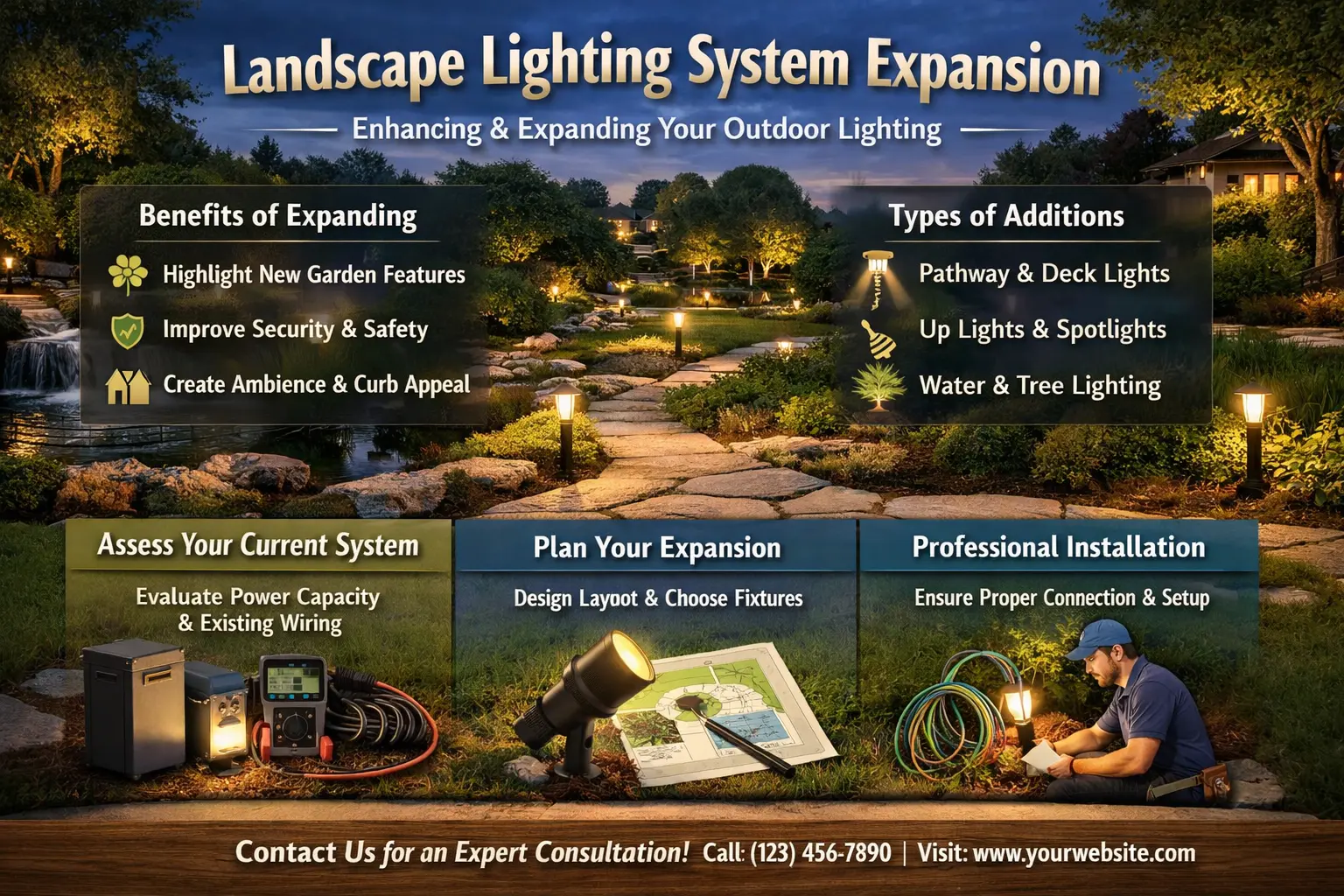
Expanding a low-voltage landscape lighting system is not just about adding fixtures. It is about making sure the existing system can support the added load, the cable layout still performs correctly, and the new lights improve the overall design instead of creating uneven brightness or electrical strain.
That is why this page belongs inside your landscape system installation cluster. It connects naturally to the landscape lighting guide, system diagram, layout guide, voltage drop guide, and transformer guide.
In practical terms, this is the page for homeowners who already have a working system and now want to extend it intelligently. Maybe you added a new bed, a longer walkway, a patio zone, or want to install tree uplighting after seeing how much difference a few accent lights can make. Whatever the reason, the expansion process should be planned like a system upgrade, not treated like random fixture add-ons.
When You Should Expand a Landscape Lighting System
Homeowners usually expand a lighting system for one of four reasons. First, the property itself changes. A new garden bed, patio, retaining wall, or walkway creates areas that feel unfinished at night if they are left dark. Second, the owner wants better curb appeal. Third, the original system handled only safety lighting and now the goal is to add visual depth with focal-point lighting. Fourth, the original design was intentionally basic and now the owner is ready for a more complete nighttime landscape.
Common expansion scenarios include adding lights to a new planting bed, lighting a longer path, introducing tree uplighting, improving the entry experience, or building out zones around a deck or patio. These are all valid reasons to expand, but they should still tie back to the broader landscape lighting guide and landscape lighting layout so the finished yard looks coherent rather than patched together over time.
How Landscape Lighting Systems Work
Most residential landscape lighting systems are low-voltage systems. Power starts at a transformer, which steps standard household current down to low-voltage output appropriate for outdoor lighting fixtures. From there, low-voltage cable carries power to the fixtures, connectors join branches and splices, and a timer or photocell helps automate operation.
In simple terms, the core system includes:
- Transformer
- Low-voltage cable
- Fixtures
- Connectors
- Timer or photocell controls
When you expand the system, you are asking those same components to carry more load and cover more distance. That is why a good understanding of the complete setup matters. If you want a visual breakdown, review the landscape lighting system diagram.
If you are also comparing brand-specific fixture categories, it is helpful to connect this page back to Portfolio low-voltage lighting and Portfolio landscape lighting.
Step 1: Check Your Transformer Capacity
The first and most important step is checking transformer capacity. Every transformer has a wattage limit. If you expand the system without understanding that limit, you risk building a design that looks fine on paper but performs poorly in reality.
A practical planning table looks like this:
| Transformer | Typical Max Lights | Notes |
|---|---|---|
| 100W | 6-8 lights | Best for smaller basic systems with low fixture count |
| 200W | 12-16 lights | Good for mid-size residential systems with LED fixtures |
| 300W | 20+ lights | Often used for broader front and backyard coverage |
These numbers are only starting estimates because actual capacity depends on the wattage draw of each fixture. A system with lower-draw LEDs can support more fixtures than a system using higher-draw lamps. For deeper planning, compare Portfolio transformer wattage guide and the broader landscape lighting transformer guide.
Step 2: Calculate Total System Wattage
Once you know the transformer size, calculate the total connected load. This is the simplest way to see whether the system has room for additional fixtures.
A basic formula is:
Total wattage = number of lights × fixture wattage
Example:
10 lights × 5W LED = 50W total load
If you plan to add six more 5W fixtures, that adds another 30W. The total becomes 80W. On a 100W transformer, that may look workable at first glance, but it is already close enough that there is not much safety margin left.
This matters because expansion does not just increase connected wattage. It also tends to increase wire length, which raises the importance of voltage drop and proper cable sizing.
Step 3: Check Voltage Drop Before Adding Lights
Voltage drop is one of the biggest reasons expanded systems disappoint homeowners. As power travels farther through low-voltage cable, voltage gradually falls. That means lights at the end of long runs can become weaker than fixtures closer to the transformer.
If you add lights to an already long run, the system may start to show signs of strain such as dim lights, uneven brightness, or subtle instability. That is why expansion planning always needs to include a review of voltage drop in landscape lighting and landscape lighting wire gauge.
In practical terms, longer distances and heavier loads often mean you need thicker cable, shorter branches, better run planning, or in some cases a different transformer strategy altogether. Expansion is not only about “Can I connect more lights?” It is also about “Will those new lights perform correctly once they are connected?”
Step 4: Plan the New Lighting Layout
Before adding cable or fixtures, plan the layout. Expansion should improve the visual design, not just add brightness to random areas. That means deciding what the new fixtures are supposed to accomplish. Are they guiding people down a path, highlighting a tree, defining a bed edge, improving patio visibility, or making the front elevation feel more layered?
Strong system expansion usually focuses on a few proven upgrade types:
- Additional path and walkway lighting
- Tree uplighting and focal-point accents
- Garden bed accent lighting
- Deck and patio lighting
These additions should still follow the same planning principles explained in the landscape lighting spacing guide and the landscape lighting design guide. If the new fixtures overlap poorly, create hot spots, or conflict with existing light layers, the expanded system will feel less polished instead of more complete.
Step 5: Run Additional Landscape Lighting Cable
Once the new layout is planned, the next step is running additional cable. Depending on the system, that may mean extending an existing run, creating a new branch, or routing a dedicated line from the transformer for the new zone.
This is where expansion decisions become more technical. A poorly planned cable extension can overload a run, create unnecessary voltage loss, or make future troubleshooting more difficult. For that reason, it helps to review how to wire landscape lighting and the landscape lighting cable guide before making final decisions.
If the new area is far from the transformer, you may be better off planning a cleaner branch or a separate run rather than simply attaching more fixtures to the end of a long existing line.
Step 6: Install New Fixtures
After transformer capacity, cable routing, and layout have been confirmed, install the new fixtures. The best expansion projects are usually the ones that add a clear new purpose to the system instead of just adding more light in general.
Good fixture categories to consider when expanding include:
- Portfolio path lights
- Portfolio landscape spotlights
- Portfolio LED landscape lighting
- Portfolio deck lighting
- Portfolio landscape lighting
For example, a homeowner who already has path lighting may get the biggest visual improvement by adding tree uplighting rather than more path fixtures. Someone expanding around a front walk may need better path light placement instead. The right fixture choice depends on what the system is missing.
As you add more fixtures to an outdoor lighting system, the wiring layout often needs to be reorganized so the transformer can distribute power efficiently. Instead of extending one long cable run, many installers divide the lighting into separate zones that power different areas of the yard. This approach helps maintain brightness and prevents overloaded wiring runs. Our guide to low voltage landscape lighting zones explains how to structure these zones and when it makes sense to create additional lighting circuits as your landscape lighting system expands.
When You Need a Larger Transformer
Sometimes expansion reaches the point where the smartest move is not squeezing more out of the current transformer, but upgrading it. A larger transformer becomes appropriate when the existing unit is already close to its safe working range, when new lighting zones significantly increase total load, or when performance problems appear after expansion.
Warning signs include:
- Lights become dim after the expansion
- The transformer runs unusually hot
- The breaker trips or the system behaves erratically
If those problems appear, compare Portfolio lighting transformer replacement, transformer getting hot, and landscape transformer not working. In many cases, a properly sized transformer upgrade is the cleanest fix.
Common Problems When Expanding Landscape Lighting
Lights Become Dim
This often points to transformer overload, excessive run length, or wire that is undersized for the expanded system. Review landscape lights dim and the voltage drop guide.
Lights Start Flickering
Flickering may come from poor connectors, unstable electrical load, or a system that is now operating too close to its limits. Review landscape lights flickering.
System Trips Breaker
A breaker that starts tripping after expansion usually indicates overload or a wiring fault. Review landscape lights tripping breaker and the broader landscape lighting troubleshooting page.
Some Lights Stop Working Altogether
When certain fixtures fail after an expansion, the issue may be in the connections, cable routing, or a stressed transformer. Compare landscape lights not working to narrow the problem down.
Best Landscape Lighting Fixtures to Add When Expanding
Not every expansion project needs the same fixture types. The best additions are the ones that improve both function and design. If the yard already has safe walkway lighting, the next strongest upgrade is often an accent layer rather than more navigation lighting.
High-value expansion options include:
- Tree uplighting for vertical depth and focal-point drama
- Path lighting improvements for better wayfinding and balance
- Deck lighting for patios, steps, and seating zones
- Landscape spotlights for architectural or bed accents
A well-expanded system should feel like the original design simply matured. It should not feel like a second unrelated system was attached later.
Landscape Lighting Expansion FAQ
Can you add more lights to an existing landscape lighting system?
Yes. Most low-voltage landscape lighting systems can be expanded if the transformer has available capacity, the wiring is sized correctly, and the new fixture layout does not create excessive voltage drop.
How many lights can a landscape lighting transformer handle?
That depends on the transformer wattage and the wattage draw of each fixture. A common planning rule is to keep the connected load at or below about 80 percent of the transformer’s rated capacity.
What happens if you overload a landscape lighting transformer?
An overloaded transformer may run hot, trip a breaker, shorten component life, or cause dim and unstable performance across the system.
Can you extend low voltage landscape lighting wire?
Yes. Low-voltage landscape lighting wire can be extended or branched with the correct cable size and weather-rated connectors, but longer runs increase the risk of voltage drop and uneven brightness.
Do you need a bigger transformer when adding lights?
You may. If the expanded system pushes total load too close to or beyond the transformer’s safe working range, upgrading to a larger transformer is often the better long-term solution.