
Quick Answer
If your Portfolio light has no visible label, start by identifying the fixture type, checking hidden model-number locations, and matching the failed part or housing style.
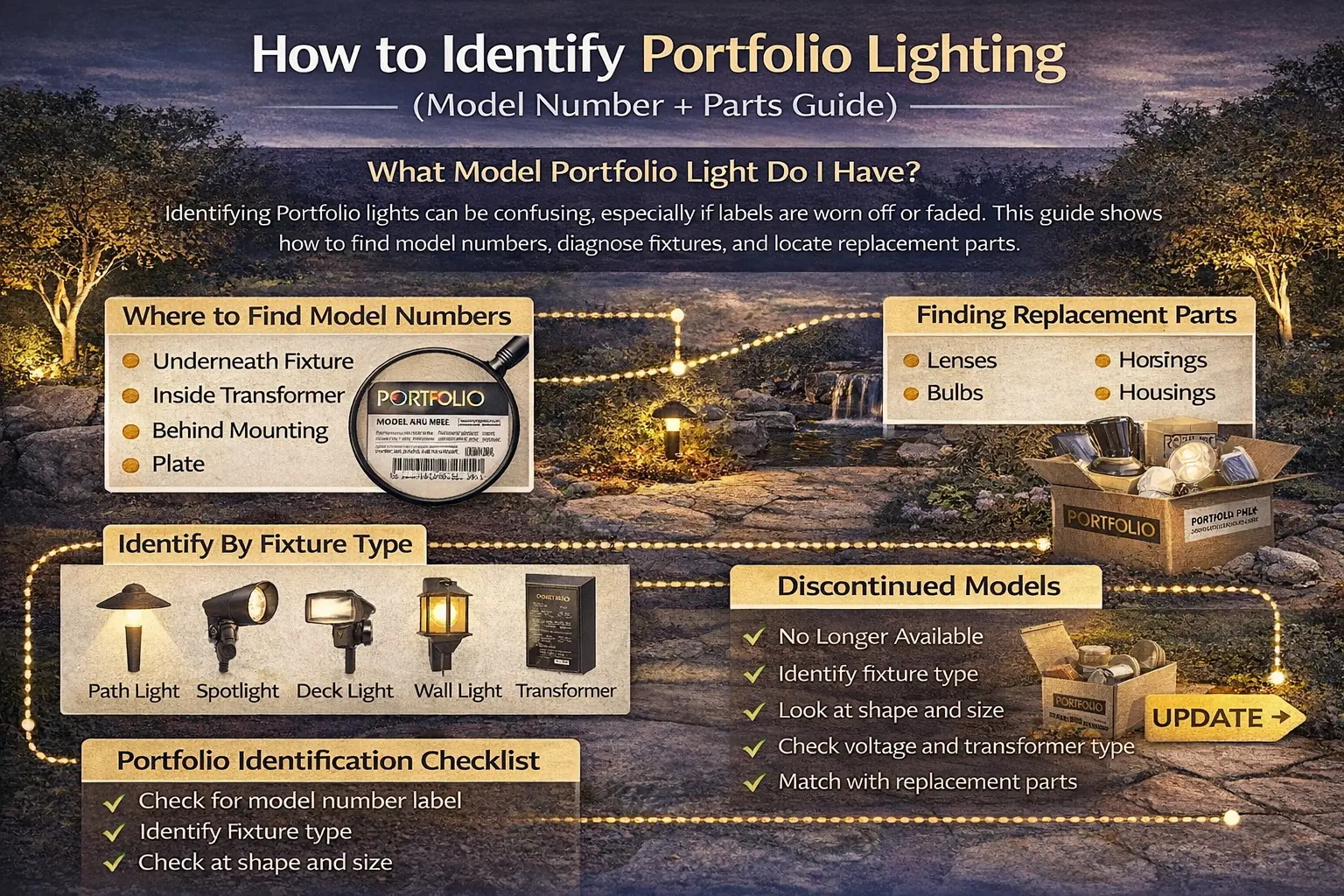
- Look on the base, inside the housing, behind the mounting plate, or inside the transformer door
- Match the light by category: path, spot, deck, wall, or transformer
- Use the broken part as an identification clue
- Check voltage and transformer style
- Use those clues to find parts or the best replacement
You can usually identify Portfolio lighting by checking the model number, fixture type, housing shape, mounting style, and failed part—even when the original label is missing.
Portfolio lighting can be frustrating to identify because model labels wear off, numbers are often hidden in awkward places, and parts become harder to track down as fixtures age. Many homeowners think identification is impossible once the label is damaged, but that usually is not true.
This guide helps you work backward from what you can still see: the fixture type, housing shape, lens style, mounting method, voltage, transformer type, and the problem you are trying to fix. Even partial information can still move you much closer to the right part or the right replacement decision.
Where to Find Portfolio Lighting Model Numbers
When people cannot identify a Portfolio fixture, the first problem is usually not the fixture itself. The first problem is that the model number is harder to find than expected. Portfolio lighting labels are often placed in locations that make sense for manufacturing but not for everyday homeowners trying to replace a part years later.
Even a partial model number can be enough to identify your fixture and find compatible parts. Use this Portfolio lighting model number lookup guide to quickly search your model, confirm your fixture, and locate the correct replacement components.
Common places to check
- Bottom of the fixture base
- Inside transformer doors
- Behind mounting plates
- Inside the fixture housing
- Near the wiring entry point
- On a small adhesive label attached to the stem or body
If you have part of a model number, use your browser search feature (Ctrl + F on desktop or Find on Page on mobile) to quickly locate it within this guide or a parts list.
- Look for numbers on the fixture base
- Check inside transformer doors
- Look behind mounting plates
- Even partial numbers can help identify the product
Do not assume you need the full number on your first try. In many cases, even part of a number, combined with the fixture type and problem, can be enough to narrow down what you have.
Once you identify the model or Lowe’s item number, use the Portfolio Lighting Master Model Technical Database to compare electrical specs, replacement paths, connector types, and legacy compatibility notes.
How to Identify Portfolio Lighting Without a Model Number
If the model label is missing, the best way to identify a Portfolio fixture is by fixture type, housing shape, lens style, mounting method, and the part that failed.
In many cases, that is enough to narrow the fixture down to the correct category and help you find a compatible part or replacement.
Identify by Fixture Type
When the label is missing, fixture type becomes your next best clue. Many Portfolio products can still be identified by category, body shape, lens style, and how they mount or connect into the system. That makes fixture type one of the most useful starting points when full model information is gone.
Path lights
Path lights usually have a stake mount, a top shade, and a downward-directed light pattern. They are often easiest to identify by the shape of the hat, stem, and lens section.
Spotlights
Spotlights typically have an adjustable head, directional beam, and a stake or bracket mount. The housing shape, lens size, and aiming collar often help separate one style from another.
Deck lights
Deck lights are often smaller, flatter, and built to mount into steps, rails, posts, or deck structures. Their shape and mounting style matter more than decorative details.
Wall lights
Wall-mounted fixtures are often easiest to identify by their backplate size, lantern body shape, glass style, and whether the fixture aims light up, down, or both.
Transformers
Transformers are often identified by their housing shape, wattage label, timer or photocell features, and door layout. If the transformer is what you are trying to match, its label may be easier to find than labels on the fixtures themselves.
If you are unsure which type of fixture you have, this Portfolio landscape lighting guide helps you identify different lighting categories and how they are used.
Identify by Problem
Sometimes the easiest way to identify a fixture is to start with what is wrong with it. A cracked lens, dim light, flicker, water intrusion, failed transformer, or broken stake often points you toward a smaller group of likely fixture types or parts.
Cracked lens
If the lens is cracked, broken, or missing, the fixture body and lens shape may help you identify what replacement style you need, even when the model label is unreadable.
Dim light
If the fixture glows weakly, the issue may be the bulb, LED module, voltage, wire connection, or transformer performance rather than the fixture housing itself.
Flickering
Flicker often points toward a system issue, loose connection, failing lamp, or transformer inconsistency. The problem may still help you narrow down whether you are dealing with an older replaceable-bulb fixture or a more integrated design.
Not working at all
If the light will not turn on, start with power, wiring, transformer output, and fixture type before assuming the whole unit is dead.
If your main goal is fixing a problem rather than identifying the model, this lighting troubleshooting guide walks through the most common issues and solutions.
Finding Replacement Parts
Once you identify your fixture, the next step is usually finding a compatible part. That might mean a lens, bulb, stake, housing piece, transformer, connector, or another component. The more precise your identification is, the easier it becomes to avoid ordering something that looks close but does not actually fit.
Common parts people search for
- Lenses
- Bulbs or lamps
- Transformers
- Housings
- Stakes and mounting hardware
- Connectors and wiring accessories
Once you identify your fixture, the next step is finding compatible parts. This Portfolio lighting parts and accessories guide shows where to find replacement components and what to look for.
When the Model Is Discontinued
One of the biggest frustrations with older Portfolio lighting is that many models are discontinued. That does not always mean you are stuck, but it does change the decision. Once parts become hard to find, the real question becomes whether the fixture is still worth repairing.
When repair still makes sense
Repair usually makes sense when the fixture body is still solid, the part is easy to find, and the rest of the system is still working well.
When replacement may be better
Replacement often makes more sense when the fixture is badly aged, the part is unavailable, the lens or housing is uncommon, or the rest of the system is already showing signs of decline.
If your model is discontinued or parts are no longer available, upgrading may be the best option. This replacement guide for Portfolio landscape lighting explains the best modern alternatives.
Should You Find Parts or Replace the Fixture?
If the fixture body is still solid and the part is easy to find, repair usually makes sense. If the model is discontinued and multiple parts are failing, replacement is often the better long-term move.
- Repair if the issue is a lens, bulb, stake, or connector
- Replace if the housing is badly worn or the parts are unavailable
- Upgrade if the whole system is aging and harder to maintain
Portfolio Lighting Identification Checklist
- Check for model number label
- Identify fixture type
- Look at shape and size
- Check voltage and transformer type
- Match with replacement parts
Do not jump straight to parts shopping if you are not yet sure what the fixture is. The more clearly you identify the category, model clues, and system details first, the less likely you are to waste time and money on the wrong part.
Connect the Fixture to the Full System
Understanding your specific fixture is easier when you see how it fits into your overall lighting system. This landscape lighting system guide explains how all components connect and function together.
If you are deciding whether to repair or replace your lighting, this landscape lighting cost guide helps compare the cost of fixing parts versus upgrading the system.
If you are planning to upgrade your system after identifying your fixtures, this outdoor lighting plan guide shows how to design a better layout.
Once you have identified your Portfolio lighting fixture, the next step is understanding how it fits into your overall lighting system. This complete lighting guide walks through indoor lighting, outdoor layouts, troubleshooting, installation, and replacement options so you can plan your lighting more effectively.
Also, once you identify your fixture, the next step is also figuring out which part actually needs to be replaced. If the main fixture body is damaged, this Portfolio landscape light housings guide can help you understand whether the housing is the component you need.
How to Identify Portfolio Lighting FAQ
Where is the model number on Portfolio lighting?
Portfolio model numbers are often found on the bottom of the fixture, inside transformer doors, behind mounting plates, or inside the housing. The exact location depends on the light type.
How do I identify my landscape light?
Start with the fixture type, then look at housing shape, lens style, mounting method, voltage, transformer type, and any remaining label or partial model number.
What if the label is missing?
You can still identify many fixtures by category, shape, part style, and the problem you are trying to solve. Missing labels make the process slower, but not impossible.
Are Portfolio lights discontinued?
Many Portfolio lighting products are discontinued, which is why identification matters so much. Once you know what you have, you can decide whether to repair or replace it.
Can I still find replacement parts?
In many cases, yes. Some bulbs, lenses, transformers, connectors, and housing parts can still be found, but compatibility depends on the exact fixture and how old it is.