Portfolio Landscape Lighting
Start here for the broader landscape lighting hub covering fixtures, ideas, system planning, and homeowner guidance.
Read the hub
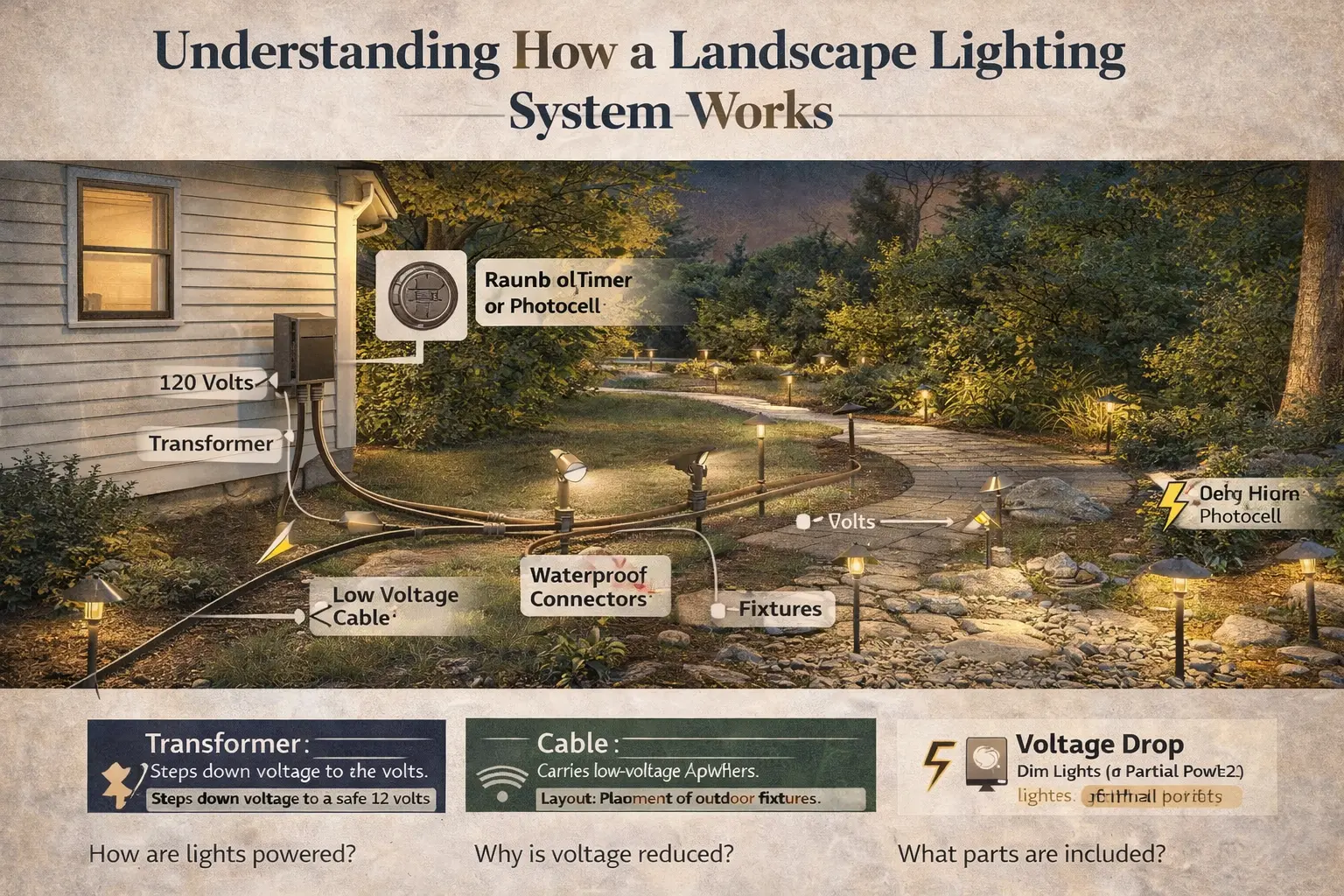
Landscape lighting works by taking power from your home, reducing it to low voltage through a transformer, and sending it through outdoor wiring to light fixtures across your yard. Once you understand that simple flow, installation and troubleshooting become much easier.
This page is built to teach the system first. If you understand how the transformer, wiring, fixtures, connectors, and layout all work together, installation becomes easier, troubleshooting makes more sense, and future upgrades become much less frustrating.
Think of this guide as the starting point for low-voltage landscape lighting. It gives you the full picture first, then naturally points you toward deeper pages on transformers, wiring, voltage drop, spacing, and layout planning when you are ready to go further.
Visitors using this page often go next to the deeper system pages on transformers, wiring, and voltage drop. If you want the broader fixture overview first, start with Portfolio landscape lighting.
See the Landscape Lighting HubLandscape lighting works by using a transformer to convert standard household power into low voltage, then sending that power through outdoor wiring to lighting fixtures.
The system starts at your home’s electrical outlet, passes through a transformer, travels through low-voltage cable, and powers fixtures like path lights and spotlights throughout your yard.
If your system is not working correctly, follow the lighting troubleshooting guide to diagnose issues step by step.
If your lights are dim, flickering, or not turning on, it usually means one part of this system is not working correctly.
If your system is already installed but not working properly, go to landscape lights not working to troubleshoot the issue.
Every landscape lighting system follows this same basic structure, even if the layout and number of lights vary.
Landscape lighting systems are designed to bring electricity safely from your home to outdoor fixtures such as path lights, spotlights, deck lights, and accent lights. Most modern systems use low voltage, which means the power is stepped down from standard household voltage to a safer level before it reaches the fixtures in the yard.
A complete system usually includes a transformer, outdoor wiring, lighting fixtures, connectors, and a layout plan. Once you understand how those parts work together, it becomes easier to install new lights, add more fixtures, diagnose failures, and avoid the most common performance problems later.
Outdoor lighting works differently depending on where the control decisions are made. Our edge vs cloud lighting guide shows why local processing often creates faster and more reliable lighting behavior than cloud-based systems.
Landscape lighting is outdoor lighting designed to improve visibility, highlight landscaping, make walkways and steps safer, increase nighttime curb appeal, and help outdoor spaces feel more usable after dark. In some homes it also supports security by brightening important edges of the property.
Common fixture types include path lights, spotlights, flood lights, deck lights, step lights, and accent fixtures used around planting beds, trees, architectural features, and entries. Each type does a different job. Path lights help guide walking areas. Spotlights emphasize a feature. Flood lights provide broader coverage. Deck and step lights improve visibility in transitional spaces.
If you want a broader overview of fixture categories and outdoor applications, the best next page is Portfolio landscape lighting.
Understanding how a landscape lighting system works can help you better estimate the total cost of your project. This landscape lighting cost guide breaks down the key factors that affect pricing.
Most residential landscape lighting systems operate at 12 volts, which is much lower than the 120 volts used inside the home. This is one reason low-voltage systems are so popular outdoors. They are easier to work with, safer for most residential applications, and flexible enough to support a wide variety of fixture layouts.
The basic power flow is simple once you see it clearly. Electricity starts at the house. The transformer reduces that power from standard household voltage to low voltage. The low-voltage power then travels through outdoor cable. Fixtures connect to that cable and produce light.
That simple flow is the foundation of the whole system, but real-world performance depends on how well the system is designed. Cable length, fixture count, wattage load, and connection quality all affect how well that power reaches each light in the yard.
The transformer is the starting point of most low-voltage landscape lighting systems. Its job is to convert standard household voltage to low voltage so the fixtures can run safely outdoors. It is often mounted on an exterior wall, near an outdoor outlet, or close to the main lighting zone.
Landscape lighting uses low-voltage cable that runs through the yard and carries power from the transformer to the fixtures. The main cable becomes the distribution path for the entire system. How it is routed affects system performance, brightness, and future troubleshooting.
Fixtures are the visible part of the system. They contain the bulb or LED module that produces light and are designed for specific outdoor jobs such as pathway guidance, tree uplighting, deck lighting, or architectural accents.
Connectors attach each fixture to the main wire. Some systems use clip connectors, while others use wire nuts or waterproof splices. These small connection points matter more than many homeowners expect because poor connections are one of the most common reasons lights stop working or begin flickering later.
The transformer is one of the most important parts of the system because every fixture depends on it. Its main job is to reduce 120-volt household power to the 12 volts that most residential landscape fixtures use. Without that voltage reduction, standard low-voltage landscape lights would not operate correctly.
Transformers are also rated by wattage. That rating tells you how much fixture load the transformer can safely handle. For example, a 300-watt transformer can power multiple fixtures as long as the total fixture load stays below that rating. If the load becomes too high, the system may run poorly, lights may look weak, and the transformer may fail prematurely or trip protection features.
Transformers often include additional control features such as timers, photocells, or smart scheduling options. Those features help automate when the lights turn on and off, but they also add another layer to the system that may need troubleshooting later.
For a deeper explanation of transformer sizing, capacity, controls, and troubleshooting, see Landscape lighting transformer guide.
Understanding how a landscape lighting system works is much easier when you also see how that system is planned across the property. This outdoor lighting plan guide helps connect transformers, fixture types, yard zones, and lighting goals into one practical layout.
Once the transformer creates low-voltage power, the wiring carries that power through the yard. This is where system design becomes more important than many homeowners expect. The wire is not just a way to connect lights. It directly affects brightness, balance, and reliability.
Common wiring methods include daisy chain layouts, hub layouts, and T-method layouts. In a daisy chain layout, the wire moves from one fixture to the next in a line. In a hub method, fixtures branch outward from a more centralized connection point. In a T-method, the cable divides to serve multiple directions more evenly.
Each method can work well, but the best choice depends on fixture load, cable distance, and how evenly you need power distributed across the yard. Proper wiring matters because weak planning leads directly to dim lights, uneven brightness, and future troubleshooting headaches.
For a detailed step-by-step explanation of wiring layouts and cable planning, read How to wire landscape lighting.
Voltage drop happens when electricity loses strength as it travels through a long wire. In a landscape lighting system, that can cause fixtures farther from the transformer to look dimmer than the lights closer to it. In more severe cases, some lights may not turn on reliably at all.
Voltage drop is influenced by wire length, number of fixtures, wattage load, and cable size. The more distance the power has to travel, and the heavier the load it is carrying, the more likely the system is to lose strength before it reaches the farthest fixtures.
This is one reason system planning matters so much. If you understand voltage drop early, you can make smarter choices about wire routes, layout design, transformer placement, and cable size before the lights ever go in the ground.
For a deeper explanation of what causes it and how to prevent it, go to Landscape lighting voltage drop.
A landscape lighting fixture typically includes a bulb or LED module, a wiring connection, weather-resistant housing, and a mounting stake or bracket. Once the fixture receives low-voltage power through the wire, the light source inside produces illumination based on the fixture design.
Different fixtures direct light in different ways. Path lights spread light downward and outward to guide walking areas. Spotlights focus light on trees, columns, walls, and other features. Flood lights cast a broader beam for larger areas. Deck lights and step lights provide lower-level light for safety and visual depth.
This is why fixture choice and system understanding go together. A good system uses the right fixture for the right job instead of expecting one light type to do everything.
Understanding how a landscape lighting system works becomes much easier when you also understand beam spread. This landscape lighting beam spread guide explains how different beam angles change coverage, brightness, and the way outdoor fixtures perform in real spaces.
Path lights are one of the most commonly used fixtures in low-voltage systems, especially for guiding movement along walkways. For a closer look at spacing, brightness, and placement, see our walkway lighting and path light guide.
Layout planning affects the final result just as much as fixture quality. Even strong fixtures can look awkward or disappointing when spacing, beam direction, or transformer location is poorly planned.
A good layout starts with the goals of the project. Are you lighting a front walkway, highlighting landscaping, creating more curb appeal, improving deck visibility, or making the yard safer at night? Once the purpose is clear, you can decide where fixtures should go and how to balance brightness across the property.
Good layouts usually avoid both extremes. Too few lights leave dark gaps. Too many lights make the yard feel cluttered and overlit. The goal is enough light to guide movement and highlight important features without washing everything out.
Landscape lighting systems are made up of several different fixture types that each serve a specific purpose. For example, Portfolio path light systems are designed to provide safe walkway illumination, while spotlights and flood lights highlight features and structures. Understanding these roles helps you design a balanced and effective lighting layout.
For deeper planning help, see Landscape lighting layout design.
Spacing guidelines depend on fixture brightness, beam spread, and the kind of effect you want, but a common starting point is to place path lights about 6 to 8 feet apart. That range often provides enough overlap to guide the walkway without making the path look crowded.
| Fixture Type | Common Starting Spacing | Why It Varies |
|---|---|---|
| Path lights | About 6–8 feet apart | Brightness, beam spread, and walkway width all affect the final look |
| Spotlights | Based on the feature being lit | Tree size, wall height, and beam angle matter more than fixed spacing |
| Flood lights | Based on area coverage | Wider beam spread means placement depends on what needs illumination |
| Deck and step lights | Placed by safety need and visual rhythm | Steps, railing length, and transition points change the spacing decision |
For a dedicated spacing page, visit Landscape lighting spacing.
This often points to transformer issues, breaker problems, timer settings, loose wiring, failed bulbs, or damaged connections somewhere along the system.
Dim lights are often caused by voltage drop, overloaded transformers, long wire runs, or poor connections that are weakening the power before it reaches the fixture.
When part of the system works and part does not, the problem is often tied to one section of the wire, one bad connection, or one branch of the layout rather than the transformer as a whole.
Once you understand how the full system works, these problems become much easier to narrow down. That is one reason system knowledge matters so much. It helps you troubleshoot more logically instead of guessing at random parts.
Once homeowners understand how the system works, it becomes much easier to expand the lighting, fix problems, improve brightness, and add new fixtures without creating new issues elsewhere in the yard.
Instead of looking at outdoor lighting as a collection of separate fixtures, you begin to see it as one connected system. That shift in thinking makes everything easier, from transformer sizing to wiring layout to future maintenance.
When you are ready to go deeper, the best next pages are Landscape lighting transformer guide, How to wire landscape lighting, Landscape lighting voltage drop, Landscape lighting layout design, and Landscape lighting spacing.
Understanding how your lighting system works often starts with identifying the fixtures and components you have installed. This Portfolio lighting identification guide shows how to locate model numbers and identify key parts.
Start here for the broader landscape lighting hub covering fixtures, ideas, system planning, and homeowner guidance.
Read the hubUnderstand transformer size, load, control options, and what to check when the system is not performing well.
Read the guideSee how the cable layout and wiring method affect brightness, system reliability, and future troubleshooting.
Read the guideLearn why voltage falls across long runs and how better design decisions can prevent dim or uneven fixtures.
Read the guidePlan a cleaner, more balanced outdoor lighting system by thinking through fixture placement before installation.
Read the guideUse spacing guidance to avoid dark gaps, overlighting, and awkward fixture placement along walkways and beds.
Read the guideMost landscape lighting systems use a transformer to reduce normal household power to low voltage. That low-voltage power then travels through outdoor cable to fixtures such as path lights and spotlights.
Most residential landscape lighting systems use 12 volts, which is much lower than standard 120-volt household power.
A landscape lighting transformer converts standard household voltage to low voltage so outdoor fixtures can run more safely and reliably.
Most residential landscape lighting systems do not run directly on standard house voltage at the fixtures. They usually use a transformer to reduce the power first.
That depends on the transformer's wattage rating and the total wattage of the fixtures connected to it. The full fixture load should stay under the transformer's capacity.
Dim lights are often caused by voltage drop, overloaded transformers, long wire runs, or poor wiring connections somewhere in the system.
This page is designed to help homeowners understand how a landscape lighting system works from start to finish, so installation, troubleshooting, expansion, and repair decisions become much easier.