

Quick Answer: Sourcing Discontinued Portfolio Replacement Parts
Matching an obsolete Portfolio component requires verifying cross-brand structural standards rather than relying on retail tracking numbers. Because Portfolio hardware spans several legacy manufacturing generations, replacement parts must be filtered by exact physical mating threads and electrical load thresholds.
To safely isolate the correct internal hardware fix without purchasing incompatible gear, cross-reference your component failure against the seven standard replacement metrics below:
- Low-Voltage Multi-Tap Power Packs: Replaces core transformers showing internal thermal sensor decay, continuous terminal lug overheating, or dead LCD boards.
- Weatherproof 3-Prong Cable Taps: Solves line-side flickering and loose direct-burial cable cuts; requires heavy-duty brass pin integration.
- Universal Threaded ABS Ground Stakes: Restores leaning or shattered path light housings via standard 1/2-inch NPT threaded mounting collars.
- Fitter-Classification Replacement Glass: Requires matching exact outer neck diameters (such as 2-1/4" or 3-1/4" fitters) to maintain airtight insect and rain barriers.
- Bi-Pin Ceramic Socket Leads: Fixes dark-spot fixtures where corroded copper contact tabs are restricting voltage delivery to active MR16 or halogen bulbs.
- Integrated Photo Eye Control Lenses: Remedially fixes automation day/night timing loops when an internal board stops reading changing seasonal daylight.
- Solid-State LED Driver Modules: Mitigates severe line-side harmonic distortion (THD) and protects modern replacement diodes from early circuit burnout.
⚠️ CRITICAL PARTS TRAP: Installing an unrated aftermarket connector or matching a legacy halogen fixture with a high-wattage unregulated LED driver will cause a rapid resistance spike, permanently shorting out your primary transformer board.
Before ordering components blindly, verify your system's operational threshold values. Check the Portfolio lighting model parts directory to map out safe physical sizing specifications and confirm exactly which replacement part series resolves your model's known failure points.
Find My Portfolio Part in 30 Seconds
Start with what happened. Most wrong-part orders happen because the failed component was guessed instead of identified.
Entire system will not turn on
Start with the transformer, outlet, timer, photocell, or terminal connections.
Check transformer issues →Only one light is out
Start with the bulb, connector, socket, or fixture lead before replacing the full fixture.
Diagnose one dead light →Glass, globe, or cover is broken
Measure the diameter, mounting lip, height, and shape before ordering a replacement.
Find globes and covers →I do not know the model number
Use fixture shape, transformer label, bulb base, connector style, and old part markings.
Use model lookup →Portfolio Lighting Parts Identification & Compatibility Guide
Use this visual guide to identify the failed part, compare compatibility, and confirm fit before ordering replacement Portfolio Lighting parts.
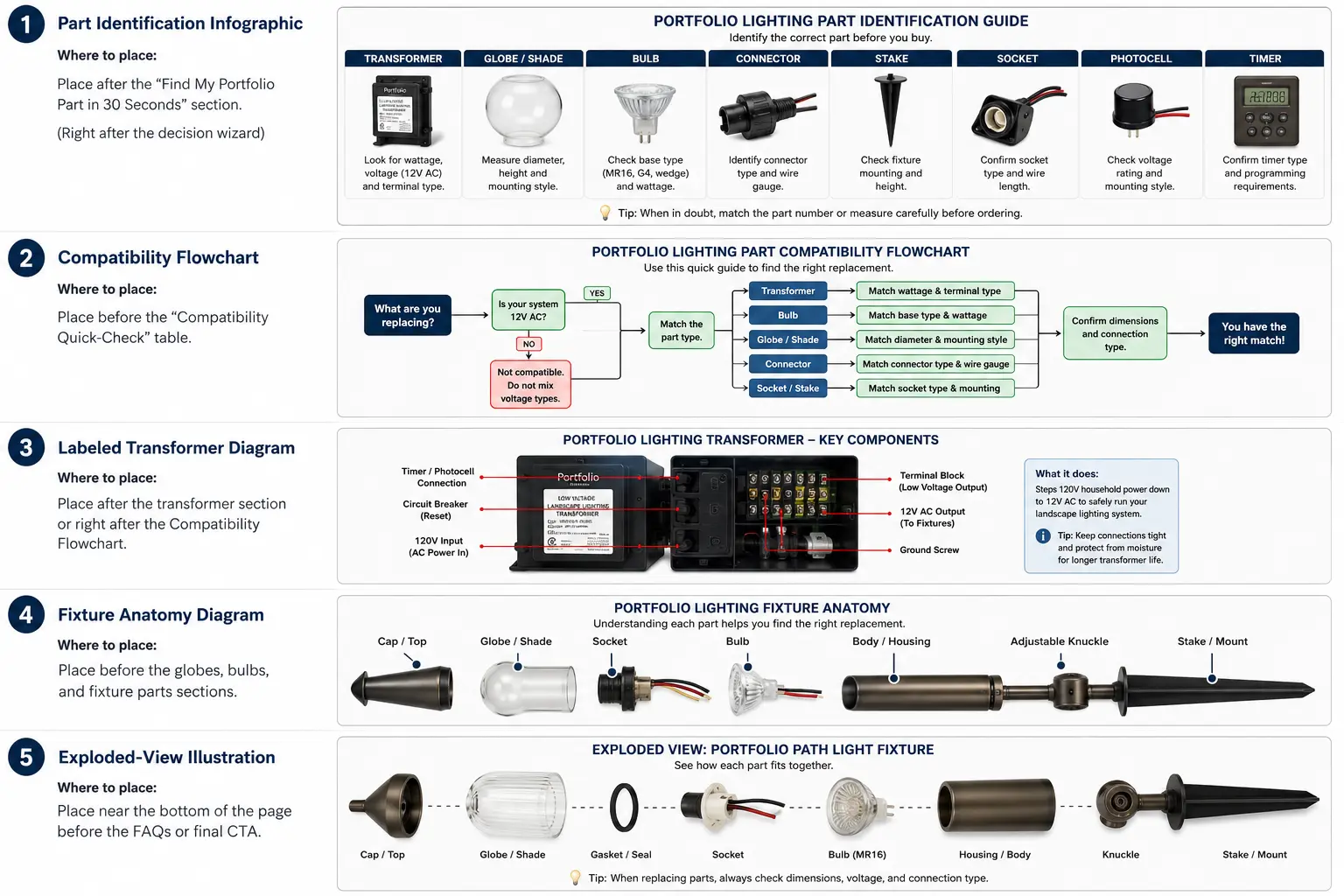
Need a Faster Parts or Troubleshooting Answer?
After you identify the basic symptom, you can use the free Portfolio Lighting AI assistant to narrow the likely failed part, compare replacement paths, and avoid jumping between manuals when a fixture, transformer, connector, photocell, or LED module is hard to identify.
For best results, enter the model number, describe what the light is doing, and mention whether the problem affects one fixture, one cable run, or the entire transformer zone.
Read how the Portfolio Lighting AI assistant works, or start a troubleshooting session with the complimentary credits included for visitors.
Fix My Lights Now With Free AI AssistanceStart Here (Fastest Way to Find Your Part)
Use this shortcut based on your situation:
- ✔ Light not working → Start with troubleshooting
- ✔ Need exact part match → Use model number lookup
- ✔ Broken glass or cover → Find covers and globes
- ✔ Transformer or power issue → Check transformer guide
- ✔ Ready to buy → scroll down to buying section
Top 3 Most Common Portfolio Parts (Start Here First)
- 1. Transformer → system not turning on or unstable
- 2. Bulbs / LED modules → dim, flickering, or dead lights
- 3. Connectors / wiring → intermittent power or partial outages
If you are not sure what failed, start with these three categories before anything else.
Looking for a specific model? Our Portfolio 0312384 parts guide breaks down the exact components that commonly fail and how to replace them.
If you are not sure which part failed, start with our replacement part identification guide to avoid buying the wrong component.
If you are replacing bulbs or retrofit parts, do not ignore Kelvin ratings. The Landscape Lighting Color Temperature Guide shows why warmer color temperatures are often the better choice for residential landscape lighting.
Before ordering replacement parts, it helps to understand which components actually fail most often. The Portfolio Lighting Failure Database ranks common failures by probability, expected service life, repair difficulty, and typical repair cost so you can focus on the parts that are statistically most likely to solve the problem.
Most Searched Portfolio Lighting Parts
These are the part categories homeowners usually need first when repairing older Portfolio landscape lighting systems.
This page helps homeowners find the exact Portfolio lighting replacement part they need. Most visitors come here because something stopped working or a piece of the fixture broke. Instead of replacing the entire light, the better solution is often replacing the one part that failed.
If you are deciding between replacing one small part and moving to a stronger fixture altogether, the best VOLT landscape lighting fixtures guide can help you compare when a full fixture upgrade makes more sense than another repair.
As you go through this guide, focus on a few simple questions. What part of the light stopped working? Is it a bulb, transformer, photocell, connector, or cover? What measurements or model information do you need before ordering? And if the fixture is older, where can you still find compatible replacement parts?
In my experience, most lighting systems don’t fail completely—they break at one small point. I’ve worked on setups where everything stopped working, and it turned out to be a single worn connector or failed component.
To make this easier, this page is organized the same way an electrician or installer would troubleshoot a lighting system. You can search for parts based on the problem you are seeing, the type of fixture you own, or the specific system component that may have failed.
If original fixtures or parts are no longer available, this guide to the best replacement for Portfolio landscape lighting will help you compare modern alternatives.
Lighting repairs often involve more than replacing a single part. See the complete lighting guide for a broader understanding of how lighting systems function and how replacement parts fit in.
If you are trying to replace a full fixture instead of just a part, this buy Portfolio lighting guide shows where to find fixtures, replacement units, and discontinued models.
If you are trying to replace a lighting assembly or accessory, see our Portfolio light kits guide to find compatible replacements.
I remember one project where I almost replaced the entire system before I traced the issue to a simple connection problem. Once I fixed that one spot, everything came back to life.
If you are not sure how all parts connect, review the Portfolio low voltage lighting guide to understand how transformers, wiring, and fixtures work together.
Some of the best holiday lighting upgrades come from better controls rather than new fixtures. See how to automate holiday lighting themes to learn how controllers, timing rules, and lighting zones work together to create seasonal scenes.
In many cases, replacing parts is only one step. See our Portfolio hybrid upgrade guide to learn how to improve control, reduce power issues, and upgrade your system without a full rebuild.
Should You Replace a Part or the Whole Fixture?
- ✔ Replace part → if fixture body is still in good condition
- ✔ Replace fixture → if housing is damaged or parts are unavailable
- ✔ Upgrade system → if multiple parts are failing
If you are unsure, compare this with Portfolio lighting alternatives before buying.
Not sure which part you need? Use the Portfolio Lighting model library and specifications index to match your model before ordering parts.
If your system uses strip-style fixtures, this strip lighting guide can help you identify, repair, or replace your setup before ordering parts.
If you need help replacing a lost or broken handheld control, see our Portfolio ceiling fan remote replacement guide for pairing steps, dip switch matching, receiver checks, and universal remote fixes.
Not sure which bracket, crossbar, or mounting hardware you need? Start with our Portfolio lighting mounting hardware and bracket replacement guide before ordering parts.
If you are matching parts to an older model number, use the Portfolio technical archive to compare shared bulbs, stakes, fuses, photocells, and connectors.
Before You Buy: Portfolio Part Fit Checklist
Confirm these details before ordering. This is the fastest way to avoid buying a part that looks right but does not fit.
If you are comparing replacement parts, do not choose by price alone. A cheap part can become expensive if it does not match the voltage, connector style, bulb base, or fixture dimensions. The Portfolio Lighting repair cost guide breaks down typical costs for bulbs, connectors, globes, transformers, fixtures, and professional service so you can decide whether the part is worth buying.
| Check This | Why It Matters |
|---|---|
| Voltage | Portfolio landscape fixtures usually require 12V AC. Do not mix incompatible low-voltage formats. |
| Bulb base | MR16, G4, wedge, and integrated LED fixtures require different replacements. |
| Connector style | Quick-connect, pierce-point, and splice connections are not always interchangeable. |
| Dimensions | Globes, shades, stakes, and covers must match diameter, height, and mounting lip. |
| Transformer load | Total wattage should stay below about 80% of transformer capacity. |
Small sealing components can have a major impact on outdoor lighting reliability. Gaskets, O-rings, and seals help protect fixtures from moisture intrusion, corrosion, and premature failure. Learn more in our outdoor lighting gaskets, O-rings, and seals guide, including where these components are used and when replacement is needed.
Compatibility Quick-Check: What Replaces Portfolio Lighting Parts?
Portfolio lighting is discontinued, so many repairs now depend on finding either a compatible replacement part or a similar fixture from another brand. This table helps you narrow the search by part type, what to check first, and which replacement paths make the most sense.
I’ve handled a lot of repairs, and in my experience, certain parts fail more often than others. I’ve seen connectors corrode, transformer terminals overheat, and wiring degrade long before the fixtures themselves go bad.
Replacement parts can extend fixture life, but only if the original housing is still worth saving. The Durable Landscape Lighting Materials Guide explains why brass, copper, and better-built metal housings are often a smarter long-term investment.
Searching for compatible glass, stakes, or transformers is much easier when you have the original part numbers. Our digital Portfolio Lighting Master Model & Replacement Handbook serves as a definitive resource for cross-referencing discontinued parts with modern alternatives.
| What You Need | Will Another Brand Work? | What to Check First | Best Alternative Brand Guides | Where to Shop |
|---|---|---|---|---|
| Path light fixture | Usually yes | Fixture height, finish, connector style, low-voltage rating | Malibu • Hampton Bay • allen + roth | Amazon (Paid Link) | eBay (Paid Link) |
| Spotlights / accent lights | Often yes | Beam style, bulb type, mounting style, wire connection | Volt • Kichler • Progress Lighting | Amazon (Paid Link) | eBay (Paid Link) |
| Transformer replacement | Yes, if wattage and setup match | Total load, timer type, multi-tap voltage, photocell setup | Transformer alternatives • Hampton Bay transformer • Malibu transformer | Amazon (Paid Link) | eBay (Paid Link) |
| Stakes and mounting | Sometimes | Stake diameter, fixture base fit, ground depth | Paradise • Utilitech | Amazon | eBay (Paid Link) |
| Connectors and wiring | Usually yes | Quick-connect vs splice, wire gauge, outdoor rating | Connector compatibility guide | Amazon | eBay (Paid Link) |
| Replacement bulbs | Usually yes | Bulb base, wattage, beam spread, halogen vs LED | Best replacements • All alternatives | Amazon | eBay (Paid Link) |
| Full fixture upgrade | Often the best long-term option | System age, finish quality, repeated repair costs | Portfolio alternatives • Volt vs Portfolio • Ring smart lighting alternatives | Amazon (Paid Link) | eBay (Paid Link) |
| Premium fixture replacement | Yes, if you want better durability | Material quality, finish, long-term reliability | Volt review • Volt fixtures | Shop premium fixtures |
When I tested different systems, I noticed that wear points tend to show early signs if you know what to look for. My approach is to check those areas first before assuming a bigger failure.
If you are unsure whether to repair a Portfolio fixture or move to another brand, start with best replacement options for Portfolio landscape lighting and then compare the brand guides above. For those looking to eliminate manual timers entirely, exploring predictive lighting logic can offer a more reliable way to manage your outdoor environment than traditional photocells.
Some outdoor lighting upgrades are about control, not just fixtures and parts. See our voice biometrics lighting guide to learn how identity-based voice control fits into a more advanced outdoor lighting system.
Most Common Portfolio Lighting Failure by System Age
This is a practical starting point when the system is older and the original model number is hard to read.
| System Age | Most Likely Failure | Start Here |
|---|---|---|
| 1–5 years | Bulb, LED module, or timer setting | Check bulbs and programming first. |
| 5–10 years | Connectors, wire taps, photocell, or stakes | Inspect corrosion and loose connections. |
| 10–15 years | Transformer terminals, timer, photocell, or fixture sockets | Test transformer output before replacing fixtures. |
| 15+ years | Multiple small failures across transformer, wire, connectors, and fixtures | Consider staged replacement instead of one random part. |
Jump to the Right Buying Section
Find the Right Part by Problem
Many visitors do not know the exact part name yet. They only know what is wrong. That is normal, and it is often the fastest way to narrow the search. Use the problem below to guide the part category you shop first.
Choosing the right parts and fixtures becomes much easier when you understand how each room should be lit. This room-by-room lighting plan guide helps you decide what type of lighting each space actually needs before selecting bulbs, fixtures, or accessories.
The type and quality of lighting parts you choose will directly affect your total project cost. This landscape lighting cost guide helps you understand how different components impact pricing.
Before ordering replacement parts, use our terminal block and lug repair guide to identify exactly which component has failed.
Lights will not turn on
Start with the transformer, photocell, timer, connectors, or bulb depending on whether the whole system is dead or only one fixture is affected.
Check transformer issuesShop transformers and controls (Paid Link)
Broken cover, globe, or shade
Look for replacement globes, covers, diffusers, shades, and decorative glass pieces that match the fixture dimensions and mounting style.
If you are replacing connectors, stakes, or a failed path light, this Portfolio 0688503 repair and parts guide shows which components typically fail first.
Find globes and coversBrowse cover and glass listings (Paid Link)
Fixture will not mount correctly
Focus on mounting hardware, canopies, brackets, trim rings, screws, stake assemblies, and installation accessories.
Find replacement hardwareShop hardware and kits (Paid Link)
LED fixture is dim or dead
Check the bulb, LED module, driver, socket, or internal electrical component before replacing the entire fixture.
Check LED modules and driversShop bulbs and LED parts (Paid Link)
Outdoor system issue
For landscape systems, think in terms of connectors, stakes, wire, transformer, timer, photocell, housings, and lamp heads.
See outdoor system guidesBrowse outdoor replacement parts (Paid Link)
Trying to match a discontinued part
Use model lookup, discontinued product guides, and category searches before assuming the part is impossible to find.
See discontinued parts helpUse model lookup
Model-Specific Portfolio Replacement Parts Matter
Portfolio replacement parts are not always interchangeable, even when two fixtures look similar from the outside. A path light, motion light, and solar light can each fail for completely different reasons: cracked lenses, corroded sockets, weak batteries, bad motion sensors, stripped mounting hardware, or weather-damaged seals. For model-level repair help, compare the Portfolio Lighting Model 7133C replacement parts guide, the Portfolio DualBrite PF-4300-BK motion light manual, and the Portfolio Lighting Model SLL12BK solar light parts guide before ordering parts.
A replacement stake, stem, riser, knuckle, or mounting screw should not be selected by appearance alone. Landscape fixtures can use straight pipe threads, tapered pipe threads, inch machine screws, metric fasteners, or manufacturer-specific molded connections that look nearly identical until they begin to bind. Before ordering mechanical hardware, use the landscape lighting screw thread guide to measure outside diameter, pitch, taper, thread gender, usable engagement length, and the shoulder or gasket that controls how the part seats.
🔍 Discontinued Portfolio Model Number Lookup
Because Portfolio Lighting is no longer in active production for many legacy lines, finding an exact “retail-shelf” match can be difficult.
In my experience, accessories are often overlooked but can make a big difference in how a system performs. I’ve used better connectors, mounting hardware, and protection components that extended the life of the entire setup.
Most discontinued units are identified by a 6-digit item number (e.g., 0805279) found on a silver or white sticker. These are typically located on the transformer housing or the underside of the fixture base.
I’ve found that small upgrades can prevent recurring issues. When I implemented higher-quality connections and better wire management, I saw fewer failures over time and much more consistent performance.
If you have successfully identified your discontinued model number, use the Site Search at the top of this page. Our database contains archived wiring schematics, original wattage ratings, and compatible LED retrofit data for over 275+ legacy Portfolio items.
⚡ Transformer & Power Pack Components
The transformer is the “brain” of your low-voltage system. When a Portfolio system fails, 70% of the time the issue is located within the power pack rather than the fixtures themselves.
Terminal Lugs
Check for corrosion or “stripped” screws where the main wire enters the base. These are the most common physical failure points.
Photocells
If lights stay on during the day or won’t turn on at night, the plug-in light sensor (photocell) likely needs a 2-prong replacement.
Internal Timers
Legacy analog timers often seize over time. Digital replacements are available for models with modular “timer slots.”
Looking for a specific component? I have documented the internal circuitry for the Portfolio 200W and 600W series, including instructions for bypassing failed photocells.
💎 Replacement Glass, Globes & Shades
Portfolio glass is often the first thing to break, but the hardest to find. Since most Portfolio fixtures are discontinued, the key to a successful replacement is measuring the “Fitter Size.”
How to Measure a Fitter
The fitter is the outer diameter of the glass “lip” that slides into the fixture. Common Portfolio sizes include 2-1/4”, 3-1/4”, and 4”. Always measure the inner diameter of the fixture cup if the glass is missing.
Compatible Materials
If you cannot find an exact Portfolio match, look for “Universal” shades. Ensure the material (Seeded Glass, Frosted, or Alabaster) matches your remaining fixtures to maintain a uniform look across your landscape.
For a complete list of dimensions for specific model series, visit our Portfolio Globes & Covers Database.
📚 Technical Manuals & Wiring Diagrams
Correct installation is the best way to prevent premature part failure. Our vault contains original PDF instruction sheets and Portfolio Lighting Manuals for the Portfolio product line.
Installation Sheets
Step-by-step assembly guides for chandeliers, pendants, and wall lanterns, including mounting bracket orientation.
Wiring Schematics
Detailed diagrams for low-voltage daisy-chaining and T-method wiring to ensure equal voltage across all fixtures.
Programming Guides
Manuals for setting digital timers, pairing remote controls, and calibrating motion sensor sensitivity levels.
Can’t find your specific manual?
Since many Portfolio items share internal components, a “General Series” manual often provides the same wiring logic you need.
Need immediate help with a wiring issue? See our Low Voltage Wiring Guide for a breakdown of wire gauges and distance limitations.
How to Find the Right Portfolio Lighting Replacement Part
Quick answer: Start with the model number if available, then match the fixture type, dimensions, voltage, and mounting style. If the model number is missing, use measurements and visual comparison to find a compatible replacement.
Most homeowners find the right part by identifying the failed component first, then narrowing the search based on fixture type and system setup.
If several parts are failing at once, compare replacement parts with a full commercial-grade landscape lighting upgrade before spending money on another temporary repair.
Water exposure is a common cause of failure in outdoor systems. If your lights stopped working after rain, see our guide to fixing landscape lights after rain before replacing parts.
If you are working with a specific recessed or integrated LED fixture, see our Portfolio LD6C lighting guide to identify compatible parts, replacement options, and troubleshooting steps before ordering anything.
If your system still works but needs improvement, upgrading controls may be a better option than replacing parts. See how to upgrade a legacy landscape lighting system to improve performance without a full replacement.
If you are shopping for parts because of an HOA warning or city lighting complaint, use the Outdoor Lighting Ordinance Guide to identify whether your compliance issue is caused by glare, brightness, color temperature, or missing controls before buying replacement parts.
If you are replacing parts for models 284369, TC001, or 284357, use the model-specific parts and manual guide to match bulbs, connectors, and components correctly.
Commercial replacement parts should never be selected by diameter or appearance alone. A trim can fit the ceiling opening and still be wrong for the housing, reflector depth, LED engine, beam distribution, or thermal system. A driver can power the LEDs briefly and still use the wrong output current or dimming protocol. Before ordering a commercial trim, engine, driver, emergency pack, or mounting component, use the Portfolio commercial lighting parts and compatibility guide to identify the complete installed assembly.
Before buying replacement parts for an older Portfolio fixture, it is worth deciding whether the repair can also become an LED upgrade. A fixture with a good housing but a worn socket, old halogen lamp, or aging transformer may still be worth preserving. Our Convert Portfolio Lighting to LED Guide explains how to evaluate the socket, transformer, voltage, lamp base, fixture dimensions, and moisture condition before deciding whether to repair, convert, or replace the fixture.
Find Parts by Fixture Type
If you already know what kind of Portfolio fixture you own, that is often the fastest way to narrow the search. A landscape spotlight does not use the same accessories as a table lamp. A pendant shade does not use the same hardware as a transformer system. Use the fixture type first, then narrow down the exact component.
If you are looking for replacement parts for an indoor fixture, it may help to first review our Portfolio indoor lighting guide. That page gives a broader overview of the main indoor fixture categories across the site.
Landscape lighting fixtures
Best first parts to check: transformers, stakes, connectors, bulbs, housings, photocells, timers, and low-voltage cable.
Open landscape lighting guidesTrack and rail lighting
Best first parts to check: cord sets, heads, bulbs, connectors, track hardware, and mounting accessories.
Open track lighting guidesPendants, vanity lights, and indoor fixtures
Best first parts to check: globes, shades, diffusers, sockets, canopies, lamp kits, and decorative hardware.
Open pendant lighting guidesParts by Outdoor System Component
Many of the people searching this page are trying to repair a low-voltage landscape lighting system. When an outdoor lighting system stops working properly, the problem is usually tied to one specific component rather than the entire system.
Instead of replacing every fixture, it is often much easier to identify the part that failed and replace that single component. In most outdoor systems, the issue usually comes from the transformer, photocell, timer, wiring connectors, bulbs, or mounting hardware.
If the outer body of your fixture is cracked, rusted, or no longer protecting the internal components, this guide to Portfolio landscape light housings can help you understand what a housing does, when it needs replacement, and what to check for compatibility.
The sections below walk through the most common landscape lighting components that need replacement. If your outdoor lights stopped working, start by checking these categories first before assuming the entire lighting system needs to be replaced.
Portfolio Lighting Transformer Replacement
Quick answer: If your entire lighting system is not turning on or is inconsistent, the transformer is often the most likely failed component. Replacing the transformer can restore power to all connected fixtures.
Spring is one of the most common times for homeowners to replace cracked stakes, cloudy lenses, corroded connectors, and damaged fixtures. The Portfolio Easter & Spring Lighting Maintenance Guide explains which parts usually fail after winter and how to inspect them safely before replacing the whole system.
Transformer replacement
If the whole system is dead or unstable, start with the transformer.
Transformer helpShop transformer options (Paid Link)
Photocell replacement
If lights do not respond correctly at dusk, the photocell may be the failed part.
Photocell guideBrowse photocell listings (Paid Link)
Bulb replacement
If one fixture is dim or dead, the bulb or LED module is one of the first things to verify.
MR16 bulb guideShop bulbs and LED modules
Connector replacement
If power is intermittent or one section is dead, connectors and low-voltage splices deserve attention.
Shop connector partsStake replacement
If the light body still works but the mount is broken, replacing the stake may save the whole fixture.
Path light guidesHousing and cover replacement
If the body or cover is cracked, a housing or globe replacement may be the better value.
Covers and globes guideWhere to Buy Portfolio Lighting Replacement Parts
Quick answer: Portfolio lighting replacement parts are typically found through online marketplaces, especially for discontinued fixtures. Common parts like bulbs, connectors, and transformers are often available through retail listings, while older or model-specific parts are more likely to be found through secondary marketplaces.
The best approach is to compare multiple sources before buying, especially if you are trying to match an older fixture or locate a hard-to-find replacement part.
If your transformer is not working, the issue may not be a failed part but an error code indicating a specific problem. Use this Hampton Bay error code breakdown to diagnose the issue before buying replacement parts.
If your smart lighting feels slow or stops responding during outages, the issue may be how the system is built rather than the fixture itself. Our edge vs cloud lighting guide explains why local processing is often more reliable than cloud-based control.
Not every Portfolio Lighting search involves landscape fixtures or transformers. Exterior security lights remain one of the most commonly researched discontinued categories, especially motion-sensing wall fixtures. The Portfolio PF-4300-BK motion-sensing porch light guide explains common replacement needs, operating controls, troubleshooting tips, and alternative fixture options for homeowners maintaining older installations.
Fast Buying Paths
If you are ready to compare live listings now, these are the two strongest starting points for buyers who want current availability.
See current Portfolio replacement parts on eBay (Paid Link)
Compare Portfolio lighting parts on Amazon (Paid Link)
Older Portfolio fixtures frequently require a different replacement strategy than newer products. Rather than replacing complete assemblies, many vintage fixtures can be restored using replacement sockets, wiring, glass panels, mounting hardware, or donor parts. The Portfolio Vintage Lighting guide explains which components are commonly reusable and which should usually be replaced during restoration.
Popular Portfolio Replacement Parts
The categories below tend to be the most searched because they solve the most common real-world failures. If you want the most practical place to begin, start here.
If you are replacing only part of your lighting system, it helps to know whether other brands will actually work with your existing connectors. See Will Other Lighting Brands Work With Portfolio Connectors? for a practical guide to compatibility, wire fit, connector problems, and mixed-brand troubleshooting.
Upgrading your lighting system does not always require new fixtures. In many cases, replacing the timer or control system is enough. The Smart Outdoor Lighting Controls Guide explains your options.
If you are deciding whether to repair your current system or replace fixtures entirely, compare your options in our LeonLite vs Portfolio landscape lighting guide before buying parts.
Replacement Globes and Covers
Best for cracked glass, broken covers, and missing protective pieces.
Many replacement parts help control light direction and reduce glare. The BUG rating system explains how shielding and optics affect backlight, uplight, and glare performance.
Find globes and coversReplacement Diffusers
Best for cloudy, yellowed, cracked, or missing diffuser panels.
Find diffusersReplacement Hardware
Best for canopy kits, brackets, trim rings, screws, and fixture mounting issues.
Find hardwareLED Modules and Drivers
Best for fixtures that use internal LED components instead of standard bulbs.
Find LED partsWhere to Buy Replacement Parts
Best if you want a dedicated buying guide for live replacement-part sources.
See where to buyModel Number Lookup
Best if you need to confirm the exact fixture before buying anything.
Look up model numberPortfolio Lighting Replacement Photocell
Find replacement photocells for Portfolio lighting systems and learn how to identify the correct dusk-to-dawn sensor before buying.
View photocell replacement guideSmall Parts Can Change the Whole Lighting Effect
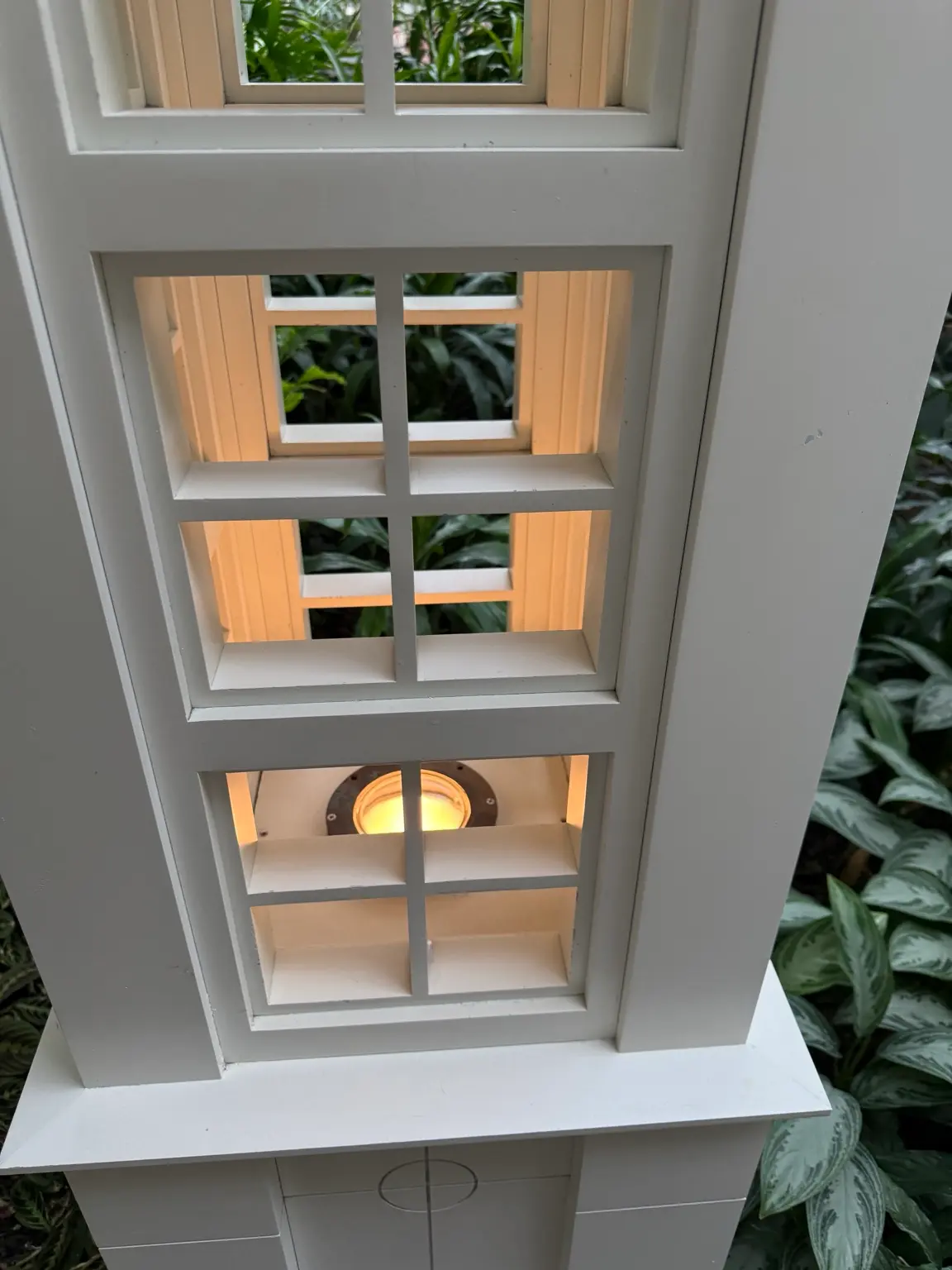
Replacement parts are not just cosmetic. A different lens, diffuser, LED module, or housing can completely change the way a Portfolio fixture performs at night. The goal is to preserve the useful lighting effect while restoring the part that failed.
If the original fixture produced soft warm light, try to match that behavior when choosing replacement parts. Brightness alone does not guarantee a good result.
Many Portfolio replacement part jobs fail before the homeowner ever reaches the bulb or socket. If the threaded collar, lens cap, or upper housing is frozen from years of oxidation, mulch moisture, and mineral buildup, twisting harder can snap the stem or destroy the fixture body. Before ordering replacement lenses, bulbs, or sockets, use this guide to opening stuck and corroded Portfolio lighting fixtures so you can loosen the housing safely without crushing the painted metal or breaking the stake assembly.
Most Common Portfolio Lighting Parts People Replace
- Transformers
- Photocells
- Bulbs and LED modules
- Connectors and wiring components
- Glass covers and globes
- Mounting hardware and stakes
Match the Problem to the Part
| Problem | Likely Part |
|---|---|
| Lights not turning on | Transformer or wiring |
| One light not working | Bulb or socket |
| Lights flickering | Bulb, connector, or voltage issue |
| Lights stopped after rain | Connectors or wiring moisture |
Before ordering replacement parts for a partial strand failure, use our troubleshooting guide for Christmas lights half out to identify whether you need a bulb, fuse, wire repair, or full replacement.
Replacing the fixture without replacing a damaged connector often leaves the real problem behind. The low-voltage plug and limited-energy connector guide explains how outdoor splice points, wire nuts, terminal blocks, and insulation-piercing connectors fail over time.
Portfolio Lighting Replacement Parts Table
Use this table to compare common replacement categories, what problem they solve, what to confirm before ordering, and where to quickly search for replacement parts.
If the outer body of your fixture is cracked, rusted, warped, or damaged, the housing may be the part that needs attention rather than the full lighting system. This Portfolio landscape light housings guide explains what housings do, how to identify them, and when replacement makes the most sense.
Not every lighting repair should end with buying another bulb. If a fixture repeatedly burns through lamps, develops socket corrosion, or loses brightness unevenly across the system, the better long-term repair may be replacing the fixture style instead of continuing to replace consumable bulbs. Our integrated LED vs. socketed lifespan data guide compares replaceable-bulb fixtures with sealed LED fixtures so you can decide whether the next purchase should be a bulb, socket repair, or full fixture upgrade.
| Part Category | Typical Use | Problem It Solves | Before You Buy | Best First Action | Buy Replacement Parts |
|---|---|---|---|---|---|
| Transformer | Low-voltage outdoor systems | Whole system will not power on or works inconsistently | Confirm wattage capacity, voltage, and timer/photocell control type | Check transformer troubleshooting |
eBay (Paid Link) Amazon (Paid Link) |
| Photocell / Optical Sensor | Dusk-to-dawn landscape lighting controls | Lights do not respond correctly at dusk or stay on too long | Confirm transformer compatibility and wiring style | Check photocell guide |
eBay (Paid Link) Amazon (Paid Link) |
| Bulbs / LED Modules | Indoor and outdoor fixtures | Dim, flickering, or burned-out lights | Check base type, wattage, lumen output, and bulb size | Check bulb guide |
eBay (Paid Link) Amazon (Paid Link) |
| Connectors / Cable Accessories | Low-voltage landscape wiring | Intermittent power or dead downstream fixtures | Verify wire gauge, connector type, and outdoor compatibility | — |
eBay Amazon |
| Glass Covers / Globes / Diffusers | Decorative fixture repair | Broken, missing, or yellowed light covers | Measure diameter, mounting lip, and fixture opening size | Check cover guide |
eBay (Paid Link) Amazon (Paid Link) |
| Hardware / Canopies / Brackets | Mounting and fixture support | Fixture will not mount correctly or hardware is missing | Confirm bracket spacing, screw size, canopy diameter | Check hardware guide |
eBay (Paid Link) Amazon (Paid Link) |
Where to Buy Portfolio Lighting Parts
For most buyers, the smartest strategy is to compare a few sources instead of relying on one search result. Portfolio parts can vary in availability depending on whether the item is a common replacement such as a bulb or connector, or a harder-to-find model-specific part such as a transformer control, decorative cover, or older globe. Marketplace listings are especially helpful for discontinued items and model-specific leftovers. Broader retailer searches can be useful for bulbs, general accessories, and compatible hardware.
Start here for current marketplace listings:
Browse Portfolio replacement parts on eBay (Paid Link)
Compare Portfolio lighting parts on Amazon (Paid Link)
If you are still deciding whether you need the exact original part or a compatible replacement, compare this page with where to buy Portfolio lighting replacement parts and Portfolio lighting alternatives.
How to Confirm Fit Before You Buy
The most expensive replacement part is the one that does not fit. Before ordering, take a minute to confirm the details that matter. For bulbs and modules, confirm the base type, wattage, voltage, and physical size. For transformers, confirm wattage capacity, control type, and whether the system uses a timer or photocell. For covers and globes, measure carefully. For hardware, compare bracket spacing, canopy size, and thread type. For connectors, make sure the wire gauge and outdoor use match the system.
If the model number is still readable, use it. That is the fastest route to a better match. If the model label is faded or missing, compare the fixture visually with the product category pages and use dimension-based matching as a backup. This is where Portfolio lighting model number lookup becomes especially useful.
Before You Buy Any Portfolio Part
- ✔ Confirm fixture type (landscape vs indoor)
- ✔ Check voltage (low voltage vs line voltage)
- ✔ Measure size (especially globes and covers)
- ✔ Match connector or base type
When a Part Replacement Makes More Sense Than a Full Fixture Replacement
In my career, I’ve found that most lighting systems can be repaired rather than replaced. I’ve worked on setups that looked completely broken but only needed a few targeted fixes to restore full function.
A replacement part is usually the smarter value when the main fixture body is still in good condition and the failed piece is isolated. A burned-out bulb, bad sensor, broken stake, loose connector, cracked shade, or worn hardware piece is often an easy example. In those situations, replacing the exact part helps you keep the look of the original fixture and usually costs much less than replacing the full light.
My recommendation is to focus on the weak point instead of the whole system. In practice, this saves time, reduces cost, and keeps a working setup in place without starting over.
A full fixture replacement starts making more sense when the body is heavily corroded, multiple parts are missing, the item is too difficult to match, or the cost of the required parts approaches the cost of a new compatible fixture. That is why parts pages and alternatives pages work well together. They help you decide whether to repair or replace based on what is actually available today.
If your Portfolio lighting fixture still works but the protective lens or cover is cracked, cloudy, or missing, replacing the lens is often the easiest repair. Our Portfolio Lighting Replacement Lenses guide explains how to identify compatible lens styles and locate replacement covers for older Portfolio fixtures.
If you cannot find the exact replacement part or your fixture is discontinued, upgrading the entire system may be the better option. This Portfolio landscape lighting replacement guide shows the best alternatives available today.
Ground stakes are one Portfolio replacement part that should be matched by more than appearance alone. If a path-light stake has snapped, corroded, stripped its threads, or cracked where it enters the fixture, use our Portfolio landscape lighting stake replacement guide before ordering a replacement. The guide shows exactly what to measure on the old stake—including thread diameter, pitch, engagement length, collar dimensions, overall length, and wire-routing method—and explains why a so-called universal landscape-lighting stake may still be incompatible with an older Portfolio fixture.
Recently Added Portfolio Fixture Model Guides
Identifying discontinued Portfolio fixtures and sourcing replacement parts is much harder when no documentation exists online. The model-specific guides below cover the most-searched discontinued Portfolio fixture item numbers — each page provides specs, parts identification, troubleshooting by symptom, and compatible replacement options for that specific model.
If you are working with outdoor wall lanterns, deck lights, or fixtures with internal circuit boards that have no available manual, these pages are the most complete resources available. Each guide also links to the broader Portfolio replacement parts library, the model number lookup, and the discontinued Portfolio lighting hub.
Replacement parts for discontinued Portfolio fixtures should not be ordered by appearance alone. Two fixtures can look similar but use different stakes, lenses, sockets, LED modules, photocells, connectors, or transformer parts. If the model number is unfamiliar or does not return a clear match, start with the Portfolio Lighting Lost Models Archive to narrow the fixture family and avoid buying the wrong bulb, glass, stake, driver, or connector.
📋 New Fixture Model Pages — Parts, Troubleshooting & Replacement
Dedicated guides for five discontinued Portfolio fixture models — the most specific and actionable resources available for these item numbers anywhere online.
For the full list of discontinued Portfolio model guides including transformer-specific pages, use the discontinued Portfolio lighting hub or the model number lookup to find the guide that matches your specific item number.
If the original Portfolio part is unavailable, compare alternative brands before replacing the full system. The Moonrays replacement parts guide is useful for homeowners looking for low-voltage stakes, bulbs, lenses, connectors, and fixture accessories.
Model-Specific Portfolio Parts and Repair Intelligence
Many discontinued Portfolio systems are still repairable if the failed component is identified correctly. The biggest mistake homeowners make is replacing an entire lighting assembly when the real problem is usually a corroded connector, weak socket tension, failed gasket, broken stake, or overloaded transformer connection.
My growing model-specific repair library focuses on the hidden behaviors that generic parts pages rarely explain. Instead of simply listing replacement components, these pages explain why the failures happen, how to diagnose them properly, and which modern replacement parts are actually compatible with the original Portfolio design.
The SS9C-P5-BKT-CPK1 parts and manual guide explains how older bundled fixture kits were configured, how missing mounting components affect compatibility, and how to identify the original hardware when only partial system pieces remain.
The 0378225 connector repair guide focuses on one of the most common hidden low-voltage failures: compressed copper strands inside aging pierce connectors. It explains moisture-assisted conductivity, oxidation spread inside wire jackets, and why “green dust” corrosion almost always signals deeper connector failure.
Flood-light-specific repair behavior is covered in the 0157561 flood light replacement guide, including lens seal breakdown, overheating trim rings, socket degradation, beam-pattern mismatch, and moisture intrusion caused by warped housings or aged gaskets.
The 0062582 path light troubleshooting and parts guide explains several advanced field-repair concepts rarely discussed online, including “ghost voltage” readings, mixed-metal thread damage, humidity trapped during bulb replacement, and socket corrosion caused by micro-arcing at the bi-pin contacts.
For low-voltage transformer systems, the 0805200 transformer diagnostic page explains overload hum, thermal breaker cycling, partial-short detection, magnetic-core stress behavior, and why oxidized output lugs often mimic full transformer failure.
The 7404280540 fixture repair and compatibility parts guide dives into lens respiration behavior, trapped moisture fogging, stake-thread upgrades, O-ring maintenance, and hidden socket-tension problems that frequently cause intermittent operation in older Portfolio path and spot-light systems.
These technical model pages are designed to function as a real repair archive for discontinued Portfolio lighting systems, helping homeowners diagnose failures logically instead of relying on trial-and-error replacement purchases.
My Newest Model-Specific Replacement Part Guides Recently Added
Replacement flood-light housings, mounting brackets, lenses, and transformers can vary significantly between older Portfolio models. This Portfolio Model 0157561 flood-light replacement parts guide helps explain common hardware layouts and replacement considerations for this fixture family.
Many discontinued Portfolio systems used proprietary connectors and fixture dimensions that are difficult to identify using retailer photos alone. This Portfolio Lighting Model 0062582 parts and manual page helps homeowners compare original hardware and replacement options more accurately.
Outdoor lighting repairs often fail because incompatible low-voltage parts are mixed together without understanding the original system design. This Portfolio Model 0394866 compatibility and replacement guide explains how to identify the correct replacement direction before ordering parts.
Some older Portfolio fixtures were designed around replaceable lamp systems while newer generations moved toward integrated LED architecture. This Portfolio Lighting Model 0482436 manual and repair guide explains how those differences affect long-term maintenance and replacement planning.
Finding replacement components for discontinued landscape-lighting systems can become extremely difficult without organized technical references. This Portfolio Model 17794-000 technical parts and troubleshooting guide helps preserve detailed repair information for older installations.
Frequently Asked Questions
Where can I buy Portfolio lighting replacement parts?
Portfolio lighting replacement parts are most often found through current marketplace listings, category-based buying guides, and retailer searches for bulbs, transformers, connectors, covers, shades, and hardware.
What are the most commonly replaced Portfolio lighting parts?
The most commonly replaced parts include transformers, bulbs, LED modules, photocells, timers, connectors, stakes, shades, covers, mounting hardware, and low-voltage wiring accessories.
Can I replace one part instead of the whole fixture?
Yes. In many cases, replacing the failed part is the better value if the main housing and the rest of the fixture are still in good condition.
How do I know which Portfolio part fits my fixture?
Start with the model number if possible, then compare fixture type, dimensions, wattage, voltage, base type, connector style, and mounting details before ordering.
Are Portfolio lighting parts hard to find?
Some common parts are easier to find than others. Bulbs, connectors, transformers, and general accessories are usually easier to locate than older decorative shades, discontinued covers, or very specific model-only pieces.
⚠️ Important: Code Compliance When Upgrading Discontinued Systems
When sourcing replacement stakes, socket assemblies, or aftermarket photocells for older or discontinued Portfolio fixtures, ensuring structural electrical compliance is critical. Mixing components with mismatched voltage tolerances or installing unrated hardware can easily trigger system-wide voltage drops, line-side overheating, and early component degradation.
Before completing your hardware repair, always verify that your wiring layouts conform to National Electrical Code (NEC) standards—specifically regarding safe direct-burial depths, proper load balancing across multi-tap transformer terminals, and GFCI breaker integration.
Portfolio Lighting Master Model & Replacement Handbook
Stop wasting time hunting for discontinued Portfolio parts. This premium PDF helps you identify legacy Portfolio Lighting models, understand common failures, and find compatible replacement options from brands like Malibu, VOLT, Hampton Bay, and Kichler.
Inside the PDF:
- 100+ model breakdown pages
- Transformer, path light, spotlight, and wall lantern specs
- Common failure patterns for discontinued models
- Compatible replacement brands and parts strategy
- What to check before buying the wrong part
If one wrong part costs you $20–$80, this $9.99 handbook can pay for itself before you make your first replacement purchase.
Expert-Verified Troubleshooting
Every guide on PortfolioLighting.net is tested for accuracy. The troubleshooting procedures are based on 25+ years of field experience and are maintained by Philip Meyer to ensure accuracy and electrical safety compliance.
Disclosure: PortfolioLighting.net participates in the eBay Partner Network and the Amazon Associates Program. Some links on this page are affiliate links, meaning we may earn a commission if you purchase through them. This comes at no additional cost to you and does not influence which products or sources we recommend.
Follow Portfolio Lighting
Get landscape lighting troubleshooting tips, maintenance advice, wiring guides, product updates, and outdoor lighting inspiration.
Follow Us on Facebook