
Quick Answer: Legacy Portfolio System Management Standards
Managing a legacy Portfolio lighting system requires balancing specific mechanical physical metrics against exact electrical circuit thresholds. Because these discontinued fixtures span multiple product generations, localized component repairs must map back to strict structural dimensions, safety configurations, and load distributions.
Before sourcing components or adjusting your wiring layout, verify your system's symptoms against the seven foundational engineering and compatibility benchmarks below:
- Hardware Model Verification: Tracking legacy tracking numbers prevents sourcing incompatible housing parts—requires cross-referencing factory shell stamps before replacement.
- Fitter Sizing & Glass Seals: Replacement globes require verifying exact neck outer diameters (like 2-1/4" or 3-1/4" fitters) to maintain airtight moisture and insect seals.
- Loop Voltage Optimization: Operational current must remain strictly between 10.8V and 12.1V at the furthest fixture run to stop halogen yellowing and LED driver flashing.
- Transformer Circuit Constraints: Cumulative system wattage loads across a direct-burial circuit loop must never exceed 80% of your power pack's maximum rated core capability.
- Structural Anchor Stability: Repairing leaning or broken pathway stalks requires standard 1/2-inch NPT threaded male mounts to bypass weak plastic factory stakes.
- Line Resistance & Gauge Matching: Longer secondary loop runs require stepping up from standard 16-gauge or 14-gauge direct burial lines to heavy-duty 12-gauge copper wire.
- Cross-Generational Rebrand Realities: Replacing discontinued components with modern Origin21 retail hardware requires balancing driver frequencies to avoid severe circuit hum.
⚠️ SYSTEM-WIDE FAILURE ALERT: Swapping individual fixtures or resetting a transformer without isolating underlying cable resistance lines will cause three irreversible system-wide faults, which are detailed across our technical blueprint directories linked below.
Select your immediate project path below to access our deep-dive databases, dimensional sizing charts, and model-specific manufacturer manuals.
What Do You Need Help With?
Choose the fastest path based on what you are trying to find.
Find a Model Number
Look up discontinued Portfolio model numbers, fixture IDs, transformer labels, and replacement paths.
Use the model lookup →Find Replacement Parts
Glass shades, globes, stakes, connectors, bulbs, transformers, and compatible substitute parts.
Find parts →Fix Lights Not Working
Diagnose all-lights-out, one-fixture-out, dim lights, flicker, timer problems, and transformer issues.
Troubleshoot now →Find a Manual
Use manuals, installation instructions, wiring references, transformer guides, and discontinued product notes.
Find manuals →Replace a Transformer
Size a 12V transformer, understand wattage limits, reset problems, timers, photocells, and compatibility.
Transformer help →Plan Outdoor Lighting
Path lights, spotlights, low-voltage systems, spacing, layout, burial depth, and code-safe installation.
Landscape guide →Built for discontinued Portfolio Lighting owners
This resource center is designed for homeowners who cannot easily find original Portfolio Lighting support, manuals, model information, or replacement parts from the original retail listings.
⚡ Start Here: Find the Right Portfolio Lighting Guide
Most Portfolio lighting problems are system problems, not fixture problems. Use this page as the master starting point for model lookup, replacement parts, transformer sizing, wiring help, discontinued product research, and troubleshooting. If you do not know which guide you need yet, start here and follow the links by symptom, part type, or product category.
🔎 How to use this map: When something fails, start at the transformer (center-left) and work outward. Most all-lights-out failures are transformer or GFCI problems. Most single-fixture failures are bulb or connector problems. Dim far-end lights are almost always voltage drop — a wiring and capacity problem, not a fixture problem. The diagnostic guides below follow this exact order.
Lighting Fundamentals: The Three Jobs Every Fixture Performs
Understanding these three categories makes every other lighting decision clearer — from choosing fixtures to diagnosing why a room or yard still feels wrong after adding more lights.
| Lighting Job | What It Does | Typical Fixtures | Power Type | Where to Go Deeper |
|---|---|---|---|---|
| Ambient | Makes the room or area broadly usable — overall brightness and safety | Ceiling fixtures, recessed lights, wall sconces | 120V standard | Ambient lighting guide |
| Task | Supports a specific activity — reading, cooking, grooming, desk work | Under-cabinet lights, pendants, track heads, reading lamps | 120V or plug-in | Task lighting guide |
| Accent | Highlights a feature — artwork, architecture, landscaping, trees | Spotlights, uplights, wall washers, accent strips | 12V low-voltage (outdoor) or 120V | Accent and mood lighting |
| Landscape / Path | Guides movement, improves safety, adds curb appeal after dark | Path lights, spotlights, well lights, deck lights | 12V low-voltage transformer | Landscape lighting system |
The most common lighting mistake is adding more fixtures to fix a room or yard that does not feel right. In almost every case where a space still feels off after adding lights, the problem is placement or layering — not quantity. A room that needs better ambient-to-task balance does not improve with a third recessed can. A yard that feels harsh does not improve with a brighter transformer. Identify which lighting job is underperforming before adding anything. For a structured approach to this diagnosis, the room-by-room lighting plan guide walks through the layering logic for every room type, and the indoor lighting layout guide covers how ambient, task, and accent lighting combine in practice.
Light quality matters as much as quantity. For the health dimension of lighting — how flicker, spectrum, and color temperature affect comfort and sleep — see the flicker and clean power guide, the CRI 95 vs CRI 80 color rendering guide, and the full biological lighting infrastructure guide for circadian-aware design. For outdoor glare and dark sky compliance, the responsible outdoor lighting guide covers fixture shielding, beam direction, and ordinance requirements.
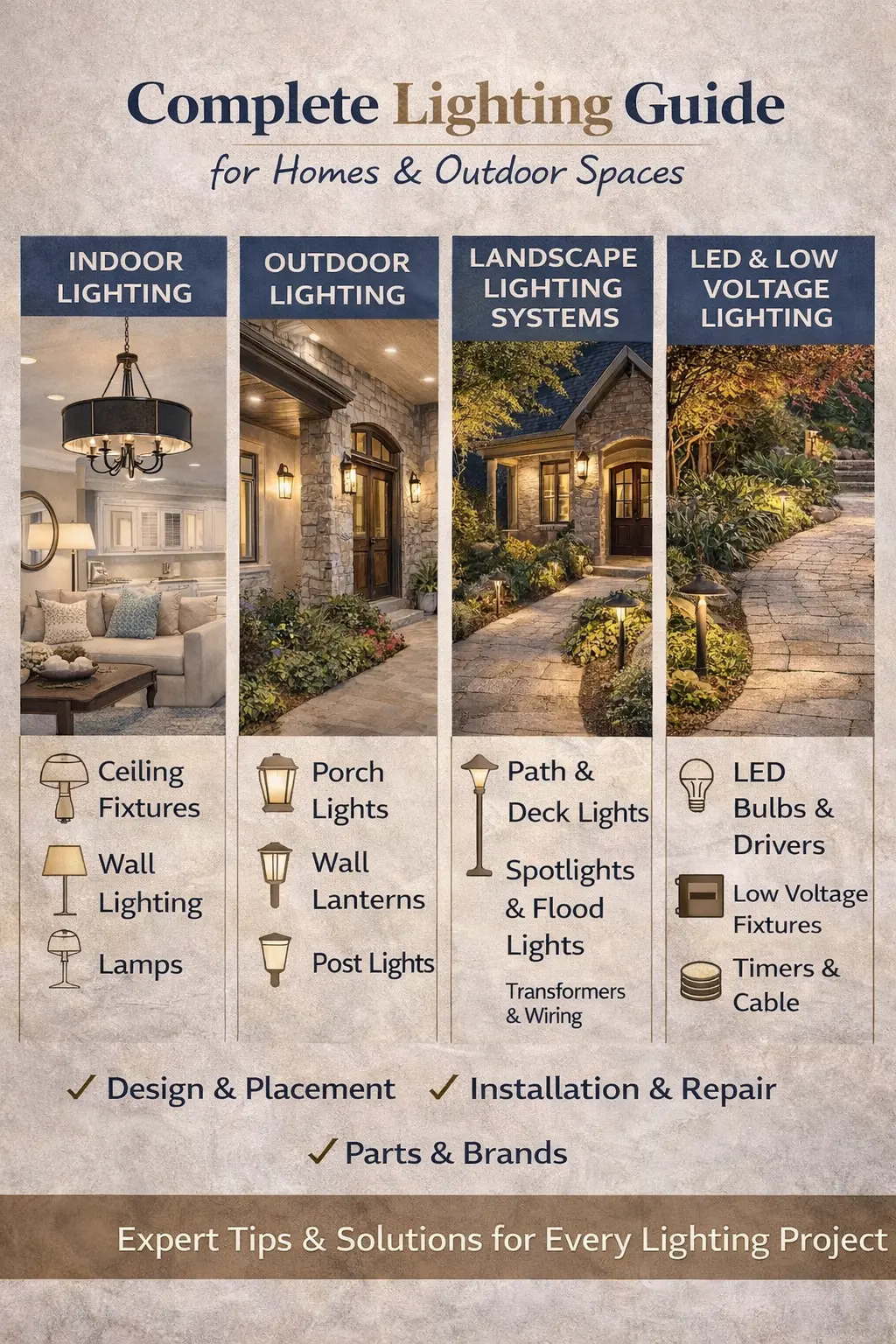
🏠 Indoor Lighting — Every Room Type and Fixture Category
Indoor lighting works best when fixture type and room function are matched deliberately rather than selected by appearance alone. A kitchen has different lighting requirements than a bedroom or a bathroom. A chandelier in a dining room serves a fundamentally different purpose than a recessed light grid in a kitchen. The guides below are organized by fixture type and room application so you can go directly to what your specific project requires.
If you are starting from scratch without a clear plan, the room-by-room lighting plan guide builds the plan before you choose fixtures. The room lighting calculator guide provides fixture count estimates by room type. The kitchen lighting layout guide covers the specific combination of recessed lights, pendants, and under-cabinet task lighting that makes a kitchen work. For indoor safety zones, staircases need their own dedicated plan — the staircase lighting guide covers step visibility, fixture placement, and low-glare stairwell design.
Whole-home lighting planning often overlaps with ceiling fan selection because many fans include integrated or add-on light kits. A fan that looks right but has the wrong blade span, ceiling clearance, light output, or control setup can create comfort and lighting problems after installation. For homeowners working with older Portfolio products, our Portfolio ceiling fans guide explains how to evaluate fan size, room use, airflow, light-kit needs, controls, and replacement options together instead of treating the fan as a basic light fixture.
Portfolio Indoor Lighting Hub
The main indoor pillar — room-lighting strategies and fixture categories compared side by side.
Indoor lighting hub →Chandeliers
How chandeliers fit dining rooms, entryways, bedrooms, and spaces needing a focal-point fixture.
Chandelier guide →Pendant Lighting
Pendants for islands, tables, bars, and rooms where hanging task light and visual style combine.
Pendant guide →Wall Lighting
Wall-mounted lighting for hallways, bedrooms, bathrooms, stairways, and layered living-room plans.
Wall lighting guide →Bathroom Lighting
Vanity lighting, mirror placement, fixture ratings, and room-specific bathroom lighting decisions.
Bathroom lighting guide →Recessed Lighting
When recessed lighting is the right answer for clean ceilings, distributed light, and subtle styling.
Recessed lighting guide →Track Lighting
Directional light, adjustable heads, and more flexibility from one ceiling mounting location.
Track lighting guide →Floor Lamps
How portable lamps improve room comfort, reading areas, dark corners, and layered indoor plans.
Floor lamp guide →Under-Cabinet Lighting
Kitchen task lighting, work surfaces, and focused light where detail matters.
Under-cabinet guide →For specialized comfort applications — nurseries, bedrooms with light-sensitive occupants, and evening spaces — see the nursery lighting safety guide and the voltage stability and melatonin guide. For seniors, the senior safety lighting guide covers low-glare path lighting, contrast, and fall-risk reduction. For understanding how lighting troubleshooting builds systematic problem-solving skills, see the lighting troubleshooting and engineering skills guide.
🌿 Outdoor Lighting — Fixture Types, Placement, and System Design
Outdoor lighting has to handle weather, darkness, safety, curb appeal, and open spaces simultaneously. The most common outdoor lighting mistake is prioritizing brightness over placement — one overly bright fixture creates a hotspot that makes surrounding areas appear darker by contrast, making the walkway or yard harder to navigate, not easier. The goal is guided movement and highlighted features, not maximum illumination.
For a complete exterior lighting strategy, the outdoor lighting plan guide walks through pathways, entry areas, front yards, backyards, and focal points as a coordinated system rather than isolated fixture decisions. For realistic budgeting, the landscape lighting cost guide covers what homeowners typically spend by system size and fixture type. For visual inspiration before committing to a plan, the outdoor lighting ideas and examples page covers front yard, backyard, pathway, and landscape approaches. For seasonal installations, the permanent vs temporary holiday lights guide covers system type decisions. For electrical code compliance, the landscape lighting electrical code and safety guide covers NEC requirements, burial depth, GFCI protection, and permit considerations.
Not every outdoor lighting project requires visible fixtures or dramatic spotlighting. Downlighting has become increasingly popular because it allows light to originate from above, producing softer shadows and a more natural nighttime appearance. Homeowners evaluating different lighting techniques should review our Portfolio downlighting guide to understand where downlighting works best, how fixture placement affects results, and why many designers prefer it for pathways, patios, seating areas, and landscape features.
Lighting design is not only about fixture selection and brightness levels. Visible cords, extension cables, and exposed wiring can significantly reduce the visual impact of an otherwise attractive installation. Our hidden holiday lighting wire management guide provides practical strategies for concealing wiring around rooflines, landscaping, pathways, entryways, and outdoor living spaces while maintaining a clean, professional appearance.
Portfolio Outdoor Lighting Hub
The broader outdoor hub — fixture categories, placement ideas, and system choices in one place.
Outdoor lighting hub →Path Lights
Walkways, front entries, and low-level fixture spacing in outdoor areas.
Path light guide →Deck Lighting
Deck surfaces, steps, railings, and outdoor gathering spaces — safer and more attractive.
Deck lighting guide →Bollard Lighting
Paths, driveways, edges, and structured landscape lighting layouts.
Bollard guide →Post Lighting
Driveways, mailbox areas, entries, fences, and elevated fixture coverage.
Post lighting guide →Flood Lighting
Broader yard illumination, security lighting, and stronger beam coverage.
Flood lighting guide →Outdoor Stair Lighting
Step visibility, fixture placement, and spacing for safe exterior stair illumination.
Stair lighting guide →⚡ Low-Voltage Landscape Lighting Systems
Low-voltage landscape lighting is not just a collection of fixtures — it is a system with interdependent components. The transformer converts 120V to 12V and controls the entire system. The wire runs carry that 12V to each fixture, losing a small amount of voltage per foot based on wire gauge and load. The connectors pierce the wire and feed each fixture. The fixture housing, stake, globe, and bulb are the visible end of a chain that starts at the wall outlet.
This systems perspective is why most landscape lighting problems are misdiagnosed. A fixture that goes dark is almost always a connector or bulb problem — not a fixture problem. A system where all lights go dark is almost always a transformer reset or GFCI trip — not a wiring failure. A system where far-end lights are dim is almost always a voltage drop problem — not a fixture problem. Getting the diagnosis right before buying anything is the most important step in any landscape lighting repair.
The Critical Variables in Every Low-Voltage System
Transformer capacity. Total fixture wattage must not exceed 80% of the transformer's rated watts. A 150W transformer safely runs 120W of fixtures. Exceeding 80% causes thermal protection cycling — the lights activate and then shut off after 30 to 90 minutes. This is the most frequently misdiagnosed landscape lighting problem because it looks like an intermittent fault but is actually an engineering constraint. See the landscape lighting transformer guide for sizing calculations.
Voltage drop. Every foot of wire loses a small fraction of voltage based on wire gauge and current draw. Long runs of thin wire deliver less than 12V to the far-end fixtures, making them dim or flickering while near-transformer fixtures appear normal. This is not a fixture fault — it is a wiring design problem. The voltage drop guide covers the calculation. The cable guide specifies correct wire gauge by run length and load.
Connector condition. 3-prong quick-connect landscape connectors have a service life of approximately 5 to 8 years in buried soil conditions before corrosion degrades their contact quality. A system that worked for years and then developed intermittent single-fixture failures almost always has corroded connectors as the root cause. See how to wire landscape lighting for the correct connector installation and inspection procedure.
For control system efficiency — timers, photocells, and smart automation — see the smart outdoor lighting controls guide. For the full system layout approach, the landscape lighting layout design guide covers fixture placement as a coordinated plan. For visual system reference, the system diagram page shows how every component connects. For circadian and wellness lighting in outdoor spaces, see the circadian landscape lighting guide.
Portfolio Low-Voltage Hub
The main low-voltage landscape pillar — system design, component selection, and Portfolio compatibility.
Low-voltage hub →Portfolio Landscape Lighting
Path lights, spotlights, transformers, design ideas, and landscape system choices for Portfolio fixtures.
Landscape lighting →Transformer Sizing Guide
How transformers work, how to size them correctly, and how they control the whole system.
Transformer guide →How to Wire Landscape Lighting
Cable runs, connector installation, fixture connections, and layout wiring for homeowners.
Wiring guide →Voltage Drop Guide
Why far-end fixtures go dim, how load affects performance, and how to correct the problem.
Voltage drop →Cable and Wire Guide
Wire sizing, run length limits, and wiring decisions that determine long-term system reliability.
Cable guide →📌 Lighting Design, Placement, and Layout Planning
Placement determines whether a lighting installation feels planned and professional or random and underwhelming. This is equally true indoors — where layering, spacing, and fixture height determine room balance — and outdoors, where path-light spacing, tree uplighting angle, and beam spread determine whether the yard feels intentional after dark.
The most important rule in lighting design is that fixtures affect each other. A path light placed at 6 feet creates a pool of light that interacts with the pools on either side of it. Space them at 15 feet and you get alternating light and dark zones that make the path harder, not easier, to navigate. Space them correctly and the pools overlap at 50% of their radius, creating even coverage without hotspots. The landscape lighting spacing guide and path light placement guide cover the exact spacing math for common fixture types.
For tree uplighting — the technique most homeowners get wrong — the tree uplighting guide covers beam angle, fixture distance from trunk, and how to create depth without glare. For driveways, the driveway landscape lighting guide covers edge lighting, fixture height, and spacing for safe vehicle navigation. For overall layout, the landscape lighting layout guide covers the zone-by-zone planning approach. For indoor placement, the Portfolio lighting placement guide covers ceiling height adjustments, room-size scaling, and fixture-to-fixture interaction. Before buying specific fixtures, the 2026 landscape lighting fixture benchmark rankings compare temperature, repairability, voltage-drop behavior, and transformer compatibility. For fixture mounting and hardware, the mounting hardware and bracket replacement guide covers bracket types, crossbars, and missing hardware sourcing. For material durability, the durable landscape lighting materials guide compares brass, copper, aluminum, and plastic for corrosion resistance and service life.
🔧 Installation, Wiring, and System Setup
Installation problems are often not obvious until the lights are actually tested at night in the conditions they will operate in. A connector that passes a daylight test may fail after rain because moisture infiltration only becomes a ground fault path when the connector is wet. A transformer that appears to work may cycle off after 45 minutes because the total fixture load was calculated incorrectly. Getting installation right the first time requires working through the decisions in the right order — not installing first and troubleshooting second.
The primary installation references for Portfolio systems are: Portfolio lighting installation and instructions for the general installation framework, how to wire landscape lighting for the cable run and connector procedure, and the Portfolio lighting transformer wiring diagram for the specific terminal layout and wiring connection sequence for Portfolio transformer models. For code compliance on outdoor installations — burial depth, GFCI protection, conduit requirements, and permit thresholds — see the landscape lighting electrical code and safety guide.
For homeowners considering smart lighting integration, the AI outdoor lighting systems guide covers smart control integration. The edge vs cloud lighting guide explains why some smart lighting systems keep working during internet outages while others rely entirely on cloud processing. For the sustainability dimension of controls, the smart outdoor lighting controls guide covers how timers, sensors, and automation reduce energy consumption and extend transformer life.
🔬 Troubleshooting and Repair — Diagnose Before You Buy
Portfolio lighting troubleshooting follows a consistent logic: start at the power source and work outward. A system where all lights went dark at once is almost always a transformer reset, GFCI trip, or timer programming failure — not a wiring or fixture problem. A single dark fixture on an otherwise working system is almost always a bulb or connector — not a fixture that needs replacing. Dim far-end lights on a long wire run are almost always voltage drop — not failing fixtures.
The central resource is the Portfolio lighting troubleshooting hub which covers the full diagnostic sequence. For specific failure modes, the most-accessed guides are: Portfolio LED lights flickering, Portfolio lighting too dim, Portfolio lights blinking, Portfolio landscape lights not working, and Portfolio transformer not powering lights. For the GFCI-specific failure mode — which requires a completely different diagnostic approach than breaker trips — see the landscape lighting keeps tripping GFCI guide, which covers the zone isolation method used to find ground faults in under 30 minutes.
Before troubleshooting any failure, identifying the exact fixture or model number is essential because different Portfolio models have different known failure modes. The Portfolio lighting identification guide covers how to find model numbers even when labels are weathered, and how to identify fixtures by physical characteristics when no label is readable. For seasonal lighting troubleshooting, the Christmas lights half-out troubleshooting guide covers the circuit topology that causes partial-strand failures.
For homeowners who want the comprehensive model-specific reference before ordering any repair parts, the Portfolio Lighting Master Model & Replacement Handbook is a 104-page digital download covering every Portfolio product family with failure patterns, parts cross-reference, and repair decision frameworks.
Understanding how Portfolio lighting systems fail over time is just as important as knowing how they are installed. Our comprehensive Portfolio Lighting Failure Database brings together real-world failure patterns, repair success rates, expected component lifespans, maintenance schedules, repair costs, and preventive strategies into one centralized engineering reference that supports every troubleshooting guide on PortfolioLighting.net.
Full Troubleshooting Hub
The central diagnostic resource — covers every Portfolio system failure mode in order of diagnosis priority.
Troubleshooting hub →GFCI Keeps Tripping
GFCI trips require a completely different diagnostic approach than breaker trips. Zone isolation method finds the fault fast.
GFCI tripping guide →LED Lights Flickering
Voltage drop, loose connections, failing LED modules, overloaded transformers — each has a different fix.
Flickering guide →Landscape Lights Not Working
The diagnostic sequence for all-dark and partial-dark landscape system failures.
Not working guide →Transformer Not Powering Lights
Full transformer diagnostic — reset procedure, load calculation, and replacement decision.
Transformer guide →Lighting Too Dim
Voltage drop, wrong transformer tap, or low-output bulb — the three causes and how to confirm each.
Dim lights guide →🔌 Replacement Parts by Category
Most Portfolio lighting searches that look like fixture-shopping searches are actually parts searches. A broken shade, a missing lens, a failed photocell, a corroded connector — these are individual replaceable components that can restore a working fixture without replacing the entire unit. The most expensive buying mistake in Portfolio lighting is replacing the whole fixture when only a $6 connector or $8 bulb actually failed.
The central parts resource is the Portfolio lighting parts and accessories guide, which covers all replacement categories in one place. For specific component types: replacement glass for broken globes and covers, replacement shades for indoor fixtures, replacement lenses for outdoor fixtures, replacement LED modules and drivers for integrated LED fixtures, and replacement photocells for automatic dusk-to-dawn sensors. For discontinued Portfolio models specifically, the discontinued Portfolio lighting hub contains a 25-model quick-match table, a diagnosis wizard, a part identification grid, and cost estimator tools. For ENERGY STAR certified current-production options, the ENERGY STAR certified fixture guide covers certification criteria, wattage-to-brightness comparison, and long-term operating cost. For fixture repairability ratings before buying new, the LED fixture repairability guide ranks fixtures by modularity, replacement-part availability, and real-world repair access. For Malibu system parts — the most common Portfolio-compatible alternative brand — the Malibu Lighting Top 40 Model Library covers ML-series transformers and LX path light parts still actively searched by homeowners.
🏭 Brands and Compatible Replacement Options
Portfolio was Lowe's house brand — not a standalone manufacturer. When it was discontinued, there was no OEM parts supply chain. This makes brand knowledge and compatibility understanding essential for Portfolio lighting owners. Any 12V AC landscape lighting transformer from any brand is compatible with Portfolio low-voltage fixtures. Portfolio 3-prong connectors use the standard quick-connect format shared by Malibu, Hampton Bay, and most consumer landscape brands. LED bulbs are standardized by base type — any LED matching the base and wattage is a compatible replacement regardless of brand.
The Portfolio lighting alternatives guide covers compatible replacement brands for every Portfolio fixture category. For buying current-production Portfolio fixtures and parts, the buy Portfolio lighting guide covers what is still available, what requires secondary market searching, and the full fix-vs-replace framework. For customer service and warranty questions, the Portfolio lighting customer service guide covers Lowe's support, what manufacturer support is and is not available, and where to go when standard support channels cannot help. For the history of discontinuation, see the why Portfolio lighting was discontinued context in the discontinued Portfolio lighting hub.
Portfolio Lighting Alternatives
Compatible replacement brands — Volt, Kichler, Malibu, Hampton Bay — for every discontinued Portfolio category.
Alternatives guide →Model Number Lookup
Central reference for transformer models, wall lantern models, path light models, and landscape fixture identification.
Model lookup →Malibu Lighting Replacement Parts
Parts lookup for Malibu lighting — the most common Portfolio-compatible brand with shared connector standards.
Malibu parts →Hampton Bay Replacement Parts
Hampton Bay lighting parts — Home Depot's house brand with significant landscape lighting parts availability.
Hampton Bay parts →Kichler Replacement Parts
Kichler lighting parts — a premium alternative brand with strong parts availability and full fixture warranty support.
Kichler parts →Utilitech Replacement Parts
Utilitech lighting parts for Lowe's-sourced fixtures that shared display space with Portfolio before discontinuation.
Utilitech parts →Portfolio Lighting Resource Center FAQ
How far apart should Portfolio landscape path lights be placed?
Most Portfolio path lights perform best when spaced approximately 6 to 8 feet apart. High-output LED fixtures can often be spaced up to 10 feet apart while maintaining even illumination. The goal is to create overlapping pools of light without producing bright "runway" spots or dark gaps between fixtures. Proper spacing depends on fixture height, beam spread, bulb output, and walkway width. See the landscape lighting spacing guide and path light placement guide for complete spacing calculations.
Where can I find discontinued Portfolio Lighting replacement parts?
Begin with the Portfolio Lighting model number lookup to identify your exact fixture. Many original Portfolio products have been discontinued, but compatible replacement globes, stakes, bulbs, transformers, connectors, and mounting hardware are still widely available. Even when an original part no longer exists, most low-voltage components can be replaced with compatible generic alternatives that match the original specifications.
Where should I start if I do not know my Portfolio Lighting model number?
If the model number has faded or the label is missing, do not worry. Many homeowners identify their system using the fixture style, transformer model, bulb base, connector design, installation age, or visible part numbers instead. Start with the Portfolio Lighting model lookup if any identifying numbers remain. Otherwise, use the Portfolio Lighting troubleshooting guide to determine whether the failure involves the transformer, wiring, connector, bulb, or fixture before purchasing replacement parts.
Is Portfolio Lighting still in business?
Most Portfolio Lighting products formerly sold through Lowe's have been discontinued, making original replacement parts increasingly difficult to locate. Fortunately, nearly every low-voltage landscape lighting system can continue operating using compatible replacement transformers, bulbs, connectors, wire, stakes, and fixtures from other manufacturers. This Resource Center helps homeowners identify discontinued Portfolio products and select compatible replacement solutions.
What transformer size do I need for Portfolio landscape lighting?
Add together the wattage of every fixture on the system, then divide by 0.80 to determine the minimum transformer size. Keeping the connected load below approximately 80% of transformer capacity helps prevent overheating and nuisance shutdowns. A system drawing 48 watts should typically use at least a 75-watt transformer. If every light turns on normally and later shuts off after 30 to 90 minutes, transformer overload is one of the first things to investigate. See the transformer sizing guide for detailed calculations.
Why do Portfolio landscape lights flicker, dim, or randomly turn off?
The most common causes are voltage drop on long wire runs, overloaded transformers, loose or corroded wire connectors, damaged underground cable, failing bulbs, or aging LED modules. Dim fixtures at the far end of the system usually indicate voltage drop rather than fixture failure. Begin by checking the transformer output, connector condition, and cable length before replacing fixtures. See the voltage drop guide, LED flickering guide, and complete troubleshooting center.
Can I use a different brand transformer with Portfolio landscape fixtures?
Yes. Portfolio low-voltage fixtures operate on standard 12-volt AC landscape lighting systems, so compatible transformers from other manufacturers work perfectly well. The replacement transformer simply needs to provide 12V AC output and sufficient wattage for the connected fixtures. Existing wire runs and fixtures normally do not need modification. See the Portfolio transformer master guide for replacement recommendations.
Can I replace just one Portfolio fixture instead of replacing the entire system?
Usually, yes. Most failed path lights, spotlights, deck lights, and accent fixtures can be replaced individually without rebuilding the entire landscape lighting system. As long as the replacement fixture matches the system voltage and total transformer capacity remains adequate, individual fixtures from many manufacturers can operate alongside existing Portfolio fixtures.
What type of lighting works best inside each room of a home?
The most effective lighting plans combine ambient lighting for overall brightness, task lighting for work areas, and accent lighting to highlight architectural features or décor. Kitchens require strong task lighting over work surfaces, bedrooms benefit from softer layered lighting, and bathrooms require balanced mirror illumination. See the room-by-room lighting guide for complete recommendations.

Every guide on this page is built from field experience diagnosing actual Portfolio lighting systems — not from manufacturer documentation or marketing materials. The most important lesson from 25 years of landscape lighting work: most problems are connector problems, most connector problems look like fixture problems, and most fixture problems look like system problems. Starting at the right point in the diagnostic sequence saves time and prevents replacing components that were not actually failing. The system map at the top of this page reflects exactly how I think through any Portfolio lighting failure before recommending a repair or replacement.
Expert-Verified Technical Content
Every technical guide on PortfolioLighting.net is reviewed for accuracy and maintained by Philip Meyer to meet current safety and electrical standards. Field-tested procedures, not manufacturer talking points.