
Quick Answer
Modern landscape lighting is more vulnerable to surges than many homeowners realize. Old halogen systems could sometimes survive a mild voltage spike with nothing more than a burned-out bulb. That is not how many 2026 systems fail. Today, integrated LED fixtures, smart transformers, app-based timers, and wireless controls all contain sensitive electronics that can be damaged by dirty power or nearby lightning activity.
If a surge destroys an integrated LED driver, you usually cannot replace just one small component. In many cases, the entire fixture has to be replaced. That is why surge protection is no longer optional for systems built around smart controls or non-replaceable LED modules.
Since surge protection depends on how the system is wired, review Portfolio low voltage lighting to understand how transformers and cable runs interact.
- All lights out → check transformer or outlet surge damage
- One zone dead → likely low-voltage surge damage
- Lights dim → possible driver damage
- Timer reset → surge hit control electronics
Surge damage follows a simple pattern: incoming power hits the transformer, while induced energy hits the cable—so both sides must be protected to prevent failure.
Why Your 2026 Lighting System Is at Risk
If you are new to outdoor systems, start with our landscape lighting guide for a complete overview of layout, wiring, and fixture types before adding surge protection.
Integrated LEDs Are Not Like Old Bulbs
Many newer landscape fixtures use built-in LED modules and electronic drivers. That gives you better efficiency and longer normal operating life, but it also means the fixture is more sensitive to abnormal voltage events.
Smart Transformers Have More Electronics to Damage
Wi-Fi timers, memory settings, app-based schedules, Matter support, Thread radios, and internal control boards add convenience, but they also create more points of failure during a surge.
Nearby Lightning Can Damage a System Without a Direct Hit
One of the biggest myths in outdoor lighting is that lightning only matters if it strikes the transformer directly. In reality, nearby strikes can induce high voltage into buried low-voltage cable, especially on longer runs. That can damage the transformer, inline electronics, or fixture drivers even when nothing appears physically burned.
For complete system safety beyond surge protection, see landscape lighting electrical code and safety guide for grounding, wiring, and placement best practices.
The Two-Layer Protection Strategy
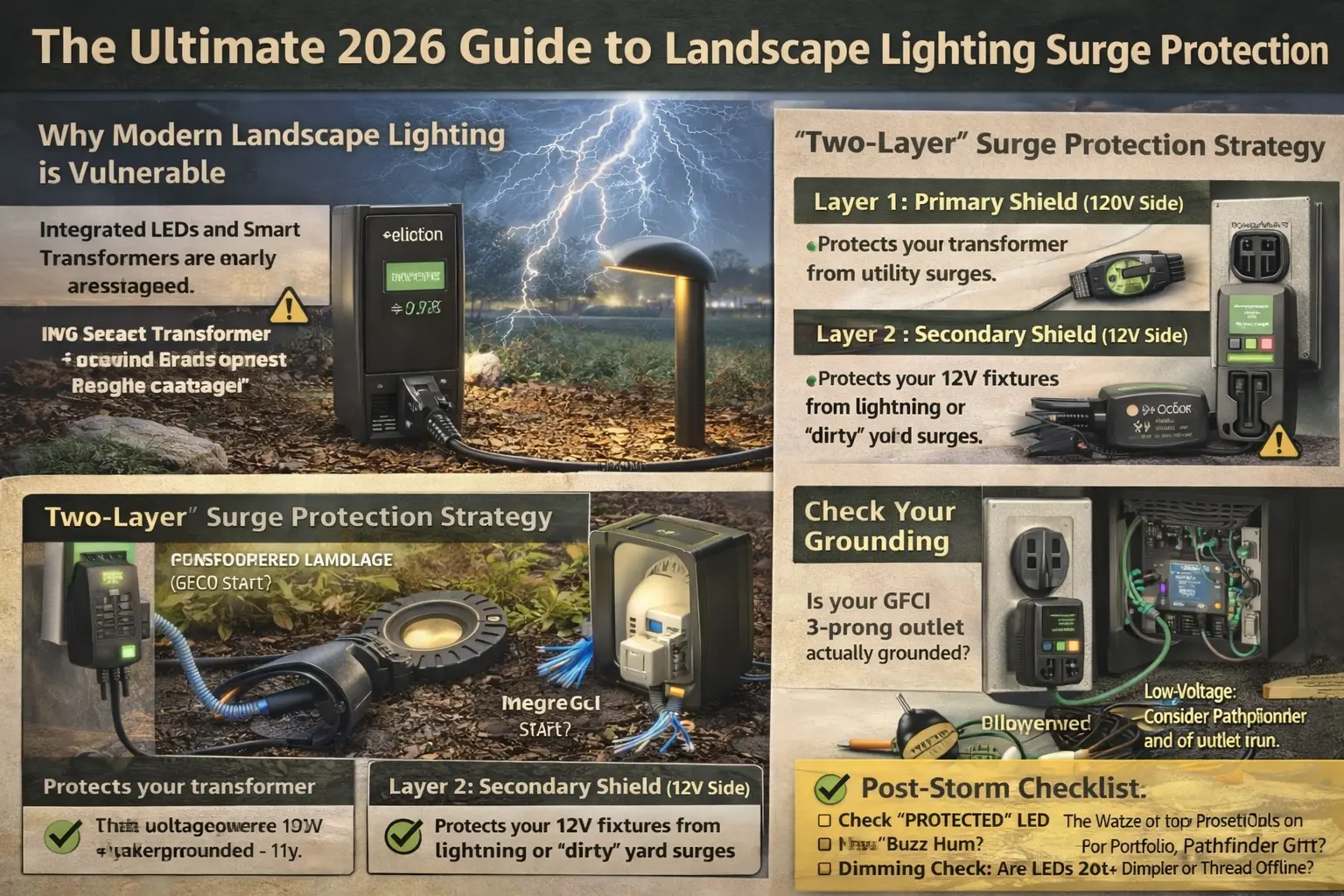
This is the simplest and strongest way to explain surge protection for a modern landscape lighting system. Each layer protects a different part of the system.
| Protection Layer | What It Protects | Where It Goes | Why It Matters |
|---|---|---|---|
| Layer 1: 120V side protection | Transformer electronics and outlet-fed power input | At the outdoor receptacle or transformer plug-in point | Stops many utility-side surges before they reach the transformer |
| Layer 2: 12V side protection | Low-voltage cable run, fixtures, and downstream LED drivers | Inline between the transformer and the first outgoing run | Helps absorb induced surges from nearby lightning or cable exposure in the yard |
Layer 1: The Primary Shield on the 120V Side
The first layer protects the transformer from surges coming in from the home electrical system or utility side. This is where many homeowners stop, but it is still an important first step.
Important for Portfolio systems: This 120V protection is especially critical for units like the Portfolio 121408 or the SL-200-12, which use digital timers and internal control boards that are highly sensitive to even small surge events.
What to Install
Use a point-of-use surge protector rated for outdoor or damp-location use at the receptacle where the transformer plugs in. For many residential systems, that means a quality unit with weather resistance and enough energy absorption capacity to protect a transformer and timer electronics.
What to Look For
- Outdoor or weather-appropriate rating
- Grounded 3-prong configuration
- Visible protected-status indicator
- Strong joule rating rather than the cheapest basic strip
If you are installing surge protection components, follow Portfolio lighting installation and instructions for safe setup and wiring practices.
Layer 2: The Secondary Shield on the 12V Side
The second layer protects the part most people miss: the low-voltage run leaving the transformer. This matters because the cable in the yard can act like an antenna during nearby lightning activity. Even if the transformer survives, downstream fixtures may still be damaged.
What to Install
Install a low-voltage surge module inline between the transformer and the first light or first outgoing cable run. This type of device is designed to take the hit before the fixture drivers and control electronics do.
Why This Layer Is So Important
Integrated LED fixtures often fail at the driver, not the visible LED itself. If the driver is built into the fixture and surge-damaged, you may be replacing the entire fixture instead of one serviceable component.
Important for Portfolio systems: This 120V protection is especially critical for units like the Portfolio 121408 or the SL-200-12, which use digital timers and internal control boards that are highly sensitive to even small surge events.
If you need replacement surge devices or wiring components, see Portfolio lighting parts and accessories.
How to Ground Your Transformer Properly
A surge protector cannot do its job well if the surge energy has nowhere to go. Good grounding is not just a code detail. It is part of whether the protection method actually works.
Check the Green Ground Wire
If your transformer has a ground conductor, confirm it is properly connected and that the transformer is bonded as intended by the installation method. Loose or missing grounding reduces the value of the protection devices connected to it.
Verify the Outlet Is Truly Grounded
Use a 3-prong outlet tester at the outdoor GFCI or exterior receptacle. If the tester shows an open ground condition, do not assume your plug-in surge protector will still protect the system effectively.
Think About Long Cable Runs
Longer low-voltage runs have more exposure to induced energy. On larger properties or systems with runs beyond roughly 100 feet, the cable layout, grounding quality, and surge path all matter more.
Does Dirty Power Damage Landscape Lighting?
Yes. Not all damaging events are dramatic lightning strikes. Some systems slowly degrade because of repeated minor voltage irregularities, unstable utility power, or switching events that stress internal electronics over time.
What Dirty Power Looks Like in Real Life
- Smart timer memory loss
- Random transformer resets
- LED brightness changes without a wiring change
- Premature failure of integrated fixtures
- Wireless control instability after storms or grid events
Small surge events can weaken internal components before they fail completely. That is why some systems seem fine for months and then start buzzing, dimming, or dropping connectivity later.
If a landscape lighting system trips a GFCI during normal power, generator power will not magically make the problem safe. Wet connectors, damaged cable, water inside fixtures, and poor cord routing can still trip protection during an outage. Before relying on a generator to power outdoor lighting, review our landscape lighting power outage guide for safe generator placement, extension cord routing, and transformer checks.
What Each Device Does: GFCI vs Surge Protector vs Transformer
This is one of the most confusing parts of outdoor lighting for homeowners. These devices do not do the same job.
| Device | Main Job | What It Does Not Do | Why You Still Need It |
|---|---|---|---|
| GFCI outlet | Protects against shock from ground faults | Does not stop surge voltage | Important for safety at outdoor outlets |
| Surge protector | Diverts damaging overvoltage away from equipment | Does not replace grounding or overload planning | Protects transformers and electronics from surge events |
| Transformer | Steps 120V down to low-voltage output | Does not inherently stop surge damage | Required for most low-voltage landscape systems |
Post-Storm Survival Checklist
If a storm just passed and your system is acting strangely, this checklist helps separate obvious surge damage from minor reset issues.
If your system already shows damage, use the Portfolio lighting troubleshooting guide to isolate transformer, wiring, or fixture failures.
- Check the protected light: If the indicator on the surge device is off or shows failure, the unit may have sacrificed itself and now needs replacement.
- Listen for a new hum or buzz: A transformer that suddenly hums louder after a storm may have internal damage.
- Check for partial dimming: LEDs that look noticeably dimmer than normal may have a damaged driver rather than a wiring problem.
- Check timer and smart control memory: Lost schedules, reset clocks, or dropped wireless connections can point to a surge event.
- Inspect only one zone vs all zones: If one run is dead, the damage may be local to the low-voltage side. If everything is dead, start at the outlet and transformer.
Signs a Transformer Has Been Partially Damaged
Not every surge destroys a transformer instantly. Sometimes the transformer still works, but not correctly.
Common Symptoms
- New or louder buzzing sound
- Heat increase compared to normal operation
- Lights that now dim under load
- Timer or control board acting erratically
- Only some taps or zones behaving correctly
These symptoms are often overlooked because the system still turns on. Partial damage can shorten transformer life and create unstable output that slowly harms the rest of the system.
Why Integrated LED Fixtures Need More Protection
Integrated LED landscape lights are efficient and compact, but they are not as forgiving as older replaceable-bulb systems. The driver circuitry inside the fixture is sensitive to abnormal voltage. Once it fails, there may be no simple field repair.
Old Halogen vs Modern Integrated Fixtures
With halogen systems, a bad event might leave you replacing a lamp and moving on. With integrated LED systems, the same event may take out the electronic driver and force a fixture replacement.
Can Smart Timers and Wireless Controls Be Damaged Too?
Yes. Smart timers, app-based controllers, and wireless radios are often among the first things to behave strangely after a surge event. Even when the lights still work, the control logic may reset, lose schedules, or fail to reconnect normally.
If your system includes modern connectivity features, protecting the transformer alone is not enough. You also need a plan for preserving the low-voltage side and keeping the grounding path healthy.
For connected systems, it also helps to review the broader compatibility and connectivity guidance in the approved smart lighting pages.
If your transformer or fixtures need replacement after a surge, compare options on the buy Portfolio lighting page.
Surge Protection Works Best When the Whole System Is Healthy
Surge protection helps defend the transformer, but it cannot fix corroded fixture contacts, wet sockets or poor replacement choices. Before assuming every failure is surge-related, inspect problem fixtures with this Portfolio corroded socket cleaning guide, then use the Portfolio transformer surge protector installation guide for transformer-side protection. If you are replacing damaged fixtures after a surge event, the dark-sky compliance versus IDA certification guide helps choose better outdoor lighting rather than simply repeating the same glare or quality problems.
Landscape Lighting Surge Protection FAQ
How do I protect my landscape lighting from lightning?
Use a two-layer approach: a 120V surge protector at the outlet and a low-voltage surge module inline on the 12V cable leaving the transformer. That protects both the transformer and the downstream fixtures more effectively than one device alone.
Do LED landscape lights need surge protection?
Yes. Integrated LED fixtures contain sensitive electronic drivers. A voltage spike can damage the driver and force full fixture replacement rather than a simple bulb change.
Can lightning hit landscape lights?
Direct hits are rare, but nearby strikes can induce damaging voltage into the buried low-voltage cable and connected fixtures. That is one reason longer runs and exposed yard wiring deserve extra attention.
Will a GFCI protect against surges?
No. A GFCI helps prevent shock from ground faults, but it does not stop high-voltage surge events. You need a dedicated surge protective device for that job.