
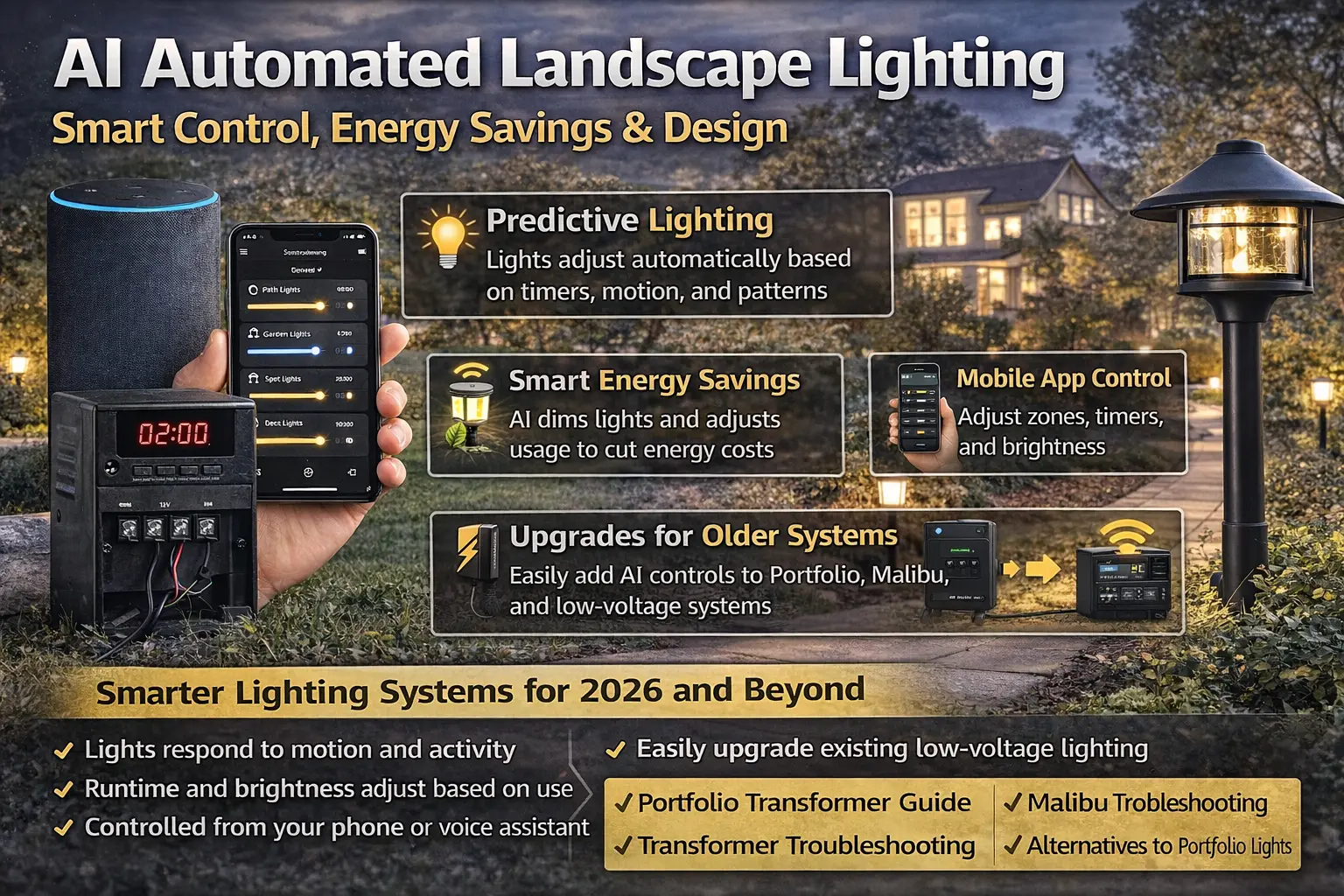
AI outdoor lighting systems automatically adjust brightness, timing, and zones based on motion, activity, and real-world conditions instead of using a fixed timer.
Quick Answer: AI Outdoor Lighting Architecture & Integration
Next-generation AI outdoor lighting systems replace rigid mechanical timers with predictive edge-computing controllers, environmental sensor arrays, and dynamic network logic. Instead of running a continuous power drain, these systems actively recalculate system-wide voltage distribution and adaptive lumen levels based on live telemetry.
To safely upgrade a property or integrate automated features into an existing landscape network, your layout must align with seven core technical framework standards:
- Dynamic Motion-Triggered Profiling: Replaces simple binary PIR sensors with computer-vision zoning that distinguishes between wind-blown foliage and genuine perimeter security breaches.
- Adaptive Lumen Scaling Matrix: Automatically modulates individual fixture outputs from a low 50-lumen ambient power-save mode up to a high 600-lumen safety wash based on real-time activity tracking.
- Localized Atmospheric Telemetry: Uses real-time weather feeds and local ambient light sensors to dynamically boost path light penetration during dense fog, heavy rain, or unexpected cloud cover.
- Multi-Zone Power Load Balancing: Divides layouts into isolated, software-controlled zones (e.g., walkways, patios, driveways) to distribute circuit draw only where illumination is actively required.
- Legacy Step-Down Compatibility: Integrates smart automation modules directly onto older 12V magnetic transformer lines, upgrading analog loops in cost-effective structural stages.
- Predictive Component Degradation Tracking: Continuous line-resistance monitoring automatically flags sudden voltage drops or failing LED drivers before a fixture completely burns out.
- Astronomical Clock Self-Correction: Replaces manual seasonal pin adjustments with automated, GPS-synced location mapping to track moving twilight lines flawlessly throughout the year.
⚠️ CRITICAL UPGRADE RISK: Layering automated smart nodes over an unverified legacy line that suffers from pre-existing voltage drops below 10.8V will corrupt the local controller's logic loop, causing permanent circuit humming and erratic data signal cycling.
The Core Integration Rule: Modern automated lighting controllers don't just supply constant current. They make predictive, split-second processing decisions regarding voltage allocation, structural zoning safety, and long-term diode conservation.
Before splicing automated smart modules into an existing low-voltage run, verify your network's foundational electrical capacity. Use our step-by-step diagnostic blueprints and component compatibility indexes below to map out a stable, glitch-free automation layout.
Is AI Outdoor Lighting Worth It?
Yes for most systems. If your lighting runs every night, uses a timer, or wastes power, upgrading to a smarter control system will improve performance and reduce unnecessary runtime.
If you are working with a standard landscape lighting system, start with how to connect your transformer to smart control before moving into more advanced automation setups.
- Best for: older low-voltage systems
- Best upgrade: smarter transformer or controller
- Biggest benefit: better control + less wasted energy
This page covers how to design, upgrade, and control outdoor lighting systems so they work better and are easier to manage. Whether you are improving an older setup or planning a new system, this guide gives you a clear path forward.
Traditional low-voltage lighting mainly runs on simple timers. Modern systems go further by improving how lighting looks, how it performs for safety, how much energy it uses, and how easy it is to control without constant adjustments at the transformer.
In practical terms, that means brighter walkways when needed, softer lighting later in the evening, less wasted runtime, and better use of light across the yard. For older systems, it can extend the life of what you already have. For new systems, it helps you build it the right way from the start.
Modern lighting systems do not always require new hardware. See how to retrofit a legacy transformer to bring older lighting systems into a more advanced setup without replacing the entire system.
Not all smart lighting systems are built the same. See our edge vs cloud lighting guide to understand why some systems respond instantly and keep working during outages while others depend entirely on internet-based control.
Many homeowners start with automation, but upgrading the existing system is often the first step. See our Portfolio hybrid upgrade guide to learn how to prepare older systems for advanced control.
If you are comparing different automation options, start with the basics first. The Smart Outdoor Lighting Controls Guide explains timers, astronomical controls, and smart upgrades in simple terms.
This guide explains how these systems work, how to design them, and how to upgrade existing landscape lighting setups without starting over. If you are currently working with an older low-voltage system, keep this page alongside Portfolio lighting transformer troubleshooting, Portfolio lighting alternatives, best replacement for Portfolio landscape lighting, and Malibu lighting replacement parts so you can move from old hardware toward a smarter whole-system plan.
Outdoor Lighting System Logic Summary
A well-designed outdoor lighting system should do more than turn lights on and off. It should connect power, control, sensing, and zone behavior in a way that keeps the system reliable, efficient, and easy to expand over time.
- Good systems are built in layers: power, control, wiring, and fixtures
- Reliable performance depends on both smart control and stable electrical design
- Zone-based planning makes it easier to adapt lighting to real outdoor use
- The strongest systems are designed for both automation and long-term maintenance
How AI Outdoor Lighting Systems Work
- Controller: manages automation rules, schedules, and zone behavior
- Sensors: detect motion, light levels, and activity changes
- Transformer: powers the low-voltage system
- Zones: divide lighting into useful areas with different roles
These parts work together to create a system that responds to what is actually happening around the house instead of blindly following one timer setting every night. That is the main difference between an old-style landscape lighting system and a modern one. The old system has one basic instruction. The modern system has logic.
The controller acts as the brain. It decides what each zone should do. The transformer still matters because it provides the electrical foundation. The sensors matter because they supply the information that makes the system responsive. The zones matter because outdoor lighting is rarely one-size-fits-all. A front path, patio, side yard, and security area all deserve different lighting behavior.
When these pieces are planned correctly, the system becomes easier to live with. You get better visibility where you need it, less wasted output where you do not, and more flexibility when your routines change. That is why system architecture matters. It is not technical clutter. It is what makes the lighting feel intelligent instead of rigid.
If you want a more detailed look at how automated outdoor lighting works in real-world setups, see the AI automated landscape lighting guide. It breaks down how smart controllers, sensors, and zone-based lighting work together to improve control, reduce energy use, and upgrade older low-voltage systems without replacing everything.
If you are trying to connect an existing lighting system to a smart hub, the smart hub compatibility guide explains what works, what does not, and how to safely connect Portfolio transformers to Alexa, Google Home, HomeKit, or Matter.
One of the most advanced uses of AI in exterior lighting is electrical correction rather than simple scheduling. Read AI transformer voltage load balancing to see how smart transformers can reduce dimming, improve wattage efficiency, and prioritize the most important zones under real load conditions.
AI outdoor lighting systems become much more valuable when they can do more than automate schedules. A strong system should also detect early electrical warning signs before visible failure occurs. For a deeper look at how voltage, thermal, and impedance monitoring can forecast lighting problems before outages happen, see AI predictive maintenance for outdoor lighting.
A complete outdoor lighting system needs more than fixtures, wiring, and schedules. It also needs a control layer that can understand what the homeowner actually means when giving spoken commands. For that part of the system, see AI voice lighting logic, which explains how voice commands are translated into scenes, zones, brightness levels, and real lighting behavior.
A complete outdoor lighting system should also account for how lighting feels throughout the evening, not just how it turns on and off. Many modern setups adjust color temperature and brightness over time to support comfort while maintaining visibility. For a deeper look at how this works, see circadian outdoor lighting.
Advanced lighting systems can go beyond simple schedules by adjusting brightness and timing throughout the night. See biophilic outdoor lighting design patterns to understand how natural lighting changes can improve the overall experience.
Modern outdoor lighting systems should do more than turn on and stay bright all night. Our Dark Sky outdoor lighting guide explains how timing, dimming, and motion-based brightness can reduce light pollution while keeping your property safe and visible.
Smart controls can improve how long lights run and how bright they appear, but color temperature still shapes how the system feels at night. The Landscape Lighting Color Temperature Guide explains why warm-toned lighting usually works best for homes.
Smart lighting systems can quietly use power even when the lights look off. Before adding dozens of connected bulbs or modules, compare real-world idle draw in the smart bulb standby power comparison.
How the System Thinks
- Detect activity → adjust brightness
- Check time of night → change output levels
- Evaluate zones → light only what is needed
This step-by-step logic is what separates modern lighting systems from basic timer-based setups.
Advanced outdoor lighting depends on more than automation rules alone. Our Matter and Thread connectivity guide explains how devices communicate reliably through low-latency mesh networking, local control, and proper Border Router placement so outdoor lighting systems stay responsive and stable.
Automation can control when lights turn on, but fixture design controls how light behaves. Learn how glare, uplight, and spill are measured in the BUG rating system to build a smarter lighting setup.
AI outdoor lighting becomes more useful when it adapts to human biology, not just motion or clock time. The circadian landscape lighting synchronization guide explains how spectrum, brightness, and timing affect nighttime comfort.
Predictive Outdoor Lighting (Next-Level Automation)
Predictive lighting is where modern outdoor control becomes truly useful. Instead of reacting only after motion happens or only following a fixed schedule, a more advanced system can respond to patterns over time. It can learn that the front walk needs brighter light around normal arrival windows, that the backyard can shift lower later in the evening, and that some zones rarely need full output after a certain hour.
- lights activate based on routine timing instead of one rigid schedule
- brightness adjusts based on how frequently a space is used
- color temperature can shift warmer as the night gets later
- zones can stay active only where people are actually moving
This creates a more natural nighttime environment. The property feels prepared instead of overlit. Paths can be welcoming without the whole yard running at full strength. Accent lighting can stay attractive without wasting power. Security zones can become more targeted instead of throwing light everywhere all at once.
One of the most advanced uses of AI in exterior lighting is electrical correction rather than simple scheduling. Read AI transformer voltage load balancing to see how smart transformers can reduce dimming, improve wattage efficiency, and prioritize the most important zones under real load conditions.
This is the section where smarter systems separate themselves from basic app timers. A timer is useful. Predictive behavior is better. It responds to how a home lives at night, and that is a much stronger long-term design approach.
If your goal is better security without harsh lighting, the AI security and ambient lighting guide explains how to reduce false triggers, improve visibility, and balance lighting across your property.
For a deeper look at how AI can move beyond simple schedules and motion triggers, see predictive arrival lighting behavior patterns. That page explains how an AI lighting system can learn repeated homeowner arrival habits and activate outdoor lighting before someone reaches the property.
Seasonal themes are one of the most practical ways to use a modern outdoor lighting system. Our holiday lighting automation guide explains how date triggers, color rules, and zone controls work together to create reliable outdoor holiday scenes.
Real-World Lighting Automation Examples
- walkway lights brighten when motion is detected near the drive or front gate
- backyard seating zones dim later at night after activity drops off
- security zones activate only when needed instead of running at high output all night
- accent lighting remains softer while primary path lighting becomes brighter for safe movement
These examples matter because they show how smart outdoor lighting actually helps a homeowner. It is not about adding gadgets for the sake of it. It is about matching light to purpose. Walkways need guidance. Patios need comfort. Security areas need rapid response. Accent zones need restraint.
The strongest outdoor lighting designs always had those goals. What has changed is the system’s ability to support them automatically. Instead of setting one brightness level and hoping it works for every use case, smarter systems can support different moods, different safety needs, and different activity patterns at different times of night.
For a real-world example of how modern outdoor lighting systems are being built into the structure itself, see the hardscape and linear step lighting guide. It shows how hidden 12V LED strips, under-cap channels, and glow-line layouts can turn steps, walls, and seating areas into a cleaner, more modern lighting system.
Smart controls are only part of the system. For the underlying power quality, spectrum, and flicker control, see biological lighting infrastructure .
For homeowners trying to meet HOA or city lighting rules, automation is often the easiest upgrade path. Our Outdoor Lighting Ordinance Guide shows how timers, dimming schedules, and ordinance-friendly control logic fit into real compliance planning.
Can Smart Lighting Work With Existing Landscape Lighting?
Yes, most low-voltage systems can be upgraded with better controllers or compatible transformers.
Many homeowners think upgrading outdoor lighting means starting over, but that is not usually the case. In many setups, the wiring can stay in place and some fixtures can still be used. The biggest improvement often comes from better control and more efficient lighting, not a full rebuild.
Smart lighting systems introduce even more compatibility variables. I recommend reviewing the universal lighting compatibility source before mixing AC, DC, and smart-controlled fixtures.
Holiday scenes are one practical use case for automated outdoor lighting. The Patriotic July 4th Outdoor Lighting Guide shows how RGBW color settings, voltage planning, and scheduled dimming create a better July 4th display.
This is especially true for older Portfolio and Malibu systems. If you are deciding whether to repair or upgrade, review your setup using Portfolio Lighting model number lookup, Portfolio lighting transformer troubleshooting, Portfolio Lighting model 121408 transformer manual, and Malibu 8100-9120-01 troubleshooting. These will help you figure out if your system is a good candidate for an upgrade or if it needs repair first.
The key point is simple: if the wiring and transformer are in good shape, upgrading control is straightforward. If there are power issues, damaged wiring, or failing equipment, fix those first before adding new controls.
Reliable outdoor lighting depends on more than schedules and controls. Systems also need protection when transformers and wiring start running too hot. See thermal throttling protection for outdoor lighting systems to learn how staged dimming helps prevent overheating, shutdowns, and transformer damage.
If you are comparing traditional lighting with smart roofline systems, see our permanent vs temporary holiday lights guide to understand the upgrade path.
Why I Built This Guide Differently
If you’ve ever stood in your yard at night wondering why your lights look "patchy" or why one fixture keeps flickering, you know that a brand name on a box doesn't solve the problem. Most of us don't have a perfectly matching set of lights; we have a mix of older fixtures, newer LED upgrades, and different wiring runs that all have to work together.
I’ve spent years opening up corroded housings and digging up buried lines. What I’ve learned is that you don't just need a list of parts—you need a strategy. This page isn't about selling you a specific fixture; it’s about helping you solve real problems like wasted power, uneven brightness, and layouts that feel "pieced together."
That is where this guide becomes more useful than a standard manual. It connects the dots between your older system and new upgrades so you can plan a path that actually makes sense. Instead of looking at parts in isolation, I want to help you understand how your entire outdoor setup functions as one reliable system.
Even the most advanced automated lighting still depends on the physical hardware underneath it. If you're dealing with systems that buzz, flicker, or lag, my smart outdoor lighting compatibility guide explains exactly what is happening with the electricity and hardware behind the scenes.
How to Design an AI Outdoor Lighting System
- Define the lighting zones: entry, walkway, patio, accent, and security.
- Choose the smart control path: controller, transformer, or both.
- Upgrade to LED fixtures or LED-compatible lamps where possible.
- Add sensors and automation rules based on how the property is actually used.
Design is where many outdoor systems either get stronger or become messy. A good layout separates function clearly. Path lights should not behave the same way as patio lights. Accent lighting should not be treated like security lighting. Once the zones are defined properly, the automation becomes much easier to program in a way that feels natural.
This is also why broader design pages matter. If you are still shaping the physical layout, use landscape lighting layout design, how to design outdoor lighting plan, landscape lighting spacing, and path light placement. Better automation always works better when the original placement plan is strong.
Automated lighting systems can help reduce energy use and improve nighttime comfort by dimming lights or shutting them off during low-activity hours. These features are especially useful when aligning your system with dark sky compliance and outdoor lighting regulations.
Modern AI outdoor lighting systems are becoming far more advanced than simple motion-triggered automation. Our detailed AI wellness lighting schedule guide for circadian health explains how intelligent dimming curves, seasonal sunset adaptation, warm-spectrum evening transitions, and gradual nighttime lumen reduction can improve visual comfort, reduce glare fatigue, and create a more biologically supportive outdoor environment after dark without sacrificing usability or security.
How to Upgrade Your Existing System
Most upgrades focus on replacing the transformer or adding a smart controller, not rebuilding the entire system. That is good news for homeowners because it turns a potentially expensive project into a phased improvement plan.
- replace a weak or outdated transformer first if the control side is the real bottleneck
- switch older lamps to LED to reduce load and improve dimming flexibility
- improve connectors, splices, and cable condition before adding more control logic
- add sensor-based triggers only after the base system is stable
The reason staged upgrades work so well is that each step improves the next one. A stronger transformer supports better zones. Better zones make automation more useful. Better automation reduces wasted runtime. Lower runtime and lower load help protect the rest of the system.
A complete outdoor lighting system should do more than automate scenes and schedules. It should also help identify where a failure is happening when a zone starts flickering, dimming, or dropping out. For the diagnostic side of that system, see AI fault isolation logic for landscape lighting.
Smart lighting automation can also improve windowless indoor spaces. The biophilic basement lighting guide shows how timed scenes, virtual skylights, wall-washing, and amber evening resets can simulate natural daylight cycles underground.
Some smart landscape systems respond instantly while others pause, delay, or stagger during startup. The smart landscape lighting startup delay comparison explains how cold-start latency affects outdoor automation performance.
Traditional vs AI Outdoor Lighting
| Traditional Lighting | AI Outdoor Lighting System |
|---|---|
| Fixed timer | Adaptive automation |
| Same brightness all night | Dynamic dimming by zone and activity |
| Manual adjustments | App-based control and smarter response |
| All zones treated the same | Different logic for walkways, patios, security, and accents |
That comparison table is the heart of the shift. Traditional systems are functional. Smart systems are adaptive. The difference shows up in comfort, convenience, safety, and operating efficiency. The right setup does not just save power. It makes the property feel better at night.
Energy Savings Are Real, But Better Control Is the Bigger Win
Energy savings are part of the story, but they are not the only reason to upgrade. The bigger win is control. A smarter outdoor lighting system lets you decide how different parts of the property behave without setting the whole yard to the same pattern every night.
That said, energy improvements are still meaningful. Dimming zones that do not need full output, reducing late-night runtime, and using LED-based light sources all help reduce wasted power. Over time, those changes also tend to reduce stress on transformers, lamps, drivers, and connection points.
If energy use and load planning are part of your upgrade path, use Portfolio lighting transformer wattage guide, landscape lighting transformer size calculator, and landscape lighting voltage drop calculator. A smarter control system performs best when the underlying electrical design is still comfortably within range.
Modern outdoor lighting systems are no longer limited to a single power source. For a deeper look at how solar and transformer power can work together for better reliability, see solar hybrid lighting optimization. This explains how systems maintain consistent performance during cloudy weather and low-charge conditions.
Modern systems can do more than follow schedules or motion triggers. See how camera-based outdoor lighting control allows lights to respond differently to people, vehicles, and real activity instead of turning on for every small movement.
When a Full System Upgrade Makes More Sense Than One More Repair
Some outdoor systems are worth upgrading. Others are really asking to be replaced in a more organized way. If your transformer is already unstable, the fixtures are inconsistent, the cable has multiple bad sections, and the connectors have seen years of weather damage, one more patch may not move the system forward in a useful way.
- repeated transformer problems
- dim or unstable zones
- outdated fixture mix with rising maintenance needs
- water-related connection failures after storms or irrigation
- older control logic that makes modern automation difficult
In that situation, a cleaner upgrade path usually starts with a stronger transformer and a better control plan. Helpful next pages include best replacement for Portfolio landscape lighting, Portfolio lighting transformer alternatives, where to buy Portfolio lighting replacement parts, and replacement for Portfolio landscape lighting.
Smart controls can change timing and brightness, but they cannot fix poor color quality. Review CRI 95 vs CRI 80 lighting before choosing LEDs for high-comfort automated lighting.
Related Guides
- Portfolio Transformer Guide
- Malibu Transformer Troubleshooting Guide
- Transformer Troubleshooting
- Lighting Alternatives
- Compatibility Guide
- Landscape Lighting Hub
These pages connect the key parts of outdoor lighting—troubleshooting, replacements, compatibility, and long-term control—so you can move through your system step by step instead of jumping between disconnected information.
Do I Need to Replace My Entire Lighting System?
No. Most systems can be upgraded by improving the control point first, without replacing all fixtures.
AI Outdoor Lighting Systems FAQ
What is AI outdoor lighting?
AI outdoor lighting uses smart controllers, sensors, schedules, and automation rules to adjust lighting automatically based on activity, timing, and changing conditions around the property.
Can I upgrade my old landscape lighting system without replacing everything?
Yes. Many older low-voltage systems can be improved with a better transformer, smarter controller, LED lamps, and zone planning without replacing every fixture.
Do smart outdoor lighting systems save energy?
Yes. They reduce wasted runtime, dim unused zones, and help limit full output to areas that actually need it.
Can smart control work with Portfolio or Malibu lighting?
In many cases, yes. Existing low-voltage systems can often be upgraded if the transformer, wiring, and connected fixtures are still in workable condition.
Is AI outdoor lighting worth it?
For many homeowners it is worth it because it improves convenience, energy use, visibility, and overall nighttime control across the property.
Final Note
AI outdoor lighting systems are less about adding complexity and more about improving control. When lighting responds to how a property is actually used, it becomes easier to manage, more efficient to run, and more useful at night. Whether you are upgrading an older system or starting fresh, the goal is a setup that works naturally instead of relying on a single timer.
Expert-Verified Troubleshooting
I personally review every guide for accuracy and updated standards to ensure proper information. Our troubleshooting procedures are based on 25+ years of field experience and are maintained by Philip Meyer to ensure accuracy and electrical safety compliance.