
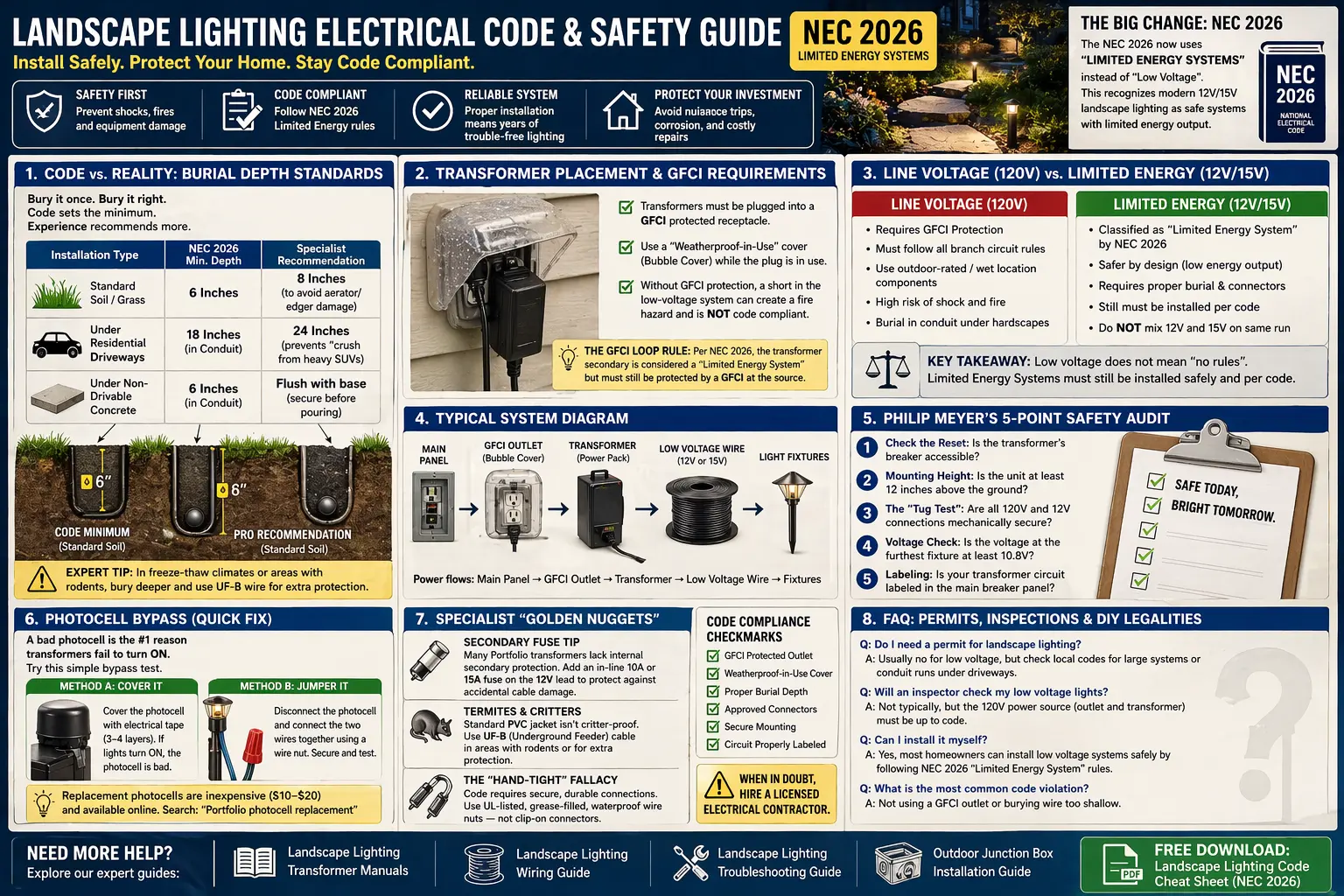
The guidance throughout this site is intended to help homeowners, contractors, and property managers understand the reasoning behind common lighting compliance principles rather than simply memorizing isolated rules. Local amendments, inspector expectations, and manufacturer instructions should always be considered alongside national standards. Use these resources to ask better questions, identify potential issues before they become expensive corrections, and build a stronger documentation trail for inspections and future maintenance.
When safety concerns, permit questions, line-voltage work, recurring electrical problems, or water-adjacent installations are involved, consult a qualified electrical professional or your local authority having jurisdiction. For a practical field-ready review process, use the NEC low-voltage lighting inspection checklist before beginning work or requesting final approval.
Water can change an otherwise routine landscape-lighting installation into a much more specific safety situation. This is especially important when fixtures are built into retaining walls beside pools, ponds, fountains, irrigation runoff, or other wet areas. Our retaining wall lighting near water guide explains how to distinguish normal outdoor moisture exposure from pool, spa, fountain, and other water-adjacent conditions, including fixture selection, transformer placement, wiring, drainage, and moisture protection.
Ponds and decorative water features need extra electrical planning because a landscape light beside the water is not the same installation as a fixture exposed to constant spray or installed below the waterline. Our Pond Lighting Code Requirements Guide explains low-voltage pond lighting, underwater fixtures, transformer placement, GFCI considerations, wet-location exposure, wiring connections, and why equipment must be matched to its actual contact with water.
Outdoor lighting compliance is rarely determined by a single code section. A safe installation requires balancing transformer capacity, burial depth, wet-location requirements, voltage drop, inspection documentation, and water-adjacent safety concerns simultaneously. The Universal NEC landscape lighting compliance calculator was designed to bring those variables together in one place, helping homeowners and contractors evaluate real-world installation scenarios before small oversights become failed inspections, troubleshooting headaches, or expensive corrective work.
Quick Answer For Lighting Compliance
I put together this guide to help translate a complicated area of outdoor lighting compliance into practical, real-world advice that homeowners and contractors can actually use. Electrical standards continue to evolve, and newer NEC requirements, inspection procedures, and documentation expectations can be surprisingly easy to miss—especially when you're working on an older system, expanding an existing installation, or trying to troubleshoot a problem that doesn't have an obvious cause.
Every property, local jurisdiction, and lighting system is different. What passes inspection in one area may require additional safeguards or documentation in another. Use this information as a starting point to ask better questions, identify potential safety concerns early, and understand the reasoning behind common code requirements rather than simply following a checklist.
When in doubt, slow down and do a little extra research before making changes to your system. If your project involves line-voltage wiring, work near pools or spas, recurring breaker trips, signs of overheating, permit questions, or anything that could impact electrical safety, consult a qualified electrical professional or your local authority having jurisdiction. A few minutes of expert guidance can prevent costly repairs, failed inspections, and—most importantly—help keep your home and family safe.
Truly safe landscape lighting is not just about making the lights turn on—it is about creating an outdoor electrical system that continues to operate safely through rain, irrigation cycles, freeze-thaw movement, soil shifting, landscaping work, and years of environmental exposure. The safest systems begin with a properly protected 120-volt power source, transition through a correctly installed and accessible low-voltage transformer, distribute power using cable sized for the actual electrical load, and rely on waterproof connections that resist corrosion and voltage loss over time.
Most outdoor lighting failures do not occur because a fixture suddenly "goes bad." They begin at transition points where electricity changes environments: where line voltage becomes low voltage, where dry equipment enters wet soil, where buried cable crosses hardscape, where connectors are exposed to irrigation, or where fixtures are installed near pools, spas, retaining walls, and other high-risk areas. Understanding these transition zones allows homeowners to prevent problems before they become shock hazards, nuisance GFCI trips, transformer failures, inspection violations, or expensive excavation projects.
Lighting compliance involves dozens of interconnected decisions involving transformer sizing, burial depth, voltage drop, wet-location suitability, inspection documentation, and water-adjacent clearances. Instead of researching each requirement separately, the Universal NEC landscape lighting compliance calculator helps homeowners and contractors quickly evaluate common installation scenarios using a structured framework built around the most frequently overlooked compliance considerations. It serves as a practical planning companion before troubleshooting existing systems or beginning a new installation.
Many homeowners hear references to both NEC Article 411 and NEC Article 725 but aren't sure which one actually applies to a low-voltage landscape lighting system. Understanding the difference can prevent wiring mistakes, incorrect transformer selection, and failed inspections. Before starting a new installation or modifying an existing system, read our complete comparison of NEC 411 vs. NEC 725 for landscape lighting to learn which rules apply to your project.
- Protect the primary power source first: A low-voltage system is only as safe as the 120V circuit feeding it. Verify that outdoor receptacles, weatherproof covers, GFCI protection, and line-voltage connections are properly maintained and protected from moisture exposure. Many "low-voltage" problems actually originate on the primary side of the transformer.
- Design cable routes to survive the landscape: Burial depth should account not only for minimum requirements but also for future aeration, edging, planting, irrigation repairs, pet activity, and seasonal soil movement that commonly damage shallow cable runs. The goal is to protect the wiring from the realities of yard maintenance.
- Treat every splice as a permanent underground connection: Moisture intrusion often begins at connector points. Use connectors specifically listed for wet or direct-burial environments to prevent corrosion, intermittent flickering, green copper oxidation, and heat buildup caused by increased electrical resistance.
- Balance transformer capacity with actual demand: Oversized transformers can hide poor design practices, while overloaded transformers create voltage instability, nuisance shutdowns, shortened component life, and inconsistent fixture performance. Calculate total connected load and maintain reserve capacity for future expansion.
- Minimize voltage drop before it becomes visible: Long cable runs, undersized wire, and excessive fixture counts can gradually reduce brightness, alter color appearance, and accelerate LED driver failures. Testing voltage under load helps identify weak sections before symptoms develop.
- Apply enhanced safety practices near water: Pools, spas, fountains, hot tubs, docks, and irrigation-heavy planting beds require additional attention to fixture selection, placement, wet-location suitability, cable routing, and protective devices because the consequences of electrical failure increase dramatically in wet environments.
- Protect wall penetrations and hardscape transitions: Areas where cable enters structures, passes beneath walkways, crosses retaining walls, or travels through conduit sleeves often experience abrasion, settling, and water migration. These hidden transition points deserve the same attention as visible fixtures.
- Document the system before it disappears underground: Photographs, cable maps, transformer labels, voltage readings, and as-built diagrams create a maintenance record that simplifies future repairs, warranty claims, inspections, property transfers, and system expansions.
A landscape lighting system should be reviewed the same way an electrical inspector would approach it: start at the power source, verify GFCI protection, check transformer mounting, follow the cable path, inspect splices, confirm fixture ratings, and document hidden work before it is covered. For a practical step-by-step review, use the electrical inspector landscape lighting checklist to catch the issues that often lead to failed inspections, correction notices, warranty disputes, and unsafe outdoor lighting conditions.
Outdoor lighting safety requirements become even more complex in coastal environments, where salt-laden air accelerates corrosion long before visible damage appears. A fixture that performs well inland may experience premature finish degradation, fastener failure, connector oxidation, and shortened service life near the ocean. Our coastal lighting salt spray exposure and compliance ratings guide explains how marine environments influence fixture selection, corrosion resistance expectations, compliance considerations, and long-term maintenance planning so homeowners can choose products designed to withstand some of the harshest outdoor conditions.
Bottom Line: The safest landscape lighting systems are designed with the assumption that the environment will eventually test every installation decision. Rain will find weak splices. Irrigation will expose poor fixture choices. Soil movement will challenge shallow cable routes. Future landscaping projects will uncover undocumented installations. A system engineered to withstand those realities delivers more than attractive nighttime illumination—it provides long-term reliability, easier troubleshooting, fewer inspection problems, lower maintenance costs, and greater protection for everyone who lives around it.
Jump to Section
Understanding the NEC 2026 “Limited Energy” Shift
One of the biggest authority signals on this page is using the current terminology correctly. For years, many homeowners and even many contractors casually used “low voltage” for everything from landscape lighting to doorbells to data-adjacent systems. NEC 2026 pushes the language toward Limited Energy because the code is increasingly organized around hazard level, system behavior, and the way power-limited installations overlap with control and communications technologies.
That does not mean homeowners must stop saying “low voltage.” People still search that way, and they will for years. But using the newer code language helps show that your content is more up to date than the typical copycat page that still treats modern 12V lighting as if nothing changed after 2017.
For the practical installer, the real benefit of this code shift is that it encourages thinking beyond voltage number alone. A 12V system can still fail, corrode, overheat, or create expensive damage if the transformer is poorly protected, the wire is too shallow, or the splice method is weak.
If you want the practical system view behind these code rules, see low voltage landscape lighting for a clearer breakdown of how transformers, cable runs, and fixtures work together in a real residential setup.
One of the most important safety requirements for outdoor lighting is GFCI protection. Review NEC 2026 GFCI requirements for outdoor lighting to understand current code rules and protection methods.
For the latest changes to outdoor lighting code, including GFCI updates and limited-energy systems, see NEC 2026 landscape lighting code updates.
Permit, Inspection, and Documentation Pages to Review Before Installation
A code-safe landscape lighting project should be documented before the trench is closed, not after a failure occurs. Start with the landscape lighting permit requirements by state to understand when local approval may apply, then use the as-built lighting diagram requirements for permits to record fixture locations, cable routes, transformer placement, and load data. For equipment selection, the solar lighting UL 8750 performance standards guide explains why listed components matter. Before final review, compare the installation against the common landscape lighting code violations guide and the landscape lighting inspection failure database so small hidden mistakes do not become failed inspections.
Electrical code requirements exist because failures in outdoor lighting systems can create consequences that extend far beyond a failed inspection. Improper transformer sizing, missing GFCI protection, shallow cable burial, wet-location mistakes, undocumented modifications, and neglected maintenance have all appeared repeatedly in real-world disputes involving property damage, electrical shock allegations, and expensive repair claims. Our landscape lighting liability claims database examines the patterns behind these incidents so homeowners and contractors can understand how seemingly small installation shortcuts sometimes develop into significant financial exposure years after the original work was completed.
Water features represent one of the most specialized areas of landscape lighting compliance because electricity, moisture, pumps, transformers, and public access frequently intersect in a confined area. Even experienced installers often apply additional safety precautions around waterfalls, streams, and decorative ponds. For a detailed review of these unique requirements, see our waterfall lighting code requirements guide, which examines equipment selection, GFCI protection, wiring methods, and common inspection concerns associated with illuminated water features.
Electrical code establishes minimum safety requirements, but it does not measure transformer operating efficiency or standby losses. For engineering-focused performance data—including no-load consumption, efficiency curves, and operating temperatures—visit our Landscape Transformer Efficiency & Load Loss Benchmarks.
Related Outdoor Lighting Safety and Code Guides
Outdoor lighting safety starts with using fixtures that are actually rated for the environment where they are installed. For damp walls, exposed landscape areas, pool zones, fountains, and weather-facing fixtures, review this guide to outdoor lighting wet-location listing requirements before assuming a fixture is safe outdoors.
Transformer access is another safety detail many homeowners overlook. A low-voltage system still needs a practical way to shut off power for service, testing, and emergency repair, which is why this landscape lighting transformer disconnect NEC guide is important for any permanent outdoor lighting setup.
Pool areas require extra caution because water, people, and electrical equipment are all close together. If your lighting project is near a swimming pool, this NEC 680 swimming pool lighting clearance guide explains why fixture distance, transformer location, and wiring separation matter.
Fountain lighting has its own risk profile because fixtures may be submerged or exposed to continuous splash zones. Use this submersible fountain lighting code requirements guide before installing or replacing lighting in ponds, basins, or decorative water features.
Lighting also affects accessibility, especially on sidewalks, ramps, steps, and outdoor routes. This ADA outdoor pathway lighting compliance guide explains how even illumination, glare control, and fixture placement support safer movement for more users.
Many outdoor failures begin at the splice, not the fixture. Before burying or repairing any connection, review this landscape lighting splice connection code guide so wire joints are protected from moisture, corrosion, and long-term failure.
Transformer Placement & GFCI Requirements
This is where many otherwise decent installs go wrong. The transformer may be listed correctly, the cable may be decent, and the fixtures may be fine — but the supply receptacle is outdated, unprotected, or sitting behind the wrong type of cover.
If you need the exact trench depth rules for low-voltage cable, PVC conduit, or direct-burial wiring, see our landscape lighting wire burial depth code guide.
The “Bubble Cover” Rule in Real Life
Many installers and homeowners call it a bubble cover. Code language usually calls it a weatherproof in-use cover or extra-duty weatherproof enclosure for the receptacle in a wet location. The important real-world idea is this: if the transformer plug is inserted, the receptacle still needs to remain protected from the weather.
Why GFCI Still Matters on a 12V Lighting System
The yard-side lighting may operate at 12V or 15V, but the transformer itself is still fed from a standard outdoor branch circuit. That means the safety of the receptacle and upstream power source still matters. If the receptacle is not GFCI-protected, the overall setup can fall short of modern outdoor safety expectations.
If your transformer has power but the system still does not turn on correctly, review landscape lighting timer setup to separate supply-side safety issues from timer, photocell, and control-setting mistakes.
Outdoor transformer placement affects more than convenience. The outdoor lighting transformer mounting code requirements explain practical clearance rules for GFCI receptacles, grade height, drip loops, ventilation, pool zones, and combustible mounting surfaces.
Electrical safety matters, but so does long-term hardware stress. The lighting heat buildup and driver stress comparison archive compares how transformers, drivers, and smart fixtures behave after extended runtime.
Transformer Placement Basics
- Mount the transformer where it stays above standing water and splash zones.
- Keep it accessible for resets, timer changes, and fuse checks.
- Do not bury or crowd it behind dense shrubs where heat and service access become a problem.
- Keep the plug and cord path neat so the in-use cover can close properly.
If low-voltage lighting wire passes through an exterior wall from a basement, garage, or crawlspace to the outside transformer or yard, the entry hole should be sealed with duct seal or outdoor-rated caulk. This helps prevent moisture intrusion, air leakage, and pest entry at one of the most commonly overlooked failure points in a lighting installation.
If the transformer is already installed and you are trying to confirm whether it is actually bad, use How to Test a Landscape Lighting Transformer before replacing the unit based on symptoms alone.
Proper grounding and bonding are critical for code compliance and shock protection. For a detailed breakdown, see our landscape lighting grounding and bonding guide.
Understanding transformer warning indicators is an important part of maintaining a safe low-voltage lighting installation because many modern systems include built-in overload, heat and wiring protection. This landscape lighting transformer error code lookup tool explains how fault conditions are commonly reported and what those warnings often mean in the field.
Outdoor kitchens often combine lighting, receptacles, disconnects, appliances, transformers, and utility equipment within a limited footprint, creating unique safety and accessibility challenges that homeowners rarely anticipate during the design phase. The outdoor kitchen lighting clearance guide explores how NEC working-space principles influence equipment placement, maintenance access, and future serviceability while helping property owners create outdoor entertaining spaces that remain both functional and safety-conscious.
Many landscape lighting problems are not caused by complex code violations but by basic installation mistakes that fall under general electrical workmanship requirements. Loose terminations, damaged conductors, improperly secured equipment, missing strain relief, and installations that are not performed in a neat and workmanlike manner can create reliability and safety issues long before a system completely fails. Our NEC 110 landscape lighting requirements guide explains the foundational electrical standards that inspectors frequently evaluate regardless of fixture type, voltage level, or lighting application.
Burial Depth Standards (The 6-Inch Rule)
Before installing buried 12V lighting cable, check whether your project needs approval using the low voltage lighting permit requirements guide.
Burial depth is one of the most searched and most misunderstood parts of landscape lighting safety. Homeowners hear “low voltage” and assume the wire can just sit under mulch or barely under the sod. That shortcut is exactly why so many systems get sliced by aerators, edging tools, or basic yard work.
Minimum Burial Depth Comparison
| Installation Type | NEC 2026 Min. Depth | Specialist Recommendation |
|---|---|---|
| Standard Soil / Grass | 6 Inches | 8 Inches to reduce aerator and edger damage |
| Under Residential Driveways | 18 Inches (in conduit) | 24 Inches to better resist crush stress |
| Under Non-Drivable Concrete | 6 Inches (in conduit) | Flush with prepared base before pour when properly secured |
Those professional recommendations go beyond bare minimum because landscape lighting failures are often mechanical, not electrical. A perfectly code-minimum cable can still get destroyed by an aerator, edging blade, shallow trenching, frost lift, or repeated exposure near a walkway edge.
Electrical troubleshooting requires structured thinking, observation, and logic sequencing similar to engineering workflows. The lighting troubleshooting and coding skills guide explains why diagnosing outdoor lighting systems builds valuable technical reasoning skills.
A landscape lighting system can look finished but still have inspection problems hiding in the transformer, cable route, splice points, fixture listings, burial depth, GFCI protection, and documentation trail. Before treating a new installation, repair, or retrofit as complete, use the NEC low-voltage landscape lighting inspection checklist to verify the parts of the system that are easiest to miss: listed power source, protected primary connection, wet-location fixtures, direct-burial cable, proper connector ratings, physical damage protection, voltage-drop testing, and final photo documentation.
Most homeowners think of landscape lighting as a convenience feature, but certain properties, commercial sites, multifamily developments, public facilities, and emergency-access areas may also involve life-safety lighting considerations. When power is lost, occupants must still be able to identify exits, navigate pathways, and move safely through designated egress routes. Our emergency backup lighting and egress pathway requirements guide explains how emergency illumination systems, code requirements, and pathway visibility standards are commonly applied in safety-critical environments.
Parking lots add accessibility requirements that go beyond ordinary outdoor-lighting installation. Accessible parking spaces, access aisles, curb ramps, signs, pedestrian routes, and vehicle conflicts all need to work with the lighting plan. Our Parking Lot Lighting ADA Guide explains what the ADA actually requires, why there is no single universal “ADA foot-candle” number for parking lots, and how accessibility should be coordinated with current parking-lot lighting standards and local electrical requirements.
Line Voltage (120V) vs. Low Voltage (12V/15V) Code Differences
What Changes on the 120V Side
When you bring line voltage directly into the yard, code expectations become stricter around wiring method, burial protection, box fill, conduit, fittings, receptacle placement, and shock protection. This is one reason most homeowners should prefer a listed low-voltage transformer-based system for garden and path lighting instead of trying to run 120V fixture circuits everywhere.
What Still Matters on the 12V / 15V Side
Low voltage does not mean careless wiring is acceptable. Cable still needs protection from physical damage. Splices still need to stay dry and mechanically secure. Transformers still need correct sizing and placement. Output still needs to be high enough that the far fixture is not starved for voltage.
For the practical side of routing and connecting cable safely, use how to wire landscape lighting to see how wiring layout, splices, and fixture connections affect both safety and long-term reliability.
Electrical safety is only one part of outdoor lighting compliance. Commercial and institutional properties may also need to meet energy-code limits on how much exterior lighting power can be installed and when that lighting is allowed to operate at full output. Our ASHRAE 90.1 exterior lighting requirements guide explains exterior lighting power allowances, lighting zones, automatic daylight shutoff, scheduled reductions, parking-area controls, and the major exterior-lighting changes in ANSI/ASHRAE/IES Standard 90.1-2025.
The Secondary Fuse Tip
Many older Portfolio transformers do not include robust secondary-side protection. For that reason, adding an inline 10A or 15A fuse on the 12V lead can be a smart protection step. If a gardener slices the cable or a downstream short develops, that fuse can help protect the transformer from overheating or internal damage.
For a typical residential landscape lighting system to remain in the safer “limited energy” category, the transformer should be UL-listed as a Class 2 power source. Many Class 2 systems are limited to about 300 watts per circuit or 600 watts total depending on configuration. That matters because a large industrial transformer paired with small 16-gauge landscape cable can defeat the safety intent of a standard residential low-voltage system.
Simple rule: Match the transformer class, cable size, and total load together instead of assuming “low voltage” automatically means safe under every setup.
Critter and Rodent Risk
Standard jacketed low-voltage cable is not automatically critter-proof. In areas with rodent activity or repeated cable chewing, sturdier cable selection and deeper installation planning matter. In severe conditions, some installers look at more rugged cable strategies rather than assuming every standard kit wire will hold up indefinitely.
Inspection Problems Usually Start Before the Inspector Arrives
A landscape lighting system can look complete at night and still fail review because the proof trail is missing or a hidden defect was covered too early. Before calling a project code-ready, use the landscape lighting inspection failure code guide to classify defects by power source, transformer, cable, splice, fixture, and documentation category. If the issue is serious enough to stop work, the landscape lighting red tag violation guide explains which failures require immediate correction. For less severe review comments, the inspector correction notice guide helps turn the inspector’s note into a repair plan. Before requesting approval, run the system through the outdoor lighting final inspection checklist and compare the submittal package with the landscape lighting permit rejection reasons guide.
Many outdoor lighting installations operate for years before hidden compliance problems are discovered during renovations, property sales, neighbor complaints, insurance investigations, or routine inspections. The landscape lighting code enforcement cases guide documents how inspectors have addressed issues such as buried indoor connectors, improper transformer protection, concealed splice defects, insufficient burial depth, and installations near water features that failed to meet safety expectations. These case studies provide valuable context by showing not only what the code requires, but how those requirements are enforced when real-world violations are uncovered.
Electrical code tells you how outdoor lighting must be installed safely, but it does not answer every lighting-performance question. Professional outdoor-lighting design also uses ANSI/IES standards for topics such as landscape lighting, pedestrian areas, glare, uplight, photometric testing, and roadway or parking applications. Our Outdoor Lighting ANSI Standards Guide explains which standards apply to different projects and how ANSI/IES guidance fits alongside the NEC, product listings, and local lighting ordinances.
Connector Safety: Why “Hand-Tight” Is Not Enough
This is one of the biggest gaps between kit-level DIY installs and long-lasting professional installs. The connector included in a retail box may work on day one, but after moisture, soil chemistry, and repeated thermal cycling, that same connection may loosen, corrode, arc, or become intermittent.
Low-voltage systems still need safe wiring practices and listed outdoor connectors. The low-voltage plug and limited-energy connector guide explains how limited-energy systems fail, why connector listings matter, and how moisture can create hidden current leakage outdoors.
Electrical safety also affects homeowner liability when outdoor lighting creates trip hazards, glare, exposed wiring, or unsafe fixture placement. See the landscape lighting insurance and liability guide for risk-reduction steps before installing or modifying an outdoor lighting system.
If the supply side is protected, the transformer is listed correctly, the cable is buried deeply enough, the splices are waterproof, and the layout avoids water hazards and physical damage, the system is much more likely to stay both code-conscious and reliable long term.
Seasonal outdoor lighting displays create unique safety issues around pathways, cords, fog machines, and temporary fixtures. The Halloween landscape lighting electrical safety guide explains safer placement practices for outdoor holiday lighting effects.
Outdoor electrical safety depends partly on choosing fixtures designed for the moisture conditions they will face. The IP-rated landscape lighting safety guide explains how enclosure protection affects fixture safety in wet and damp locations.
Code-safe landscape lighting is not only about wire depth and GFCI protection; some work may require a licensed contractor depending on your state, voltage level, and scope of installation. Review the landscape lighting contractor licensing requirements guide before hiring or advertising outdoor lighting work.
GFCI trips should never be ignored on outdoor lighting systems because they often point to moisture, damaged insulation, or unsafe leakage current. The outdoor lighting ground-fault diagnosis guide explains how to separate normal nuisance trips from real electrical safety problems.
Electrical safety also depends on using equipment that has been properly evaluated for its intended use. If you see different certification marks while shopping for transformers, fixtures, or other outdoor lighting equipment, our UL vs ETL landscape lighting guide explains what each mark means, why ETL Listed equipment can be legitimate safety-certified equipment, how third-party testing works, and what you should verify before installing a product outdoors.
Most Common Landscape Lighting Code and Safety Failures
- Transformer plugged into a non-GFCI outdoor receptacle
- Cable buried too shallow in lawn or edge zones
- Weak clip connectors used in wet soil
- Wire entering the house without exterior sealing
- Transformer mounted where standing water or mulch can build up
- Oversized transformer paired with undersized cable
- Fixtures placed too close to pools, spas, or fountains
Why this matters: Most landscape lighting failures are not caused by the fixture itself. They come from support issues like bad splices, bad placement, shallow wire, overload, or moisture intrusion.
Voltage drop is not just a performance issue — it is a major electrical design and code-compliance consideration in low-voltage landscape lighting systems. Our detailed landscape lighting voltage-drop code and NEC requirements guide explains how transformer tap selection, conductor sizing, allowable voltage-loss percentages, and long-run load balancing affect overheating risk, LED driver stress, brightness stability, and long-term system safety.
Electrical safety involves more than installation methods alone. The materials used inside fixtures, drivers, circuit boards, solder joints, wiring assemblies, and electronic components can also affect long-term environmental performance and product quality. Our RoHS compliance guide for landscape lighting products explains how manufacturers limit the use of lead, mercury, cadmium, and other restricted substances while meeting modern environmental standards.
Electrical code tells you how outdoor lighting equipment must be installed safely, but it does not answer every question about how a pedestrian space should actually be illuminated. For guidance on walkways, plazas, building approaches, glare, lighting zones, nighttime visibility, controls, and responsible use of outdoor light, see our ANSI/IES RP-43-25 Outdoor Pedestrian Lighting Guide. It explains how the current IES recommended practice fits alongside NEC requirements rather than replacing them.
Critical Safety: Pools, Spas, and Water Features
Electrical safety rules become much stricter near water. If your landscape lighting project is near a swimming pool, hot tub, spa, or decorative fountain, standard placement assumptions may no longer apply.
As a general safety rule, low-voltage luminaires should be installed at least 10 feet away from the inside wall of a pool or spa unless the fixture is specifically listed for closer proximity and installed under the rules that apply to that location.
Transformers should also be kept well away from pool and spa splash zones, and the receptacle serving the transformer should have working GFCI protection. In wet-foot-traffic areas, small installation mistakes can create serious shock hazards.
When upgrading an older outdoor lighting system, safety and ROI should be planned together. See the commercial-grade landscape lighting upgrades guide for durable fixtures, safer wiring, and long-term value.
Bottom line: If your project is anywhere near water, do not rely on ordinary yard-lighting assumptions. Treat pool and spa proximity as a separate safety condition.
If your outdoor lighting project includes splices, conduit entries, or exposed connections, review our outdoor lighting junction box requirements before final installation.
For safe operation, always confirm bulb compatibility using the LED holiday bulb replacement guide before installing new lighting components.
If pets or backyard wildlife can reach your lighting cable, also review whether landscape lighting wire is safe for pets and wildlife before finalizing the installation.
Outdoor lighting safety involves more than just voltage and wiring because fixture location near grills, fire pits, gas lines and heat-producing features can also create installation concerns. This fire pit and landscape lighting clearance guide explains important spacing considerations, heat exposure risks and practical lighting placement strategies around outdoor fire features.
A safe lighting installation requires more than selecting the correct fixtures and power source. Wiring should also be routed carefully to reduce physical damage, tripping hazards, moisture exposure, and accidental disconnection. While seasonal displays present unique challenges, many of the same principles apply. Our hidden holiday lighting wire management guide explains practical techniques for organizing and concealing wiring without compromising accessibility or safety.
The Philip Meyer “Safety-First” Installation Checklist
- Check the Reset: Is the transformer breaker or reset protection accessible without removing the unit from the wall?
- Mounting Height: Is the transformer mounted high enough to avoid puddles, splashback, snow contact, or mulch buildup?
- The Tug Test: Are all 120V and 12V connections mechanically secure and not loose under gentle pull?
- Voltage Check: Is the voltage at the furthest fixture still high enough for stable operation?
- Labeling: Is the branch circuit feeding the transformer labeled clearly in the breaker panel?
These checks matter because many outdoor lighting failures are not caused by the fixtures themselves. They are caused by support issues: inaccessible resets, weak splices, wet mounting locations, unlabeled circuits, or poor voltage planning across long runs.
If the system is already showing symptoms like dead runs, dim fixtures, or intermittent operation, continue with Portfolio lighting troubleshooting to narrow down whether the problem is the transformer, wire path, splice, or fixture branch.
For a more outdoor-specific diagnostic path, use Portfolio landscape lighting troubleshooting to work through common yard-lighting failures after installation.
Electrical safety begins long before fixtures are installed in the yard. Our detailed landscape lighting load calculation and code compliance guide explains how transformer sizing, safe load balancing, voltage-drop planning, startup surge behavior, and NEC low-voltage requirements all work together to prevent overheating, overloaded transformers, flickering systems, and long-term electrical reliability problems.
Older Outdoor Lighting, Smart Controls, and Fixture Moisture All Change the Safety Picture
Outdoor lighting safety is not limited to wire depth or transformer sizing; it also depends on whether the system has been modified, whether the control wiring is power-limited, and whether fixtures are still sealed against weather. If you are adding app-based controls, sensors, smart hubs, or low-voltage control wiring, review the smart lighting control and NEC Article 725 Class 2 guide before mixing control circuits with power wiring. If the system is older and you are trying to decide whether existing work can remain, the outdoor lighting electrical grandfather clause guide explains when old installations may still need correction. If the visible issue is moisture inside a fixture instead of wiring damage, the Portfolio foggy lens and condensation repair guide helps separate normal condensation from a failed gasket, cracked lens, or wet-location seal problem.
A proper transformer test begins before the multimeter ever touches the low-voltage terminals. Confirm that the receptacle feeding the transformer is protected, dry, mechanically sound, and delivering reliable power under load. If that outlet is questionable, transformer readings can mislead you. Use the outdoor lighting receptacle code requirements as the supply-side checklist before interpreting transformer output.
Low voltage reduces shock risk, but it does not guarantee clean electrical behavior. Modern LED drivers are nonlinear loads that can draw current in short peaks instead of following the incoming sine wave smoothly. When many drivers operate on the same transformer, generator, inverter, or branch circuit, that distortion can contribute to transformer noise, excess neutral current, unstable controls, and premature electronic failure. The LED driver harmonic distortion compliance standards guide explains current THD, power factor, IEEE 519, IEC 61000-3-2, field measurement, and the driver specifications that should be checked before a large LED installation is approved.
Specialist’s Code Cheat Sheet
If you want the shortest practical summary of this page, it looks like this:
Water features create some of the most demanding electrical environments found in residential landscape lighting. Unlike standard path lights or accent fixtures, illuminated waterfalls combine moisture, pumps, transformers, wiring systems, and public access areas in a concentrated space that requires careful attention to safety and code compliance. Homeowners planning a pondless waterfall, decorative stream, water wall, or cascading rock feature should review our waterfall lighting code requirements guide, which explains equipment placement, transformer separation, GFCI protection, wet-location ratings, and common installation mistakes that can lead to inspection problems or long-term reliability issues.
- Use a properly protected outdoor receptacle with a weatherproof in-use cover.
- Bury listed low-voltage cable to at least the minimum required depth, and deeper where yard damage is likely.
- Do not rely on weak clip connections if a listed waterproof splice method is available.
- Mount the transformer high enough to stay out of standing water and keep it serviceable.
- Plan cable length and transformer taps so the far fixture still performs correctly.
For specialty outdoor lighting projects, I recommend checking the deeper code guides before finalizing layout or wiring decisions: this dock and pier lighting NEC 555 safety guide explains electrical datum planes and shock-risk zones near water, the NEC 300.5 underground conduit fill calculator guide helps plan buried raceway and conductor capacity, the turtle-safe and wildlife-friendly lighting code guide covers shielded, low-impact outdoor lighting near sensitive habitats, and this photometric lighting plan code guide shows how to read foot-candle layouts, fixture schedules and compliance notes before installation.
Electrical Safety Includes Fixtures, Transformers and Light Control
Outdoor lighting safety is not limited to burial depth or GFCI protection. Aging fixtures may need Portfolio corroded socket cleaning and repair to prevent heat, flicker and poor contact problems, while transformer-fed systems may need the Portfolio transformer surge protector installation guide to reduce damage from voltage spikes and storms. For the visible side of the installation, the dark-sky compliance versus IDA certification guide helps explain how safety, quality and responsible light direction fit together in a complete outdoor lighting plan.
Modern Outdoor Lighting Problems Go Beyond Basic Wiring
Outdoor lighting safety now includes electrical noise, water-adjacent placement, warranty documentation, and light trespass control—not just whether a fixture turns on. If smart controls, cameras, communication wiring, or LED drivers are involved, the low-voltage lighting EMI and NEC 800 guide explains how signal interference can develop when lighting power and communication paths are routed poorly. If the project is near a spa or soaking area, the outdoor hot tub lighting safety guide covers glare, wet-location planning, GFCI awareness, and fixture placement around water. For systems that may need product or installer support, the voltage drop testing documentation guide shows how to prove whether failures came from the product or the wiring run. If exterior lights shine toward bedrooms or neighboring windows, the dark-sky bedroom light trespass guide explains how to reduce glare, spill light, and nighttime sleep disruption.
FAQ: Permits, Inspections, and DIY Legalities
If you are here because the system is already failing rather than because you are planning a new install, see landscape lights not working for a practical diagnostic path that starts with the transformer and works outward through the yard.
Do I need a permit for low-voltage landscape lighting?
Permit requirements vary by city, county, and whether the work includes new 120-volt wiring or only listed low-voltage components. Always check local authority requirements before installation.
Does a landscape lighting transformer need GFCI protection?
Yes, the outdoor receptacle serving the transformer should be GFCI-protected and installed with a weatherproof in-use cover where required for wet-location use.
How deep should landscape lighting wire be buried?
For listed low-voltage lighting systems under 30 volts, 6 inches is a commonly cited minimum cover depth in qualifying installations. Many professionals still go deeper for durability and physical protection.
Are clip-on landscape lighting connectors fully code-safe long term?
They may be included with kits, but long-term reliability often improves when installers use UL-listed waterproof connectors or grease-filled wire nuts that create more secure mechanical and moisture-resistant connections.
Expert-Verified Troubleshooting
Every technical guide on PortfolioLighting.net is bench-tested in our Specialist Workshop. Our troubleshooting procedures are based on 25+ years of field experience and are maintained by Philip Meyer to ensure accuracy and electrical safety compliance.