Landscape Lighting Guide
This is the broader planning hub and the best place to connect transformer size decisions to the full outdoor lighting system.
Read the guide
Most landscape lighting problems—dim lights, overload, and shutdown—are caused by choosing the wrong transformer size.
The fix is simple: calculate your total wattage, add a safety margin, and choose the next size up. Use the calculator below to get the right answer in seconds.
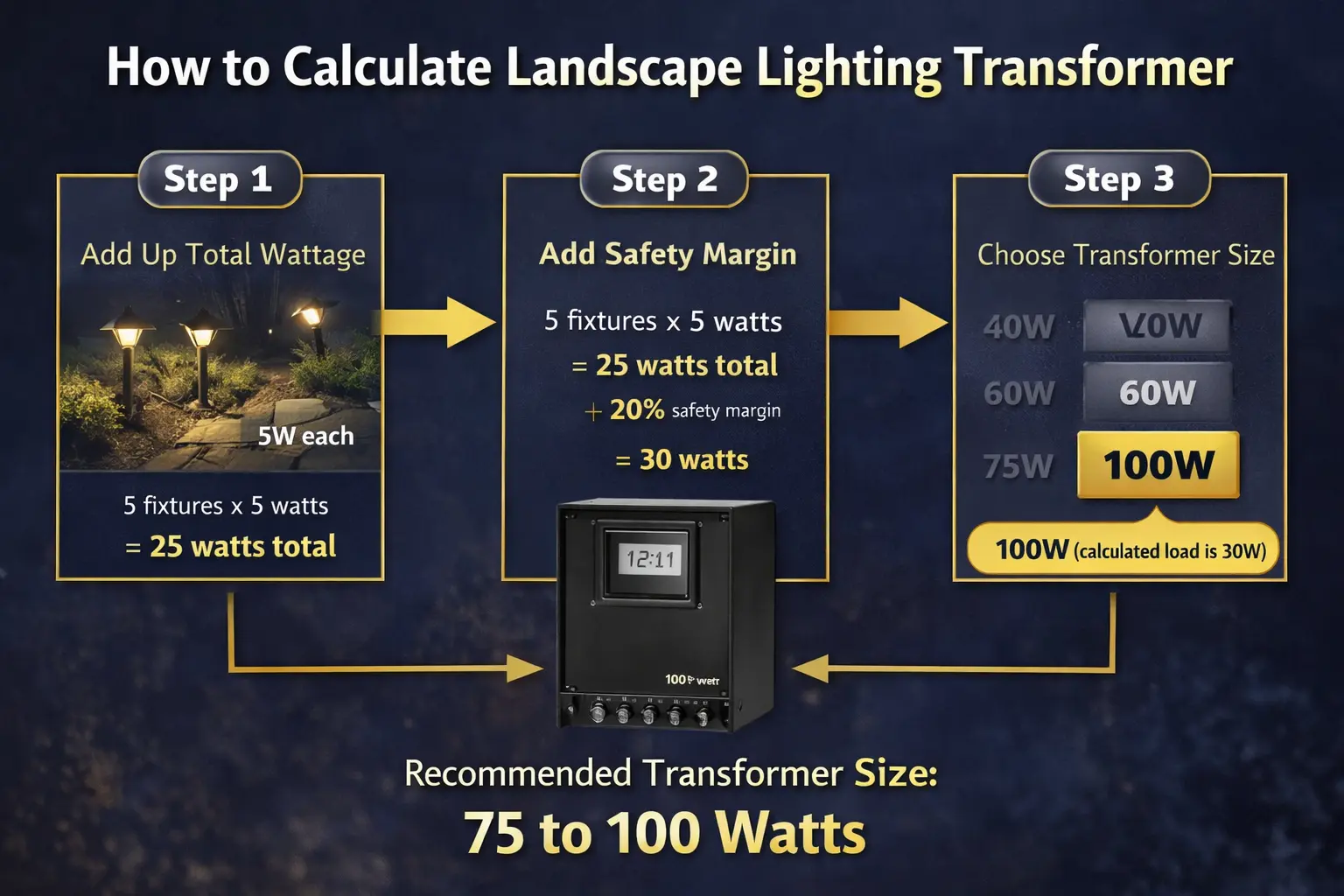
Most landscape lighting systems need a transformer that is larger than the total fixture wattage. A simple rule is to add up all fixture watts, then choose a transformer with about 20 to 30 percent extra capacity.
For example, if your lights use 80 watts total, a 100W to 150W transformer is usually the right range. Use the calculator below for a fast answer, then check the sizing chart if you want to confirm your choice.
This page works best alongside landscape lighting guide, how landscape lighting works, and landscape lighting transformer guide. If you need parts after sizing the system, visit Portfolio lighting parts and accessories.
See the Transformer GuideSizing a low-voltage transformer is about managing continuous thermal loads and structural line voltage drop, not just checking off a total wattage checklist. If you load your power pack all the way up to its maximum rated capacity, the internal hardware will run dangerously hot, degrade its inner circuitry, and fail to provide enough push to illuminate the furthest lights in your yard.
Whenever I plan an installation or audit a residential outdoor lighting layout, I use these seven strict math and load rules to ensure the transformer runs smoothly without burning out:
Real-World Example: If your yard lights pull a combined total of **80 watts**, multiplying that load by 1.25 means you need a minimum **100W transformer**. To keep the unit running smoothly and protect against future additions, stepping up to a **150W transformer** is always the smarter choice.
⚠️ CRITICAL COMPONENT RISK: Overloading a budget digital power box will permanently cook its solid-state motherboard. Violating these load balancing baselines triggers three distinct terminal box failures and severe line faults that I detail inside my deep diagnostic blueprints below.
Don't guess on your total yard draw or mount hardware blindly. Use my step-by-step layout design templates, multi-tap terminal wiring charts, and advanced voltage calculator tools detailed further down this page to map out your perfect setup in under 60 seconds.
Goal: not maximum power, but stable and consistent lighting.
| If This Happens | What It Means | What To Do |
|---|---|---|
| Total wattage is too close to transformer size | The transformer is running at its limit | Increase size by 20–30% |
| Lights are dim or inconsistent | Possible overload or voltage drop | Use a larger transformer or improve wiring layout |
| Transformer shuts off or trips | System is overloaded | Upgrade to a higher wattage transformer |
| Planning to add more lights later | Future load will increase | Choose the next size up now |
| Long wire runs | Voltage drop reduces performance | Use larger transformer or multiple runs |
The goal is not just to match your current wattage, but to give your system enough capacity to run efficiently, stay bright, and avoid overload problems over time.
| Total Fixture Load | Recommended Minimum | Practical Transformer Size |
|---|---|---|
| 20W to 40W | 25W to 50W | 60W |
| 41W to 60W | 52W to 75W | 75W or 100W |
| 61W to 80W | 76W to 100W | 100W |
| 81W to 120W | 101W to 150W | 150W or 200W |
| 121W to 160W | 151W to 200W | 200W |
| 161W to 240W | 201W to 300W | 300W |
| Over 240W | Over 300W | 300W+, multiple runs, or multiple transformers |
Undersized transformers are one of the biggest causes of overload shutdowns, blinking fixtures and recurring lighting system faults. Before adding more fixtures or replacing wiring, review this transformer error code troubleshooting resource to understand how different lighting systems report overload conditions, overheating events and power-supply failures.
A transformer should not be sized only for what your system needs this minute. It should also be sized for how the lighting is laid out, how far the power must travel, and whether you expect to add more fixtures later. That is why simple wattage totals are important, but they are not the only part of the decision.
The calculator below gives you a practical starting point. After that, the deeper sections explain when to choose a slightly larger transformer, when to think about multiple zones or multiple transformers, and how wiring distance can change what looks correct on paper.
Choosing the right transformer the first time can prevent replacing the entire system later.
👉 Not sure how your layout affects transformer size? Start with landscape lighting guide.
Use this calculator to get a fast transformer size recommendation based on your number of lights and wattage per light.
Start here if you want to know whether you need a 60W, 100W, 150W, 200W, or 300W transformer before buying or replacing one.
Total fixture wattage: 50 watts
Recommended minimum with extra capacity: 75 watts
Practical transformer size to shop for: 100 watts
This recommendation includes added capacity so the transformer is not running at its limit and the system has room for later expansion.
Example: If you have 10 lights at 5 watts each, your total load is 50 watts. A safe transformer size would be 75 to 100 watts to allow for capacity and future expansion.
After choosing the correct transformer size, make sure the unit is installed safely. The outdoor lighting transformer mounting code requirements explain where to mount the transformer, how high to place it, and how to avoid heat, water, pool, and GFCI problems.
Start by identifying the wattage of each fixture or lamp in the system. Then multiply that wattage by the number of fixtures using it. If your system uses more than one fixture type, calculate each group separately and add the totals together.
This gives you the real electrical load the transformer must support under normal operation.
After you know the fixture load, add extra capacity. A practical rule is to leave about 20 to 30 percent of additional room instead of sizing the transformer exactly to the current total.
That extra margin helps prevent overload and gives the system some breathing room for future additions.
Once the adjusted total is clear, choose the next practical transformer size above that number. The common shopping sizes often include 60W, 100W, 200W, 300W, and larger units beyond that.
Proper transformer sizing becomes more challenging when fixtures from multiple manufacturers operate on the same system. Integrated LEDs, MR16 lamps, and specialty fixtures all draw power differently and often have different acceptable voltage ranges. The Landscape Lighting Brands Specifications Guide compares these differences so you can size transformers more accurately before expanding an existing installation.
The system may dim, overload, run hot, shut down, or fail to support the whole layout reliably. Undersized transformers often become a long-term performance problem rather than just a small efficiency issue.
A transformer can be larger than the current load, and that can be helpful, but choosing a much larger unit than needed may cost more than necessary and may not match the real system plan as well as a properly chosen size.
| Transformer Size | Typical Use | What It Often Fits |
|---|---|---|
| 60W | Small starter systems | A few low-wattage path lights or a very small front section |
| 100W | Small front yard systems | Path lights and a few accent fixtures in a limited area |
| 200W | Medium systems | Path lights plus spotlights or multiple outdoor sections |
| 300W and up | Larger properties | Full-yard systems, multiple zones, or higher fixture counts |
Undersized transformers are not the only reason outdoor lighting systems fail because overloaded circuits are often combined with unstable fixtures, exposed wiring and damaged landscape stakes. This Portfolio fixture stake repair and stabilization resource explains how leaning fixtures and broken mounts can create long-term wiring stress, while the transformer error code guide for landscape lighting systems helps identify overload conditions before larger electrical failures develop.
A transformer size calculator helps you choose the right low-voltage transformer for the lighting load, but backup power adds another layer. A generator must supply the transformer’s 120-volt input side, handle startup behavior, and leave enough margin for voltage stability. If you want the system to keep working when utility power is out, read the landscape lighting generator sizing and outage guide after calculating your transformer load.
A small system might include six path lights with a total load around 30 to 60 watts. In that case, a transformer around 60 to 100 watts is often a practical starting range depending on future plans.
A medium system might include path lights plus spotlights, placing the total load in the 100 to 200 watt range. This is where transformer choice becomes more important because mixed fixture types and larger layout distances begin to matter more.
A large system may include full front yard lighting, driveway lighting, accent trees, and multiple hardscape zones. These systems often land in the 200 to 400 watt range or more depending on size and fixture count.
Transformer size and voltage drop belong in the same conversation because long wire runs can weaken the power reaching fixtures at the far end of the system. A transformer choice that looks fine on total wattage may still perform poorly if the layout forces long heavy runs without enough planning.
This is one reason large properties often need more than a simple one-number answer. Good sizing has to account for the distance the power must travel. For the full explanation, read landscape lighting voltage drop.
Long runs need good wiring strategy. If too many fixtures are placed on one line, the transformer may technically have enough wattage but the layout may still perform weakly or unevenly.
This is why transformer sizing should always be considered alongside how to wire landscape lighting and landscape lighting zone planning. The layout, the zones, and the transformer size all work together.
Correct transformer sizing improves brightness consistency, helps fixtures operate more reliably, and reduces the stress placed on the system. That improves long-term performance and makes the system less likely to show weak light, overload issues, or temperature-related shutdown problems.
A properly sized transformer also supports future growth better because it gives the layout room to expand without forcing an immediate replacement the moment you add more fixtures.
One of the most common mistakes is sizing the transformer exactly to the current load instead of leaving any room above it.
Distance matters. A system can look correct on paper and still underperform if the runs are long and heavily loaded.
This can lead to dim lights, hot operation, tripping, shutdown, or shorter system life.
Even if the transformer is large enough overall, putting too much demand on one branch often creates performance problems.
A larger transformer becomes the better choice when you are adding lights, upgrading to a more ambitious layout, or building a system with clear room for expansion. It is also often helpful when the current transformer is working too close to its limit.
Sizing up can be especially practical if you know the yard plan is not finished yet and more fixtures will likely be added later.
Large properties sometimes work better with multiple transformers instead of one oversized central unit. This is especially true when the yard naturally divides into separate sections, the distances are long, or the property uses multiple zones with different fixture groups.
Multiple transformers can make the wiring more manageable and reduce the strain of trying to carry the entire property on one central run.
If the system is dim, overloaded, shutting down, or failing unevenly, the transformer size may be part of the problem. In those cases, continue with portfolio transformer not working and landscape lights not working.
Sizing is not always the only cause, but it is one of the most important system-level checks when performance problems keep returning.
The right transformer is not just about wattage. You should also think about the number of outputs, whether the unit supports zoning well, and whether timer or photocell features matter for how you want the system to operate.
This is where transformer choice becomes both a technical and buying decision. For parts and buying help, use Portfolio lighting parts and accessories.
Transformer sizing should not happen in isolation. It belongs inside the full outdoor plan, alongside layout, wiring, fixture count, voltage drop, and long-term expansion. This is why the calculator is useful, but the planning sections around it matter too.
For the bigger picture, use landscape lighting guide and how landscape lighting works.
This is the broader planning hub and the best place to connect transformer size decisions to the full outdoor lighting system.
Read the guideHelpful when you want to understand the full power path before choosing the transformer size.
Read the guideUse this page when transformer size decisions need to be matched with practical cable layout and connection planning.
Read the guideOne of the most important supporting pages because transformer size and wire distance directly affect each other.
Read the guideHelpful when the system is large enough that one transformer or one heavy run is no longer the best structure.
Read the guideUse this page if the system is already showing overload, shutdown, or transformer-related performance problems.
Read the guideThis is the broader troubleshooting page when transformer sizing may be only one part of a larger system failure.
Read the guideUse this page when the next step is buying a new transformer or related system parts after sizing the layout.
Read the guideAdd the wattage of every fixture in the system, then add extra capacity for safety margin and future expansion. Many homeowners size the transformer above the current total load so it is not running at maximum output all the time.
It depends on the wattage of each light. If 10 lights use 5 watts each, the total is 50 watts, and a practical transformer choice is often 75 to 100 watts to allow extra capacity.
The wattage per landscape light depends on the fixture type and lamp type. Many LED path lights and accent lights use far less wattage than older halogen fixtures.
A transformer can be larger than the current load, and that is often useful for future expansion, but it still needs to fit the system design and layout.
An undersized transformer can overload, run hot, shut down, cause dim lights, and reduce overall system reliability.
This page is designed to act as a calculation, buying, and planning hub for transformer sizing, helping you move from simple wattage math into wiring, voltage drop, troubleshooting, transformer selection, and future system expansion.