
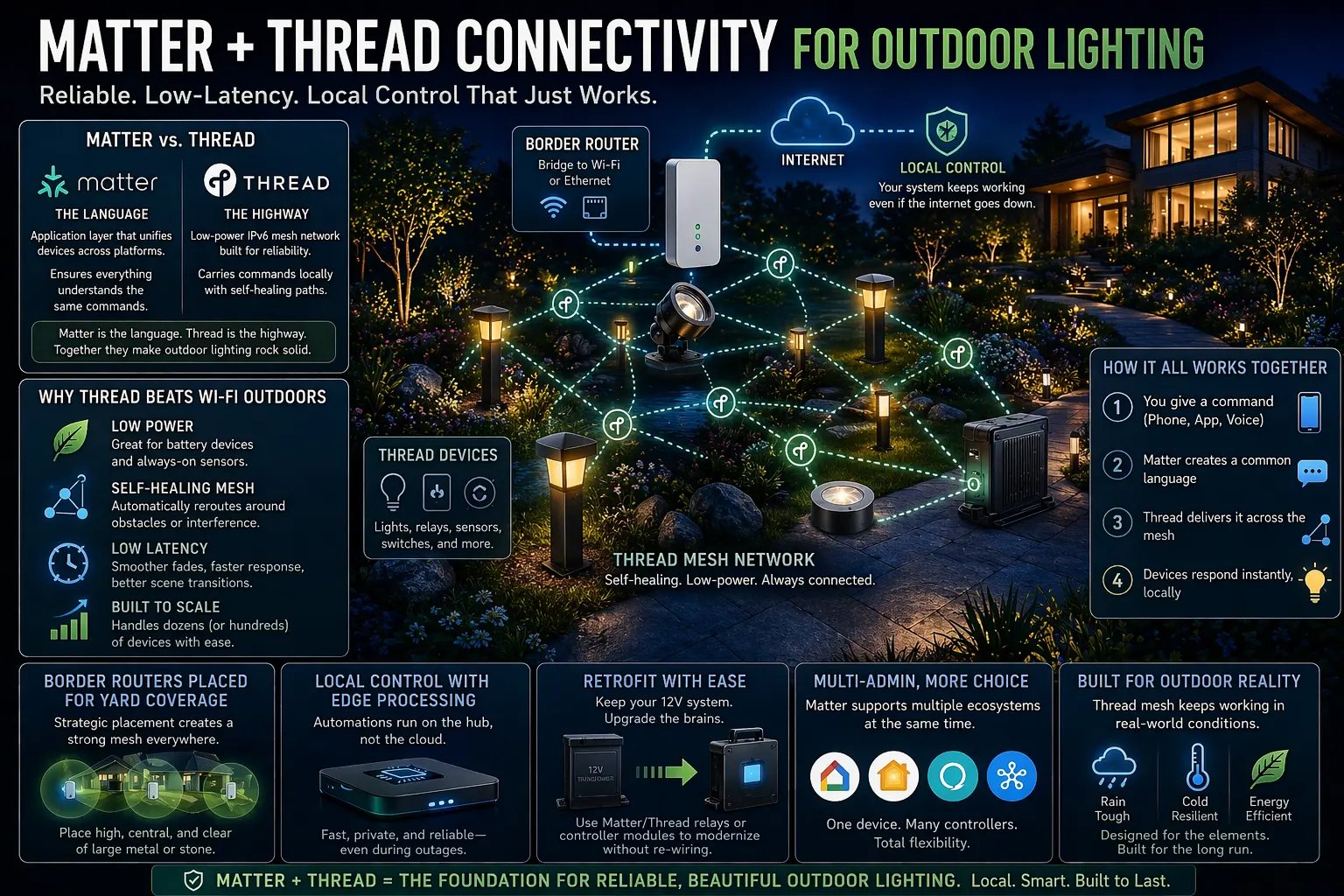
Matter and Thread Logic Summary
Outdoor automation works best when the control language and the network layer are both reliable. Matter handles device interoperability, while Thread provides a self-healing, low-power mesh that carries commands locally with less delay and less dependence on the home router.
- Matter handles device-to-device understanding across platforms
- Thread carries commands over a low-power IPv6 mesh
- Border Routers bridge the Thread mesh to Wi‑Fi or Ethernet
- Local control at the hub keeps lighting behavior working even if the internet fails
Quick Answer: Matter vs Thread
Matter is the language. It is the application layer that lets a transformer controller, a smart hub, and a phone understand the same commands.
Thread is the highway. It is the low-power IPv6 mesh network that carries those commands across the property with better reliability, lower power draw, and self-healing coverage.
This page is the network foundation for your entire automation cluster. All the advanced outdoor lighting ideas on the site depend on stable connectivity, low latency, and local control.
In other words, smooth outdoor lighting patterns only work when the network is stable, low-latency, and locally controlled.
Matter vs Thread: Clear Roles, Better Outdoor Reliability
Matter is not the mesh itself. Thread is the mesh transport. Matter can run across more than one network type, but Thread is what gives low-power outdoor devices a local, self-healing mesh path that is especially useful around yards, pathways, and detached outdoor zones.
That distinction matters because interoperability and transport are not the same problem. Matter solves the shared language problem. Thread solves the reliable local delivery problem.
This is why the page belongs beside AI outdoor lighting systems and AI automated landscape lighting. Those pages explain what the system does. This page explains how the signal gets there reliably.
Connectivity improvements often start with upgrading how older systems are controlled. Our legacy transformer retrofit guide explains how to bring older lighting systems into a more connected setup.
If your goal is a complete seasonal lighting setup rather than connectivity alone, start with the holiday lighting guide for year-round planning, holiday themes, safety, and troubleshooting.
Matter and Thread can improve response time, but they do not automatically solve transformer hum, low-end flicker, or LED inrush problems. The Matter smart landscape dimming guide explains how protocol speed works with transformers, wire gauge, drivers, and low-voltage connectors.
Why Thread Beats Wi‑Fi for Outdoor Lighting
Wi‑Fi can handle certain outdoor devices, but it is not always the best network foundation for a large group of lighting controllers, sensors, and relays. Thread is designed for low power, local responsiveness, and self-healing mesh behavior.
- Lower power draw for sensor-heavy systems
- Self-healing Mesh Topology that can reroute around node loss
- Less dependence on pushing every device onto the main router
- Better scaling when more outdoor devices are added
- Stronger local behavior for smooth scene changes
That mesh reliability becomes especially important when you connect it to pages like predictive arrival lighting and biophilic AI design patterns, where small delays can make the lighting feel fake or broken.
Border Router Logic and Outdoor Placement Strategy
A Border Router bridges the Thread mesh to the broader IP network. In practice, that means it becomes one of the most important placement decisions in the entire system.
For outdoor lighting, Border Router placement near an exterior wall, garage edge, or window-facing yard coverage area is often much smarter than leaving it buried deep inside the house. Poor placement weakens outdoor reliability even when the devices themselves are technically compatible.
Reliable connectivity helps commands move quickly, but hardware protection is what keeps the lighting system online when conditions get extreme. Our thermal throttling protection guide explains how outdoor lighting systems prevent overheating by reducing load instead of failing abruptly.
Connectivity Comparison for Outdoor Lighting
| Feature | Thread | Wi‑Fi | Zigbee / Z-Wave |
|---|---|---|---|
| Self-healing behavior | Strong mesh rerouting | Limited | Mesh-capable depending on device layout |
| Power draw | Low | Higher | Low to moderate |
| IP connectivity | Native IPv6 Network Layer | Native IP | Typically requires more translation |
| Outdoor latency | Low and local-friendly | Can vary with router congestion | Can be stable, but depends on bridge design |
| Router dependence | Lower | Higher | Depends on hub/bridge path |
| Bridge requirement | Border Router | Standard router/AP | Usually dedicated hub or bridge |
Local Control and Edge Processing
Local edge control means the hub handles automations locally instead of waiting for the cloud to approve every scene change. That matters for outdoor lighting because natural transitions, adaptive scenes, and quick sensor responses feel better when they happen without network lag.
As long as the local network is intact, a local Thread mesh plus an edge-capable hub can keep many automations working even when the internet is down.
This is one of the strongest bridge points to AI solar hybrid optimization and AI transformer voltage load balancing, because those pages only work as intended when control decisions can happen quickly and locally.
Lower late-night brightness and motion-based lighting only work well when the system responds reliably. See how to reduce light pollution with smart outdoor lighting control to understand how timing, dimming, and warm-light behavior fit into a better nighttime setup.
Multi-admin Control and Real-World Flexibility
Multi-admin Control lets supported Matter devices live in more than one smart-home ecosystem. For outdoor lighting, that means a homeowner is less likely to get trapped inside one app or one assistant just because a controller was installed years earlier.
This flexibility is especially useful in homes where the lighting system may need to interact with multiple hubs, phones, or platform preferences over time.
Holiday themes only feel smooth when the control network is reliable. Our holiday lighting automation guide shows how scheduled scenes, app changes, and zone-based color themes work best when commands reach the system consistently.
Thread Sleepy End Devices for Outdoor Sensors
Thread Sleepy End Devices are useful for battery-powered outdoor sensors because they conserve power by sleeping much of the time and waking when they need to communicate. That makes them a practical fit for occupancy, motion, or ambient-light sensing around landscape zones.
For a yard full of sensors, lower power and local mesh reliability matter far more than flashy app features.
Why Network Stability Matters for the Rest of Your Automation Upgrades
Connectivity is the glue layer for your entire automation section. Without a stable network, the smarter pages lose credibility in the real world.
Connected lighting becomes more powerful when commands can be tied to the person speaking. Our voice biometrics lighting guide explains how identity-based voice control fits into modern outdoor lighting systems.
- Biophilic AI design patterns need smooth timing so natural rhythms do not look robotic.
- Predictive arrival lighting needs low-latency response so scenes arrive when the homeowner does.
- AI transformer voltage load balancing benefits from stable local coordination between zones and control layers.
- AI solar hybrid optimization works better when power decisions and priority logic are not delayed by cloud dependence.
Retrofitting Older Portfolio Transformers for Matter
A 10-year-old 12V transformer does not need to be discarded just because it lacks modern connectivity. A Matter-enabled relay or smart controller can often be added at the transformer level to bring older systems into a newer architecture.
That makes this page especially valuable on a site with strong legacy hardware authority. The retrofit path connects your automation content to the practical reality of homeowners who already have working low-voltage infrastructure in place.
This retrofit strategy makes the strongest sense when paired with outdoor transformer lighting, transformer planning, wiring guidance, and troubleshooting.
How to Commission a Matter-Enabled Outdoor Lighting Controller
- Scan the Matter QR code.
- Authenticate through a nearby Border Router.
- Join the device to the Matter fabric.
- Assign it to the correct outdoor lighting zone.
- Verify local Thread connectivity and response speed.
- Test manual scenes and automation behavior with local control enabled.
Connectivity Standards Do Not Replace Electrical Installation Rules
Matter and Thread can improve device interoperability, but they do not eliminate the need to understand how the lighting system is actually powered and wired. If a smart lighting project includes Class 2 power supplies, low-voltage control conductors, sensors, relays, or driver control leads, the NEC Article 725 Class 2 smart lighting guide explains the physical wiring layer behind the wireless ecosystem. If you are retrofitting older outdoor lights, the outdoor lighting electrical grandfather clause guide explains why existing work may require correction when controls are upgraded. If lights appear dim, cloudy, or inconsistent because moisture is trapped inside the fixture, the Portfolio foggy lens condensation fix helps separate connectivity problems from weather-seal failures.
Matter and Thread Connectivity FAQ
What is the difference between Matter and Thread?
Matter is the application layer that lets devices understand the same commands across platforms, while Thread is the low-power IPv6 mesh network that carries those commands locally across the property.
Why is Thread better than Wi‑Fi for outdoor lighting?
Thread is often better for outdoor lighting because it uses a self-healing mesh topology, lower power, lower latency, and less dependence on the main home router than a crowded Wi‑Fi setup.
What does a Border Router do?
A Border Router bridges the Thread mesh to the broader IP network so outdoor Thread devices can communicate with apps, hubs, and other Matter devices.
What is Multi-admin Control?
Multi-admin Control allows supported Matter devices to be shared across more than one smart-home platform so the same lighting controller can work in multiple ecosystems.
What are Thread Sleepy End Devices?
Thread Sleepy End Devices are low-power battery-friendly devices, such as certain outdoor sensors, that stay asleep much of the time to conserve energy and wake when they need to report or act.
Does Matter still work if the internet goes down?
Local Matter automations can still work when the internet goes down if the local network, Thread mesh, Border Router, and edge-capable hub remain available.
How do you retrofit an older 12V transformer for Matter?
An older 12V transformer can often be modernized by adding a Matter-enabled relay or smart controller at the transformer level, allowing existing low-voltage infrastructure to join a newer control architecture.