Landscape Lighting Guide
This is the main outdoor planning hub and the best place to connect zone planning to the rest of the full landscape lighting cluster.
Read the guide
Most homeowners begin outdoor lighting by thinking about fixtures and placement. That is natural, but it is only part of the real system. A landscape lighting plan does not work well just because the fixtures are placed in attractive spots. It works well because the system is organized into sensible zones that balance power, keep wiring manageable, reduce voltage drop, and make the entire layout easier to control later.
A zone is what turns a collection of fixtures into a working system. It helps you group lights by area, by function, or by electrical load so the transformer is not doing too much in one place and the wiring does not become long, uneven, or hard to troubleshoot.
This becomes more important as the system grows. A few simple path lights near the front walk may not need much planning. A front yard with a driveway, trees, facade lighting, and multiple hardscape areas absolutely does. This page is designed to help you understand that structure clearly so your layout, wiring, transformer planning, and future expansion all work together.
Most lighting problems like dim fixtures and uneven brightness come from poor zone planning — not bad fixtures.
This page connects the design side of landscape lighting with the electrical side. For the full planning foundation, start with landscape lighting guide. If you need to understand the system basics first, also see how landscape lighting works.
See the Landscape Lighting GuideA landscape lighting zone is a group of lights connected to the same transformer output or circuit. Zoning helps balance power, reduce voltage drop, and organize your lighting system into manageable sections.
Landscape lighting zones are one of the most practical ways to organize an outdoor lighting system. They help you control different parts of the yard more logically, spread electrical load more evenly, reduce the risk of long weak wire runs, and make future troubleshooting much easier. When a system is broken into well-planned zones, the lighting usually looks more balanced and the electrical side of the system is easier to understand.
Without zoning, large systems often become messy. Too many lights may be placed on one run. Brightness may become uneven. Voltage may weaken at the far end. Wiring becomes harder to follow. And when something fails, the entire diagnosis becomes slower because the system is not clearly divided into manageable sections.
For full system layout planning, see landscape lighting layout design to connect zones with fixture placement.
A landscape lighting zone is a group of lights connected to the same circuit or transformer output that operate together as one section of the system. Instead of thinking of the yard as one large collection of fixtures, zoning breaks the lighting into organized groups that make sense.
A zone may be based on a physical area of the property, such as the front yard, driveway, backyard, or garden. It may also be based on function, such as path lighting, accent lighting, or security lighting. In larger systems, zones are also used to help manage electrical load so one run does not become too long or too heavily loaded.
Real-world examples might include a front yard zone, a driveway zone, a backyard zone, or a garden zone. Each one acts as a manageable part of the overall system instead of forcing the entire property into one oversized wiring plan.
Zones matter because they make the system easier to control, easier to balance, and easier to maintain. When the lighting is divided logically, brightness is usually more consistent, transformer load is easier to manage, and you are less likely to run into problems caused by putting too much demand on one part of the system.
Zoning lets you think about each part of the yard as its own lighting section. That makes the planning cleaner and helps the system feel more intentional.
If one zone fails while the others stay on, you immediately know the problem is likely local to that branch rather than the whole system.
Zoning makes it easier to keep brightness consistent because the fixture count and wire length in each section are easier to manage.
Breaking the system into zones helps keep too many fixtures from being forced onto one output or one run.
There is no single perfect zoning method for every property. The right structure depends on the size of the yard, the type of fixtures being used, the wire distances involved, and how you want the property to function after dark. In practice, most systems are divided in one of three useful ways.
One of the simplest methods is by location. A front yard zone, backyard zone, and side yard zone each make sense because the physical layout of the property already separates them naturally.
Some systems are divided by what the lighting is doing. Pathway lighting may be one zone. Accent lighting on trees or architectural features may be another. Security or broader coverage lighting may be another.
In larger systems, electrical balance becomes especially important. That means dividing lights into zones based on how many fixtures are on a run, how much wattage they draw, and how far they are from the transformer.
The number of zones depends on the size and complexity of the system.
Spacing affects how zones perform visually. See landscape lighting spacing to avoid uneven layouts.
Small systems often work well with 1 to 2 zones, especially if the property has only a few fixtures and the runs are short.
Medium systems often benefit from 2 to 4 zones, especially when the front yard, driveway, and garden areas each deserve their own grouping.
Larger properties may need 4 or more zones depending on the number of lights, transformer capacity, wire distances, and how spread out the lighting plan becomes.
A good way to think about it is this: the more complex the property and the longer the wire runs, the more valuable zoning becomes.
| System Size | Recommended Zones |
|---|---|
| Small yard | 1–2 zones |
| Medium yard | 2–4 zones |
| Large yard | 4+ zones |
Zoning and transformer planning belong together. Each zone may connect to a different transformer terminal, output grouping, or planned wire run. This matters because the transformer has to support the load of the entire system while still delivering usable power to each part of the layout.
Some transformers offer multiple output options or allow different runs to leave the transformer separately. That makes zoning much easier because each section of the property can be treated more intentionally instead of forcing everything into one heavy line.
For the dedicated transformer page, read landscape lighting transformer guide.
If zones vary in distance, use the voltage tap calculator to balance output correctly.
Good zone planning affects wiring layout directly. Each zone should usually have its own sensible wire path so the system stays organized and easy to follow later.
Separate runs help isolate each zone and keep one section from becoming electrically tangled with another.
Wire size plays a major role in zone performance. See wire gauge guide to match your zones correctly.
Choosing the right cable type is critical for zone reliability. See landscape lighting cable guide.
The longer the run, the greater the chance of weak power delivery at the far end.
Zone planning does not help if the connections inside each zone are weak or inconsistent.
For the full wiring basics, use how to wire landscape lighting.
One of the strongest reasons to divide a system into zones is to reduce voltage drop. Long wire runs are one of the biggest causes of dim, weak, or uneven lights in low-voltage systems. When too many fixtures are placed on one long run, the last lights in line often suffer first.
Zoning helps because it shortens distances, spreads the load more evenly, and keeps one section of the property from carrying the electrical burden of the entire yard. That usually leads to more consistent brightness and a healthier system overall.
For the detailed technical page, see landscape lighting voltage drop.
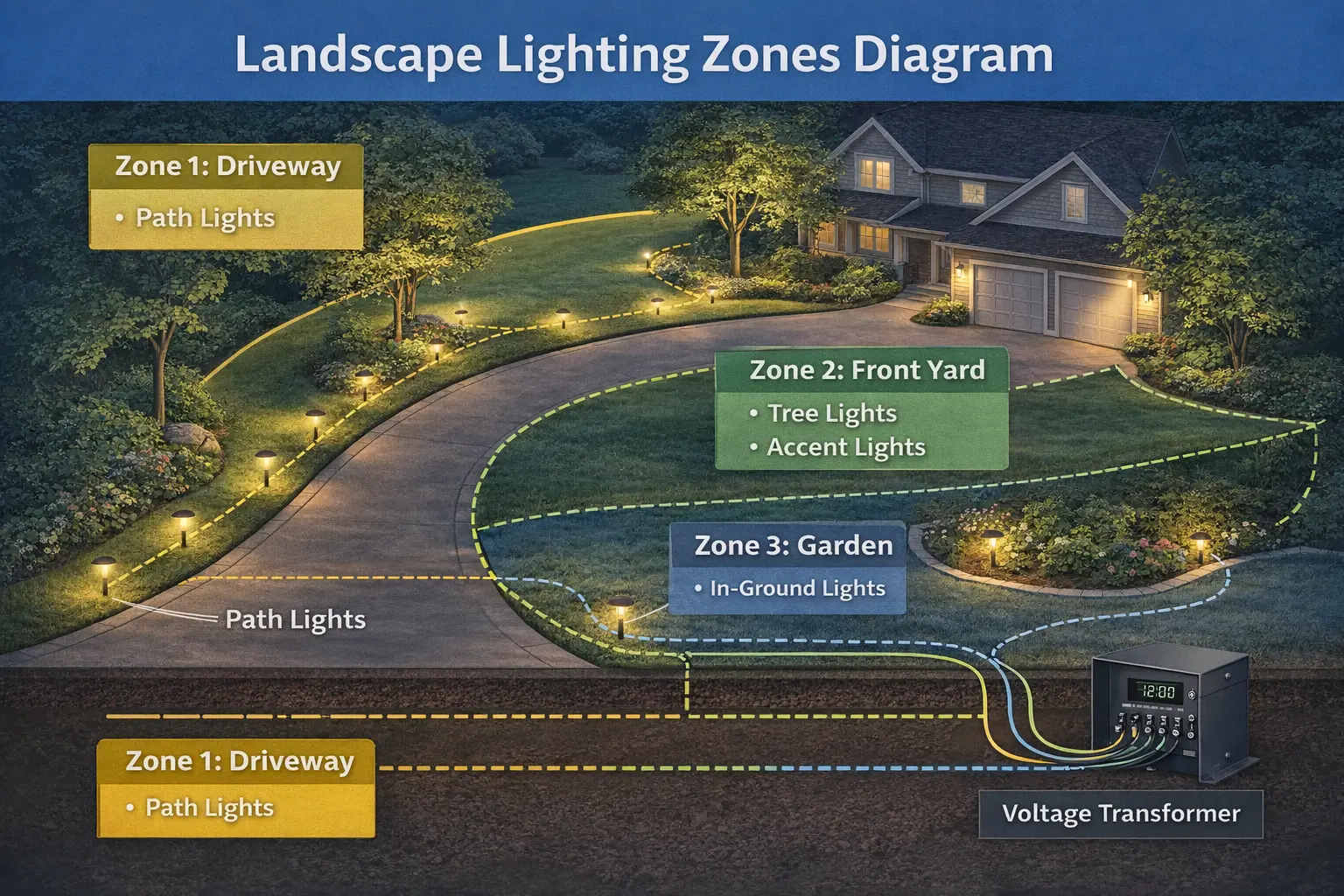
Imagine a front yard system with three clear parts:
This is a strong example because each section has a clear purpose. The driveway lights guide movement. The tree lighting adds depth and landscape interest. The facade lighting supports the architecture of the home.
Electrically, it also makes sense. Instead of putting all three jobs on one line, each zone can be planned for its own distance, fixture count, and power needs.
Timers often control the full system schedule, but the existence of zones still matters because the timer is controlling a system made up of separate sections. In some layouts, multiple zones may run on the same schedule. In other cases, the planning structure still matters even when the timer controls everything together.
If timer behavior becomes part of the problem, use landscape lighting timer not working.
A photocell usually controls whether the system turns on based on ambient light conditions. That does not remove the value of zoning. It simply means the zones operate inside a system that responds to darkness as a whole.
If photocell behavior becomes unreliable, see landscape lighting photocell not working.
This is one of the biggest mistakes because it can overload the system or at least put too much strain on one run.
Some zones end up bright and short while others become long, weak, and overloaded. That makes the system feel unbalanced visually and electrically.
Distance matters. A zone that looks fine on paper may perform poorly if the run is too long.
A property often grows over time. If the zoning plan leaves no room for added fixtures later, the system becomes harder to upgrade cleanly.
One of the biggest advantages of zoning appears when something goes wrong. If one zone fails while others still operate normally, the problem is often local to that branch. That usually points toward wiring, connectors, or fixtures in that area.
If all zones fail at once, the transformer or overall power source becomes a much stronger suspect. This is one reason zoning helps troubleshooting so much. It narrows the search faster.
For the main troubleshooting pages, use landscape lights not working and portfolio transformer not working.
A well-zoned system is easier to expand because the structure already exists. You can add a new area, increase fixture count, or upgrade part of the yard without forcing everything into one overloaded circuit.
Expansion planning may involve adding a new zone, increasing transformer capacity, or extending wiring in a more controlled way than trying to squeeze every addition into an existing run.
A well-planned zone does not always need to cover a large area. In many systems, pathway lighting may be grouped into its own zone so walkways, entrances, and transition areas can be illuminated consistently without affecting accent lights or other parts of the layout. This can make the system easier to balance and maintain over time.
The full planning sequence usually looks like this:
This order matters because it keeps the design and the electrical plan connected. For the broader hub, go to landscape lighting guide.
This is the main outdoor planning hub and the best place to connect zone planning to the rest of the full landscape lighting cluster.
Read the guideHelpful when you want to understand the overall system path before dividing it into separate zones and runs.
Read the guideUse this page when zoning decisions need to connect directly to transformer size, outputs, and load planning.
Read the guideImportant when you are moving from zone planning into actual wire runs, branch structure, and connection layout.
Read the guideOne of the most important supporting pages because zoning is one of the best ways to reduce long-run voltage loss.
Read the guideHelpful when the zone plan is solid but system scheduling or timer behavior is still keeping the lighting from operating correctly.
Read the guideUseful when the system is zoned well but photocell control creates unreliable on and off behavior across the layout.
Read the guideUse this page when one zone fails, the entire system fails, or you need step-by-step troubleshooting beyond the zone plan itself.
Read the guideBest when all zones are down and the transformer becomes the strongest suspect instead of one local zone branch.
Read the guideA lighting zone is a group of landscape lights connected to the same circuit or transformer output that operate together as one section of the system.
Small systems often use 1 to 2 zones, medium systems often use 2 to 4 zones, and larger properties may need 4 or more zones depending on fixture count, transformer size, and layout complexity.
Yes. Many landscape lighting transformers can run multiple zones by using separate wire runs, multiple terminals, or carefully planned grouped circuits.
Landscape lighting circuits are often divided by area, by fixture function, or by electrical load so the system stays balanced, easier to control, and easier to troubleshoot.
Proper zoning helps reduce voltage drop because it shortens wire runs, spreads load more evenly, and keeps one long circuit from carrying too many fixtures too far from the transformer.
This page is designed to be the system planning hub for landscape lighting zones, helping you connect layout, transformer planning, wiring structure, voltage drop prevention, troubleshooting, and future expansion into one organized outdoor lighting strategy.