
Quick Answer: Portfolio Path Light System Specifications
Portfolio path lights are low-profile, downward-directed outdoor fixtures engineered to establish visual guidance corridors without causing blinding glare. Operating as core sub-components of a balanced low-voltage landscape network, these fixtures rely on strict spacing intervals and voltage stabilization to maintain consistent illumination lines.
To ensure a professional installation that meets outdoor electrical codes and aesthetic standards, your path layout must integrate seven technical design parameters:
- Lumen Output Standards: Path fixtures typically operate between 100 to 200 lumens to provide clear structural visibility across walkways while maintaining a calm ambient balance.
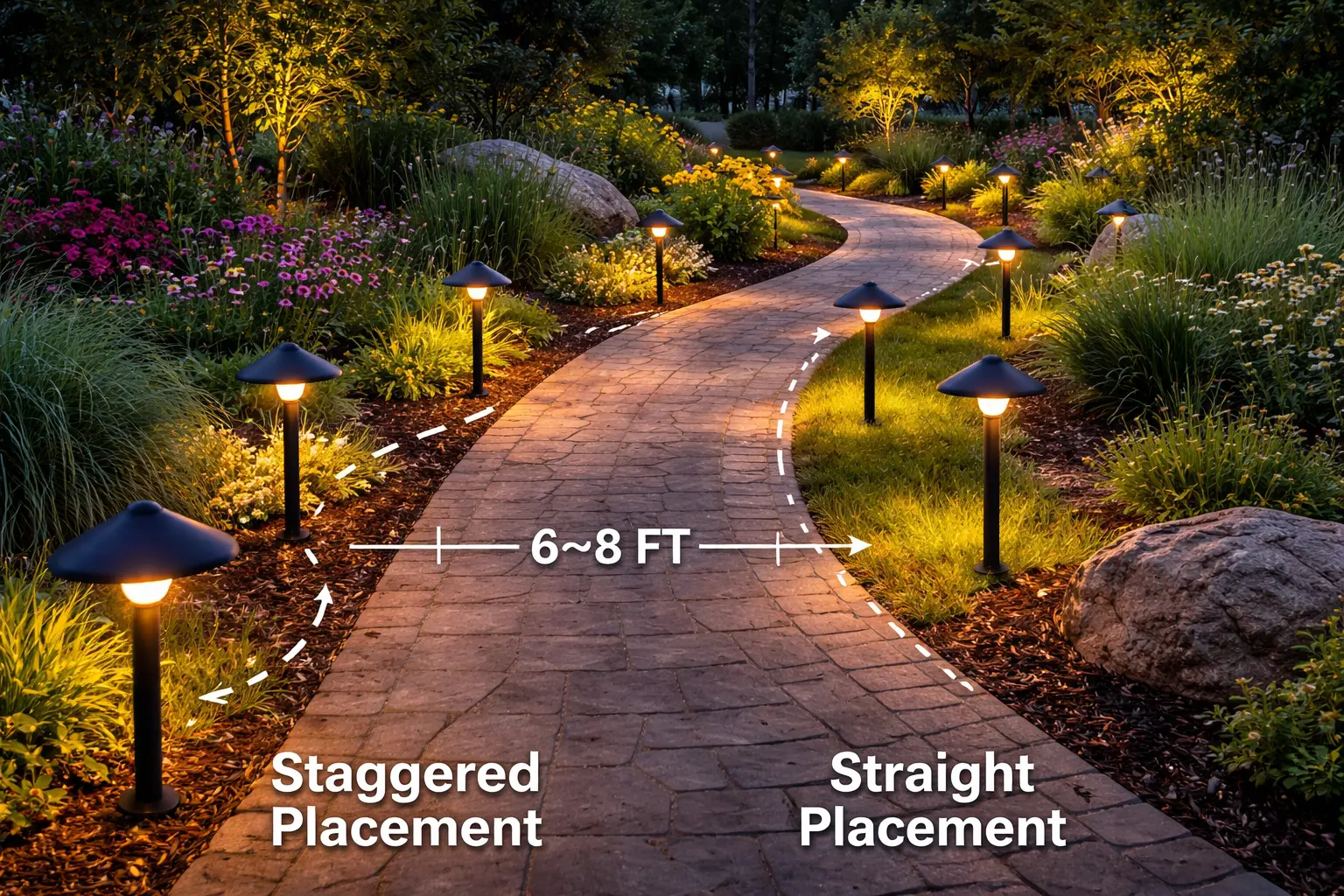
- Staggered Spacing Intervals: Fixtures must be installed 6 to 8 feet apart in an alternating, staggered layout; placing lights in perfectly straight, opposing rows creates an artificial "runway effect."
- Vertical Height & Beam Spread: Standard stem heights range from 12 to 18 inches, projecting a downward cone of light that must match the physical width of the walking surface.
- Voltage Range Stabilization: Individual fixture terminal boards must receive between 10.8V and 12.1V; slipping below this threshold causes premature halogen yellowing or severe LED driver flashing.
- Threaded Anchor Requirements: Shifting soil or foot traffic requires replacing weak factory stakes with heavy-duty 1/2-inch NPT threaded ABS ground mounts to prevent fixtures from leaning.
- Direct-Burial Wire Intersections: Main line connections must utilize heavy-duty brass pin taps or gel-filled waterproof splices to block localized ground moisture corrosion.
- Cross-Brand Driver Limitations: Mixing legacy Portfolio path fixtures with modern Origin21 replacement heads requires verifying total circuit load limits to prevent line humming.
⚠️ CRITICAL RUNWAY ERRORS: Setting up your path fixtures along a single line without checking your cable's far-end voltage drop will trigger three severe operational failures, which are mapped in our step-by-step layout blueprints below.
Instead of guessing at spacing or blindly buying replacement heads, verify your line lengths and system limits first. Use our specific database guides below to find your matching model dimensions, wiring layouts, and system balance guides.
Path Light Spacing Cheat Sheet
| Path Width | Spacing | Layout Style |
|---|---|---|
| Narrow (3ft) | 6 - 8 Feet | Single Side |
| Wide (5ft+) | 5 - 7 Feet | Staggered |
*Swipe left/right on mobile to view full table details.
Where Should You Use Path Lights?
- Along front walkways and entry paths
- Garden borders and landscape bed edges
- Driveways and side-yard passages
- Patios, transitions, and outdoor living spaces
- Any area that needs subtle nighttime guidance
Path lights are designed to guide people through outdoor spaces while also improving the look of the landscape at night. They are most often used along walkways, driveways, garden paths, and transitions around patios or entry areas where safe visibility matters.
The best path lighting usually feels intentional and quiet. It should help visitors understand where to walk, highlight the shape of the space, and fit naturally into the rest of the outdoor design without creating a runway effect.
Path lighting works best when it turns on at the right moment without noticeable delay. Our edge vs cloud lighting guide explains why local control can make outdoor lighting feel faster, smoother, and more reliable.
How to Design Path Lighting the Right Way
The biggest mistake with path lights is focusing on the fixture instead of the layout. Good path lighting comes from spacing, placement, and how the lights guide movement through the space.
- Spacing: typically 5–8 feet apart depending on brightness
- Placement: stagger lights instead of lining them up evenly
- Goal: create a natural rhythm of light, not a runway effect
Once the layout is correct, choosing fixtures and installing them becomes much easier.
How Many Path Lights Do You Need?
The number of path lights depends on the length of the walkway and the spacing between fixtures. Most layouts use lights every 5 to 8 feet, but the goal is even coverage rather than a fixed number.
If your path light is no longer working, this Portfolio 0688503 repair guide walks through the most common causes of failure, including connectors, voltage drop, and integrated LED issues.
How Bright Should Path Lights Be?
Path lights should provide enough light to guide movement without creating glare. Softer light often produces better results than high brightness, especially in residential landscapes.
Portfolio Path Lighting Help Center
If you are planning a new path light layout or fixing an older low voltage system, these pages can help with design, spacing, transformer setup, wiring, and troubleshooting.
If your path lights are dim, flickering, or not turning on at all, the issue is often related to wiring connections, voltage drop, or transformer problems rather than the fixtures themselves. Before replacing parts, it’s worth walking through a structured diagnostic process to identify the exact cause. This Portfolio lighting troubleshooting guide covers the most common issues homeowners run into and shows you how to test, isolate, and fix problems step by step.
If you are replacing a failed path light from model 0312384, use our 0312384 parts guide to find compatible replacement fixtures and components.
What Are Portfolio Path Lights?
Portfolio path lights are typically low voltage outdoor fixtures designed to illuminate the edges of a walkway or path rather than flood the entire yard with light. They are different from spotlights, which are meant to highlight a specific feature, and different from floodlights, which cover a much wider area with stronger output.
Path lights are one part of a complete outdoor lighting system. If you are building a full layout, start with this Portfolio Lighting Guide, Plan and Placement page to understand how path lighting fits into a balanced outdoor design.
Most path lights are used for guidance, visual rhythm, and curb appeal. They help define the walkway, separate the walking surface from the surrounding landscape, and create a more polished look at night.
Path Lights vs Spotlights vs Floodlights
| Fixture Type | Main Job | Best Use | What It Does Best |
|---|---|---|---|
| Path lights | Guide movement and define edges | Walkways, garden paths, driveway borders | Creates safe, comfortable navigation |
| Spotlights | Highlight a focal feature | Trees, walls, statues, architectural details | Draws attention to one feature |
| Floodlights | Cover a larger area | Wide zones, security, broader outdoor coverage | Provides stronger general illumination |
Best Places to Use Portfolio Path Lights
Proper placement is what makes path lighting look clean and professional instead of uneven or cluttered. For a deeper breakdown of layout strategies, visit Landscape Lighting Layout Design to see how path lights work alongside accent and focal lighting.
Walkways
Walkways are the most common place for path lights because they benefit directly from better nighttime guidance. The lights help define where to walk without turning the area into a bright corridor.
Driveway Edges
Path lights can be useful along driveways when the goal is to define edges, soften the look of the hardscape, and improve visibility without relying on intense flood lighting.
Garden Paths
Garden paths often look best with softer path lights that work alongside planting beds and accent lighting. In these areas, the path light should support the landscape instead of overpowering it.
Around Patios and Outdoor Transitions
Patios, side yards, and small step-down areas can all benefit from path lighting when there is a change in direction, elevation, or walking surface that needs to be easier to read at night.
Path Light Spacing Rules
Spacing is one of the most important parts of path lighting. Lights placed too close together can look harsh, while lights too far apart create dark gaps. Follow this Landscape Lighting Spacing guide to achieve more consistent and safe illumination.
Many path light layouts end up somewhere around 5 to 8 feet apart, but that is not a hard rule. The real answer depends on fixture output, fixture height, path width, and whether you want a softer or stronger visual rhythm.
In many cases, a staggered layout looks more natural than placing fixtures directly across from each other on both sides. That helps avoid the runway look and makes the path feel more inviting.
How to Install Portfolio Path Lights
Most Portfolio path lights are part of a low voltage system that is straightforward to install with the right setup. If you are wiring your own system, follow this How to Wire Landscape Lighting guide to help ensure safe and reliable installation.
Stake Placement
Many path lights install with a ground stake, which makes planning easier because you can test spacing and positioning before everything is finalized. That flexibility is one of the reasons path lights are so practical for walkways and gardens.
Wire Routing
Wire routing should be planned before the fixtures are set permanently. Clean routing makes the system easier to maintain, less noticeable, and less likely to create trouble later if a fixture needs service or replacement.
Transformer Connection
The path lights must be tied into a transformer correctly so the system receives stable low voltage power. A weak plan at this stage often leads to dim lights, inconsistent brightness, or early troubleshooting headaches.
Choosing the Right Transformer
Your transformer powers the entire lighting system, including path lights. Choosing the right size helps prevent dim lighting and system overload. Learn how to size the system correctly in this Landscape Lighting Transformer Guide.
This becomes even more important if your path lights are only one part of the full outdoor system. Adding more fixtures later without enough transformer capacity is a common reason systems become unreliable.
Voltage Drop Problems in Path Lighting
If your path lights appear dim at the end of the run, voltage drop is often the cause. This is especially common in longer pathways. Use this Landscape Lighting Voltage Drop guide to diagnose and fix uneven lighting issues.
Voltage drop is one of the main technical reasons a path lighting layout can look inconsistent even when the fixtures themselves are fine. The farther the run and the more fixtures added, the more important this becomes.
Common Path Lighting Mistakes
Many path lighting issues come from simple mistakes like incorrect spacing, poor placement, or using the wrong fixtures. Avoid these problems by reviewing Landscape Lighting Mistakes before installing your system.
Too Much Light
More light is not always better. Over-lighting a walkway can make the yard feel harsh and can reduce the elegance that path lighting is supposed to add.
Ignoring the Path Shape
Curves, intersections, and changes in width should influence where fixtures go. A path is rarely just a straight line that needs identical spacing from one end to the other.
Forgetting the Rest of the Design
Path lights look best when they work with nearby plantings, walls, and focal lighting rather than competing with them.
Troubleshooting Portfolio Path Lights
If your path lights are not turning on, flickering, or only partially working, the issue is usually related to wiring, connections, or the transformer. Use this Portfolio Lighting Troubleshooting Guide to identify and fix the problem step by step.
Common problems include a section of the path going dark, a few fixtures becoming much dimmer than the rest, lights that blink on and off, or a transformer that is no longer providing stable output. Those symptoms can have different causes, so the smartest approach is to narrow the problem before you start replacing parts.
Should You Repair or Replace Path Lights?
Many path lighting problems can be fixed without replacing the entire fixture. Issues like dim lights, broken stakes, or loose connections are often repairable.
If the fixture housing is damaged or outdated, replacing the full light may be the better option.
Replacement Parts and Buying Options
If your path lights are damaged, outdated, or no longer performing well, replacement parts or new fixtures may be the best solution. Explore options in Portfolio Lighting Parts and Accessories to find compatible components for your system.
Replacement often makes sense when the fixture body is cracked, the stake is broken, the lens is damaged, the bulb or LED module is failing, or the connector is no longer reliable. In some situations, a parts-based repair is smarter than replacing the full system.
Portfolio Path Lights FAQ
Why are my Portfolio path lights blinking?
Blinking usually indicates a transformer overload or a short circuit in the low-voltage wire. Check your total wattage against the transformer's capacity to ensure it is not exceeding the rated limit.
How far apart should path lights be placed?
For most residential walkways, path lights should be spaced 5 to 8 feet apart. This spacing helps avoid a "runway" effect while maintaining safety and a comfortable rhythm of light along the path.
How many lumens do path lights need?
Most path lights do not need extreme brightness. Softer light often creates the best mix of visibility and appearance, especially on residential walkways and garden paths.
Why are my path lights dim?
Dim path lights often point to voltage drop, a transformer issue, loose or corroded connections, or aging fixture components somewhere along the run.
Can I install path lights without a transformer?
Some alternatives exist, such as solar products, but most Portfolio path lights are part of a low voltage system that uses a transformer for more consistent performance.
Do path lights need to be staggered?
Staggering often creates a better visual result than placing fixtures directly across from each other. It usually feels more natural and helps avoid the runway effect.