AI Predictive Maintenance
Use this page to understand how systems detect fault signals before a visible failure fully develops.
Read the guide
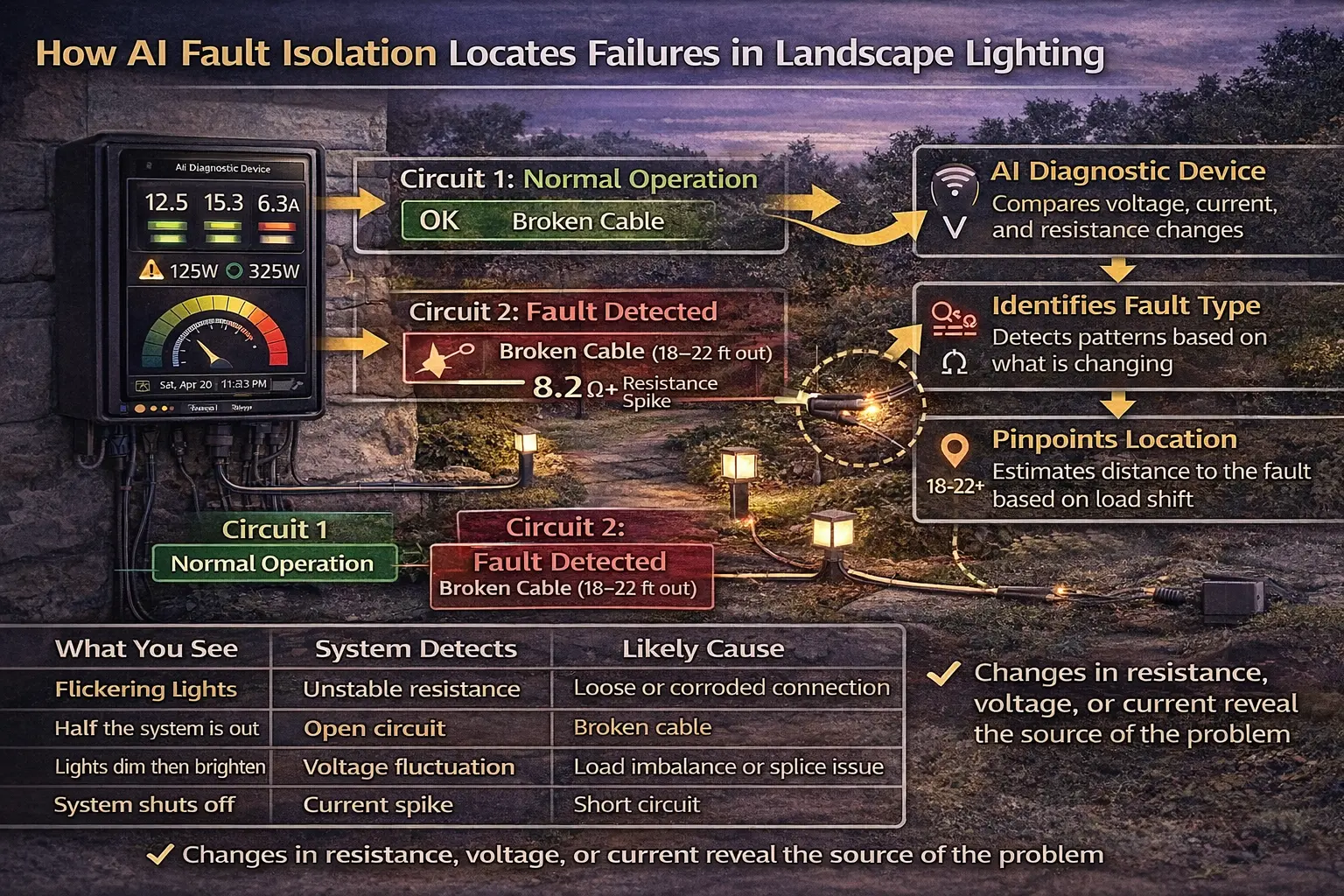
AI fault isolation is the process of identifying exactly where a lighting system is failing by analyzing electrical behavior like voltage drop, resistance changes, and load imbalance.
Instead of manually testing wires and fixtures, the system detects patterns that reveal whether the problem is a loose connection, damaged cable, or failing component.
This matters because outdoor lighting failures rarely begin with a clear label attached to them. Homeowners see flickering, dimming, half the system going out, or a full shutdown. Fault isolation translates those symptoms into electrical logic that points toward the most likely cause.
That makes this page different from a basic troubleshooting article. The focus here is not only on what failed, but on how a system narrows the problem area before the whole installation has to be checked by hand.
If you want the broader system context first, start with AI outdoor lighting systems and AI automated landscape lighting. If you want the physical system foundation behind the logic, review low-voltage lighting, wire gauge, and voltage drop.
See Troubleshooting GuidesFault isolation works by detecting changes in electrical behavior and using those changes to locate the source of a problem. Instead of guessing, the system compares how the lighting should behave to how it is behaving now.
This page is designed to explain engineering-level fault detection in a way that still makes sense to a homeowner. The core idea is simple: different failures create different electrical fingerprints, and those fingerprints can be used to narrow the likely problem area much faster than manual guessing.
That makes fault isolation one of the most practical AI layers in an outdoor lighting system. It connects what the homeowner sees to what the system can detect.
A system finds faults by monitoring electrical behavior and comparing it to normal operation. Changes in voltage, resistance, or current reveal whether the issue is a broken wire, loose connection, or overloaded circuit, allowing the system to isolate the problem area quickly.
| What You See | What the System Detects | Likely Cause |
|---|---|---|
| Flickering lights | Unstable resistance | Loose or corroded connection |
| Half the system is out | Open circuit | Broken cable |
| Lights dim then brighten | Voltage fluctuation | Load imbalance or splice issue |
| System shuts off | Current spike | Short circuit |
This is one reason the page fits naturally beside AI predictive maintenance and AI transformer load balancing. Those pages focus on early warning and electrical stability, while fault isolation focuses on narrowing the actual failure.
Fault isolation works by narrowing down the location of the problem instead of checking every connection manually.
This allows the system to focus on the exact section of wiring instead of the entire installation. That is especially valuable in larger systems where a single damaged splice or cable break could otherwise take a long time to find.
Some advanced systems go a step further by estimating how far away the fault is instead of only identifying the affected zone. This is done by sending a low-voltage pulse down the line and measuring how long it takes for that pulse to reflect back from a break, short, or major wiring defect.
That timing can be used to estimate the linear distance to the problem area, which helps narrow the repair to a smaller section of cable instead of forcing a full-yard dig. In practical terms, that can turn a wide search into a much more targeted repair.
Modern systems can isolate faults automatically, but many failures originate from voltage loss across wiring. See minimizing voltage drop and energy waste for a deeper technical breakdown.
When the symptom is already visible, pages like lights not working, lighting troubleshooting, and voltage drop help connect the diagnosis to the repair path.
If the likely cause points back to cable condition or run length, it also helps to compare wire gauge and low-voltage system design so the repair solves the root problem instead of only the visible symptom.
Many standard transformers rely on physical fuses or internal protection to shut down when something goes wrong. While this protects the system, it does not explain what caused the problem.
More advanced setups add monitoring and control layers that detect issues earlier and provide more insight into what is happening in the system. That can include load tracking, abnormal resistance detection, and zone-based comparison against known normal behavior.
This is where AI-driven outdoor lighting becomes more useful than a passive transformer alone. The system is not just powering fixtures. It is interpreting electrical behavior.
Fault isolation is one part of a larger AI lighting stack. It works alongside predictive maintenance, transformer load balancing, and system automation to create an outdoor lighting environment that is easier to diagnose, maintain, and trust.
Together, these pages turn lighting into a diagnostic system instead of a black box that only gets attention after a failure.
Use this page to understand how systems detect fault signals before a visible failure fully develops.
Read the guideHelpful when fault logic interacts with load instability, voltage behavior, and real-time electrical correction.
Read the guideUse this page for the broader architecture behind AI monitoring, fault detection, automation, and system control.
Read the guideUseful for the wider automation layer that controls scenes and behavior once the system is healthy and stable.
Read the guideHelpful when you need the broader repair workflow after fault logic has narrowed the likely cause.
Read the guideGood support page for the physical lighting system underneath the diagnostic layer.
Read the guideUse this page for fixture and layout context across the zones that fault isolation is testing.
Read the guideImportant for understanding how cable size affects electrical behavior and fault symptoms.
Read the guideUseful for understanding one of the most common electrical patterns that can look like a fault.
Read the guideUse this page when the fault has already progressed into a visible outage and you need the repair path.
Read the guideAI fault isolation is the process of using electrical behavior such as voltage, resistance, and current changes to determine where a lighting system is failing and what type of fault is most likely involved.
The system compares current electrical behavior to normal performance. Changes in voltage, resistance, or current help reveal whether the issue is a broken wire, loose connection, or overloaded circuit.
Flickering often points to unstable resistance, which is commonly caused by a loose, damaged, or corroded connection.
A short circuit usually causes a sudden current spike and shutdown, while an open circuit stops current flow and leaves part of the system dark.
It can reduce the amount of guesswork and narrow the problem area much faster, but physical inspection and repair are still needed once the likely fault is identified.
Zone isolation helps the system narrow the fault to a specific section of wiring or fixtures, which reduces the time spent checking the entire installation.
This page focuses on how outdoor lighting faults can be identified through electrical behavior instead of guesswork alone. It explains how flickering, voltage changes, resistance spikes, and zone failures connect to real system problems so homeowners can understand why a failure is happening before starting repairs.