
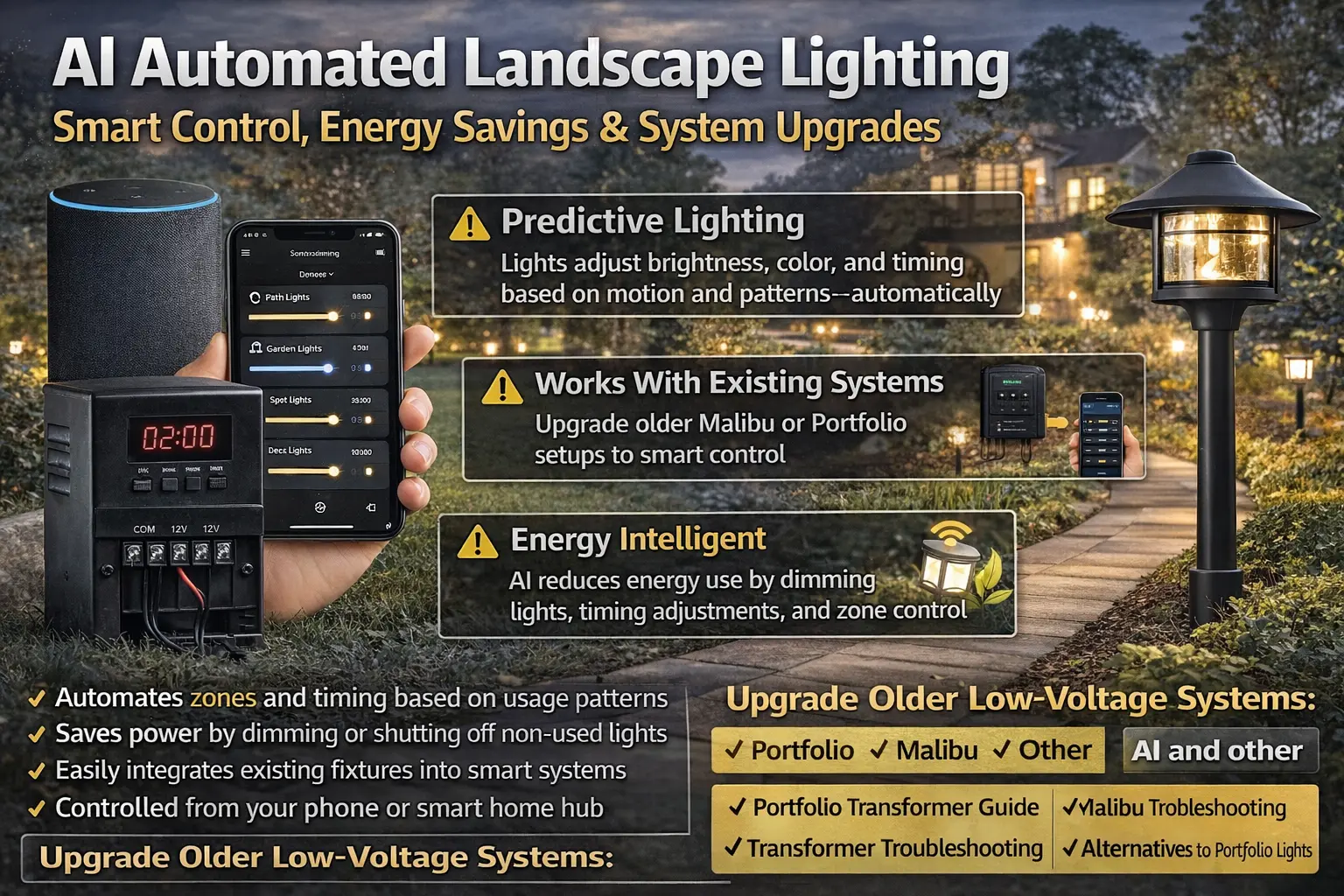
AI landscape lighting uses smart controllers, sensors, and automation to adjust outdoor lighting in real time based on motion, schedules, and environmental conditions.
Quick Answer
AI landscape lighting uses smart controllers, sensors, and automation to adjust outdoor lighting based on motion, schedules, and environmental conditions.
- Automatically turns lights on and off based on activity
- Adjusts brightness to save energy
- Can integrate with smart home systems
- Works with both new systems and many upgraded legacy systems
How AI Landscape Lighting Works
- Controller: Manages schedules and automation rules
- Sensors: Detect motion, light levels, and activity
- Zones: Divide the yard into functional lighting areas
- Automation: Adjusts brightness and timing automatically
These components work together to create a system that responds to real conditions instead of following a fixed timer.
Before adding automation, it is important to confirm compatibility between your transformer and smart hub. The smart hub compatibility guide walks through the safest and most effective ways to connect your lighting system.
For a focused look at how outdoor lighting can improve security while still looking balanced, see the AI security and ambient lighting guide. It covers false triggers, brightness control, and better lighting behavior at night.
This page focuses on how to upgrade older low-voltage landscape lighting systems with better control and smarter operation. Many homeowners already have wiring in place, working fixtures, and a transformer that can either be improved or replaced. The goal is not to start over—it is to make the system easier to control and more efficient to run.
Modern outdoor lighting upgrades usually come down to better controllers, sensor-based operation, mobile access, and simple zone control. Instead of running on a fixed timer, the system can respond to real use, adjust brightness when needed, and reduce wasted runtime. The result is a setup that works more naturally, uses less power, and fits how the property is actually used.
If you want to understand how AI-driven landscape lighting can learn real homeowner routines instead of just reacting to motion, read predictive arrival lighting behavior patterns. It breaks down how smart systems can model 6 PM versus 9 PM arrival habits and adjust lighting zones automatically.
As more landscape lighting systems use smart controls and automation, installation requirements are evolving. See NEC 2026 landscape lighting code updates to understand how modern code applies to smart lighting systems, controllers, and limited-energy wiring.
Automated Landscape Lighting Logic Summary
Automated landscape lighting works best when the system responds to real outdoor conditions instead of relying only on fixed schedules. The goal is to make lighting feel natural, useful, and consistent without constant manual adjustment.
- Good automation follows patterns, timing, and actual lighting needs
- Schedules alone are less reliable than systems that adapt to conditions
- Control is more effective when zones can respond independently
- The best results come from combining timing, sensing, and stable system design
Predictive AI Landscape Lighting (Next-Level Automation)
The biggest difference between standard smart lighting and more advanced AI-style landscape lighting is prediction. A simple timer follows fixed instructions. A more advanced system can respond to patterns and make better decisions over time. That means lighting zones can prepare for use before someone reaches the front walk, dim after activity falls off, and create a more natural flow across the property instead of one fixed brightness level all night long.
- lights activate before normal arrival times based on routine patterns
- brightness adjusts based on movement and property activity
- different zones can follow different rules for front yard, driveway, backyard, and path lighting
- color temperature can shift warmer later at night for a calmer look
The reason this matters is simple: it makes outdoor lighting feel useful instead of mechanical. A responsive system can keep the entry area safer without blasting the whole yard at full brightness for hours that no one is outside. That is the real promise of predictive lighting. It is not novelty. It is smarter use of the system you already have or the system you are building.
AI landscape lighting is not just about automation rules and schedules. Our AI transformer voltage load balancing guide explains how AI can solve a deeper electrical problem by correcting load imbalance, reducing voltage drop effects, and managing power more intelligently across outdoor lighting zones.
Automation is only part of the long-term value of an AI lighting system. The next step is using that same intelligence to detect hidden electrical faults before they cause dimming, flickering, or full zone failure. To see how that works in real low-voltage systems, read AI predictive maintenance for outdoor lighting.
Automated landscape lighting works best when voice requests can flow naturally into the same scene and zone logic the system already uses. Instead of treating voice as a separate feature, strong systems connect spoken requests to the same control rules used for automated lighting behavior. For that interpretation layer, visit AI voice lighting logic.
Automation becomes even more effective when the power system itself is flexible. Our solar hybrid lighting optimization guide explains how combining solar and low-voltage transformer power improves reliability, protects batteries, and keeps outdoor lighting running in changing conditions.
Automation improves convenience, but lighting quality also depends on how it changes over time. See biophilic outdoor lighting design patterns to learn how natural brightness shifts and timing can make automated lighting feel more comfortable and realistic.
Can AI Work With Existing Landscape Lighting Systems?
Yes. Many smarter outdoor lighting upgrades can be added to existing low-voltage setups using better controllers, upgraded transformers, or app-based control devices.
This is one of the most important parts of the whole page because it breaks the idea that you must replace every fixture to modernize a yard. In many cases, older systems can be upgraded in layers. You may keep the cable. You may keep part of the fixture inventory. You may keep some path lights and only change the control side first.
That is especially useful for homeowners starting with older Portfolio or Malibu systems. If you are already dealing with aging control hardware, compare your current setup with Portfolio Lighting model 121408 transformer manual, Portfolio lighting transformer troubleshooting, and Malibu 8100-9120-01 not working. Those pages help you understand whether your existing transformer is something to keep, repair, or retire.
Most automated landscape systems only focus on convenience, but true wellness lighting requires biological timing logic. The circadian health automation guide explains how AI schedules can dynamically reduce brightness, shift color temperature, and minimize glare exposure throughout the evening to support healthier nighttime adaptation and improved outdoor comfort.
How AI Reduces Energy Use in Landscape Lighting
AI-controlled lighting reduces energy use by adjusting brightness, runtime, and activation based on real-world conditions.
- dimming lights when no motion is detected
- reducing runtime during low-activity hours
- prioritizing brighter output only where activity is happening
- cutting unnecessary power draw across zones that do not need full output
These changes matter more than many homeowners expect. Traditional systems often run too long and too bright because they only know one rule: on at this time, off at that time. A smarter system can use a lighter touch. That usually lowers electricity use, reduces heat stress on components, and helps LED lamps and drivers last longer.
If your current system already struggles with load, dim zones, or transformer limits, compare these ideas with landscape lighting transformer size calculator, landscape lighting voltage drop calculator, and Portfolio lighting transformer wattage guide. Better automation works best when the electrical basics are already in safe shape.
One of the strongest examples of automated outdoor lighting is hidden hardscape lighting built into steps, caps, and wall edges. This hardscape and linear step lighting guide explains how to combine glow-line design, low-voltage LED strips, and smart control into a cleaner outdoor layout.
Traditional vs Smart Landscape Lighting
| Traditional System | AI-Driven System |
|---|---|
| Fixed timer schedule | Adjusts based on activity and conditions |
| Full brightness all night | Dimming based on usage |
| Manual adjustments | Automatic zone control |
| Higher energy use | Optimized energy consumption |
Automated lighting should still use quality light sources so you aren't wasting time or missing important upgrades. See CRI 95 vs CRI 80 color rendering to understand how spectrum quality affects comfort and visual clarity.
How to Upgrade to AI Landscape Lighting
- Start with a smart-compatible transformer or controller.
- Replace older halogen bulbs with LED where practical.
- Add motion sensors or activity triggers for key zones.
- Connect the system to an app, hub, or central smart control point.
The best upgrade path is usually staged, not all at once. Start by improving the control side. Then modernize the light source. Then add better triggers and zoning. This keeps the project manageable and lets you see which improvements deliver the biggest real-world value on your property.
Can I Make My Old Landscape Lighting Smart?
Yes, most low-voltage systems can be upgraded using smart controllers or transformers without replacing all fixtures.
This is one of the strongest reasons this topic works as an authority page. It connects the world of troubleshooting old systems to the world of modern upgrades. If your current setup still has useful cable and at least some working fixtures, you often have more to build from than you think. The question becomes which parts are worth keeping and which parts are holding the system back.
Is AI Landscape Lighting Worth It?
For many properties, yes. Smarter outdoor lighting improves convenience, reduces waste, and makes the system feel more responsive and useful.
The real value is not just that you can control lights from a phone. The real value is that the system can better match safety, visibility, comfort, and appearance with less constant manual adjustment. For many homeowners, that is worth far more than another year spent trying to live with a tired timer and outdated control logic.
Cross-Brand Control Is a Big Part of the Future
A smart outdoor lighting page should not live inside one brand silo. Real properties are mixed. Some homeowners have leftover Portfolio fixtures. Some have Malibu parts. Some have newer replacements mixed into older cable. A useful system page has to speak to that reality.
That is why cross-brand control matters so much. The future of outdoor lighting is not tied to one discontinued fixture line. It is tied to whether the controller, transformer, wiring, sensors, and fixtures can work together in a reliable way. If you are comparing options across systems, useful next reads include Portfolio lighting alternatives, best replacement for Portfolio landscape lighting, Malibu lighting replacement parts, and Portfolio lighting compatibility guide.
What a Fully Automated Outdoor Lighting System Usually Includes
| System Part | What It Does | Why It Matters |
|---|---|---|
| Smart transformer or controller | Runs schedules, zones, and automation logic | Acts as the control center for the whole system |
| LED fixtures or LED-compatible lamps | Provide lower-energy, longer-life light output | Make smarter dimming and runtime strategies more practical |
| Sensors or triggers | Detect movement, light level, or user activity | Allow the system to respond instead of only following a clock |
| Zone design | Separates walkways, driveway, backyard, and accents | Lets the system apply different rules where needed |
| App or hub control | Provides remote access and setup changes | Makes the system easier to manage over time |
In the real world, this means your future upgrade path is usually clearer than it first appears. You do not need every piece on day one. You need a smart starting point and a system plan that keeps your next changes moving in the same direction.
Automation works best when the lighting network itself is stable. See Matter and Thread connectivity for outdoor lighting to understand how controllers, hubs, and outdoor devices communicate without depending entirely on congested Wi-Fi connections.
How This Page Fits Into a Better Outdoor Lighting Strategy
This page works as a true authority bridge because it speaks to three groups at once. It helps homeowners building a new smart system from scratch. It helps homeowners upgrading older Portfolio or Malibu equipment. And it helps people who are simply trying to get more life and better control out of low-voltage infrastructure they already own.
For a broader understanding of how modern outdoor lighting systems are designed, controlled, and upgraded, see the AI outdoor lighting systems guide. It explains how smart controllers, sensors, and system design come together to create a more efficient and responsive lighting setup.
Automation is not only about schedules or motion triggers. Some systems adjust lighting gradually through the evening to match how outdoor spaces are actually used. This type of lighting focuses on comfort, timing, and visibility instead of fixed settings. To understand that approach, see circadian outdoor lighting.
Automation works best when the system can also recognize when something has gone wrong electrically. If a zone stops responding or lighting becomes unstable, the next step is not just more automation—it is better diagnosis. For that layer, read AI fault isolation logic for landscape lighting.
Starting With an Older Transformer?
Check whether your current transformer is worth keeping before you plan the upgrade.
Check Transformer HealthNeed a Better Replacement Path?
Compare smarter replacement options if the old system is too limited.
See AlternativesNeed Brand Compatibility Help?
Make sure the control side, cable, and fixtures can work together.
Check CompatibilityCommon Questions About AI Landscape Lighting
Can I make my old landscape lighting system smart?
Yes, most low-voltage landscape lighting systems can be upgraded with smart controllers or compatible transformers without replacing all fixtures. This allows you to add automation, scheduling, and remote control to an existing setup.
Do I need to replace all my lights to use AI lighting?
No, most upgrades focus on the transformer or controller, not the fixtures. Existing lights can usually stay in place while the control system is improved.
How does AI landscape lighting save energy?
AI lighting reduces energy use by adjusting brightness, runtime, and activation based on activity and conditions. Lights can dim or turn off automatically when full brightness is not needed.
What is the difference between smart lighting and AI lighting?
Smart lighting follows schedules and manual controls, while AI lighting adapts automatically based on usage, motion, and environmental conditions. This makes AI systems more responsive and efficient.
Can AI lighting work with older transformers?
Yes, many older transformers can be upgraded with smart controllers or replaced with AI-compatible units. This allows modern automation without rebuilding the entire system.
AI Landscape Lighting FAQ
What is AI landscape lighting?
AI landscape lighting uses smart controls, sensors, schedules, and automation rules to adjust outdoor lighting based on activity, timing, and changing conditions.
Can I make my old landscape lighting smart?
Yes. Many older low-voltage systems can be upgraded with a smarter transformer, controller, or app-based control system without replacing every fixture.
Does smart outdoor lighting save energy?
Yes. It can lower energy use by dimming zones, reducing runtime, and using full output only when and where it is needed.
Can AI work with Portfolio or Malibu systems?
In many cases, yes. Legacy low-voltage systems can often be upgraded if the wiring, load, and fixture condition are still usable.
Is AI landscape lighting worth it?
For many homeowners, yes. Better control, improved efficiency, and easier system management make it a strong upgrade path for many outdoor lighting setups.
Final Note
AI landscape lighting is less about technology and more about better control. When lighting responds to how a property is actually used, it becomes more efficient, easier to manage, and more useful day to day. Whether you are upgrading an older system or starting fresh, the goal is the same: a setup that works with you instead of forcing you to work around it.