
Quick Answer
To minimize voltage drop and energy waste, reduce resistance in the wiring, keep transformer loads reasonable, use heavier wire on long runs, and apply better layouts such as center-feed or T-method wiring. The goal is not just brighter lights, but less wasted heat and better long-term efficiency.
Reducing voltage drop is only one part of building a more efficient outdoor lighting system. For a broader approach that also covers light pollution, fixture direction, and responsible nighttime design, see the Dark Sky compliance guide.
Quick Decision: What Reduces Voltage Drop Fastest?
- Long run: use heavier wire
- Far-end dim lights: use a higher voltage tap
- One long daisy chain: switch to center-feed or T-method
- Transformer near max load: reduce circuit load or resize transformer
Rule of 5 and Core Efficiency Logic
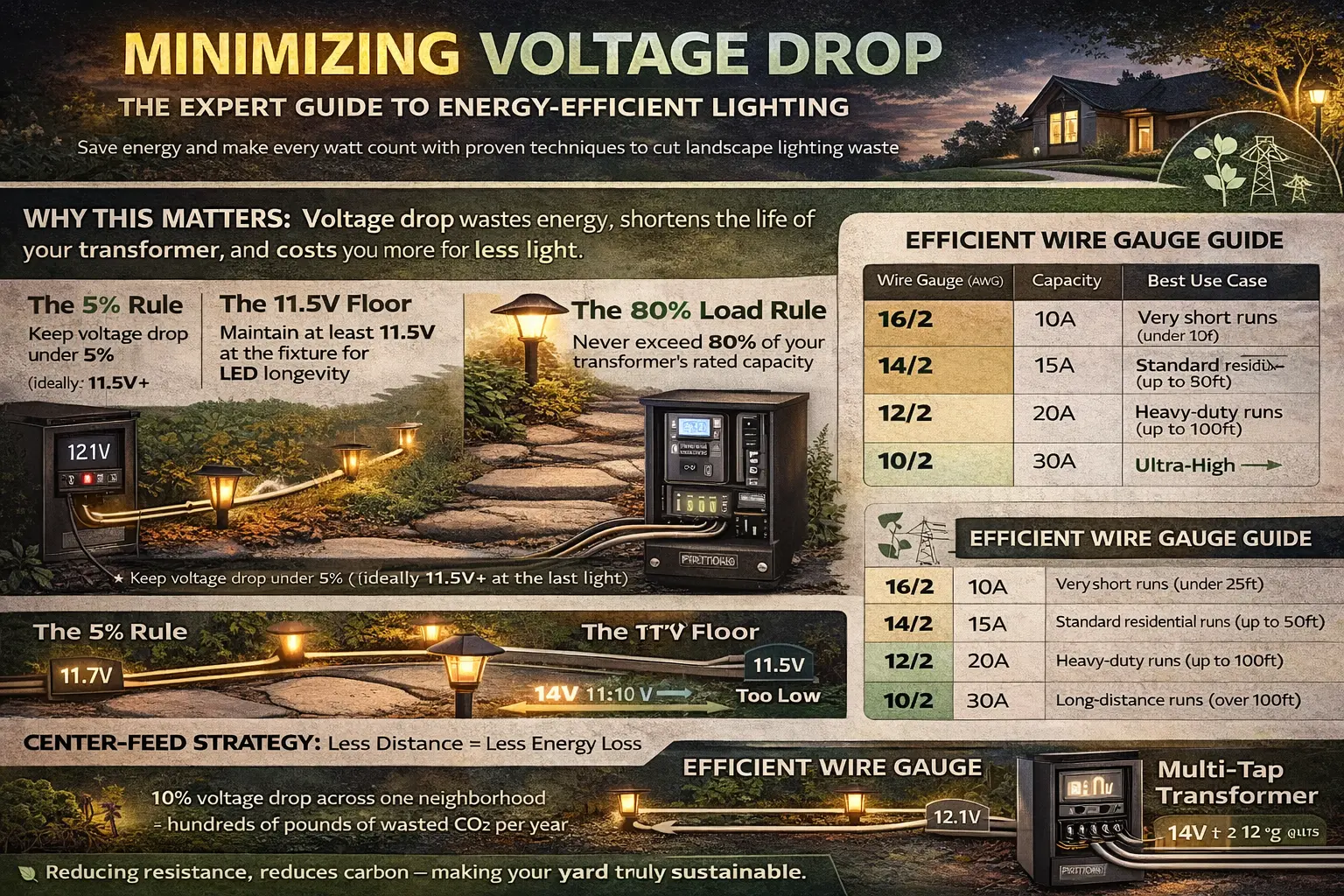
In a 12V system, a 5% drop equals 0.6 volts. If you measure more than a 0.6V drop from the transformer to the first fixture, your system is already losing efficiency.
- The 5% Rule: Aim for no more than a 5 percent voltage drop from the transformer to the last fixture.
- The 11.5V Target: Try to keep the last LED fixture near 11.5 volts for better performance.
- The 10.5V Floor: Avoid letting voltage at the fixture fall below about 10.5 volts.
- The 80% Load Rule: For efficiency and transformer longevity, keep the total circuit load under about 80 percent of rated capacity.
How to Calculate Voltage Drop
If you want to measure how much voltage your system is losing, you can use this basic formula:
Voltage Drop = (2 × Length × Total Load × Wire Resistance Factor) / 1000
For most homeowners, this can be simplified. For 12-gauge landscape lighting wire, use:
(2 × Distance × Wattage) / 7500 = Voltage Drop
- Distance: total wire run in feet
- Wattage: total load on the circuit
- Result: estimated voltage loss
Why Voltage Drop Wastes Energy
When current travels through wire, resistance turns part of that energy into heat. That means the transformer is feeding power into the system, but not all of that power reaches the light as useful output.
In practical terms, voltage drop steals performance twice. First, it reduces light output at the fixture. Second, it wastes energy in the cable and makes the transformer run less efficiently.
Fast answer: Voltage drop wastes energy because power is lost as heat in the wire instead of reaching the light fixture as usable output.
If you want to see how voltage drop fits into the full system, review the low voltage landscape lighting system diagram for a clearer view of how transformers, wire runs, and fixtures interact.
Voltage drop wastes energy, but it can also make lighting unstable and uncomfortable. I explain the biological side of that problem in voltage stability and melatonin.
The Physics of Energy Loss in Landscape Lighting
The reason voltage drop wastes energy comes down to how electricity behaves in a wire. Power loss is calculated using the formula:
Ploss = I² × R
This means the energy lost in the wire is proportional to the square of the current. In practical terms, doubling the load on a wire does not just double the wasted energy—it can increase it by four times.
Why Low Voltage Can Shorten LED Lifespan
Many homeowners assume that lower voltage is easier on LED lights, but the opposite is often true.
While the LED diode itself may run cooler, the internal driver (the circuitry inside the bulb) has to work harder to compensate for low voltage. This extra strain can cause the driver to overheat and fail prematurely.
Voltage drop is not always caused by cable length alone. Humidity, irrigation, fertilizer salts, coastal chlorides, and repeated freeze-thaw movement can increase resistance at connectors and buried splices long after the system was installed correctly. A run that once delivered proper voltage may gradually become dim or unstable as corrosion develops. The Outdoor Lighting Climate Performance Guide shows which environmental conditions accelerate connection resistance and when inspection intervals should be shortened.
Master Wire Gauge Efficiency Table
| Wire Gauge (AWG) | Capacity (Amps) | Best Use Case | Efficiency Rating |
|---|---|---|---|
| 16/2 | 10A | Very short runs under 25 feet and small accent lights | Low (high resistance) |
| 14/2 | 15A | Standard residential runs up to about 50 feet | Medium |
| 12/2 | 20A | Heavier runs up to about 100 feet and higher load systems | High (gold standard) |
| 10/2 | 30A | Long-distance runs over 100 feet | Ultra-high |
Most Common Causes of Voltage Drop
- Wire runs that are too long
- Wire gauge that is too small for the load
- Too many fixtures on one circuit
- Daisy-chain layouts with heavy far-end loss
- Transformers that are overloaded or poorly configured
Best Engineering Strategies to Eliminate Waste
If one circuit is carrying too much load, dividing the system into zones can reduce resistance and improve efficiency. See low voltage landscape lighting zones to plan cleaner, lower-loss circuit layouts.
Because voltage drop is often a layout problem as much as a wiring problem, review the landscape lighting layout design guide to reduce long runs and balance fixture placement more effectively.
The center-feed strategy
Instead of running one long daisy chain from one end of the fixture group to the other, feed the wire to the center of the lighting cluster. That reduces the average travel distance for current and helps cut voltage loss dramatically.
The T-method
A T-method split reduces how much load the first segment of wire has to carry. That means the system wastes less energy early in the run and delivers more balanced power to the rest of the fixtures.
Use a better transformer design
Transformer efficiency matters too. Higher-quality designs run cooler and waste less energy internally. That is one reason better multi-tap and toroidal transformer designs are worth paying attention to in larger or more demanding systems.
Voltage Drop vs. Better Design
| Design Choice | What Happens | Efficiency Result |
|---|---|---|
| Long 16-gauge daisy chain | More resistance, more heat, lower far-end voltage | Lower efficiency |
| 12-gauge center-feed layout | Shorter average path, lower resistance, stronger far-end voltage | Higher efficiency |
| Multi-tap correction on a long run | Transformer starts higher so distant fixtures receive better final voltage | Higher performance when used correctly |
Where Multi-Tap Transformers Help
Multi-tap transformers do not eliminate bad wiring, but they can compensate for long-distance runs by starting the circuit at 13V, 14V, or 15V instead of 12V. That way the voltage arrives at the distant fixture much closer to where it needs to be.
To understand where those terminals are and how they fit into the system, see the Portfolio Lighting Transformer Master Guide and the Voltage Tap Calculator.
For a broader explanation of transformer roles, output, and system behavior, see the landscape lighting transformer guide before adjusting taps or resizing your setup.
If your transformer is underpowered, running hot, or no longer matches the system load, see how to replace a landscape lighting transformer for the next step.
Why This Also Protects LEDs and Transformers
Voltage drop is hard on more than just brightness. When the system is poorly designed, the transformer runs warmer, the wire wastes more energy, and fixtures at the far end run underpowered. Over time, that can mean more flicker, more inconsistent light output, and more stress across the whole system.
That is why proper wiring design belongs in both the troubleshooting conversation and the sustainability conversation.
The Hidden Energy Loss: Poor Connections
One of the most overlooked causes of voltage drop is resistance at the connection point. Loose or corroded connectors create small “hot spots” where energy is lost as heat instead of reaching the fixture.
- Loose wire nuts increase resistance
- Corrosion blocks proper electrical contact
- Cheap connectors fail over time outdoors
The fix is simple: use waterproof, gel-filled connectors designed for landscape lighting.
Voltage drop can waste energy and make distant fixtures look dim even when the transformer is sized correctly. The low-voltage lighting energy use calculator helps estimate how fixture wattage, run time, and system size affect real-world power consumption.
Reducing voltage drop improves performance and energy efficiency, but long-term sustainability involves more than electrical losses. Fixture replacement frequency, maintenance requirements, and component lifespan often contribute more to overall ownership costs than energy waste alone. For a complete picture of lighting economics, see our lighting life-cycle cost analysis guide, which evaluates energy use alongside maintenance and replacement expenses over the life of a lighting system.
Voltage Drop and Energy Waste FAQ
Why does voltage drop waste energy?
Because the lost electrical energy becomes heat in the cable instead of useful light output at the fixture.
What is the ideal voltage at the last fixture?
For good LED performance and longevity, keep the last fixture close to 11.5 volts when possible, and avoid dropping below roughly 10.5 volts.
What wire size is best for reducing voltage drop?
For many residential systems, 12/2 is the best overall choice because it cuts resistance far more effectively than 16/2 on longer or higher-load runs.
The Sustainability Takeaway
Resistance always has a cost. In landscape lighting, that cost shows up as wasted heat, shorter equipment life, and extra power that never becomes useful light.
That is why reducing voltage drop is not just a wiring improvement. It is also a sustainability improvement. Across enough systems, even modest losses add up to a significant amount of wasted energy that could have been avoided with better design.
Reducing voltage drop is only part of a more efficient system. The smart outdoor lighting controls guide shows how better schedules and controls can reduce wasted runtime as well.