AI Outdoor Lighting Systems
Use this page for the broad system architecture behind AI-driven outdoor lighting, monitoring, and automation.
Read the guide
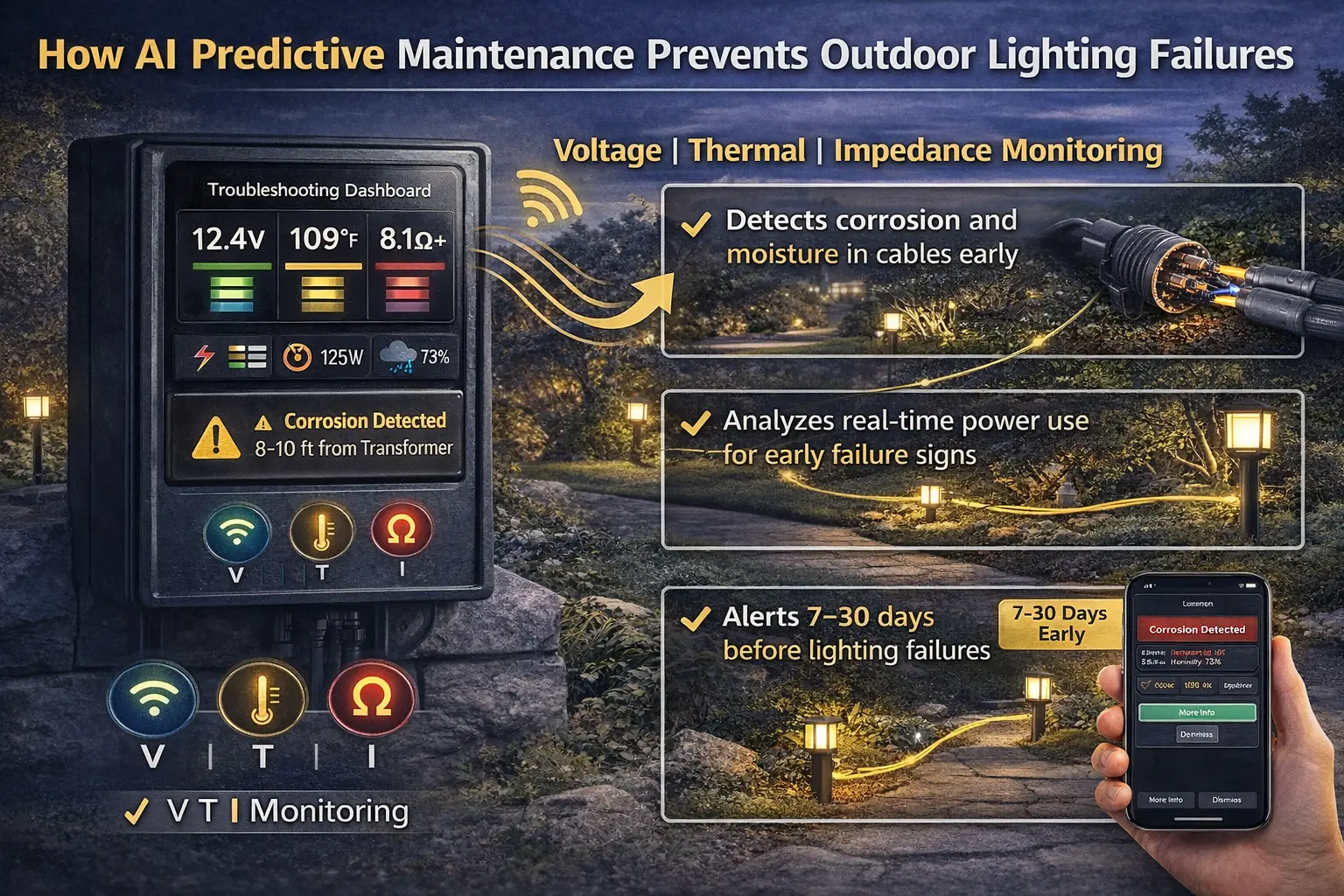
AI predictive maintenance (PdM) in outdoor lighting uses real-time voltage, thermal, and impedance monitoring to detect early-stage system failures before lights stop working.
Instead of reacting to outages, predictive systems identify soft faults like moisture intrusion, connector corrosion, and transformer heat buildup—often 7 to 30 days before visible failure occurs.
This is why predictive maintenance matters so much in low-voltage outdoor systems. Many failures do not begin as obvious outages. They begin as small electrical changes that look harmless at first, then slowly turn into flickering, dimming, corrosion, short circuits, or complete loss of a zone.
Predictive maintenance is part of a larger system. To understand how AI controls and monitors lighting systems as a whole, see AI outdoor lighting systems and AI automated landscape lighting.
If you want the underlying electrical foundation first, review Portfolio low-voltage lighting, voltage drop, and landscape lighting cable basics. If your concern is failure after moisture or storms, also review lights not working after rain.
See More Troubleshooting HelpAI predictive maintenance analyzes voltage drop, thermal changes, and impedance shifts to forecast failures before they happen.
You are not just building a page here. You are defining a subcategory. Predictive maintenance for outdoor lighting is different from generic smart lighting because it focuses on failure forecasting, measurable thresholds, and system-health logic rather than simple app control or scheduling.
The biggest advantage is that AI can see problems forming while the system still appears to work. That changes the maintenance model from “fix it after failure” to “inspect it before the outage ever happens.”
Most outdoor lighting failures follow predictable electrical patterns. The difference with AI predictive maintenance is that those patterns are measured and interpreted before they become visible problems.
Predictive maintenance can identify failing components early, but many issues start with power loss in the system. See minimizing voltage drop and energy waste to understand the root cause.
Predictive maintenance works by catching small electrical changes before they become visible lighting problems. Instead of waiting for outages, the system watches for patterns that suggest a connector, transformer, fixture, or wire run is starting to drift out of normal operating range.
Predictive maintenance works by tracking small electrical changes before failure happens. If voltage drops, impedance rises, or heat increases, the system flags a problem before lights stop working.
| Observed Issue | AI Signal Change | Predicted Root Cause |
|---|---|---|
| Lights dim over time | Voltage drop + thermal rise | Overloaded transformer or long cable run |
| Lights flicker intermittently | Irregular current signature | Failing LED driver or unstable connection |
| System fails after rain | Impedance spike | Moisture intrusion in connectors |
| Breaker trips randomly | Thermal spike + current surge | Short circuit or wiring fault |
Advanced lighting systems use three key signals to predict failure: Voltage drop, Thermal spikes, and Impedance shifts. Together, these create a diagnostic fingerprint of system health.
These early signals connect directly to real-world issues like voltage drop and landscape lighting corrosion, which are often misdiagnosed as fixture failures.
These signals are also used in advanced load balancing systems. Learn how this works in AI transformer voltage load balancing, where AI redistributes power to prevent overload and failure.
Predictive maintenance systems can run either in the cloud or locally on an edge device. For outdoor lighting, edge processing is more reliable.
In real-world landscape lighting systems, outages often happen during storms—the exact time you need reliability. That’s why edge-based systems outperform cloud-only setups.
Most predictive systems run on local controllers. See smart hub compatibility guide to understand which systems support edge-based AI processing.
AI would detect rising impedance days before failure.
AI would detect unstable power signatures early.
AI would detect thermal buildup before shutdown.
AI systems learn the normal electrical signature of each fixture. When that signature changes, it indicates early failure.
These patterns often appear before issues like LED flickering or dim lighting become visible.
This same behavioral modeling is used in user-based automation. Compare this with predictive arrival lighting behavior patterns, where AI anticipates homeowner activity instead of system failure.
Predictive maintenance helps identify abnormal behavior before a visible failure happens, but once a fault becomes active, the system still needs to narrow down the actual problem area. That is where AI fault isolation logic for landscape lighting becomes important, because it connects those warning signals to the most likely wire, splice, or zone failure.
| Maintenance Type | Approach | When You Fix It | Result |
|---|---|---|---|
| Reactive | Fix after failure | After outage | Downtime + emergency repairs |
| Preventative | Scheduled maintenance | Fixed intervals | Misses hidden issues |
| Predictive | AI monitoring | Before failure | Prevents outages completely |
In high-humidity environments, low-voltage lighting systems degrade faster due to moisture entering connectors and wire splices.
Advanced predictive systems use impedance monitoring to detect this early.
These conditions are commonly linked to issues like lights not working after rain and short circuits.
Environmental monitoring also plays a role in security systems. See how this integrates with AI security ambient lighting to adjust lighting based on environmental risk factors.
Predictive maintenance is especially valuable in systems that already show stress patterns or have known risk factors. Long cable runs, moisture-heavy connectors, transformer heat buildup, and fixtures with unstable power behavior all benefit from earlier detection.
This becomes even more important in hardscape and long-run installations where voltage drop and connector degradation are more likely. Predictive maintenance is especially critical in hardscape linear step lighting, where electrical issues can stay hidden until performance drops across a full section.
If the system is already showing symptoms, start with portfolio landscape lights not working, portfolio lighting troubleshooting, and short-circuit troubleshooting so predictive monitoring can be layered on top of a sound baseline.
Predictive maintenance focuses on keeping lighting systems working properly, but overall lighting quality also depends on how the system is used over time. Lighting that adjusts based on time of night can reduce strain on components while improving the experience outdoors. For that design approach, see circadian outdoor lighting.
Predictive maintenance is just one layer of a full AI lighting system. It works alongside automation, behavior prediction, and load balancing to create a fully adaptive lighting environment.
Predictive maintenance helps the system detect failure patterns early, but spoken control still matters because homeowners need a simple way to interact with those scenes and system states. Voice commands can work alongside monitoring, maintenance alerts, and adaptive scene control when the interpretation layer is built correctly. That layer is explained in AI voice lighting logic.
Together, these pages form a complete AI-driven lighting system where predictive maintenance prevents failures before they affect performance.
Use this page for the broad system architecture behind AI-driven outdoor lighting, monitoring, and automation.
Read the guideHelpful when you want the wider automation layer around sensing, scheduling, and adaptive lighting behavior.
Read the guideImportant for understanding how AI protects electrical stability while predictive maintenance watches for failure signatures.
Read the guideBest for understanding what control layer can support reliable edge processing and local predictive maintenance logic.
Read the guideStart here if you want the practical foundation behind transformer behavior, zones, cable runs, and system planning.
Read the guideUse this page to understand the electrical symptom patterns that predictive maintenance can catch earlier.
Read the guideWire sizing still matters because predictive maintenance does not replace sound system design.
Read the guideHelpful for understanding cable resistance, connector stress, and the conditions that produce early fault signatures.
Read the guideUse this page when the system has already moved from hidden warning signs into visible failure.
Read the guideImportant for moisture-related failure patterns that predictive maintenance is especially good at identifying early.
Read the guideAI predictive maintenance uses real-time voltage, thermal, and impedance monitoring to detect early-stage faults before outdoor lighting systems visibly fail.
The V-T-I framework stands for voltage, thermal, and impedance monitoring. Together, these signals help create a system-health fingerprint that reveals hidden failure patterns early.
Well-designed predictive systems can often identify soft faults 7 to 30 days before visible failure occurs, depending on the type of issue and how much monitoring data is available.
Yes. Rising impedance and resistance changes can reveal moisture-related degradation before corrosion becomes obvious at the connector or fixture.
For outdoor lighting, edge AI is often more reliable because local monitoring continues working during internet outages and storms.
Yes. Older low-voltage systems can often benefit from monitoring layers that flag overheating, corrosion, short-circuit risk, dimming behavior, and transformer stress earlier than reactive troubleshooting alone.
This page is built to own the specific topic of AI predictive maintenance for outdoor lighting. It stays focused on early fault detection, V-T-I monitoring, power-signature analysis, humidity thresholds, and system-level logic so it supports the wider AI automation cluster without drifting into generic lighting automation or basic troubleshooting alone.