
Apply this guide to Portfolio landscape lighting
When using What Wire Gauge for Landscape Lighting? (12 vs 14 vs 10 Guide) with an existing Portfolio system, begin with the transformer output, fixture ratings, cable route and the model of each light. Existing Portfolio equipment may constrain wire sizing, replacement choices or layout changes.
Portfolio owner’s first step: Map the existing Portfolio fixtures and transformer first, then use the installation and troubleshooting guides for product-specific decisions.
Quick Answer: My 7-Point Line Resistance & Cable Sizing Matrix
Fixing dim or uneven yard lights is about controlling line resistance across your entire circuit path, not just swapping out bulbs. When the fixtures closest to your house burn bright but the ones at the back edge of your lawn look weak and yellow, your system is suffering from a massive voltage drop. This happens because the thickness of your copper cable can't push enough current to the end of the line.
Whenever I lay out a low-voltage circuit or troubleshoot a dim system in the field, I rely on these seven baseline wire parameters to guarantee perfect brightness across the whole loop:
- 1. The 12-Gauge Household Standard: I consider 12 AWG direct-burial cable the absolute sweet spot for most residential yards; it offers the ideal copper thickness to handle standard loads without breaking the bank.
- 2. The 14-Gauge Short-Run Boundary: I only run thinner 14-gauge wire when a circuit layout stays completely under 50 feet and powers just a few low-wattage accent heads close to the main power source.
- 3. The 10-Gauge High-Resistance Shield: When a wire run stretches past 100 feet or carries a heavy cluster of high-output fixtures, I upgrade to thick 10-gauge lines to keep the current flowing without choke points.
- 4. The 10.8V Terminal Floor: I always check the very last fixture on a line with a digital multimeter; if line resistance pulls the terminal voltage below 10.8V, halogen bulbs turn yellow and LED drivers begin to flicker wildly.
- 5. Calculating Copper Load Geometry: Instead of running a single long daisy chain that starves the final light, I split my lines into balanced hub runs or center-fed configurations to feed the current evenly.
- 6. Accounting for Total Wire Length: I calculate my run distance from the exact terminal block lugs on the power box all the way to the final fixture splice, including every loop and turn through the soil.
- 7. Splicing at High-Resistance Taps: Factory pierce clips create tiny focal points of high resistance that choke voltage; I strip back the wire ends and lock them inside gel-filled waterproof wire nuts to keep the connection clean.
⚠️ CRITICAL WIRING HAZARD: Blindly adding higher-wattage bulbs to fix dim lights will backfire completely. Pushing more load onto a wire that is already too thin drops the line voltage even further, triggering three severe system breakdowns that I break down inside my layout blueprints below.
Your actual cable planning must happen before your power pack is permanently anchored to the wall. Take a close look at my outdoor lighting transformer mounting guide to see exactly how your box placement, drip loops, GFCI requirements, and clearance codes dictate the true starting point of your wire paths.
In my experience, trying to outsmart a voltage drop by guessing your cable size will always leave you with an uneven, half-lit yard. Taking the time to calculate your total fixture wattage and matching your wire gauge to your actual run lengths is what keeps a system dependable, bright, and built to last.
Wire gauge is one of the most important parts of low-voltage landscape lighting design because it directly affects brightness, voltage stability, and how far power can travel from the transformer.
In simple terms, lower gauge numbers mean thicker wire. Thicker wire carries more current with less voltage drop, which is why longer runs and larger lighting systems usually need 12-gauge or 10-gauge cable instead of 14-gauge.
Wire gauge is especially important for long July 4th roofline and landscape lighting runs. See the Patriotic July 4th Outdoor Lighting Guide for examples of how undersized wire can make red, white, and blue scenes fade or shift color.
Undersized cable can create unstable voltage conditions that cause lights to flicker or fail intermittently on longer runs. The landscape lighting unstable power guide explains how wire size affects lighting reliability.
Landscape lighting wire gauge affects the low-voltage side of the system, but generator use also makes extension cord sizing important on the 120-volt side. A properly sized 12/2 landscape cable does not fix an undersized household extension cord feeding the transformer from a generator. If you plan to run outdoor lights during an outage, pair this wire gauge guide with our generator setup guide for landscape lighting.
Which Wire Gauge Should YOU Choose?
If your run is short and has only a few lights, 14-gauge may work. But for most homeowners, 12-gauge is the best choice because it provides better voltage performance and reduces the risk of dim lights.
If your run is long, or if you plan to expand your system later, 10-gauge is often worth it to avoid problems.
Proper wire gauge is still the foundation of a strong low-voltage system, but advanced control can improve performance too. See AI transformer voltage load balancing for a technical look at how AI can monitor live load behavior, correct imbalance, and help reduce visible dimming across landscape lighting zones.
Wire gauge affects more than brightness. It also influences how much heat builds up under load. Our thermal throttling protection guide explains why rising resistance and temperature can push outdoor lighting systems toward shutdown if load is not managed properly.
Can You Use 14-Gauge Wire for LED Landscape Lights?
Yes, 14-gauge wire can work for LED landscape lighting on shorter runs with a small number of fixtures. The lower power draw of LEDs gives you more flexibility than older halogen systems, but once the run gets longer or the fixture count grows, 12-gauge is usually the better choice.
Wire gauge and connector size need to match each other. The low-voltage plug and limited-energy connector guide explains why larger insulation-piercing connectors may fail on thin 16/2 cable and how poor contact points create heat, flicker, and voltage loss.
Connect this project to an existing Portfolio landscape system
Identify the Portfolio fixtures, transformer, cable layout, and controls already installed. Use that inventory to decide whether to maintain, extend, or replace parts of the system.
Why Your Landscape Lights Are Dim
- Wire gauge is too small for the run length
- Too many fixtures on one cable
- Voltage drop across long runs
- Poor wiring layout
What Wire Gauge Is Used for Landscape Lighting
Most low-voltage landscape lighting systems use 10-gauge, 12-gauge, or 14-gauge cable. The best choice depends on run length, total wattage, layout style, and how evenly you want power delivered across the system.
Wire gauge directly affects how fixtures behave at the far end of a run. The landscape lighting fixture voltage-loss guide explains how undersized wire changes LED brightness, dimming stability, and driver performance.
10-gauge wire
Ten-gauge wire is thicker and is usually used for long runs, larger lighting systems, or installations where voltage drop would otherwise become a problem. It is often the safest choice when the run is long or when future expansion is likely.
12-gauge wire
Twelve-gauge wire is one of the most common residential choices for landscape lighting. It gives a good balance of flexibility, cost, and voltage performance for many standard front-yard and backyard systems.
14-gauge wire
Fourteen-gauge wire is usually best for shorter runs with fewer fixtures and lower wattage loads. It can work well in smaller systems, but it reaches its limits sooner than thicker cable when runs get longer or the fixture count increases.
Wire gauge affects more than brightness; it also affects smart dimming stability. The smart landscape lighting wire gauge compatibility guide explains why older 16/2 runs often flicker or drop out at low dimming levels.
Choosing the correct wire gauge helps reduce voltage loss, but even properly sized cable can fail if the insulation deteriorates over time. Our Landscape Lighting Insulation Breakdown Guide explains the most common causes of insulation damage and how it affects low-voltage lighting systems.
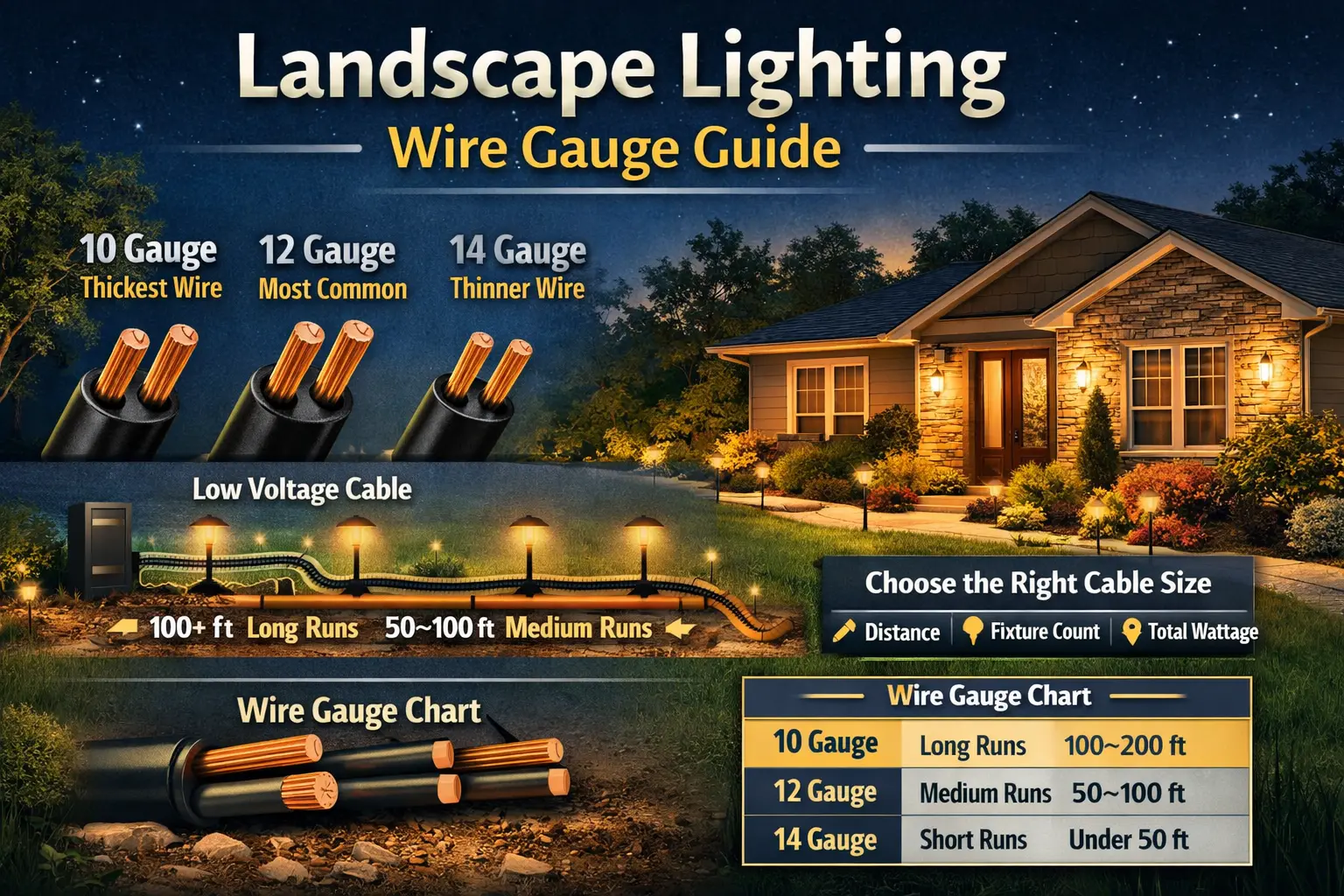
Landscape Lighting Wire Gauge Chart
This chart gives a simple practical reference for common residential landscape lighting cable choices. Exact performance still depends on total wattage and layout, but these ranges are a useful planning starting point.
Wire gauge decisions make a lot more sense when you run the actual numbers. The Landscape Lighting Voltage Drop Calculator helps you estimate whether your current cable size is enough for the distance and wattage on the run.
For systems with long runs or heavier loads, pairing the correct wire size with a multi-tap transformer is critical. This Portfolio 200W wiring guide shows how voltage taps and wire gauge work together.
| Wire Gauge | Typical Distance | Typical Use | Best Fit |
|---|---|---|---|
| 10 gauge | Long runs, roughly 100 to 200 feet or more depending on load | Large lighting systems | Best for longer runs and higher wattage systems |
| 12 gauge | Medium runs, roughly 50 to 100 feet depending on load | Most landscape lighting | Best general residential choice |
| 14 gauge | Short runs, often under 50 feet depending on load | Small lighting setups | Best for lighter, shorter runs |
How to Identify Landscape Lighting Wire by Looking at It
Many homeowners already have low-voltage cable in the ground but are not sure what size it is. This quick reference helps you match the wire you see to the most common landscape lighting cable sizes.
Wire gauge alone does not determine system performance. Different fixture brands ship with different lead wire sizes, connector styles, and driver electronics that respond differently to voltage loss. The Landscape Lighting Brands Specifications Guide explains how these engineering differences affect real-world installations and offers practical recommendations for mixing brands safely.
| Wire Gauge | Approx. Thickness (With Insulation) | Common Marking on Jacket | Best For |
|---|---|---|---|
| 14 AWG | About 1/4 inch wide | 14/2 Low Voltage | 2 to 4 LED fixtures, under 50 feet |
| 12 AWG | About 3/8 inch wide | 12/2 Landscape Cable | Standard 6 to 10 fixture runs |
| 10 AWG | About 1/2 inch wide | 10/2 Direct Burial | Higher-wattage halogens or runs over 100 feet |
Why Wire Gauge Matters in Landscape Lighting
Wire gauge matters because it affects how much voltage is lost as power travels from the transformer to the fixtures. If the wire is too small for the distance or lighting load, the system can suffer from voltage drop, dim lights, uneven brightness, flickering, or a transformer that appears to be working harder than it should.
This is why the farthest fixtures in a run often look weaker when the wrong cable size is used. The system may technically work, but the performance will not be even across the yard.
If you are dealing with brightness problems now, continue with landscape lighting voltage drop and compare the symptoms to your current cable size and run length.
Wire size affects more than brightness. It also changes how the system behaves when a cable run is stressed, overloaded, or partially damaged. If you want to understand how those electrical changes can help locate a fault, see AI fault isolation logic for landscape lighting.
Wire size affects performance, but trench depth affects protection. Review our landscape lighting wire burial depth code guide before burying your run.
Wire-gauge decisions become especially important on a 200-watt transformer because one long, heavily loaded run can lose substantial voltage even while the transformer terminals measure correctly. The GLA-200-12WF-1 is better used with 12-gauge trunk cable and shorter branches than with one extended 14- or 16-gauge daisy chain carrying most of the load. The GLA-200-12WF-1 transformer manual provides model-specific load examples, zoning advice, and field checks for dim or flickering endpoint fixtures.
Check Portfolio parts and power compatibility
Before moving or adding fixtures, confirm output voltage, total connected load, cable condition, connector ratings, and the specifications of replacement lamps or housings.
How to Choose the Correct Wire Gauge
The best wire gauge depends on three practical things: the distance from the transformer, the number of fixtures on the run, and the total wattage of those fixtures. The more distance and wattage involved, the more important thicker cable becomes.
Choosing the right wire size is not just about brightness—it also affects long-term efficiency. See minimizing voltage drop and energy waste to understand how wire gauge impacts overall system performance.
Simple starting rules
Under about 50 feet, a lighter run may work with 14-gauge wire. Between roughly 50 and 100 feet, 12-gauge is usually a stronger choice. Over 100 feet, or on heavier lighting loads, 10-gauge often becomes the safer option.
Distance matters
Even if each fixture uses only a modest amount of power, a longer run increases resistance and voltage loss. That is why long paths, driveway edges, and backyard perimeter lighting often benefit from thicker wire.
Fixture count matters
A run with many fixtures places more demand on the cable than a run with only a few. As fixture count rises, the wire needs to support more current while still delivering usable voltage to the farthest lights.
Total wattage matters
Add the wattage of all connected fixtures on the run, then compare that load to both your transformer capacity and your run length. Higher wattage systems usually need thicker cable even if the distance does not seem extreme.
Common Landscape Lighting Cable Types
Most residential low-voltage systems use direct burial cable designed for outdoor conditions. This cable is built with insulation meant to handle soil contact, moisture exposure, and the temperature changes that come with outdoor installation.
Direct burial cable
This is the most common choice for low-voltage landscape lighting because it is designed to be placed in the ground without requiring full conduit in many standard installations.
Low-voltage lighting cable
Low-voltage cable is specifically made for the transformer-to-fixture portion of the system and is different from standard household branch-circuit wiring. It is designed to carry lower voltage but still needs the correct wire gauge for the load and distance involved.
Wire gauge affects how much voltage is lost over distance, but the final step is choosing the correct transformer output. Use the voltage tap calculator to match your wire size and run length to the proper voltage tap.
Outdoor-rated insulation
Outdoor-rated cable matters because landscape lighting is constantly exposed to water, soil moisture, irrigation, mulch, heat, and cold. Using the correct cable type is just as important as choosing the correct gauge.
For deeper cable planning, continue with landscape lighting cable guide.
Landscape Lighting Wiring Layouts
Wire gauge decisions work together with wiring layout. The same cable size can perform differently depending on whether the system uses a daisy chain, hub method, T-method, or loop method.
Daisy chain
This is a common layout where fixtures are connected one after another along the same run. It is simple, but voltage drop tends to become more noticeable near the end of the run.
Hub method
In a hub layout, fixtures branch outward more evenly from a central point. This often helps keep lighting performance more balanced, especially when trying to reduce visible brightness differences.
T-method
The T-method splits the load into multiple directions, which can reduce the stress on one long run and improve voltage balance across the system.
Loop method
Some systems use looped layouts to help deliver more even power to fixtures, especially on larger installations. This method takes more planning but can help reduce uneven brightness.
For deeper layout planning, compare your system to landscape lighting layout design and how to wire landscape lighting.
Simple Practical Wire Gauge Rules for Homeowners
Homeowners usually do not need complicated electrical formulas to make better landscape lighting cable decisions. A few simple rules solve most residential planning questions.
- shorter runs with fewer fixtures may work with 14-gauge
- most medium residential runs work better with 12-gauge
- long runs and larger systems often need 10-gauge
- if brightness is uneven, check both cable size and layout
- leave room for future expansion instead of sizing everything at the limit
Portfolio Systems and Landscape Lighting Wire Gauge
Many outdoor lighting systems installed over the past two decades used Portfolio low-voltage transformers and fixtures sold through Lowe’s. If your landscape lighting system includes Portfolio components, the correct wire gauge and wiring layout can affect brightness and overall performance. You can explore troubleshooting help in our Portfolio lighting troubleshooting guide, learn more about system layouts in Portfolio landscape lighting, diagnose transformer problems in Portfolio transformer troubleshooting, or review wiring layouts in our Portfolio lighting wiring diagram guide.
Landscape Lighting Wire Gauge FAQ
What wire gauge should I use for landscape lighting?
Most residential landscape lighting systems use 12-gauge wire for general runs, 14-gauge for shorter lighter runs, and 10-gauge for longer runs or heavier lighting loads.
Is 12-gauge wire good for landscape lighting?
Yes. Twelve-gauge is one of the most common choices for landscape lighting because it works well for many residential low-voltage systems and gives better voltage performance than 14-gauge on medium-length runs.
Can wire gauge cause dim landscape lights?
Yes. If the wire is too small for the run length or fixture load, voltage drop can reduce brightness and make some landscape lights look dim or uneven.
How far can you run landscape lighting cable?
The answer depends on wire gauge, total wattage, and layout. Short lighter runs may work with 14-gauge, while longer runs often need 12-gauge or 10-gauge to keep voltage drop under control.
Is thicker wire better for landscape lighting?
In many cases yes. Thicker wire, which means a lower gauge number, reduces voltage drop and usually performs better on long runs or systems with more fixtures.
Make Portfolio troubleshooting part of the maintenance plan
Record cable routes and transformer settings, inspect accessible splices after wet weather, and compare symptoms across fixtures before replacing components.
Final Thoughts on Landscape Lighting Wire Gauge
Choosing the right landscape lighting wire gauge is one of the easiest ways to improve long-term system performance. The right cable size helps keep fixtures bright, reduces voltage drop, and gives the transformer a more balanced load.
For most homeowners, the smartest approach is to choose wire size based on run length, total wattage, and future expansion plans instead of just the lowest-cost cable. That planning step makes the rest of the installation work better from the start.
Wire size plays an important role in how power travels through a landscape lighting system. If you want to see where the cable fits into the full system layout, the low voltage landscape lighting system diagram illustrates how the transformer, wiring, connectors, and fixtures are connected.
Choosing the wrong wire size is one of the biggest causes of dim landscape lights and overheated cable runs. The landscape lighting wire gauge ampacity database compares 12/2, 14/2, 16/2, and longer-run load limits for real outdoor lighting systems.
More Low Voltage Landscape Lighting Guides
Landscape Lighting Cable Guide
Learn the basics of cable types, direct burial wire, and common outdoor lighting cable decisions.
Read the cable guideLandscape Lighting Voltage Drop
Understand why lights get dim and how distance, wattage, and cable size affect performance.
Read the voltage drop guideLandscape Lighting Transformer Guide
Learn how transformers, wattage sizing, and system planning work together in low-voltage lighting.
Read the transformer guideHow to Wire Landscape Lighting
Review basic installation layouts, connector planning, and practical wiring methods for homeowners.
Read the wiring guideLandscape Lighting Layout Design
See how run layout affects brightness, balance, and the wire gauge choices that work best.
Read the layout guideLandscape Lighting System Diagram
Review how transformers, cable paths, branches, and fixtures connect in a complete low-voltage system.
View the system diagramLandscape Lights Dim
Use this guide if weak brightness or uneven lighting may be tied to cable size and voltage loss.
Fix dim landscape lightsLandscape Transformer Overload
Check whether wire size, run length, and system load are stressing the transformer.
Read the overload guideLandscape Lighting Wire Gauge, Landscape Lighting Wire Size, and Low Voltage Landscape Lighting Cable Size Help
This page is designed to help readers choose the correct landscape lighting wire gauge by connecting cable size to run length, fixture count, voltage drop, and overall system performance. Use the chart and planning guidance above before buying cable or troubleshooting weak brightness.
Because wire gauge decisions affect installation quality from the start, this page focuses on planning and performance instead of only symptom repair. That makes it a strong reference page for both new systems and existing lighting upgrades.