
Quick Answer
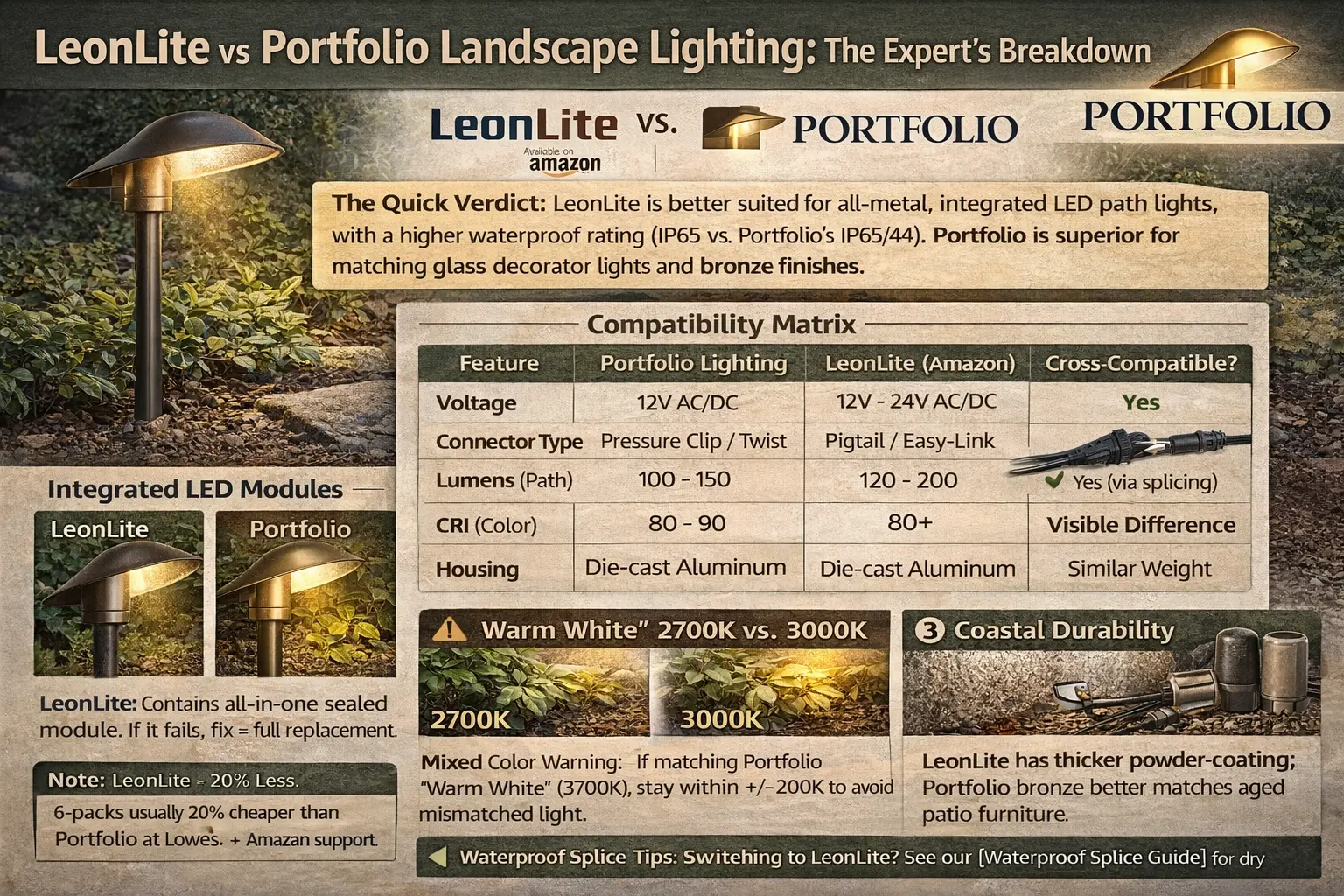
LeonLite is usually the better choice when your main goal is replacing failed integrated LED path lights or spotlights quickly with a modern low-voltage fixture. Portfolio is often the better choice when your main goal is preserving the exact look of an existing system, keeping finish consistency, or repairing older decorative fixtures instead of changing brands.
This page matters because many people go from Lowe’s straight to Amazon after they cannot find Portfolio parts locally. LeonLite shows up often in that search path, but marketplace listings do not explain the real issues that decide whether the swap will work: voltage range, connector style, color temperature, and what happens when an integrated LED fixture fails later.
- You need a fast replacement for a failed integrated LED path or spot light
- You already have a working low-voltage transformer
- You are comfortable making a waterproof splice if the connector style differs
- You want a modern sealed fixture instead of hunting for discontinued Portfolio modules
If you are newer to landscape lighting systems, start with low voltage landscape lighting for a broader overview of how transformers, cable runs, and fixtures work together.
LeonLite vs Portfolio: Decision Logic Summary
| If Your Goal Is... | Better Choice | Main Reason |
|---|---|---|
| Fast replacement for a failed integrated LED fixture | LeonLite | Widely available and typically easier to source and install quickly. |
| Exact finish and style match | Portfolio | Provides the closest visual match when expanding or repairing an older Portfolio installation. |
| Mixing brands on an existing transformer | Either, with proper planning | Overall system compatibility depends more on voltage, wattage, wiring, and connector quality than on the brand name. |
| Higher moisture protection near sprinklers | Often LeonLite | Many LeonLite fixtures use sealed housings that tend to resist water intrusion better in demanding outdoor environments. |
IP Rating Comparison: Why Sealing Matters More Than Buyers Expect
One of the most overlooked differences in landscape lighting replacements is moisture protection. LeonLite fixtures are often sold with a visible IP65 rating, which means they are designed to resist heavy rain and irrigation overspray. Portfolio fixtures are often listed for wet locations, but many older models do not show a clear IP rating on the packaging or fixture body.
This does not automatically make LeonLite the better fixture in every yard, but it does matter when water exposure is one of the reasons your original lights failed.
Will LeonLite Fixtures Work with a Portfolio Transformer?
Yes, in most cases they will. LeonLite low-voltage fixtures are commonly designed for 12V or 12V-24V AC/DC operation, which fits well with the low-voltage transformer setup used in many Portfolio systems. That makes LeonLite one of the easier modern replacement options when the old transformer is still good.
What to Check Before You Mix Brands
If you are not sure whether your existing transformer is large enough for a LeonLite upgrade, use the Portfolio lighting transformer sizing guide before adding higher-wattage fixtures.
If you want a faster estimate before swapping multiple fixtures, try the landscape lighting transformer size calculator to check your projected load.
- The transformer output voltage and total wattage capacity
- The wattage draw of the LeonLite fixture you are adding
- The total number of fixtures already on the run
- The cable length and voltage drop risk on long runs
If your current transformer is already close to capacity or the far end of the run is dim, do not assume a new fixture brand will solve the underlying electrical problem. In that case, review the voltage drop guide and the transformer guide before adding more load.
LeonLite spotlights often draw 5 watts to 10 watts per fixture. If you are replacing older 1-watt to 3-watt Portfolio LEDs with higher-output LeonLite units, check your transformer capacity first.
Use the 80% Rule: On a 120W Portfolio transformer, try not to exceed 96 watts of total connected load. This leaves a safety margin and helps prevent overheating, voltage drop, and circuit breaker trips.
Wattage Math: The Load Difference Buyers Often Miss
One of the biggest real-world differences between LeonLite and older Portfolio value-pack fixtures is wattage. Many older Portfolio LED path lights and spotlights draw only around 1W to 3W, while many LeonLite fixtures draw 5W to 10W depending on the model and output level.
For a more detailed breakdown of how many fixtures your transformer can realistically support, compare your setup with the Portfolio lighting transformer wattage guide.
- Older low-output Portfolio LED = often 1W to 3W
- LeonLite spotlight or path light = often 5W to 10W
- More brightness = more transformer load
- More wattage on long runs = more voltage drop risk
If you are replacing several fixtures at once, always total the new wattage before assuming the old transformer is still large enough.
Are LeonLite Parts Compatible with Portfolio Connectors?
This is where many buyers get tripped up. Electrical compatibility does not always mean connector compatibility. Portfolio often uses quick-connector or plug-and-play style systems. LeonLite commonly uses pigtail leads that expect a standard low-voltage splice or direct connection into the cable run.
If the old Portfolio connector has to be removed and the new LeonLite fixture needs a pigtail splice, follow the Portfolio lighting wire replacement guide for a cleaner, longer-lasting repair method.
The Safe Fix
If the old Portfolio connector does not match the LeonLite lead, use a weatherproof splice method and protect the joint properly. That is the same reason your approved waterproof splice guide is such an important companion page for brand-mixing repairs.
The Integrated LED Problem: The Biggest Real-World Difference
One of the most important reasons this comparison matters is the way each brand approaches integrated LED fixtures. A lot of modern LeonLite fixtures are sealed integrated units. When they work, they are efficient and clean-looking. When they fail, you usually replace the fixture.
Portfolio Can Sometimes Be More Repair-Friendly
Some older Portfolio systems give you more repair paths through replacement parts, connector repairs, or fixture-specific troubleshooting. That is one reason Portfolio still matters if your goal is preserving an existing system instead of swapping whole fixtures.
LeonLite Is Often Better for Straight Replacement
If you are tired of tracking down older modules or matching discontinued Portfolio components, LeonLite can be the simpler choice: remove the old light, splice the new low-voltage fixture in, and move on.
Color Temperature Matching: The Expert Tip Most Buyers Miss
Even when the voltage and wiring work perfectly, a mixed-brand yard can still look wrong if the color temperature is off. This is one of the biggest “why does this replacement look strange?” complaints after a brand swap.
Why 2700K vs 3000K Matters
Many warm-white Portfolio fixtures visually lean toward the softer amber side of warm white, while many current LeonLite low-voltage fixtures are sold around 3000K. That difference can make one fixture look whiter and another look more golden, especially when the lights sit close together along a path.
How to Keep the Yard Looking Consistent
Try to stay within a narrow range when mixing brands. A difference of around 200K can already be visible in a tight grouping of path lights, spotlights, or stair lights. If the swap is happening in one prominent area, it often looks better to replace that whole visible group at once instead of mixing one new fixture into five old ones.
LeonLite vs Portfolio: Which Brand Wins by Problem Type?
This decision table is often more useful than a generic “which brand is better” answer.
| Your Situation | Better Choice | Why | Best Next Step |
|---|---|---|---|
| You need a fast replacement for a dead integrated LED path light | LeonLite | Modern low-voltage fixtures are usually easier to source quickly | Compare replacement options |
| You want to preserve an older Portfolio look or finish | Portfolio | Finish and style consistency matter more than simple compatibility | Check parts first |
| You are mixing brands on the same transformer | Either | The real issue is connector method, wattage, and voltage drop | Review connector compatibility |
| You are replacing fixtures on a long cable run | Either, with planning | Voltage tolerance helps, but cable conditions still matter | Check voltage drop first |
| You are replacing a single visible path light among older warm fixtures | Portfolio or full group replacement | Color mismatch is often more obvious than buyers expect | See replacement strategy |
Does LeonLite Handle Voltage Drop Better?
In some real-world situations, yes. Many LeonLite low-voltage products are marketed for a wider 12V-24V AC/DC operating range, which can make them more forgiving on systems where the delivered voltage is not perfectly stable all along the run. That does not mean voltage drop stops mattering, but it can make a fixture less sensitive than an older narrow-range module.
If your run is long or your far-end fixtures are already dim, review the landscape lighting cable guide before assuming a new brand alone will solve the problem.
Why This Matters on Older Portfolio Runs
If you are working with a longer cable run or a system that already has some age on it, a newer constant-current style driver design can help keep performance more stable. That is especially relevant when the old fixture family seemed fine near the transformer but dim at the far end of the run.
Which Brand Is Better for Coastal Environments?
Neither brand wins automatically in every coastal install. In salty or humid environments, the real deciding factors are fixture material, coating quality, seal design, maintenance habits, and how well the cable splices are protected from corrosion.
What to Watch for in Coastal Conditions
- Powder coating that starts to chalk or pit
- Fasteners that corrode early
- Lens seals that trap moisture
- Connector areas that stay wet and oxidize
In coastal installs, maintenance and sealing often matter as much as brand choice. That is another reason the splice and connector pages in your approved cluster are so valuable.
When LeonLite Is the Better Amazon Alternative
LeonLite becomes especially attractive when you want a modern integrated fixture, quick online availability, and a straightforward low-voltage replacement path. If the original Portfolio fixture is integrated LED and already failed, replacing the fixture can be faster than trying to source brand-specific internal parts.
When Portfolio Still Makes More Sense
Portfolio still makes more sense when your yard has a very specific visual identity, the bronze finish match matters, or you are dealing with repairable fixtures where you already know the system and only need parts, stakes, glass, or connectors.
That is why this page should be read alongside the broader Portfolio Lighting Alternatives hub and the more focused best replacement guide.
LeonLite vs Portfolio Landscape Lighting FAQ
Will LeonLite fixtures work with a Portfolio transformer?
Yes, in most cases. Many LeonLite low-voltage fixtures are designed for 12V to 24V AC/DC systems, so they usually work with a standard Portfolio low-voltage transformer as long as wattage and wiring are appropriate.
Are LeonLite parts compatible with Portfolio quick connectors?
Not directly in every case. Portfolio often uses quick-connect or plug-and-play styles, while LeonLite commonly uses pigtail leads. They can still be mixed, but you may need a waterproof splice instead of a direct snap-in connection.
Are LeonLite stakes the same size as Portfolio?
They are often close, but not always identical. Replacement stakes and thread styles vary by fixture family, so always compare the mounting details before assuming a perfect mechanical fit.
Which brand is better for coastal environments?
Both can work, but corrosion resistance depends heavily on material, coating quality, sealing, and maintenance. In salt-heavy environments, fixture care and waterproof splicing matter just as much as the brand name.
Still Can’t Find the Right Portfolio Part?
If Origin21 does not match your old Portfolio setup, do not force the fit. The better move is to compare replacement brands, transformer options, connector compatibility, and long-term repair paths before you spend money.
I built the main alternatives guide for exactly this situation. Start there if your old Portfolio fixture, transformer, connector, or replacement part is no longer available.
Open the Portfolio Lighting Alternatives GuideDirect Brand Comparisons
- Best Overall Replacements
- Portfolio vs. Origin21
- VOLT vs. Portfolio
- LeonLite vs. Portfolio
- Connector Compatibility
Replacement Part Guides
Read my VOLT landscape lighting review.