Portfolio Transformer Not Working
Use this page when rain may have triggered a transformer shutdown, GFCI issue, or a deeper transformer-related fault.
Read the guide
If your Portfolio landscape lights stopped working after rain, the most likely causes are wet connectors, moisture in a fixture, damaged low-voltage wiring, or a transformer shutoff caused by a fault. Start by checking the transformer and GFCI, then inspect every connection that may have gotten wet.
Rain usually does not destroy a healthy low-voltage lighting system by itself. What it often does is expose weak points that were already developing. Moisture gets into a bad connector. Water reaches damaged insulation. Corrosion that had been building quietly suddenly becomes serious enough to interrupt power. A transformer or GFCI responds to a fault and shuts the system down for protection.
That is why this page focuses only on rain, water, and moisture failures in Portfolio landscape lighting. If the system stopped working without a weather trigger, that is a different troubleshooting path. This page is for the specific situation where wet conditions changed how the system behaves.
If your lights stopped working without any weather-related trigger, visit our main landscape lighting troubleshooting guide for a complete step-by-step diagnosis. If rain exposed a bad transformer or damaged component, you may also need portfolio transformer not working or Portfolio lighting parts and accessories.
See the Main Troubleshooting GuideThe most common cause is moisture getting into a weak connection. Rain usually exposes a bad connector, damaged wire, cracked fixture, or a transformer shutdown caused by a short or fault.
Start here: Check whether the whole system is off, then inspect the wettest connectors and fixtures first.
Use this order so you do not waste time replacing the wrong part.
Rain-related landscape lighting failure is different from general system failure because the weather event gives you a strong clue about the real cause. If the system worked before the rain and stopped afterward, moisture likely reached a weak part of the system that had already started to fail. That weak point may be a connector, a cracked fixture base, damaged insulation, a bad splice, a low wet spot in the yard, or a transformer protection shutoff reacting to a fault.
In other words, rain often reveals the problem rather than creating it from nothing. That is why the smartest troubleshooting path is to focus first on moisture entry points and connection quality instead of treating the system like a general failure with no pattern.
Partial failures often follow the layout of the system. If one branch or section stops working, it usually connects back to how the wiring was originally run. For a better understanding of system structure, see landscape lighting layout.
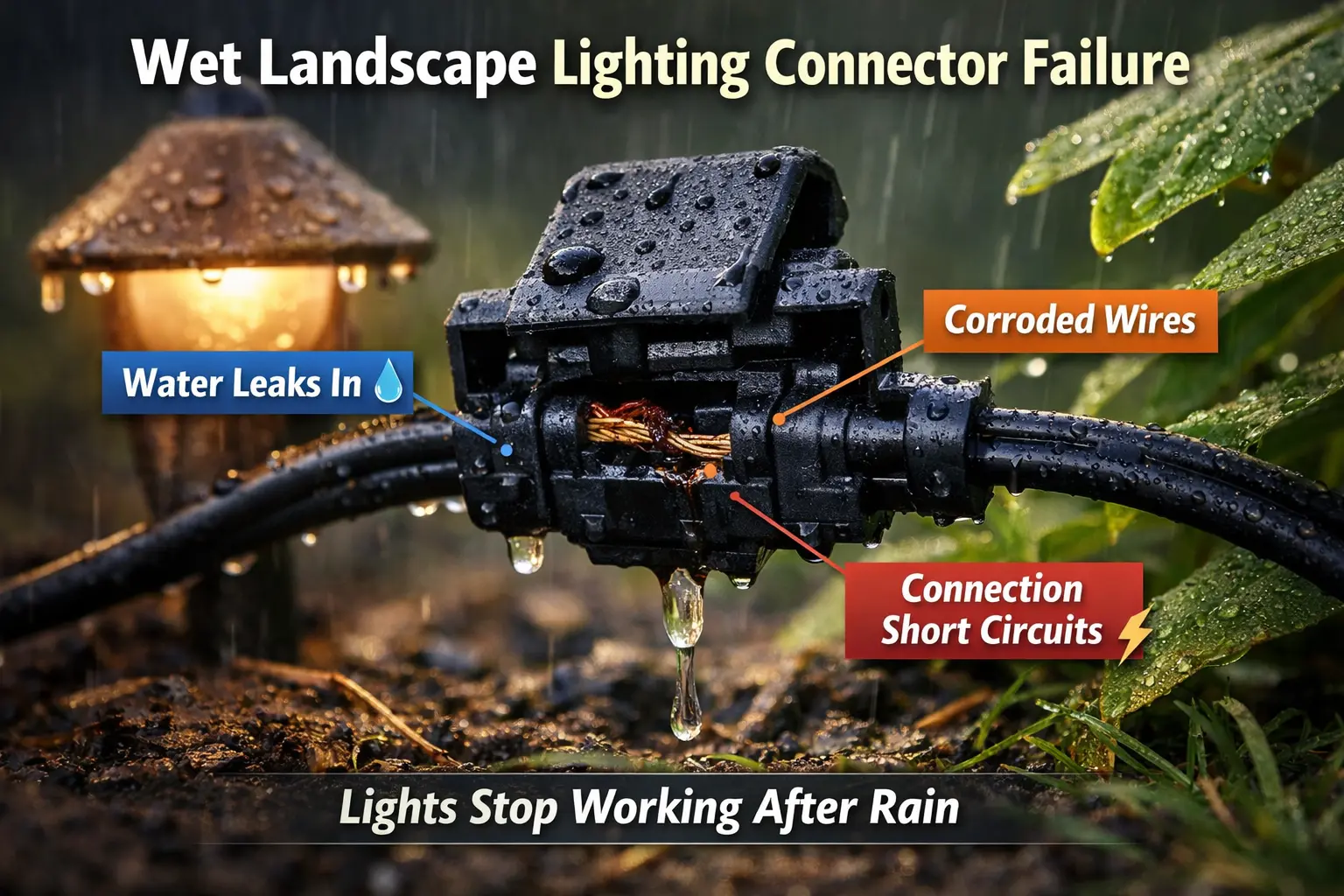
Rain usually does not break a properly sealed, well-connected low-voltage system. What it does is expose hidden weaknesses. When water reaches a weak point, the system may fail immediately, partly fail, flicker, or shut down for protection.
Poor seals, aging connection points, and low-quality connectors often allow moisture to enter. Once that happens, the electrical contact becomes unstable or fails completely.
Exposed wiring, damaged insulation, and poorly protected splices can allow water to create a shorting condition that changes how the system behaves.
Corrosion is often a slow problem until a heavy rain accelerates it. Once contact quality drops enough, the lights may stop working or become unstable.
Some transformers respond to fault conditions by shutting down. If moisture creates a short or overload-like situation, the transformer may stop sending power as a protective response.
To understand how moisture affects different parts of the system, it helps to see how everything connects together. Review the landscape lighting system diagram to see how transformers, wiring, and fixtures interact in a complete setup.
These symptoms strongly suggest rain or water exposure is part of the real cause:
That pattern is what separates this page from a more general troubleshooting page. The weather trigger gives you a specific direction to follow.
Rain-related failures usually start before the system goes completely dark. Moisture often changes resistance and connector behavior first, which means the warning signs can appear before visible corrosion or a total outage. For a technical look at how AI can catch those moisture-related faults early, see AI predictive maintenance for outdoor lighting.
If Portfolio landscape lights stop working after storms, the issue may go beyond convenience when the system lights steps, entries, or walkways. The landscape lighting insurance risk guide explains when lighting failures can become safety concerns.
If all lights stopped working after rain, start with the transformer, GFCI, and the main feed connection. If only some lights failed, the problem is more likely a local connector, splice, branch wire, or fixture in that section of the run.
If the lights come back after drying, that usually means moisture is creating a temporary short, weak contact, or unstable connection rather than a permanent full-system failure.
Even though connectors are often the real cause, the transformer still deserves the first check because it tells you whether the entire system is shut down or only one section is affected.
If the whole system is dark after rain, the transformer may have responded to a fault or short by shutting down.
Rain-related moisture problems often trigger GFCI protection. If the outlet supplying the transformer has tripped, the transformer may appear dead even though the deeper cause is still moisture in the system.
For the transformer-specific pages, use portfolio transformer not working and landscape lighting transformer guide.
In most real-world after-rain failures, connectors are the first place to look. If you only check the transformer and skip the splices and clip connections, you will often miss the true cause of the outage.
This is one of the most important parts of the entire process because connection points are usually the first place moisture-related failure appears.
Connectors that are wet inside, loose, or poorly sealed should move high on your suspect list.
A connector may still look connected but fail electrically when moisture weakens the contact.
Green, white, or dark residue on the metal contact points usually means corrosion has already been developing and rain has pushed the problem farther.
For the broader wiring page, read how to wire landscape lighting.
Moisture problems can also combine with weak power delivery, especially on longer runs. If lights are dim or unstable after rain, review landscape lighting voltage drop to understand how power loss can make moisture-related issues worse.
Once you know the problem likely involves moisture, the next goal is to find where the water is getting in.
Connectors resting directly in wet soil or mulch are one of the most common problem areas.
If the yard has drainage low points where water collects, those areas deserve special attention.
Damaged insulation or poorly protected splices can allow water into the system below the surface.
Cracks, loose seals, or worn housings can let water enter the fixture itself.
Once you identify a wet connection, the next step is to disconnect it, dry it thoroughly, and reconnect it properly. This is not just about getting the lights back on. It is about correcting the weak point that allowed moisture in.
A connection that works only after drying but is not resealed correctly will likely fail again the next time the system gets wet.
Fixtures can also fail after rain if water enters the housing, reaches the socket area, or damages the internal light source.
Visible moisture or fogging can be a strong clue that the fixture seal has failed.
Small cracks often become real electrical problems only after the system gets wet.
Worn gaskets and failed seals let water reach parts of the fixture that should stay dry.
Bad connectors are one of the highest-value checks on this page because they are often the number one cause of landscape lights failing after rain. Clip-style connectors and poorly sealed splices may work for a while, but over time they become vulnerable to moisture, movement, corrosion, and weak contact.
This is why a system can seem fine in dry weather and then suddenly fail in wet weather. The connector was already weak. Rain simply made the weakness visible.
In real-world troubleshooting, connection points are often more likely than the transformer itself to be the true rain-related failure point.
This is one of the most telling moisture-related symptoms. If the lights stop working when wet but come back after drying, the system is showing you that a connection or component is temporarily failing under moisture exposure.
That can feel encouraging because the lights came back, but it is really a warning sign. The weak point still needs repair. Otherwise the next storm is likely to repeat the same failure.
If only some lights fail after rain, the problem is often local to one branch of the system rather than the entire transformer or main feed. That usually means one split in the wiring, one group of connectors, or one local wet area is affecting only part of the layout.
This is one reason the pattern of failure matters so much. Partial failure usually points toward a local moisture problem instead of a full system shutdown.
If you need the broader failure guide, see landscape lights not working.
Flickering after rain usually means the connection is not fully failing yet, but the electrical contact has become unstable because moisture is interfering with it. That may happen at a connector, fixture base, splice, or damaged cable point.
For the dedicated flicker page, use landscape lights flickering.
A strange Portfolio failure pattern is when the system behaves better during rain than during dry weather. If that is happening, use this wet-only landscape lighting diagnostic to check for moisture bridges, wicking corrosion, and high-resistance connector failure.
Waterproof connectors are one of the strongest ways to prevent rain-related failures.
Avoid leaving vulnerable connections sitting in low wet spots whenever possible.
Areas that hold water for long periods create ongoing stress on the system.
The connection should not only be electrically sound. It should also be protected from moisture entry.
Annual inspection helps catch corrosion and aging connectors before the next storm turns them into an outage.
Some rain-related failures are simple connector repairs. Others point to bigger system trouble. Repeated failures, corroded wiring, moisture inside multiple fixtures, or transformer shutdown that keeps returning may mean the system needs more than a quick reconnection.
In those cases, replacement parts may be the smarter path. For that help, use Portfolio lighting parts and accessories.
Rain-related lighting failures often start at one damaged splice or wet connector, but the visible symptom may spread across a larger section of the system. To understand how electrical behavior can help isolate the most likely fault area, visit AI fault isolation logic for landscape lighting.
Do not buy replacement parts until you know whether the problem is a connector, a fixture, or the transformer. Rain-related failures often look bigger than they are, and many systems can be fixed by repairing one bad wet connection instead of replacing multiple components.
General landscape lighting failures often come from power loss, bulbs, transformer issues, or ordinary wiring faults. Rain-related failures are different because the weather event points directly toward moisture, connection quality, corrosion, and shorting conditions as the main suspects.
That is why this page should stay focused on rain, water, and moisture-related landscape lighting failure. It fills a specific cause-based topic without overlapping with broader troubleshooting.
If your lights stopped working without any weather-related trigger, visit our main landscape lighting troubleshooting guide for a complete step-by-step diagnosis.
Use this page when rain may have triggered a transformer shutdown, GFCI issue, or a deeper transformer-related fault.
Read the guideHelpful when you need to understand how the transformer reacts to faults, overload, and moisture-triggered shutdown conditions.
Read the guideImportant when your after-rain failure appears tied to splices, cable routes, connectors, or weak outdoor connection practices.
Read the guideUseful when moisture problems overlap with weak power delivery and the far end of the system is dim or unstable.
Read the guideThe main troubleshooting page when the problem is not tied specifically to rain and you need the full general diagnosis path.
Read the guideBest when the system still runs after rain but shows unstable output, pulsing, or partial moisture-related flicker.
Read the guideUse this page when rain exposure reveals that connectors, transformers, fixtures, or related components now need replacement.
Read the guideLandscape lights often stop working after rain because moisture gets into connectors, damaged wiring, fixture bases, or other weak points that were already developing in the system.
Yes. Water can cause corrosion, short circuits, unstable voltage, and fixture or connector damage in low voltage landscape lighting systems.
Use weather-resistant waterproof connectors, seal connections properly, keep them out of low wet spots when possible, and inspect them regularly for corrosion or looseness.
If lights come back on after drying, moisture likely created a temporary connection problem or short. The system may work again for now, but the weak point still needs to be repaired.
Yes. Rain can trigger a transformer shutdown if moisture creates a fault, trips a GFCI, causes a short, or forces the transformer’s protection features to respond.
The fastest way to solve this problem is to treat it as a moisture-exposed weak-point failure, not a random outage. That mindset usually leads you to the real cause much faster and helps prevent the same rain-related shutdown from happening again.