
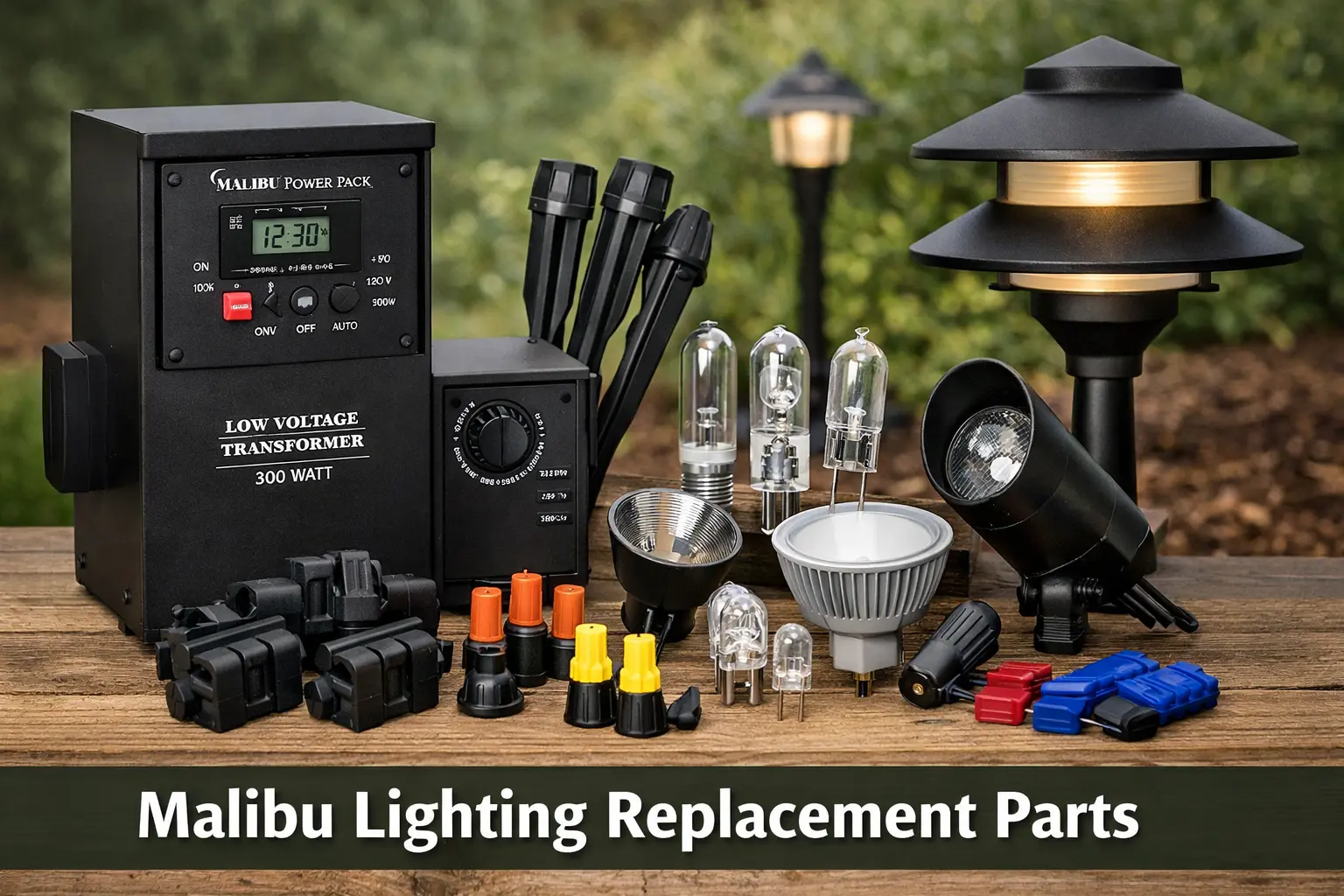
Quick Answer: What Malibu Parts Fail Most Often?
Most Malibu lighting problems come from a few key parts: the transformer, connectors, bulbs, stakes, or low-voltage cable.
- Whole system off → transformer
- Section off → connector or cable
- Single light off → bulb or fixture
- Intermittent issues → loose or corroded connection
Start Here: What’s Happening With Your Lights?
- Nothing turns on → check transformer
- Only part of yard is dark → check connector or cable
- One light is out → replace bulb
- Lights flicker → check connections
Tools Needed for Malibu Lighting Repair
Most Malibu repairs do not require a full electrical toolkit, but a few basic tools make troubleshooting much easier and help you avoid replacing parts that are still good.
- Digital multimeter: Confirms whether the transformer is producing 12V output and whether voltage reaches the fixture.
- Wire stripper: Prepares fresh copper when replacing old Malibu quick clips with waterproof connectors.
- Small screwdriver: Helps check transformer terminals, fixture screws, and some socket assemblies.
- Known-good replacement bulb: Quickly separates a bad bulb from a bad fixture.
- Outdoor-rated connectors: Replaces cracked Malibu quick clips or corroded splice points.
- Measuring tape or caliper: Helps match stakes, stems, caps, and fixture hardware.
If you are trying to identify an exact Malibu model before buying parts, use the Malibu ML, LX & 8100 Model Lookup Database. It includes transformer specifications, digital timer codes, replacement stakes, quick-clip connector failures and troubleshooting details for the highest-volume Malibu lighting products ever sold.
What Malibu Lighting Replacement Parts Usually Fail First
Most older Malibu systems do not fail all at once. They usually start with one weak point, and that weak point is often a practical, replaceable part rather than the whole system. The most common trouble spots are transformers, photocells, bulbs, fixture stakes, cable connectors, and low-voltage wire.
Transformers and Power Packs
If every light is out, the transformer is always one of the first things to inspect. Older Malibu transformers can fail internally, lose timer function, stop supplying reliable output, or simply age out after years of outdoor exposure. Manuals for models like the Malibu ML100THBM 100-watt power pack and the 8100-9045-01 45-watt power pack are still publicly indexed, which makes them useful reference points when you are trying to confirm wiring, power rating, and setup style.
Stakes, Caps, and Small Fixture Hardware
Malibu path lights and tier lights often live close to the ground, so broken stakes and cracked plastic parts are common. A lot of homeowners assume the light itself is done when the actual problem is just a failed stake, cap, or bulb holder.
Bulbs and Lamp Assemblies
On older Malibu systems, burned-out bulbs are still one of the simplest repairs. They can also be one of the most misleading, because a light that looks dead may actually still have a good fixture body and a bad lamp.
Connectors and Cable
If only one branch of the system is dark, look closely at the connector and wire before assuming you need a new transformer. A corroded or loose connection can knock out part of a run while the rest of the yard still works normally.
The Malibu Quick-Clip Fix: Why Original Clips Are Usually Not Worth Chasing
I see more failures with old Malibu quick-clip plastic connectors than almost any other Malibu part. The plastic tabs get brittle, the metal teeth bend, the clip loses pressure on the cable, and moisture works its way into the puncture point.
If your original Malibu clip snapped, cracked, or no longer bites into the wire, I would not spend much time hunting for another old clip. A modern universal pierce-and-twist connector from a brand like Portfolio or VOLT is usually a better repair because it does not depend on the old Malibu snap-tab design.
This is one place where Portfolio lighting repair logic crosses over very well with Malibu lighting. Both systems commonly use 12V low-voltage landscape wiring, so the better long-term repair is often to remove the weak Malibu quick clip and replace it with a stronger weather-resistant connector that matches the cable gauge.
Malibu replacement parts are usually easiest to find when you think in categories instead of chasing one exact product name first. Start by asking whether the issue is in the transformer, the wire run, the connector, the bulb, the stake, or the fixture body. That one step saves a lot of wasted time.
If you are comparing older lighting brands, you may also want to review Portfolio lighting alternatives, Hampton Bay lighting replacement parts, Kichler lighting replacement parts, and Paradise lighting replacement parts. If your goal is a better long-term upgrade, you may also want to read our Volt landscape lighting review.
If you are dealing with an older Malibu transformer and are not sure whether it is still worth repairing, see the Malibu 8100-9120-01 troubleshooting and replacement guide. It explains the O, A, and D settings, blank-screen problems, photocell testing, and when a modern replacement makes more sense than chasing one more repair.
If you are moving beyond older landscape lighting brands and want a more durable replacement path, see the best VOLT landscape lighting fixtures guide for a closer look at pro-grade fixture options.
Exact Resources for Malibu Lighting Replacement Parts
When you are dealing with older Malibu landscape lights, the best resources are usually a mix of original manuals, used and new-old-stock marketplaces, and compatible low-voltage replacement parts. That combination tends to work better than relying on one source alone.
1. Original and Archived Manuals
Archived manuals are one of the most useful starting points because they help confirm the transformer rating, fixture type, installation method, and original wiring approach. Public manual pages still exist for Malibu power pack models like the ML100THBM 100 watt power pack, the 8100-9045-01 45 watt power pack, and 300-watt models such as ML300RTWM and ML300RTW. Those manuals are especially helpful when you are trying to match a transformer style or decide whether a modern compatible replacement will work with your system.
2. Old Fixture Manuals That Mention Genuine Malibu Parts
Some older Malibu fixture instructions are still available as PDF downloads. One example is the Malibu LED low-voltage fixture instructions for model 8409-1101-01. That type of document is useful because it shows how the fixture originally connected, what parts came in the box, and what the manufacturer expected homeowners to replace over time.
3. Used and New-Old-Stock Marketplace Listings
For actual physical replacement parts, marketplace listings are still one of the best sources. This is especially true for discontinued Malibu stakes, caps, bulbs, tier light parts, and older transformers that no longer show up in typical retail stores. Listings for items like LX19720T replacement stakes, LX19720T bulbs, and mixed Malibu tier light hardware still appear from time to time and can be helpful if you want to keep a matching system intact.
4. Generic Compatible Low-Voltage Parts
Not every repair requires an exact Malibu-branded part. For many systems, standard low-voltage cable, weather-resistant connectors, replacement bulbs, and some transformers can be swapped in successfully as long as voltage, wattage, and fit make sense. This is often the better long-term move if the system is older and you just want it working again without overpaying for a rare original part.
| Resource Type | Best For | What to Verify First |
|---|---|---|
| Archived Malibu manuals | Transformer ratings, wiring style, original product info | Model number, wattage, terminal layout, timer style |
| Old fixture instruction PDFs | Parts list, assembly steps, fixture style confirmation | Fixture family, connector type, mounting hardware |
| Used or NOS marketplace parts | Stakes, caps, bulbs, old transformers, exact matching pieces | Condition, dimensions, model compatibility, seller photos |
| Compatible generic low-voltage parts | Cable, connectors, bulbs, some transformer replacements | 12V compatibility, wattage, beam type, outdoor rating |
Malibu-to-Universal Replacement Parts Cross Reference
Many Malibu repairs do not require an exact Malibu-branded part. The key is matching function, size, voltage, wire gauge, and weather rating. Portfolio, VOLT, and other universal low-voltage parts can often repair older Malibu systems when the original Malibu part is discontinued or overpriced.
| Old Malibu Part or Problem | Better Replacement Direction | What to Match | Repair Note |
|---|---|---|---|
| Broken Malibu quick-clip connector | Portfolio-style or VOLT-style universal pierce-and-twist connector | Wire gauge, outdoor rating, fixture lead size | Usually better than chasing brittle original plastic clips. |
| Malibu 12V path light with dead bulb | 12V LED wedge or bi-pin replacement bulb | Base type, voltage, lamp size, beam direction, fixture clearance | Try a known-good bulb before replacing the full fixture. |
| Broken Malibu plastic stake | Universal landscape lighting stake or 1/2-inch compatible threaded adapter | Thread size, stem diameter, fixture weight | Universal stakes are often stronger than old Malibu plastic stakes. |
| Failed Malibu transformer timer or photocell | Manual-on transformer plus outdoor smart plug or modern low-voltage transformer | Total wattage, 12V output, GFCI protection, outdoor rating | If transformer output still works, the control side may be the only failed part. |
| Thin Malibu kit wire with dim far fixtures | Shorter run, lower-wattage LEDs, or heavier low-voltage cable | Wire gauge, run length, total load | Do not blame the fixture until you test voltage at the far end. |
Malibu systems often remain repairable long after the original parts disappear. The legacy Malibu and Portfolio compatibility guide explains which transformers, connectors, stakes, and MR16 upgrades commonly cross over between older landscape lighting systems.
Other Landscape Lighting Brands Commonly Compared to Malibu
Many homeowners replacing older Malibu systems also compare Hampton Bay because both brands share similar low-voltage transformer layouts and homeowner-focused installation styles. The Hampton Bay transformer replacement guide explains common compatibility concerns, wattage sizing logic, and replacement transformer considerations.
Users upgrading from entry-level systems into more advanced outdoor lighting platforms often compare professional-grade systems against older retail kits. The FX Luminaire versus Portfolio landscape lighting comparison explains how premium landscape lighting systems differ in controls, fixture construction, zoning, and long-term durability.
Transformer instability, overheating, and photocell failures are common across many older low-voltage systems. The Paradise Lighting transformer troubleshooting guide explains how to diagnose many of the same symptoms found in aging Malibu installations.
Homeowners trying to extend the life of older landscape systems frequently search for affordable replacement fixtures, connectors, and accessories. The Moonrays replacement parts guide covers common low-voltage repair parts and compatibility considerations.
For broader side-by-side evaluation across major landscape lighting systems, the low-voltage landscape lighting brand comparison guide compares transformer quality, repairability, fixture materials, smart features, and long-term ownership considerations.
Safety First Before Opening or Testing a Malibu Power Pack
Always unplug the Malibu power pack before opening the cover, touching terminals, changing wiring, or removing the low-voltage cable. Even though the lighting side is low voltage, the power pack is still plugged into household current on the input side.
If the Malibu transformer smells burnt, has melted plastic, trips a GFCI repeatedly, or shows signs of water intrusion inside the case, replace the unit or have it checked by a qualified electrician instead of trying to repair the internals.
Malibu Transformer Replacement Help
A failed Malibu transformer is one of the most common reasons an entire low-voltage lighting system goes dark. If all fixtures are off, the timer is not responding, or the power pack clicks, hums, or stops holding a schedule, the transformer is the first major part to inspect.
The nice thing about older Malibu transformers is that many of them were fairly straightforward. Models like the 45-watt and 100-watt power packs, along with 300-watt units, still have publicly viewable instruction sheets. That gives you something concrete to compare before buying a replacement. You can check whether your existing system looks like the same terminal style, whether it was built around a timer, and what total load it was designed to carry.
When to Look for an Exact Malibu Transformer
An exact replacement makes the most sense if you want to preserve the original look and controls, or if the current mounting setup matches that old transformer style cleanly. Marketplace listings are usually where these show up now, especially for used working units or new old stock.
When a Compatible Transformer Is the Better Choice
If the old Malibu transformer is hard to find or badly overpriced, a compatible low-voltage transformer can be the smarter solution. This is especially true if your main goal is simply to restore a 12V system and you are willing to move away from strict brand matching.
Malibu Timer Codes: O, A, and D Settings
Some Malibu power packs still work, but the timer settings confuse homeowners into thinking the transformer is dead. Before replacing the power pack, check which mode it is actually using.
When the Malibu Transformer Works but the Photocell Does Not
Older Malibu power packs often fail in the timer or photocell section before the transformer output actually dies. That means the transformer may still produce usable 12V power, but the built-in sensor no longer turns the lights on correctly.
If the transformer works in Manual ON but fails in Auto or Dusk-to-Dawn mode, you may be able to leave the Malibu power pack in manual mode and move the schedule to a weather-rated outdoor smart plug or timer. That keeps the working transformer in service while replacing the broken control function.
This is also where Portfolio lighting troubleshooting can help Malibu owners. The same repair logic applies: separate transformer output failure from timer, photocell, plug, GFCI, and connector failure before buying a replacement.
| Code | What It Means | Troubleshooting |
|---|---|---|
| O | Manual ON | If the lights do not work in Manual ON, check the GFCI, plug, internal fuse, transformer output, and first connector. |
| A | Auto / photocell mode | The lights should turn on when the sensor is covered or when it gets dark enough outside. |
| D | Dusk-to-dawn mode | If the lights stay on all day, the photocell may be dirty, shaded, blocked, or failed. |
If you are comparing older outdoor brands, you may also want to check Hampton Bay lighting replacement parts and Kichler lighting replacement parts to see how their replacement ecosystems compare.
Stakes, Bulbs, Caps, and Small Malibu Fixture Parts
Many Malibu repairs are small-part repairs. That matters because it means you may not need a new fixture at all. A broken plastic stake, missing cap, cracked lens, or dead bulb can make an outdoor light look beyond saving when the main body is still usable.
Replacement Stakes
Malibu tier lights and path lights are well known for stake wear over time. Soil movement, freeze-thaw cycles, mower damage, and normal age all work against those parts. If the light leans or will not stay upright, start there. Exact Malibu stakes can sometimes be found through used part listings, but compatible low-voltage stakes often work if the fit is right.
Replacement Bulbs
For bulb-based Malibu fixtures, a failed lamp is still one of the easiest wins. If you are not sure whether the fixture itself is bad, try a known-good bulb before replacing the whole head. This is especially helpful on older path lights and tier lights where the rest of the fixture may still be perfectly usable.
LED Bulbs in Old Malibu Fixtures: Flip the Bulb Before You Give Up
Older Malibu fixtures were often built around incandescent wedge bulbs, which did not care much about polarity. When you upgrade to LED replacement bulbs, the new lamp may behave differently. Some LED drop-in bulbs are sensitive to how the contacts line up inside the old Malibu socket.
If a new LED bulb does not turn on but the fixture has voltage, remove the bulb and flip it 180 degrees if the base allows. On some old Malibu sockets, the stamped contact plates do not line up cleanly with every LED replacement on the first try.
If several new LED bulbs flicker or look dim at the end of the run, the issue may be voltage drop from thin Malibu kit wire rather than bad bulbs. This is common when older low-voltage cable is reused with modern LEDs.
Caps and Small Hardware
Caps, tops, and decorative pieces are often the hardest parts to match because they are cosmetic and model-specific. If visual matching matters, used marketplace listings are still one of the best places to look. If function matters more than appearance, it can sometimes be more practical to replace that one fixture with a close low-voltage alternative.
The Malibu Stake Fit Problem: Thread and Stem Size Matter
Malibu stakes are one of the most frustrating replacement parts because the fixture may still work, but the plastic ground stake cracks, strips, or disappears. Older Malibu tier lights often used a small threaded stem that looks universal until you try to screw it into the wrong stake.
A practical field check is to take the fixture stem to the plumbing aisle and test it against a 1/2-inch PVC coupling or similar threaded adapter. If the stem threads cleanly and sits straight, you may be able to use a universal stake, riser, or adapter instead of hunting for the exact Malibu stake.
This is another area where Malibu and Portfolio lighting repairs overlap. Many older low-voltage landscape fixtures use similar stake and stem sizes, but the fit is not guaranteed. Always check thread engagement, fixture weight, and whether the stem sits tight enough to stay upright in soil.
If you are open to comparing other value-tier brands for parts and compatibility, you may also want to browse allen + roth lighting replacement parts, Utilitech lighting replacement parts, and Paradise lighting replacement parts.
When Compatible Malibu Parts Make More Sense Than Exact Originals
There is a point where chasing the exact Malibu-branded part stops being the best answer. If the part is rare, expensive, or only available in questionable condition, a compatible replacement may give you a better result for less money and less frustration.
Good Candidates for Compatible Parts
Low-voltage cable, weather-resistant connectors, standard replacement bulbs, and some transformer upgrades are often good candidates for compatible parts. These are functional components, so exact branding matters less than correct specifications and reliable fit.
Parts That Usually Need Closer Matching
Decorative caps, fixture tops, unusual stakes, and model-specific housings usually need closer matching if you want the system to keep the same look. These are the parts where marketplace searches and old manuals are most useful.
When an Upgrade Is Smarter Than a Repair
If several Malibu parts are failing at once, the system may be at the point where upgrading one zone or one fixture family makes more sense than constant repairs. That is where a stronger long-term brand review can help. Our Volt landscape lighting review is a good place to start if durability and upgrade quality matter more than staying with a legacy system.
What to Verify Before You Order Malibu Lighting Replacement Parts
Before you buy anything, confirm the basics. This is the step that saves the most money because it stops you from ordering a part that looked right in a listing but does not actually fit your system.
- check whether the issue affects the whole system or only one fixture
- look for a readable model number on the transformer or fixture body
- confirm whether the system is standard 12V low voltage
- match bulb type, connector style, and fixture size
- measure stakes, caps, and small hardware when appearance matters
- verify total transformer load before choosing a replacement power pack
- compare seller photos closely on used or old stock parts
If you are working across brands or trying to compare repair options, it may also help to read Progress Lighting replacement parts or Ring smart lighting alternatives depending on whether you want a traditional replacement path or a more modern lighting direction.
If you are repairing more than just Malibu fixtures, the Discontinued Landscape Lighting Parts and Troubleshooting Guide covers universal connector upgrades, transformer failures, replacement stakes, integrated LED problems, and cross-brand compatibility between Malibu, Portfolio, Hampton Bay, Paradise, and other older 12V systems.
Final Thoughts on Finding Malibu Lighting Replacement Parts
Malibu lighting replacement parts are still findable, but the easiest path usually comes from using the right kind of source for the right kind of problem. Manuals help you identify transformers and fixture families. Marketplace listings help with discontinued stakes, caps, bulbs, and older hardware. Compatible low-voltage parts help when function matters more than exact branding.
If your Malibu system still looks good and only one part has failed, a smart repair often makes sense. If multiple pieces are failing and the system is becoming a constant project, it may be time to compare better long-term options. Either way, you are in a much stronger position when you know what part actually failed and what resources still exist to fix it.
Malibu Lighting Replacement Parts FAQ
Where can you still find Malibu lighting replacement parts?
Archived manuals, older fixture instructions, used or new-old-stock marketplace listings, and compatible low-voltage outdoor parts are still some of the best resources.
What Malibu parts fail most often?
The most common failures are transformers, bulbs, photocells, stakes, connectors, and cable connections.
Can older Malibu landscape lights still be repaired?
Yes. Many older Malibu systems can still be repaired by replacing one failed part rather than rebuilding the entire setup.
Do you need exact Malibu parts or can you use compatible parts?
Many repairs can be handled with compatible low-voltage parts, especially for cable, connectors, bulbs, and some transformers, but fit and electrical compatibility still matter.
Can I use Portfolio connectors on Malibu landscape lights?
Often yes, as long as the connector matches the wire gauge, fixture lead size, and outdoor rating. Portfolio-style or VOLT-style universal connectors can be a better long-term repair than old Malibu quick clips because they do not rely on brittle snap tabs.
What do O, A, and D mean on a Malibu transformer?
O usually means Manual ON, A usually means Auto or photocell mode, and D usually means Dusk-to-Dawn. If Manual ON works but Auto or Dusk-to-Dawn does not, the photocell or timer logic may be the problem.
Why did my new LED bulb not work in an old Malibu fixture?
Some LED replacement bulbs are sensitive to contact position or polarity. If the fixture has voltage but the LED does not light, flip the bulb 180 degrees if the base allows, clean the socket contacts, and test with a known-good bulb before replacing the fixture.