
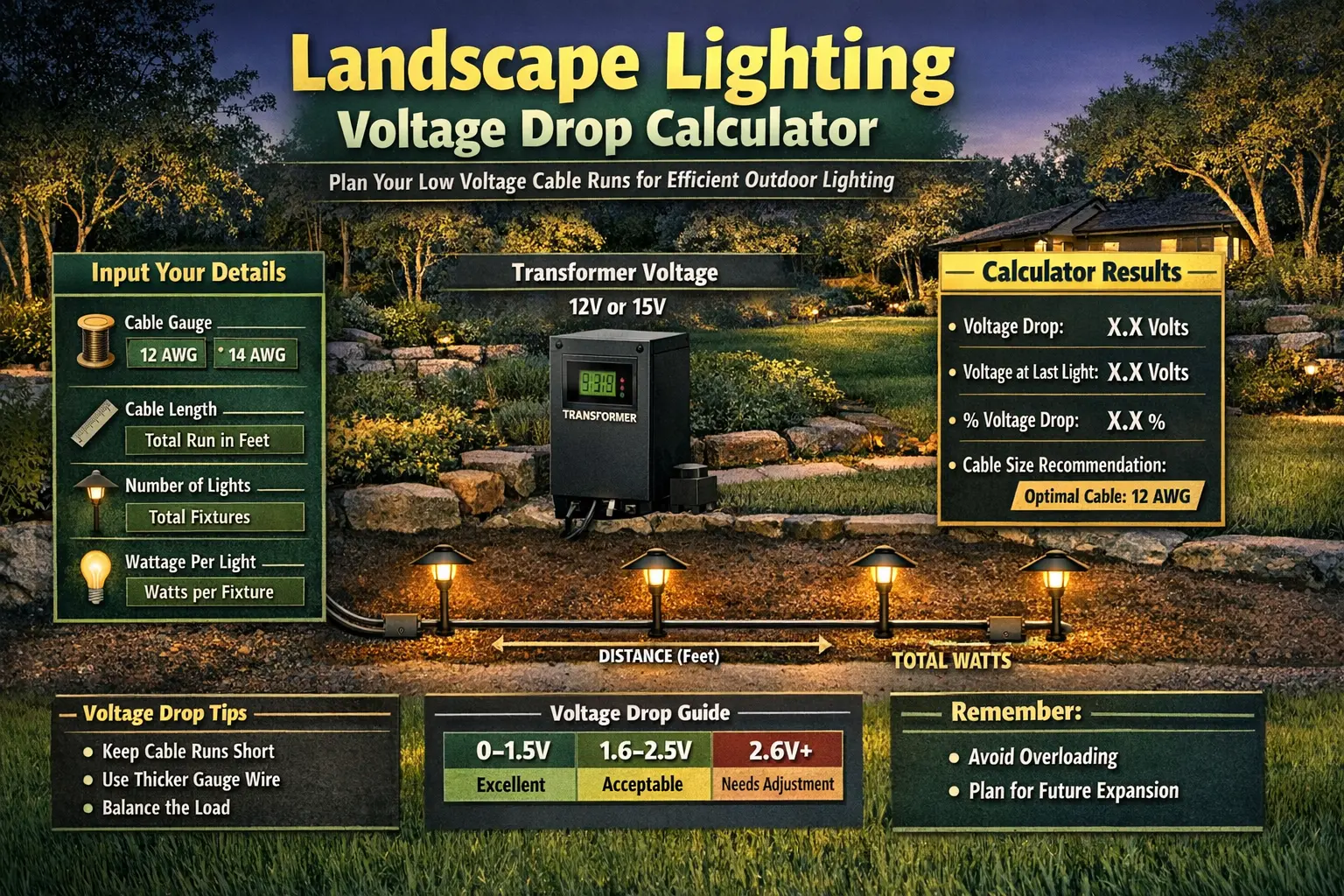
Quick Answer: My 7-Point Voltage Drop & Line-Load Balancing Protocol
Voltage drop isn't a mechanical glitch; it is simple electrical friction that starves your fixtures of the power they need to burn bright. When you force electricity down a thin copper wire over a long distance, the cable itself eats up a portion of that energy. If you overload that same line with too many lights, the voltage plummets before it ever hits the end of the run.
Whenever I design a low-voltage layout or troubleshoot a yard where the far lights look weak and faded, I balance the lines using these seven structural field rules:
- 1. The Distance Friction Factor: The longer the physical cable run, the more power you lose along the way; I cap standard home runs to prevent severe drops across the property lines.
- 2. Heavy-Gauge Wire Upgrades: Small 16-gauge or 14-gauge wire acts like a crimped garden hose; I switch to heavy-duty 12-gauge or 10-gauge low-voltage copper burial wire to ensure wide-open power delivery.
- 3. Fixture Load Caps: Stacking too many lights on a single run chokes the circuit; I divide heavy bulb counts across multiple separate wire paths back to the hub.
- 4. Splitting the Layout Geometry: Instead of a lazy single-line loop, I use center-feed or hub-and-spoke layouts to hit my lights from the middle, ensuring completely even brightness from first to last bulb.
- 5. Targeting the Sweet-Spot Window: For standard 12V LED chips, I lock in field tester measurements between 11.0V and 12.0V at the fixture; going lower causes flickering, while going higher burns out components early.
- 6. Utilizing Multi-Tap Transformer Terminals: When a run is naturally long, I bypass the standard 12V terminal block and hook up to the 13V or 14V taps on the transformer to push extra power through line resistance.
- 7. Auditing Wire Splice Integrity: Corroded or loose splices introduce massive local resistance; I replace factory clip-ons with grease-filled, waterproof wire nuts to lock in solid voltage connectivity.
⚠️ CRITICAL PERFORMANCE RISK: Starving premium LEDs of voltage forces their internal drivers to pull higher currents to stay lit, which overheats the circuit boards and causes immediate failure. Disregarding these electrical baselines triggers three distinct circuit faults that I have mapped out across our field blueprint guides below.
While we usually look at voltage problems on the low-voltage lawn lines, you can experience a major power sag on the 120-volt side of your house too. Running a long extension cord, drawing from an overloaded household circuit, or using a small portable generator can starve your landscape transformer before it even attempts to feed the yard. If you are trying to keep your property lit during a power outage, make sure to read my full landscape lighting generator power guide for a safe backup power blueprint.
Don't bury wire blindly or guess your load limits. Use my step-by-step loop diagrams, interactive wire length calculators, and multi-tap terminal wiring templates detailed further down this page to protect your hardware investments.
Voltage Drop Calculator: Check Your Run Before You Replace Parts
Enter your run length, total wattage, wire size, and bulb type to estimate whether your system is in a safe range or already losing too much voltage.
Voltage drop calculations become much more accurate when hidden resistance problems are also considered. Oxidized copper, damaged connectors, moisture intrusion, and partially severed cable strands can create real-world voltage loss far beyond what a simple calculator predicts. The low-voltage landscape lighting failure points guide explains the hidden causes of electrical resistance inside aging outdoor lighting systems.
Calculating voltage drop is only part of designing a safe outdoor lighting system. The NEC voltage-drop and low-voltage lighting compliance guide explains how code recommendations, conductor sizing, transformer loading, and acceptable voltage-loss thresholds influence real-world brightness stability, electrical efficiency, and long-term system safety.
Wire Gauge Comparison: Typical Maximum Run Length
These numbers are general planning estimates for low-voltage landscape lighting. Real-world performance still depends on layout, branch design, transformer voltage, and fixture distribution.
| Total Watts | 14 Gauge (Max Feet) | 12 Gauge (Max Feet) | 10 Gauge (Max Feet) |
|---|---|---|---|
| 50W | 150 ft | 250 ft | 350 ft |
| 100W | 75 ft | 125 ft | 200 ft |
| 200W | 35 ft | 60 ft | 100 ft |
Why LED vs Halogen Matters for Voltage Drop
Halogen systems draw much more wattage than LED systems, which means they create more load on the cable and are much more likely to show voltage drop problems on longer runs.
Compare options in Portfolio MR16 LED replacement bulbs and LED vs halogen landscape lighting.
A circuit can show acceptable steady-state voltage and still collapse during the first milliseconds of fixture startup. This is especially important with electronic LED drivers that briefly demand capacitor-charging current before settling into their normal operating load. The landscape lighting peak-load database explains how startup current, cable impedance, and simultaneous fixture energization can cause far-end LEDs to flash, retry, or fail to start.
Start Here: What Problem Are You Seeing?
- Far lights dim → voltage drop
- All lights weak → transformer issue
- One light weak → fixture problem
- Lights dim after expansion → overload
A voltage drop calculator is not just a technical tool for electricians. In my experience, it is a guide that leads you the direction you want to go. It is one of the most helpful planning and troubleshooting tools for homeowners trying to figure out why a low voltage lighting system feels uneven, dim, or underpowered.
This page is designed to help with that process by breaking voltage drop into practical steps. It connects naturally with landscape lighting voltage drop, how to wire landscape lighting, landscape lighting cable guide, transformer guide, and layout design if the problem turns out to involve one specific part of the system rather than just the fixture you notice first.
What a Landscape Lighting Voltage Drop Calculator Actually Does
A landscape lighting voltage drop calculator estimates how much voltage will be lost between the transformer and the fixtures at the end of a low voltage run. In simple terms, it helps answer a practical question: after the power travels through the cable and feeds the lighting load, will the farthest fixtures still get enough voltage to perform the way you expect?
That matters because low voltage systems are sensitive to distance and load. A short run with a modest number of fixtures may perform well with standard cable. A longer run with multiple path lights, deck lighting, or landscape spotlights may not. The transformer can be working, the fixtures can be good, and the bulbs can be fine, but the system still looks weak because too much voltage is lost before it reaches the end of the line.
The real value of a voltage drop calculator is context. It helps you plan before installation, compare cable sizes before you bury wire, and diagnose dimness before you start replacing perfectly usable parts. That is why voltage drop pages connect so naturally with Portfolio low voltage lighting, landscape lighting wiring, and landscape lights not working.
The Numbers That Matter Most in a Voltage Drop Calculator
Many visitors search for a landscape lighting voltage drop calculator because they want a quick answer, but the tool is only as useful as the information put into it. In real-world outdoor lighting, the most important inputs are cable length, wire size, total wattage, number of fixtures, and transformer output. Those numbers shape whether the system performs evenly or struggles at the far end.
Cable Length
Cable length is one of the most important variables because voltage loss increases as electricity travels farther through the wire. That is why long straight runs are more vulnerable than short compact runs. It is also why systems that expand over time often begin to dim as extra fixtures are added farther from the transformer.
Wire Size
Thicker wire handles distance and load better than thinner wire. If the wire gauge is too small for the run, the farthest fixtures may look noticeably weaker even though the transformer itself is functioning normally. This is one reason the landscape lighting cable guide is such an important companion to a voltage drop calculator page.
Total Fixture Load
The more lights you place on a run, the more power is drawn through the cable. That includes path lights, accent lights, and specialty fixtures. If the load is high enough, the run can feel underpowered even when each fixture is individually fine. In practical planning, you should think about the entire run, not just one light.
Transformer Output
A healthy transformer matters because it sets the starting point for the run. If the transformer is undersized or overloaded, the whole system may begin at a disadvantage. That is why this topic overlaps with Portfolio outdoor transformer lighting, transformer replacement, and how to replace a landscape lighting transformer.
Voltage drop and overheating often come from the same underlying stress: resistance, long runs, and high load. See thermal throttling protection for outdoor lighting systems to learn how systems reduce output gradually when heat starts building.
Run Layout
Straight-line runs, hub layouts, and split runs behave differently in the real world. That is why good planning matters. A layout that looks simple on paper may create uneven brightness outdoors if the load and distance are not distributed well. This is also where landscape lighting layout design and guide, plan, and placement become valuable.
Landscape Lighting Voltage Drop Troubleshooting Table
This table helps match common outdoor lighting symptoms with the part of the system most likely involved.
| Problem | Likely Cause | Best Next Step |
|---|---|---|
| Farthest path lights are dimmest | Voltage drop from long cable run or undersized wire | Check wire size, distance, and total load with a calculator |
| All lights on one branch look weak | Load too high on that run or poor branch layout | Review layout design and consider splitting the run |
| System was fine until more fixtures were added | Expanded load increased voltage loss | Recalculate the run after additions and reassess transformer capacity |
| Nearby fixtures are bright, far fixtures are dull | Classic voltage drop pattern | Inspect cable length, connectors, and gauge selection |
| Whole system feels underpowered | Transformer overload or poor input planning | Check the transformer guide and total connected wattage |
| One fixture is weak while the others look normal | Local connector, bulb, socket, or fixture issue | Inspect that fixture before changing the full run design |
What Voltage Drop Looks Like in Real Yards
- First lights bright, last lights dim
- Uneven lighting across yard
- Spotlights lose brightness at distance
- System gets worse over time as lights are added
Common Low Voltage Run Mistakes That Cause Voltage Drop Problems
Voltage drop issues often do not begin as dramatic failures. They usually build quietly through design choices that seem harmless at first. A common example is starting with a small, simple system and adding more fixtures over time without recalculating the run. The transformer may still turn on, the lights may still work, but the overall performance gets weaker and less consistent.
Adding Too Many Fixtures to One Run
This is one of the most common real-world mistakes. A homeowner may add a few more lights near a walkway, then another spotlight near the entry, then deck lights later. The run grows, but the original wire size and transformer plan stay the same. The result is uneven light output and frustration that looks like bad fixtures when the real issue is load.
Using Cable That Is Too Small
The wire may technically work, but that does not mean it is the right fit for the load and distance. If the gauge is too small, the run becomes less efficient and more prone to dimness at the far end. This is why planning pages should always reinforce the value of choosing the right cable before installation.
Ignoring Branch Layout
Not every yard should use a single straight run. Sometimes a split layout, T-layout, or hub approach works better. If the run design is poor, even good parts may still perform badly. Pages such as Portfolio lighting placement and landscape lighting ideas help visitors think about the layout before they focus only on fixtures.
Assuming Dim Lights Always Need Replacement Parts
This is a costly mistake. Many people start by replacing bulbs, lenses, or even entire fixtures when the more important issue is electrical delivery. Replacement pages are still useful, especially for landscape lighting replacement parts, path light replacement, and replacement stakes, but it is usually smarter to confirm the run design first if the dimness pattern affects multiple lights.
How to Reduce Voltage Drop in a Landscape Lighting System
The good news is that voltage drop is usually manageable. In many cases, the fix is not replacing the entire system. It is improving the way the system is planned or distributed.
Shorten the Run Where Possible
Shorter runs generally lose less voltage. That may mean moving the transformer, splitting the layout into separate branches, or changing the path the cable takes through the yard.
Use Heavier Cable
A thicker cable can carry the load more effectively across distance. If the current run uses a gauge that is too small, upgrading cable size can make a major difference in brightness consistency.
Reduce Load Per Run
If one run feeds too many fixtures, divide the system into smaller branches. This is often more effective than just installing a bigger transformer and hoping the problem disappears.
Check Transformer Sizing
The transformer should have enough capacity for the connected load without running near the edge all the time. If the transformer is undersized, the system may appear weak even before voltage drop becomes severe. This is why transformer troubleshooting and transformer guide work so well alongside a calculator page.
When a Voltage Drop Problem Is Really a Fixture Problem
Not every dim light means the run is poorly designed. If only one fixture is weak while the others look normal, the issue is often local to that fixture. A worn socket, a weak bulb, a corroded connector, a cloudy lens, or a failing LED module can all make one light seem underpowered without meaning the full system needs to be recalculated.
In those cases, inspect the individual fixture and compare against Portfolio lighting bulb replacement, replacement glass, replacement diffusers, replacement LED modules and drivers, and wire connectors. That keeps you from redesigning a full run when the real problem is simply one failing part.
Best Next Pages for Voltage Drop, Wiring, and Outdoor Lighting Repair
Visitors looking for a landscape lighting voltage drop calculator are usually planning a new system, expanding an existing one, or troubleshooting dim lights at the far end of a run. These related guides help narrow the issue faster.
If your calculated voltage is too low, switching to a higher voltage tap can help correct the issue. This multi-tap transformer wiring guide explains how to choose the correct tap based on distance and load.
After checking voltage drop, calculate the actual energy cost of the same lighting run. The landscape lighting electricity usage calculator estimates monthly and yearly power cost from total watts, nightly hours, and utility rate.
Voltage calculations become even more important when different manufacturers share the same transformer. Some integrated LED drivers tolerate lower voltage much better than others, while certain consumer fixtures begin flickering long before professional-grade fixtures do. The Landscape Lighting Brands Specifications Guide compares these operating characteristics across the most common landscape lighting brands.
- Landscape Lighting Voltage Drop
- How to Wire Landscape Lighting
- Landscape Lighting Cable Guide
- Landscape Lighting Transformer Guide
- Landscape Lighting Layout Design
- Portfolio Landscape Lighting Wiring
- Portfolio Low Voltage Lighting
- Low Voltage Landscape Lighting
- Portfolio Landscape Lighting Installation
- Portfolio Landscape Lights Not Working
- Portfolio Lighting Transformer Troubleshooting
- Portfolio Lighting Parts and Accessories
Landscape Lighting Voltage Drop Calculator FAQ
What does a landscape lighting voltage drop calculator help with?
It helps estimate how much voltage will be lost across a low voltage cable run so you can plan wire size, run length, fixture load, and transformer setup more accurately.
Why are my farthest landscape lights dimmer than the first ones?
That is one of the most common signs of voltage drop. The farther power travels through the cable, the more voltage can be lost before it reaches the last fixtures.
Can I fix voltage drop without replacing every fixture?
Yes. In many cases, the better fix is improving wire size, shortening the run, splitting the layout, or checking transformer capacity rather than replacing good fixtures.
Does adding more fixtures later increase voltage drop?
Yes. Expanding a run increases total load, which can make dimness worse if the original design did not account for the added fixtures.