
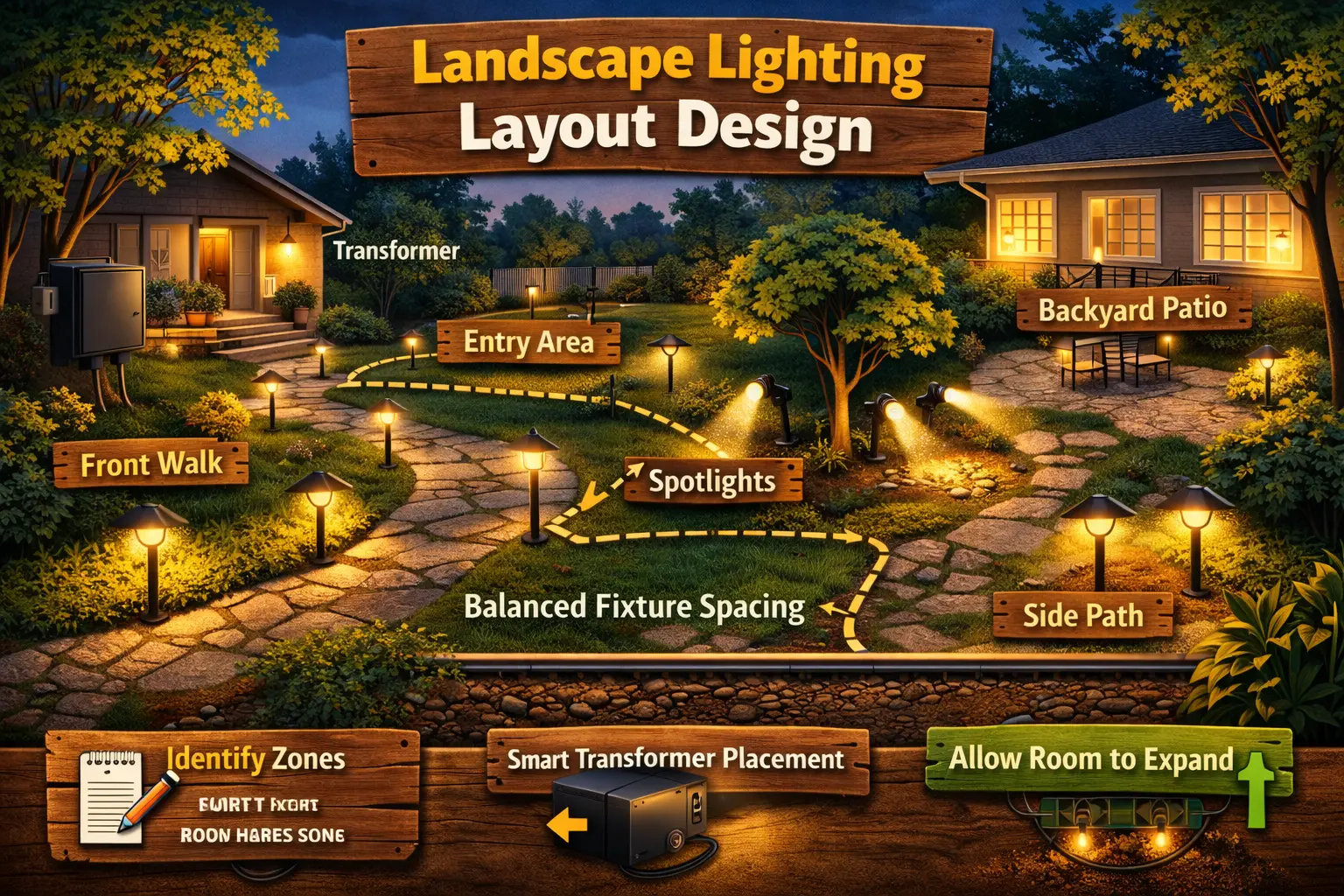
Quick Answer: My 7-Point Property Mapping & Fixture Placement Protocol
Designing a stunning landscape lighting layout is all about painting your yard with light and shadow, not just scattering fixtures around the dirt. A professional-grade plan directs attention to the best architectural features of your house and makes walking paths safe at night, all without shining bright bulbs directly into your eyes.
Whenever I take a clean sheet of graph paper to map out a property or redesign a messy, uninspired yard layout, I balance the lighting map using these seven structural design rules:
- 1. Staggering Path Light Spacing: I never line up walkway fixtures directly across from one another; instead, I stagger them along the path every 6 to 10 feet to create a natural, zigzag flow of light that guides your feet safely.
- 2. Highlighting Key Focal Points: I pick out three or four anchor features—like a mature oak tree, a stone retaining wall, or an architectural entryway column—and focus my main spotlights there to give the yard depth.
- 3. Hiding the Glare Source: Nothing ruins an evening view like a raw bulb shining right in your face; I tilt, shroud, and tuck fixtures behind low shrubs or boulders so you see the beautiful glow, never the bare bulb.
- 4. Framing with Up-Lighting and Down-Lighting: I blend different angles to make the property pop; I place low wells or bullets at the base of walls to wash vertical surfaces, and mount lights high up in tree canopies to mimic soft moonlight.
- 5. Grouping Circuits Into Zones: I split different areas of the yard onto separate wire lines; keeping your front walkway, backyard patio, and security uplights on isolated branches lets you control and adjust sections easily.
- 6. Matching Color Temperatures: Mixing stark blue-white lights with warm golden tones looks awful; I lock in a uniform 2700K warm-white for traditional homes or 3000K soft-white for crisp, modern architectural lines.
- 7. Leaving Room for Shadows: The secret to a high-end look is knowing where *not* to put light; leaving dark spaces between your highlighted elements builds contrast, drama, and dimension.
⚠️ CRITICAL PERFORMANCE RISK: Jamming path lights too close together or aiming heavy spotlights blindly will wash out your yard's textures and overload your wiring runs, triggering severe voltage drops. Ignoring these layout boundaries causes three specific lighting faults that I have mapped out across our system design templates below.
In my 25 years mapping out high-end outdoor layouts, the finest yards succeed because they focus heavily on placement planning before the first trench is ever dug. Spending an extra evening dialing in your fixture spacing saves you from dealing with an ugly, chaotic mess of lights once the sun goes down.
Don't start buying random hardware packs or trenching your flowerbeds blindly. Use my step-by-step wire routing diagrams, tree up-lighting guides, and interactive spacing calculators detailed further down this page to build a perfectly balanced system.
Landscape Lighting Layout Problem Guide
| If Your Yard Looks Like This | What It Means | What To Fix |
|---|---|---|
| Too dark | Not enough lighting coverage | Add fixtures or reduce spacing |
| Too bright | Too many fixtures | Increase spacing or remove lights |
| Uneven lighting | Inconsistent placement | Re-space fixtures evenly |
| Flat appearance | No focal lighting | Add spotlights or accents |
| Dim far areas | Voltage drop or long runs | Adjust layout or cable runs |
Most landscape lighting problems come from placement and spacing—not fixture quality.
Start Here: Choose Your Layout
- Walkways → use path lights with even spacing
- Entry areas → combine path lights and spotlights
- Backyard → mix accent and ambient lighting
- Large yards → divide into zones
Start with layout first, then choose fixtures based on each area’s purpose.
Why Landscape Lighting Layout Design Matters
Layout design is where outdoor lighting either starts to make sense or starts to fall apart. A good layout helps the eye move naturally through the property. It highlights walkways without making them look like an airport runway. It draws attention to trees, planting beds, architectural features, and gathering spaces without throwing harsh light everywhere. It supports safety, curb appeal, and atmosphere all at the same time.
That balance is hard to achieve when the layout is built on impulse. Many homeowners buy fixtures first and then decide where to place them later. The result is often uneven spacing, too many lights in one zone, not enough in another, and wiring routes that become difficult to manage. By contrast, a layout-first approach makes the rest of the installation easier. You know what needs to be lit, what can stay darker, and where the system should be divided into practical zones.
Layout also influences long-term performance. A yard that is thoughtfully planned is easier to wire, easier to troubleshoot, and much easier to expand later without creating a messy patchwork of added fixtures.
A good lighting layout starts with understanding how the system works, not just where fixtures should go. If you want a clearer overview of the components behind a successful outdoor setup, read how landscape lighting works. It explains how low-voltage lighting systems are powered, wired, and distributed so your design decisions make more sense from the start.
Gazebo lighting works best when it is part of a larger layout. See gazebo lighting ideas and connect them with a full landscape lighting layout design.
How to Plan a Landscape Lighting Layout
A strong layout usually begins with a simple question: what do you want the lighting to do? Once that is clear, the fixture plan becomes much easier to build. Some areas are meant for safe movement. Others are meant for visual interest. A few may need both.
>Before installing your system, follow this step-by-step landscape lighting wiring guide to ensure proper connections and performance.
Lighting layout has a direct impact on total cost because fixture count, spacing, and coverage all influence your budget. This landscape lighting cost guide explains how layout decisions affect overall pricing.
When upgrading or replacing a landscape lighting system, it is a good opportunity to improve the overall layout. This Portfolio lighting replacement guide helps you choose better-performing fixtures that match your new design.
Layout is only part of the design. The way lighting behaves over time also affects how natural it feels. Our biophilic outdoor lighting design patterns guide explains how changing brightness and timing can create a more organic and realistic lighting effect.
| Planning Step | What to Focus On | Why It Helps |
|---|---|---|
| Identify priority areas | Walkways, entry points, patios, trees, beds, and focal points | Keeps the design centered on the most important spaces |
| Break the yard into zones | Front path, foundation, side yard, backyard, patio, and accent areas | Makes wiring and transformer planning more manageable |
| Match fixtures to purpose | Path lights for guidance, spotlights for emphasis, deck lights for gathering spaces | Creates a more natural and useful lighting result |
| Review spacing and balance | Avoid crowded fixtures or dark gaps | Helps the yard look smoother after dark |
| Plan for future growth | Leave room for additional zones or fixtures later | Prevents a clean layout from becoming cluttered over time |
Start With Zones Before You Start Picking Fixtures
One of the easiest ways to simplify a landscape lighting layout is to divide the property into zones. Instead of thinking about twenty separate fixtures, think about the front walkway, the entry area, the foundation bed, the patio edge, the backyard tree line, and the side yard. That approach makes the design feel more organized because each zone gets its own purpose.
Zoning also helps with the practical side of the install. It often leads to better transformer placement, cleaner cable routing, and more balanced low voltage runs. If the front path and foundation lighting belong together as one zone, that gives you a logical way to plan the wiring. If the backyard patio and accent trees are far away, they may deserve their own run instead of being attached awkwardly to the front section.
This is where layout design becomes more than just decoration. It becomes the framework for the whole lighting system.
When designing a landscape lighting layout, it is also important to think about how the fixtures will be divided into electrical runs. Larger lighting systems are typically separated into zones so each area of the yard can receive consistent power from the transformer. This approach helps prevent dim lights on long cable runs and makes it easier to expand the system later. To learn how these zones work and how to divide lighting circuits effectively, visit our guide to low voltage landscape lighting zones, which explains how homeowners and installers organize lighting systems into multiple zones.
When designing lighting for planting areas and decorative spaces, it helps to focus specifically on how light interacts with plants and textures. Our garden landscape lighting guide shows how to place lights in garden beds, highlight focal plants, and create depth using layered lighting techniques.
If your yard includes steps, elevation changes, or deck transitions, stair lighting should be part of the layout from the beginning. A dedicated outdoor stair lighting guide can help you plan safer fixture placement, better spacing, and more even light coverage on steps.
A clean landscape layout starts with understanding how the whole property should be lit, not just where one fixture should go. This outdoor lighting plan guide expands on that idea by showing how to divide a property into lighting zones and choose the right fixture types for each area.
Layout decisions directly affect efficiency and performance. For a deeper look at how poor layout leads to wasted energy, see minimizing voltage drop and energy waste.
How to Think About Path Lights, Spotlights, and Accent Fixtures
Different fixtures play different roles in a good outdoor lighting layout. The best results usually come from giving each type of fixture a clear job instead of using the same style everywhere.
Path lights
Path lights are mainly about guidance and rhythm. They help people move through the yard safely and comfortably, but they should not be packed so tightly that the path looks overdone. In many layouts, staggering path lights from side to side instead of mirroring them in a rigid line creates a more natural feel.
Walkway lighting is one of the most important elements in a balanced layout. To better understand spacing, beam spread, and fixture placement, review our complete path lighting guide as part of your planning process.
Spotlights and uplights
These are the fixtures that create drama and depth. They work well on trees, columns, stonework, house fronts, and special landscape features. Used carefully, they create focal points that make the property feel richer and more layered at night.
Deck, patio, and gathering-space lighting
These fixtures should make outdoor living areas more comfortable rather than simply brighter. In a good layout, they support the space without stealing attention from the rest of the yard.
Common Landscape Lighting Layout Problems and Better Fixes
Many weak lighting designs are easy to recognize once you know what to look for. They usually come from overlighting, poor spacing, or a layout that never matched the real structure of the yard.
The difference between a good idea and a professional result comes down to layout and spacing. This landscape lighting layout guide explains how to position fixtures so your lighting looks balanced and intentional.
Good layout planning is not just about where fixtures look best. It also affects how well the system performs electrically. The Landscape Lighting Voltage Drop Calculator helps you test whether a planned run is too long or too heavily loaded before installation.
As you plan fixture placement and wire routing, use our landscape lighting wire burial depth code guide to make sure the trench depth is correct before installation starts.
| Layout Problem | What It Looks Like | Better Approach |
|---|---|---|
| Too many path lights | Walkway feels crowded and overly bright | Use fewer fixtures with better spacing |
| No clear focal points | Yard looks flat even though it has many lights | Choose a few strong accent features to highlight |
| One area is bright while another disappears | Layout feels unbalanced from zone to zone | Redistribute fixtures more intentionally |
| Layout ignores wiring reality | Design looks fine on paper but creates messy runs | Plan layout with transformer and cable paths in mind |
| Every fixture does the same job | Lighting feels repetitive and lacks depth | Mix path, accent, and gathering-space lighting more thoughtfully |
Landscape lighting layout design directly affects how easy it is to troubleshoot isolated failures years later. Poor branch planning, overloaded tee connections, and inaccessible splice points often make one-zone outages difficult to trace. The landscape lighting one-zone troubleshooting guide explains how branch circuits fail and how to isolate the affected section quickly.
Why Transformer Placement Should Influence the Layout
A beautiful layout still has to work as a low voltage system, which means transformer placement matters early in the design process. If the transformer ends up far from the main lighting zones, the cable runs may become longer than they need to be. That can make the installation harder, increase the chance of voltage drop, and complicate future expansion.
This is why layout design and transformer planning should happen together. Before finalizing fixture positions, ask how the system will actually be powered. Which zones are closest to the transformer? Which areas will require the longest run? Could a slightly different starting point make the whole design cleaner? Our Landscape Lighting Transformer Guide is useful here because transformer decisions shape the practical limits of the layout.
A smart layout is not just visually attractive. It is realistic about how the system will function once installed.
A well-designed landscape lighting layout depends heavily on choosing fixtures that direct light precisely where it is needed. Our dark-sky-friendly fixture selection guide explains how shielding geometry, beam spread control, fixture orientation, and lumen concentration affect nighttime visibility, glare management, and overall outdoor comfort throughout residential properties.
How Wiring and Cable Planning Support a Better Layout
A well-designed landscape lighting layout should make wiring easier, not harder. When the yard is divided into logical zones and the fixture plan is balanced, the cable paths often become more obvious. That leads to cleaner installations and fewer strange problem areas later.
This is where layout design overlaps with the rest of your low voltage planning. If the fixtures are arranged without thinking about wire routes, the install can become difficult even if the visual design seemed fine at first. But when spacing, zones, and focal points are planned with cable runs in mind, the result is usually stronger both visually and technically.
Our How to Wire Landscape Lighting guide and our Landscape Lighting Cable Guide both pair naturally with this page because layout planning works best when the wiring side is considered from the start.
A good lighting layout should keep light focused only where it is needed. If your current setup is spilling light into surrounding areas, use our practical guide to stopping light trespass to adjust beam direction and fixture placement more effectively.
How to Design for Depth Instead of Just Brightness
One of the biggest differences between average outdoor lighting and strong outdoor lighting is depth. A weak layout often puts light only at ground level or only along a single path, which can make the yard feel flat. A stronger layout uses layers. Path lights guide movement, spotlights highlight structure or trees, and softer accent lighting helps connect the space without making it feel busy.
Depth is what makes the yard feel interesting after dark. It creates a sense that the property continues beyond the nearest pool of light. It helps important features stand out while allowing less important areas to fade gently into the background. That contrast is what gives landscape lighting much of its appeal.
Designing for depth usually means resisting the urge to treat brightness as the main goal. More light is not automatically better. Better placement is better.
A strong lighting layout depends not only on fixture spacing, but also on how wide or narrow each beam of light is. Choosing the right beam angle is critical for good results. See our beam spread guide to match the correct beam to each feature.
Why Layout Planning Helps Prevent Voltage Drop Problems
Good layout design also protects performance. When the fixture plan is balanced and the zones are realistic, the resulting cable runs are often shorter and more manageable. That helps reduce the kinds of long stretched runs that contribute to dim far-end fixtures and uneven lighting across the yard.
In other words, a strong layout does not just improve appearance. It can also make the system healthier from the beginning. Fewer awkward distances, more practical zone groupings, and better transformer alignment all support more even power delivery. Our Landscape Lighting Voltage Drop Explained guide goes deeper on that part, but layout design is one of the easiest ways to prevent many of those issues before they start.
A yard that is designed with the electrical reality in mind will usually look better and perform better over time.
Seeing real examples can make it easier to understand how a lighting layout should come together. These outdoor lighting ideas and examples show how different layouts, spacing strategies, and fixture types are used in actual designs.
Common Landscape Lighting Layout Mistakes to Avoid
Most layout mistakes follow a few familiar patterns. The first is overlighting. When too many fixtures are placed too close together, the yard can lose the soft balance that makes outdoor lighting attractive. The second is random fixture placement. That often happens when the design is driven by empty spots in the yard instead of by actual focal points and movement areas.
Another mistake is forgetting how the property is used. A beautiful tree uplight might be less important than safe navigation to the front entry or useful patio lighting near seating. Layout design should follow the way people actually experience the yard, not just the way it looks from one angle.
The last common mistake is failing to plan for later. Outdoor lighting systems often grow over time. Leaving a little room in the layout for future fixtures keeps the design from feeling forced when the next phase is added.
Landscape Lighting Layout Design FAQ
How do I plan a landscape lighting layout?
Start by identifying priority areas like walkways, entry points, patios, and focal features, then divide the yard into zones and match each zone with the right fixture type.
How far apart should path lights be?
The right spacing depends on the path and fixture output, but the goal is even guidance without crowding the walkway or creating harsh repeated pools of light.
What makes a landscape lighting layout look professional?
Strong layouts use balance, contrast, clear focal points, practical zones, and fixture placement that supports both appearance and function.
Should transformer placement affect the layout?
Yes. Transformer location influences cable distance, wiring zones, and how practical the lighting plan will be once installed.
Final Thoughts on Landscape Lighting Layout Design
Landscape lighting layout design is where the entire system begins to take shape. Before the transformer is mounted, before the cable is buried, and before the timer is programmed, the yard needs a plan that makes visual sense and practical sense at the same time. That layout is what gives the property rhythm, focus, and a more polished look once night falls.
The strongest layouts usually feel simple when you see them, but that simplicity comes from good decisions. The right zones, better path light spacing, thoughtful spotlight placement, and smarter transformer planning all work together to create a yard that feels inviting instead of overdone. Once those pieces line up, the rest of the low voltage system becomes easier to build and much easier to enjoy.
More Low Voltage Landscape Lighting Guides
Landscape Lighting Transformer Guide
Learn how transformer location and sizing affect layout design, cable planning, and overall lighting performance.
Read the guideHow to Wire Low Voltage Landscape Lighting
Turn a better layout into a better install with smarter runs, cleaner wiring, and stronger low voltage planning.
Read the guideLandscape Lighting Voltage Drop Explained
Understand how long runs and poor zone planning can affect brightness and balance across the yard.
Read the guideLandscape Lighting Timer Setup Guide
Set up timer controls the right way once your layout and zones are planned for more dependable evening lighting.
Read the guideLandscape Lighting Cable Guide
Choose better cable runs and support a cleaner layout with smarter wire planning for low voltage systems.
Read the guideLandscape Lighting Troubleshooting Guide
Diagnose weak zones, dim fixtures, timer confusion, and other common issues tied to layout and system planning.
Read the guide