
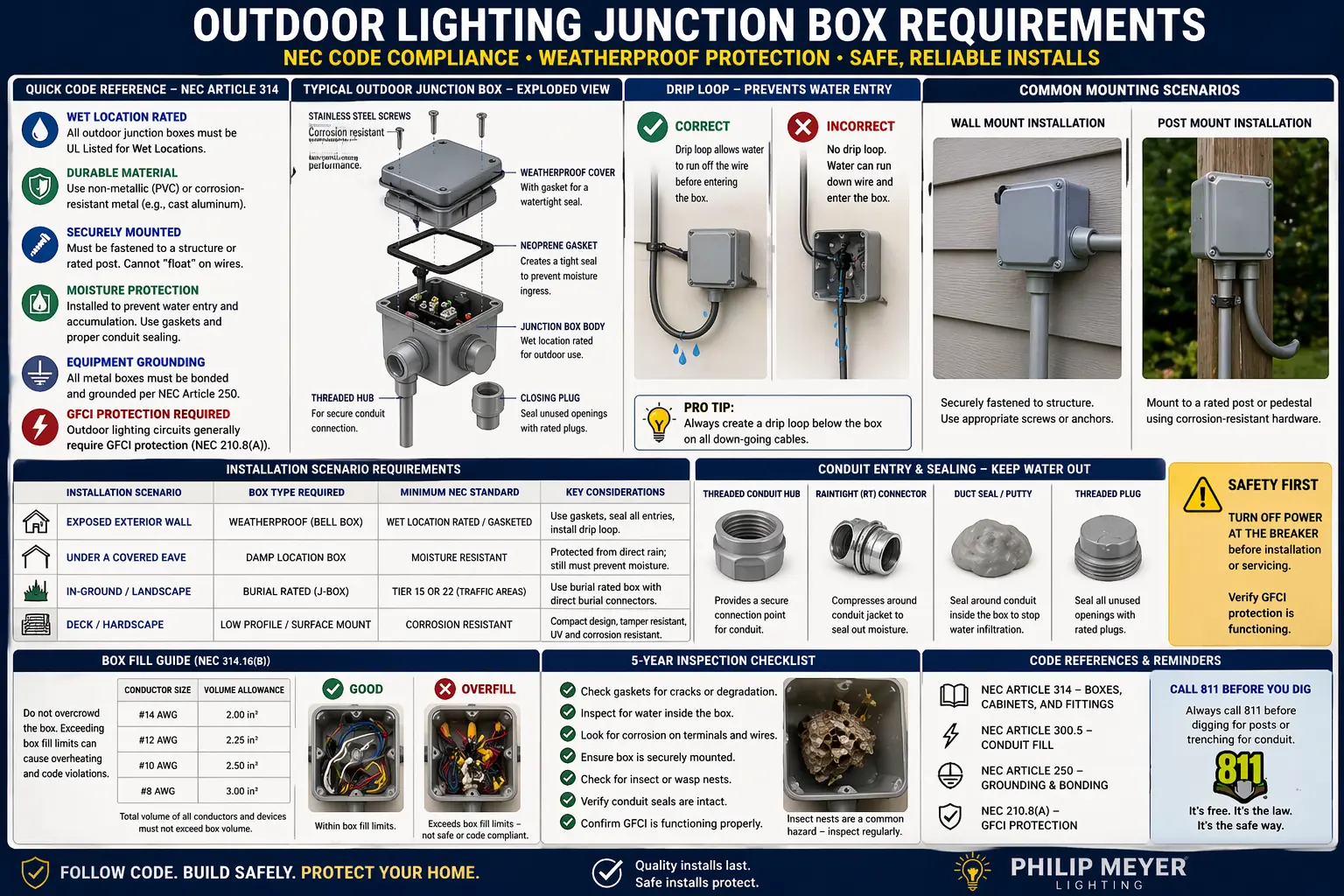
Quick Reference: Outdoor Lighting Junction Box Code Requirements
Outdoor lighting junction boxes must be rated for the installation environment, securely mounted, accessible, gasketed or covered correctly, and installed so moisture does not enter or accumulate inside the box.
For low-voltage outdoor systems, also review Portfolio low voltage lighting.
Why Outdoor Junction Box Requirements Matter
- Moisture causes corrosion and voltage loss
- Loose or wet connections create heat buildup
- Improper installs increase fire risk
- Most failures happen at connections—not fixtures
Logic Summary: The Box Must Match the Exposure
The main mistake is treating “outside” as one condition. A protected porch ceiling, an exposed exterior wall, a post in a landscape bed, and an in-ground lighting splice all face different moisture, impact, corrosion, and accessibility problems.
Exposed to rain
Use wet-location weatherproof equipment with the correct cover, gasket, and conduit entries.
Under cover
Damp-location equipment may apply only where direct rain and sprinkler exposure are not expected.
Below grade
Use listed underground boxes or handhole enclosures that remain accessible after installation.
Metal enclosure
Bond and ground the box correctly so exposed metal parts cannot become energized.
Outdoor lighting junction box requirements sit between general electrical code and real outdoor lighting conditions. The box must satisfy electrical safety rules, but it also has to survive weather, sprinkler overspray, insects, UV exposure, corrosion, and future maintenance.
This guide explains the code-aware requirements homeowners and installers should understand before adding wall lights, post lights, deck lights, landscape lighting junctions, hardscape lighting splices, or exterior fixture connections.
For the full code and safety overview beyond junction boxes, see landscape lighting electrical code and safety guide.
In addition to proper enclosures and sealing, all outdoor circuits must follow GFCI protection rules. See outdoor lighting GFCI requirements (NEC 2026) to ensure your installation is compliant and safe.
If your low-voltage transformer is hardwired into an outdoor junction box, check low voltage lighting permit requirements before starting, because hardwired installations are more likely to need inspection.
What to Check First
- Is the box weatherproof and gasketed?
- Are all conduit entries sealed?
- Is there a drip loop on incoming wiring?
- Is the box overfilled?
Outdoor Lighting Junction Box Requirement Table
Use this table as a fast decision guide. The exact box, cover, connector, and wiring method still depend on local code, the circuit type, voltage, fixture, and installation conditions.
| Installation Scenario | Box Type Required | Minimum Code Logic | Pro Tip |
|---|---|---|---|
| Exposed exterior wall | Weatherproof cast box or exterior-rated box with gasketed cover | Wet-location rated, secured, covered, and sealed against direct weather | Use corrosion-resistant screws and check gasket compression. |
| Under a covered eave | Damp-location or wet-location equipment depending on exposure | Moisture-resistant equipment where protected from direct rain | Wind-driven rain can make “protected” areas behave like wet locations. |
| In-ground / landscape area | Listed underground box or handhole enclosure | Accessible, drainage-aware, and rated for underground conditions | Use traffic-rated covers where mowers, foot traffic, or vehicles may cross. |
| Deck / hardscape | Low-profile surface box or listed hardscape splice enclosure | Corrosion-resistant, accessible, and protected from physical damage | Do not trap splices behind stone, decking, or trim with no access panel. |
| Post light or bollard | Post-rated or fixture-rated wiring compartment | Secure support, accessible splices, correct grounding, and water control | Call 811 before trenching or setting new posts. |
Wet Rated vs. Damp Rated: The Distinction That Matters Outdoors
A damp-location box is not the same as a wet-location box. Damp locations are protected from direct water but may experience humidity or condensation. Wet locations are exposed to rain, snow, irrigation spray, washdown, or direct weather.
Damp Location Examples
- Covered porch ceiling
- Protected eave area
- Outdoor ceiling with no direct rain exposure
Wet Location Examples
- Exposed exterior wall
- Landscape post light base
- Garden or hardscape junction point
- Area hit by sprinklers or wind-driven rain
For broader outdoor fixture planning, see Portfolio outdoor lighting.
Safe junction-box installation depends heavily on proper electrical planning upstream of the splice itself. The landscape lighting load calculation and NEC compliance resource explains how amperage distribution, transformer loading, wire sizing, and startup current spikes influence long-term connector temperatures, splice reliability, and safe low-voltage wiring performance outdoors.
Box Fill Calculations: Do Not Cram Too Many Wires Into the Box
Junction boxes are not just physical containers. They must have enough internal volume for conductors, splices, device yokes, clamps, and grounding conductors. Crowded boxes can damage insulation, stress wire nuts, trap heat, and make future troubleshooting harder.
- Count conductors based on wire size and box-fill rules.
- Use larger boxes when multiple lighting branches meet in one location.
- Avoid using tiny weatherproof boxes as multi-circuit splice chambers.
- Leave enough room for gasketed covers to close without pinching conductors.
If wire size and run length are part of the design, use landscape lighting wire gauge.
Box Fill Requirements (Quick Reference)
| Wire Size | Volume Required |
|---|---|
| 14 AWG | 2.00 cubic inches per conductor |
| 12 AWG | 2.25 cubic inches per conductor |
Important: All grounding wires count as one conductor, and internal clamps count as one additional volume allowance.
Most Common Junction Box Installation Mistakes
- Missing gasket or loose cover
- No conduit sealing at entry point
- Overfilled box
- No drip loop
- Box installed below grade without proper rating
Junction Box Mistakes Often Show Up as Correction Notices
Outdoor junction boxes are one of the most common places inspectors find lighting defects because they reveal how power, splices, covers, conductors, and wet-location protection were handled. If a box problem is discovered, classify it with the landscape lighting inspection failure codes so the correction is tied to the right category instead of a vague note. Serious box issues, such as exposed conductors or water in energized equipment, may fall under the landscape lighting red tag violation guide. Standard comments can be handled using the inspector correction notice guide. Before final approval, verify the corrected box against the outdoor lighting final inspection checklist and make sure the permit file does not contain issues listed in the permit rejection reasons guide.
Grounding Requirements for Metal vs. PVC Outdoor Junction Boxes
Grounding is especially important outdoors because wet surfaces, metal covers, and corroded parts increase shock risk. Metal boxes must be bonded so the equipment grounding path remains continuous. PVC boxes do not become energized the same way, but the grounding conductor still must be continuous to grounded fixtures and devices.
Metal Junction Box
Bond the metal box with the proper grounding screw or clip. Ground the fixture and maintain equipment grounding continuity through the circuit.
PVC / Nonmetallic Box
The box itself is nonconductive, but the grounding conductor still needs to continue through the box and connect to metal fixtures or devices that require grounding.
If you are diagnosing a grounding concern, see Portfolio light fixture not grounded.
All junction boxes and metal components must be properly grounded and bonded. For full safety guidance, see landscape lighting grounding and bonding guide.
Conduit Entry and Sealing: Hubs, Raintight Connectors, and Duct Seal
Water often enters outdoor lighting boxes through the conduit opening, not the front cover. A box can have a good gasket and still fail if the conduit connector, hub, or entry orientation allows water to track into the enclosure.
Use the correct entry method
- Threaded hubs for boxes designed to accept them
- Raintight connectors where the wiring method requires them
- Proper knockouts and fittings instead of improvised holes
- Duct seal putty where appropriate to discourage water, insects, and air movement
Do not create a water funnel
Conduit should not route water directly into the box. If conduit rises into a box from below, plan the entry and sealing carefully. If conduit enters from above, the connector and hub must be especially well protected because gravity works against the installation.
For wiring method basics, review how to wire landscape lighting and landscape lighting cable guide.
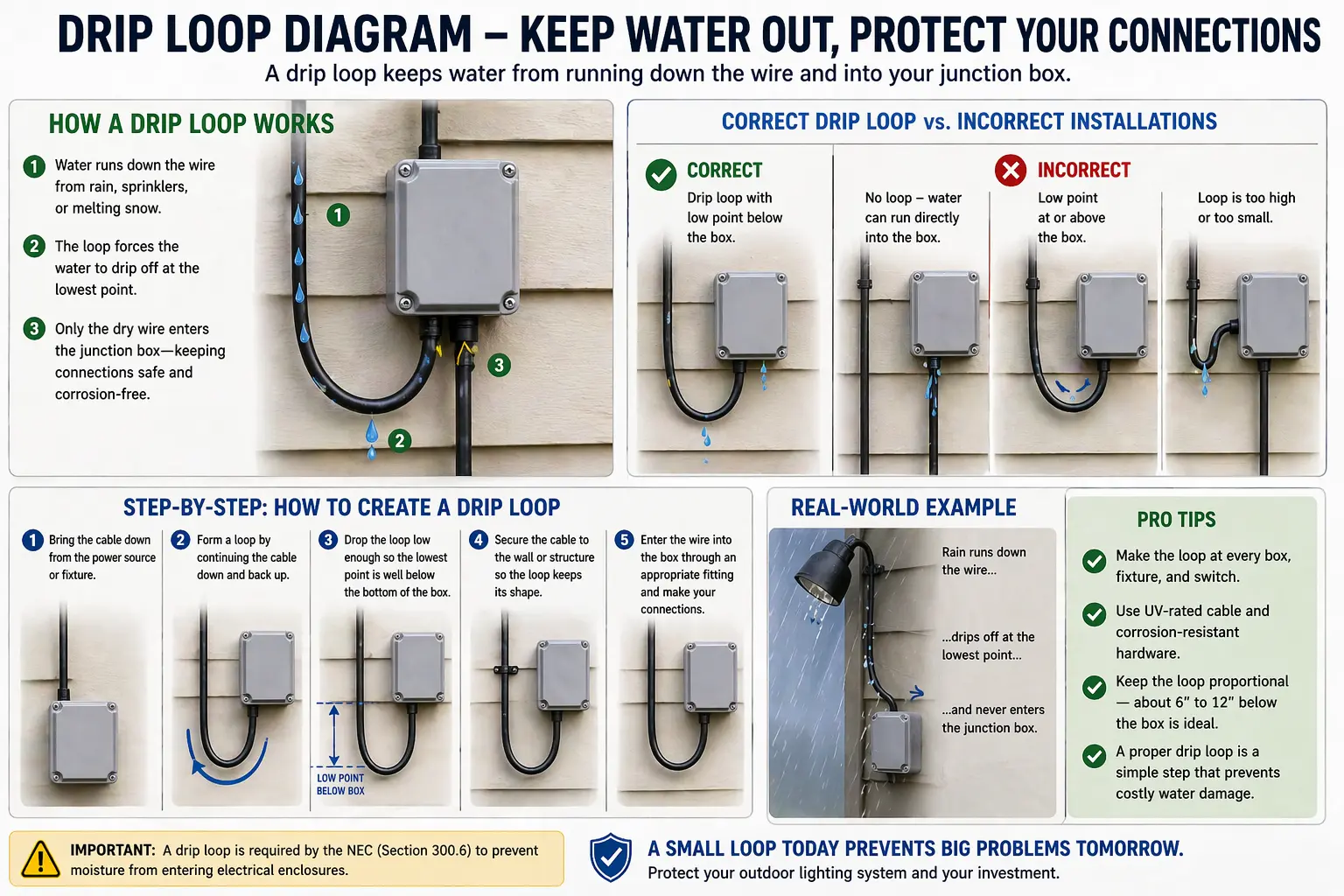
Drip Loops and Water Control for Outdoor Lighting Boxes
A drip loop is a simple wire-routing detail that prevents water from following the cable directly into the box. Instead of entering the box at the lowest point of the wire path, the wire dips below the entry and rises back up, allowing water to drip off before it reaches the opening.
- Route cable so water naturally falls away from the opening.
- Avoid upward-facing entries that collect water.
- Keep gasket surfaces clean and flat.
- Do not rely on caulk alone to fix poor box orientation.
For seasonal displays using plugs, extension cords, and temporary light strings, pair this with our weatherproofing outdoor holiday lights guide.
Drip Loop Example
A drip loop prevents water from running directly into the junction box by allowing it to drip off before reaching the entry point.
 >
>
Junction Boxes Are Where Old Wiring, Smart Controls, and Moisture Problems Often Meet
Many outdoor lighting failures become visible at the junction box because that is where power conductors, fixture leads, control modules, timers, sensors, and weather exposure often converge. If a smart relay, low-voltage sensor, or control lead is being added near line-voltage conductors, the NEC Article 725 smart lighting control guide helps explain why Class 2 and power wiring cannot be treated casually. If the box is part of an older installation, the electrical code grandfather clause guide for outdoor lighting explains when existing work may remain and when opened or modified wiring should be corrected. If moisture is showing up inside the connected fixture, the Portfolio lighting condensation and foggy lens fix helps determine whether the issue is normal temperature cycling or a failed seal that can eventually affect the junction point.
Structural Integrity: The Box Cannot Hang From the Wire
Outdoor boxes must be secured to something solid. A junction box that is supported only by cable, flexible conduit, or a loose fixture whip is vulnerable to vibration, mower contact, wind movement, water entry, and conductor stress.
- Wall boxes should be anchored to the building surface or structure.
- Post boxes should be attached to a rated post or fixture base.
- Underground boxes should be supported and accessible at grade.
- Hardscape boxes should be serviceable without demolishing the structure.
Outdoor junction boxes need the right enclosure, cover, location rating, conductor protection, and accessible splices, but the inspection should continue beyond the box. Low-voltage lighting failures often start where the box connects to a transformer, buried cable, fixture lead, or wet connector. Use the NEC low-voltage lighting inspection checklist after box inspection to verify the complete installation, including power source protection, listed cable, connector ratings, fixture suitability, voltage-drop readings, documentation photos, and final pass/fail notes.
5-Year Outdoor Junction Box Inspection Checklist
Most outdoor junction box failures are not dramatic at first. They start as a small gasket gap, insect nest, loose cover screw, cracked PVC box, corroded wire nut, or damp splice. A simple inspection every few years can prevent flickering lights, nuisance trips, and unsafe connections.
For recurring moisture-related lighting failures, compare with landscape lights not working after rain.
What Causes Outdoor Junction Box Failures
If your lights are flickering or not working due to connection issues, use landscape lighting troubleshooting to diagnose the system.
A junction box may be large enough for the conductors and still serve a lighting load that performs poorly electrically. When numerous LED drivers share a branch circuit, their combined harmonic current, inrush current, and crest factor can create heating or control problems that simple wattage calculations do not reveal. The LED driver harmonic distortion standards guide explains which measurements belong at the driver, branch circuit, and point of common coupling before a dense LED installation is specified.
- Corrosion rate: Terminals in non-gasketed outdoor boxes can experience up to 5× faster oxidation compared to sealed enclosures.
- Water intrusion: Over 60% of outdoor junction box failures are caused by poor conduit sealing or missing gaskets.
- Fire risk: An estimated 15–20% of residential electrical fires are linked to outdoor wiring where moisture compromised connections.
Bottom line: Most failures are preventable with proper sealing and installation—not better hardware.
If your lights are flickering or not working due to connection issues, use Portfolio Lighting troubleshooting to diagnose the system.
Low-Voltage Landscape Lighting vs. Line-Voltage Outdoor Lighting
Low-voltage landscape lighting and 120V outdoor lighting do not always use the same boxes, connectors, splice methods, or burial rules. The lower voltage reduces shock risk, but it does not eliminate the need for listed connectors, accessible splices, weather-resistant enclosures, and protection from water.
- Low-voltage splices still need outdoor-rated connectors.
- Line-voltage splices require compliant boxes, covers, grounding, and wiring methods.
- Underground wiring must follow burial and protection rules.
- Outdoor circuits may need GFCI protection depending on application and code.
For connector selection, see low voltage wire connectors landscape lighting.
Junction Boxes Should Match the Permit Record
Outdoor junction boxes are often where inspectors discover missing documentation, hidden splices, wrong enclosure ratings, or unclear cable routing. When a project requires review, the as-built lighting diagram requirements help show where each box, transformer, and cable path belongs in the final record. The landscape lighting permit requirements by state can help identify when local review is likely, while the common landscape lighting code violations guide and inspection failure database explain why missing box documentation causes callbacks. If solar-powered fixtures are part of the system, the UL 8750 solar lighting standards guide adds useful product-safety context.
Philip Meyer Safety Check: When to Stop and Call a Pro
Outdoor electrical work becomes higher risk when line voltage, water exposure, buried wiring, metal boxes, and structural mounting overlap. A junction box mistake may not fail immediately; it may fail months later after water intrusion, corrosion, or heat damage.
- Call a pro if the box contains 120V wiring and you are unsure of the circuit.
- Call a pro if water has entered a live junction box.
- Call a pro if the box is hot, buzzing, arcing, or repeatedly tripping GFCI protection.
- Call a pro before concealing or burying a splice you cannot inspect later.
Outdoor Lighting Junction Box Requirements FAQ
Do outdoor junction boxes need to be accessible?
Yes. Outdoor junction boxes must remain accessible for inspection, troubleshooting, repair, and maintenance. Do not bury splices behind permanent finishes, under soil, or inside hardscape where excavation or demolition is required to reach them.
Can I use a damp-rated box outside?
Only in protected damp locations where direct water exposure is not expected. Exposed walls, posts, landscape beds, and sprinkler zones require wet-location weatherproof equipment.
Do outdoor lighting junction boxes need GFCI protection?
Many outdoor circuits and outlets require GFCI protection under modern code rules. Requirements depend on the circuit, equipment, voltage, wiring method, and local amendments, so confirm before installation.
Can an outdoor junction box be installed underground?
Only if the enclosure is listed for underground use and remains accessible. Underground boxes and handholes should not be hidden under permanent paving, soil, or landscaping that must be excavated for access.
What causes water inside an outdoor junction box?
Common causes include a missing gasket, loose cover screws, wrong box rating, upward-facing conduit entries, no drip loop, cracked plastic, poor connector sealing, or wind-driven rain entering through a bad cover.
Final Thoughts on Outdoor Lighting Junction Box Requirements
A good outdoor lighting junction box protects the splice, supports the wiring method, resists water, remains accessible, and matches the environment. The correct box is not just a code detail; it is the difference between a safe long-term lighting installation and a future troubleshooting problem.
Use wet-location equipment where weather exposure exists, keep splices accessible, avoid overcrowding, bond metal parts correctly, seal conduit entries properly, and inspect outdoor boxes before small moisture problems become major electrical failures.
If you are running wiring underground, make sure you follow proper depth and protection rules using our landscape lighting wire burial depth code guide.
Even with proper sealing and weatherproof boxes, outdoor circuits must be protected by a GFCI device to prevent shock hazards. See outdoor lighting GFCI requirements (NEC 2026) to ensure your installation meets current safety standards.
Outdoor enclosures and wiring methods are influenced by current NEC rules. See NEC 2026 landscape lighting code updates for full compliance details.
More Outdoor Lighting Code and Installation Guides
Landscape Lighting Electrical Code Safety Guide
Start here for a broader safety overview of outdoor lighting code, wiring, GFCI protection, and installation risk.
Read the guideHow to Wire Landscape Lighting
Use this when planning cable routes, transformer connections, and low-voltage lighting installation basics.
Read the guideLow Voltage Wire Connectors
Helpful when choosing weather-resistant low-voltage connectors instead of unsafe indoor splices.
Read the guideLandscape Lights Not Working After Rain
Use this if water intrusion, wet splices, or outdoor box failures are already affecting the lighting system.
Read the guideUpdated Outdoor Connection and Fixture Safety Guides
A junction box protects the connection point, but the fixture itself must still be rated for the location. This outdoor wet-location listing guide explains how to match fixture ratings to damp, wet, splash, and fully exposed installations.
When a transformer feeds outdoor lighting circuits, safe servicing matters just as much as proper box placement. This landscape transformer disconnect requirement guide explains how disconnect access supports safer repairs and inspections.
Junction boxes near pool areas require extra awareness because pool-zone rules are stricter than ordinary landscape lighting rules. This pool lighting clearance and NEC 680 guide helps explain the safety logic behind separation distances.
Water-feature lighting needs a different level of protection than ordinary path lighting. This submersible fountain lighting requirements guide explains what changes when lighting equipment is installed in or near water.
Outdoor junction-box planning should also consider accessibility routes. This ADA-compliant outdoor pathway lighting guide shows how lighting placement can support safer navigation along walks, ramps, and entries.
Not every splice belongs loose in mulch or soil. This landscape lighting splice code guide explains how outdoor wire connections should be protected from moisture, tension, and corrosion.
Junction box requirements make more sense once you understand which NEC article governs the overall lighting system. Our comparison of NEC Articles 411 and 725 walks through the practical differences that affect residential landscape lighting installations.
Outdoor Junction Box Code, Wet-Location Box, and Lighting Safety Help
This page is designed to help homeowners understand outdoor lighting junction box requirements before choosing a box, sealing a splice, replacing a fixture, installing a post light, or troubleshooting water-related failures.
Outdoor electrical code can vary by local amendments and installation details. When working with 120V wiring, buried raceways, metal boxes, or GFCI-protected circuits, confirm the installation with a qualified electrician or local authority.