
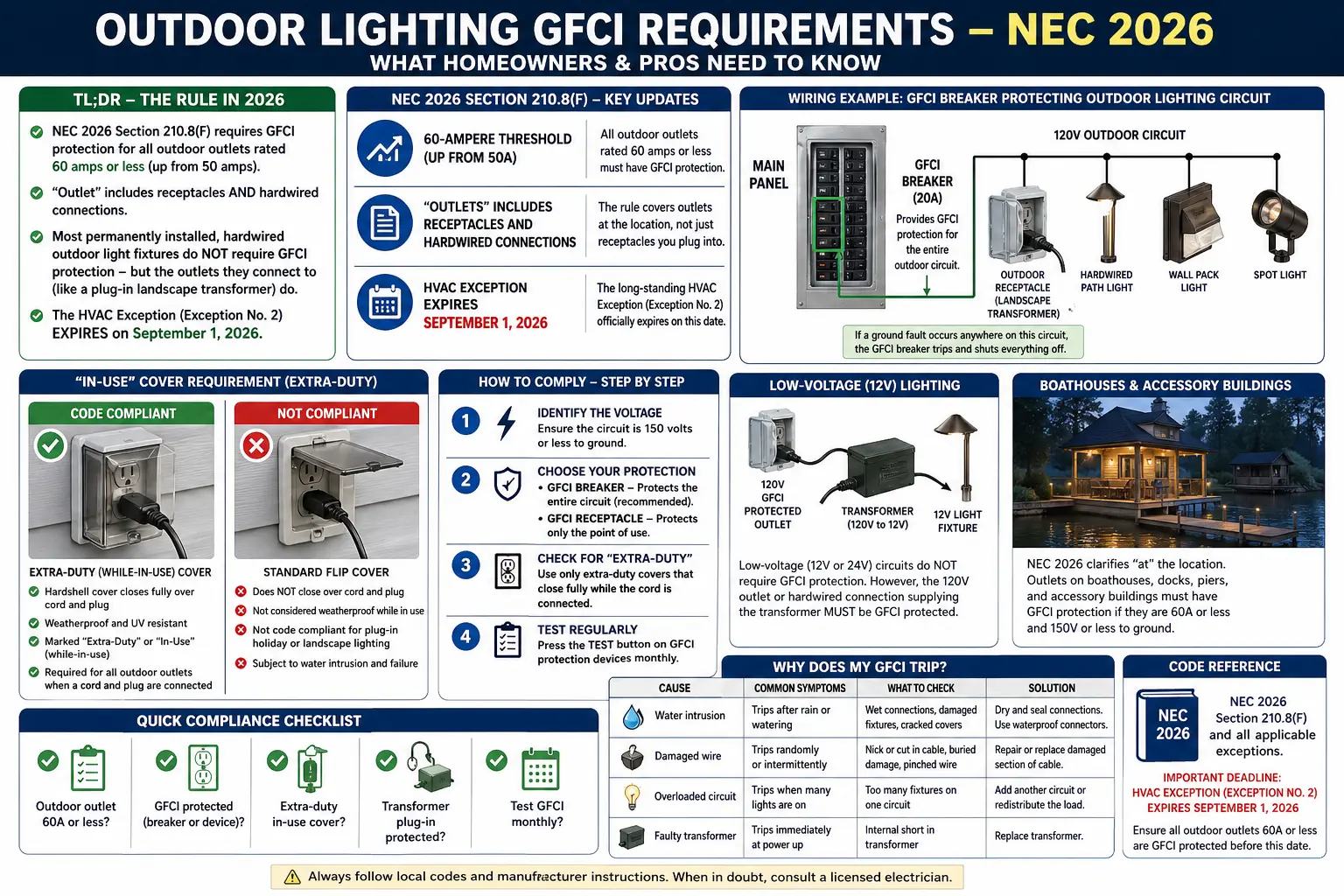
Quick Answer: NEC 2026 Outdoor Lighting GFCI Rule
NEC 2026 Section 210.8(F) requires GFCI protection for all qualifying outdoor outlets rated 60 amperes or less and supplied by single-phase branch circuits rated 150 volts or less to ground. The rule applies to outdoor outlets, not only receptacles, which means hardwired connection points can be part of the discussion.
- The rule: Outdoor outlets rated 60A or less generally need GFCI protection when covered by Section 210.8(F).
- The lighting exception: GFCI protection is not generally required for most lighting outlets except where other rules apply.
- The practical lighting takeaway: Plug-in landscape lighting transformers, holiday lights, timers, and plug-connected controllers should be supplied from GFCI-protected outdoor outlets.
- The 2026 headline: The threshold moves to 60 amperes, and the HVAC exception is scheduled to expire September 1, 2026.
Start Here: What Needs GFCI Protection?
- Outdoor receptacle powering a plug-in landscape transformer → GFCI protection generally required
- Outdoor outlet powering holiday lights or a timer → GFCI protection generally required
- Low-voltage landscape lighting cable after the transformer → GFCI usually not required on the 12V side
- Hardwired lighting outlet → generally covered by the lighting outlet exception unless another rule applies
- Outdoor equipment supplied by a qualifying outlet → check the 60-ampere threshold and local adoption rules
For full outdoor electrical safety and compliance, see landscape lighting electrical code and safety guide.
GFCI protection is only one part of a compliant outdoor lighting setup. Use the low voltage lighting permit requirements guide to confirm whether your transformer, outlet, or buried cable also needs local approval.
GFCI protection is only one part of the installation. The transformer also needs proper height, airflow, weather protection, and cable routing. See the outdoor lighting transformer mounting code requirements for the full mounting and clearance checklist.
GFCI protection is not only a code issue; it can also affect liability if outdoor lighting fails near wet walkways, patios, or public-facing areas. The outdoor lighting liability checklist explains how safer installation choices reduce risk.
GFCI protection is only one part of a code-compliant installation. The electrical article governing the system also affects installation requirements. Before adding transformers or extending wiring, review our guide comparing NEC Articles 411 and 725 so you understand how each applies to residential landscape lighting.
GFCI protection is only one part of planning outdoor lighting around water. The low-voltage side still needs appropriate fixtures, wiring, connections, and placement for the actual environment. This becomes especially important when lighting is built into a retaining wall beside a pool, pond, fountain, waterfall, or drainage area. Our retaining wall lighting near water guide shows how these installations differ from ordinary dry-yard retaining-wall lighting and what to check before installation.
Pond lighting is a good example of why the low-voltage side and line-voltage side of an outdoor lighting system should be considered separately. The fixtures may operate at low voltage while the transformer is still supplied by a line-voltage branch circuit and receptacle. Our pond lighting code guide explains how GFCI considerations, transformer placement, wet locations, underwater fixtures, and low-voltage wiring fit together around a water feature.
What to Check First
- Is the GFCI outlet tripped or faulty?
- Is the receptacle mounted above ground level?
- Are connections protected from rain?
- Are multiple transformers or LED drivers on one circuit?
Outdoor lighting GFCI requirements are confusing because homeowners often use “outlet” and “receptacle” as if they mean the same thing. The NEC uses those words differently. That distinction matters for plug-in landscape transformers, hardwired outdoor lighting, holiday lights, outdoor controllers, boathouse circuits, accessory buildings, and exterior equipment.
This guide focuses on the outdoor lighting side of NEC 2026 Section 210.8(F), including the 60-ampere threshold, lighting outlet exception, low-voltage transformer supply rules, in-use cover requirements, and the September 1, 2026 HVAC exception deadline.
A nuisance GFCI trip may be caused by moisture leakage through outdoor connectors instead of a completely failed fixture. The low-voltage plug and limited-energy connector guide explains how wet splice points and damaged connectors create partial current leakage in landscape lighting systems.
If the project involves outdoor receptacles, GFCI devices, panel work, or line-voltage wiring, licensing matters as much as the fixture layout. The outdoor lighting licensing and contractor requirements guide explains when this work should be handled by a properly licensed professional.
GFCI protection is one of the most important outdoor lighting safety checks, but it should not be reviewed alone. A system can have working GFCI protection and still fail because of poor transformer mounting, shallow cable, improper splices, wrong fixture ratings, or missing documentation. Use the electrical inspector landscape lighting checklist to connect GFCI testing with the rest of the outdoor lighting inspection process.
Also, GFCI protection represents only one part of a safe outdoor kitchen design. Electrical panels, disconnects, receptacles, transformers, and lighting controls also require adequate working space to allow safe operation and servicing. The outdoor kitchen electrical clearance resource provides practical guidance for maintaining these critical access zones while integrating attractive outdoor lighting features.
GFCI protection is one of the most important outdoor lighting safety checks, but it should not be reviewed in isolation. A system that has GFCI protection may still have poor cable burial, unlisted wet-location connectors, unsupported fixtures, damaged insulation, or undocumented voltage problems. After confirming the correct protection device and test/reset function, use the low-voltage landscape lighting NEC inspection checklist to review transformer placement, primary power protection, secondary wiring, splice ratings, fixture listing, and final operating tests in one organized inspection pass.
NEC 2026 Section 210.8(F): The 60-Ampere Outdoor Outlet Threshold
NEC 2026 Section 210.8(F) applies to outdoor outlets supplied by single-phase branch circuits rated 150 volts or less to ground and 60 amperes or less . The phrase that matters for search and code interpretation is:
Section 210.8(F) 60-ampere threshold.
That threshold matters because outdoor lighting controllers, plug-in transformers, smart outdoor equipment, heat-related outdoor accessories, and other exterior devices can fall into the practical conversation even when they are not simple 15A or 20A receptacles.
Before the 2026 shift
Many discussions focused on the earlier 50-amp outdoor outlet threshold and the HVAC exception.
NEC 2026 focus
The covered outdoor outlet threshold is 60 amperes or less for qualifying single-phase branch circuits.
Lighting relevance
Plug-in transformers and outdoor lighting controls may be supplied by outdoor outlets that need GFCI protection.
Deadline relevance
The listed HVAC equipment exception is scheduled to expire on September 1, 2026.
Most Common Outdoor Lighting Code Violations
- Non-weatherproof outlet covers
- Receptacles mounted too low to the ground
- Using non-GFCI protected circuits outdoors
- Overloading circuits with multiple transformers
- Old non-self-testing GFCI devices still in use
Outlets vs. Receptacles: The Confusion That Causes Bad GFCI Advice
In everyday language, many homeowners say “outlet” when they mean the place where a plug goes. In electrical code language, a receptacle is the device that accepts a plug, while an outlet is a point on the wiring system where current is taken to supply utilization equipment.
That means an outlet can be a hardwired connection point, not just a plug-in receptacle. This is why NEC 210.8(F) discussions can include outdoor equipment that is permanently connected, not only outdoor plug outlets.
If your system continues to trip or malfunction, use landscape lighting troubleshooting to diagnose wiring, load, and connection issues.
Not every repeated trip involving LED lighting is caused by ground-fault leakage. Large groups of electronic drivers can draw high-crest-factor current, create harmonic loading, or interact poorly with controls and backup power equipment. Those conditions should not be confused with a true GFCI fault, but they can complicate diagnosis. The LED driver harmonic distortion guide shows how to separate current THD, voltage distortion, power factor, leakage, and ordinary wiring faults before replacing protective devices.
GFCI protection is important, but it does not replace the need to use properly evaluated electrical equipment. Transformers, fixtures, and other components still need to be suitable for their intended application. If you are comparing products with different certification labels, see our UL vs ETL landscape lighting guide for a simple explanation of these marks and what they do—and do not—tell you about an outdoor lighting product.
GFCI Review Is Only One Piece of Permit Approval
GFCI protection is a major outdoor lighting safety checkpoint, but final approval often depends on the entire installation record. The landscape lighting permit requirements by state guide helps identify when local approval may be required, while the as-built lighting diagram requirements page shows how to document power source, transformer, cable, fixture, and control locations. To avoid reinspection problems, compare the project with the common landscape lighting code violations page and the inspection failure database. For solar products tied into the outdoor lighting plan, the UL 8750 solar lighting performance standards guide explains the product safety layer inspectors and buyers may care about.
Seasonal C7 and C9 strings create dozens of small line-voltage socket openings where moisture, corrosion, damaged insulation, or missing bulbs can produce leakage current. When GFCI trips follow rain or snowmelt, inspect more than the extension-cord plugs. The C7 and C9 holiday socket repair guide explains how water enters around bulb bases, how corrosion progresses at the contacts, and which socket conditions require immediate replacement rather than drying and reuse.
GFCI Trips Can Reveal Larger Outdoor Lighting Problems
A GFCI trip is often the first sign that an outdoor lighting system has crossed from normal aging into an electrical safety issue. Modern smart lighting upgrades can add control modules, sensors, timers, and low-voltage signaling paths, so the Class 2 smart lighting control wiring guide is useful when the system includes more than a simple fixture. Older systems may appear “grandfathered,” but the outdoor lighting grandfathering and code-trigger guide explains why damaged, modified, or unsafe installations may still require updates. When trips happen after rain or humidity, also inspect fixtures for trapped moisture using the foggy Portfolio lens condensation troubleshooting guide, because water inside the fixture can point to failed seals, cracked housings, or wet-location listing problems.
GFCI Problems Can Escalate From Correction Notice to Red Tag
Outdoor lighting GFCI issues should be documented carefully because they can move from a simple correction to a serious safety concern when water, repeated trips, exposed conductors, or unverified primary power are involved. Use the landscape lighting inspection failure codes to classify whether the issue is power-source, protection, junction-box, cable, or fixture related. If the defect is unsafe enough to stop work, follow the landscape lighting red tag violation process. If the inspector only requests correction, use the inspector correction notice guide to document the repair. Before calling for final approval, complete the outdoor lighting final inspection checklist and avoid the missing-details problems covered in the landscape lighting permit rejection reasons guide.
The Lighting Exception: Do Hardwired Outdoor Light Fixtures Need GFCI?
Most permanently installed hardwired outdoor lighting outlets are not treated the same as plug-in outdoor receptacles. NEC 2026 Section 210.8(F) includes an exception stating that GFCI protection is not required for lighting outlets other than those covered in 210.8(C).
In practical terms, a permanently installed wall lantern, post light, or hardwired exterior fixture may not need GFCI protection simply because it is outdoors. But the receptacle powering a plug-in landscape lighting transformer, holiday display, or outdoor smart controller generally does need GFCI protection.
For outdoor junction box and fixture connection safety, see outdoor lighting junction box requirements .
Does Low-Voltage Landscape Lighting Need GFCI?
The low-voltage side of a typical landscape lighting system is usually 12V or 15V and generally does not need GFCI protection in the same way a 120V outdoor receptacle does. The key requirement is on the power source: the 120V outdoor receptacle or outlet that supplies the low-voltage transformer.
If your system includes underground wiring, follow proper installation depth rules in landscape lighting wire burial depth code.
- 12V landscape cable: generally not the GFCI-protected side of the system
- Plug-in transformer: should be plugged into a GFCI-protected outdoor receptacle
- Hardwired transformer: evaluate the outlet, circuit, wiring method, and local code requirements
- Wet locations: still require proper connectors, covers, and weatherproofing
For low-voltage planning, review Portfolio low voltage lighting and low voltage wire connectors landscape lighting .
How to Comply: Outdoor Lighting GFCI Inspection Checklist
Check for self-testing GFCI protection: Modern GFCI outlets are required to be self-testing. Look for a status indicator light or “End of Life” signal on the device. If your outlet does not have this feature, it may be outdated and should be replaced during any lighting upgrade.
For a full breakdown of how these rules fit into the latest code cycle, see NEC 2026 landscape lighting code updates for GFCI expansion, burial depth, and system-wide changes.
Use this checklist to evaluate outdoor lighting GFCI protection before adding landscape lights, holiday lights, plug-in transformers, smart controllers, timers, or exterior lighting equipment.
- Identify the voltage: Confirm whether the equipment is supplied by a circuit rated 150 volts or less to ground.
- Identify the amp rating: Check whether the outdoor outlet is rated 60 amperes or less.
- Identify the connection: Decide whether the equipment is plug-in, hardwired, or low-voltage after a transformer.
- Choose the protection method: Use a GFCI breaker for whole-circuit protection or a GFCI receptacle for point-of-use protection where allowed.
- Check the cover: Outdoor plug-in lighting should use an extra-duty in-use cover that closes while the cord is plugged in.
- Inspect water exposure: Keep plugs off the ground, use drip loops, and weatherproof cord connections.
- Verify local adoption: Confirm your jurisdiction’s adopted NEC edition and any amendments.
If your outdoor lights keep shutting off even after resetting the outlet, the issue may be moisture leakage, damaged cable, overloaded transformer load, or a failing GFCI device. Use the landscape lighting GFCI tripping troubleshooting guide to isolate the real cause before replacing parts.
Electrical protection devices and transformer fault systems often work together when a low-voltage lighting installation develops moisture intrusion, overloaded wiring or unsafe electrical conditions. This lighting transformer diagnostic and error code guide explains how many modern systems warn users about electrical faults before complete failure occurs.
GFCI protection is only one layer of a properly designed outdoor lighting system. Our landscape lighting load calculation and code compliance guide explains how transformer sizing, balanced electrical loading, NEC Article 411 considerations, and voltage-drop management all contribute to safer low-voltage system operation and reduced electrical stress throughout the installation.
GFCI protection works best when the entire low-voltage lighting system is electrically balanced and operating within proper voltage-drop limits. Our landscape lighting voltage-drop and NEC requirements guide explains how transformer loading, conductor sizing, startup surge behavior, and long-distance voltage loss influence system stability, nuisance electrical behavior, and safe nighttime operation.
GFCI Breaker vs. GFCI Receptacle for Outdoor Lighting
Both approaches can protect outdoor lighting equipment, but they solve the problem in different places.
| Protection Type | What It Protects | Best For | Trade-Off |
|---|---|---|---|
| GFCI Breaker | Entire branch circuit from the electrical panel | Hard-to-reach outdoor outlets, multiple exterior loads, clean whole-circuit protection | More expensive and requires panel work |
| GFCI Receptacle | Point of use and downstream load terminals if wired correctly | Plug-in landscape transformers, holiday lights, timers, and outdoor controllers | Must be weatherproofed and installed correctly |
| Portable GFCI Adapter | Temporary plug-in protection | Temporary holiday lighting when permanent protection is missing | Not a substitute for a code-compliant permanent installation |
Extra-Duty In-Use Covers for Outdoor Lighting
Mounting height matters: Outdoor receptacles and plug-in transformers should be installed at least 12 inches above finished grade, and above expected snow or water levels. This prevents water intrusion during heavy rain or snowmelt.
For seasonal lighting setups using outdoor outlets and extension cords, see holiday lighting guide for safe installation practices.
If holiday lights trip a GFCI and then stay dark, the strand fuse may also be blown. See our Christmas light fuse replacement guide to check the plug before reconnecting the display.
Outdoor GFCI protection is only part of the safety picture. Plug-in landscape transformers, holiday lights, outdoor timers, and smart plugs also need weather-resistant physical protection. A standard flip cover only protects the receptacle when nothing is plugged in. An in-use cover is designed to close over the cord while equipment remains connected.
GFCI protection works together with proper grounding to reduce shock risk. Learn how both systems interact in our grounding and bonding guide.
- Use an extra-duty in-use cover for plug-in outdoor lighting loads.
- Make sure the cover fully closes over the cord or timer.
- Keep plug connections off the ground and out of mulch, puddles, and snow.
- Use drip loops so water falls off the cord before reaching the outlet or transformer.
Common Gray Areas: Boathouses, Accessory Buildings, and Outdoor Lighting Controllers
NEC 2026 Section 210.8(F) includes outdoor outlets at locations such as garages with floors at or below grade, accessory buildings, and boathouses. One major practical point is that outdoor equipment associated with these locations can still be part of the GFCI discussion even when the outlet is located at the building or equipment area rather than inside a finished room.
Boathouse lighting
Water and electrical equipment create higher shock risk, so outdoor outlets around boathouses should be evaluated carefully.
Accessory buildings
Sheds, detached garages, and lighting controllers mounted at these structures may fall into outdoor outlet requirements.
Smart lighting controllers
Plug-in outdoor controllers should be protected by GFCI and kept in weather-resistant housings.
Holiday displays
Temporary holiday lighting loads should use GFCI protection, in-use covers, weatherproof connections, and cord management.
For seasonal lighting weatherproofing, see weatherproofing outdoor holiday lights .
GFCI protection helps reduce shock risk, but it does not replace load planning. Use the holiday lighting power calculator to verify your holiday display is not drawing too much current.
Patio and fire pit areas often combine lighting, receptacles, entertainment systems and gas appliances in close proximity, making outdoor electrical planning especially important. This fire pit proximity lighting code and clearance guide explains how heat zones, fixture spacing and gas-line awareness can affect safer outdoor lighting installations.
For holiday lighting setup, see holiday lighting guide and smart holiday lighting setup .
If lighting issues appear after replacing bulbs, verify compatibility using the LED holiday bulb replacement guide to rule out incorrect voltage or mixed bulb types.
September 1, 2026 HVAC Exception Deadline: Why Lighting Pros Should Know It
The NEC 2026 update is not only about lighting. One of the biggest search trends around 210.8(F) is the expiration of the listed HVAC equipment exception. That exception is scheduled to expire on September 1, 2026 .
Lighting installers should understand this because outdoor service areas often contain more than lighting: HVAC equipment, outdoor outlets, controllers, transformers, receptacles, and accessory circuits. When a homeowner asks about one outdoor circuit, the answer may affect multiple pieces of exterior equipment.
Outdoor Lighting GFCI Requirement Table
Use this table to quickly separate hardwired lighting, plug-in transformers, holiday lights, and outdoor controllers.
| Outdoor Lighting Scenario | GFCI Requirement Logic | What To Check | Helpful Guide |
|---|---|---|---|
| Plug-in landscape lighting transformer | The outdoor receptacle supplying the transformer generally needs GFCI protection | GFCI receptacle or breaker, in-use cover, drip loop | Landscape lighting transformer guide |
| 12V landscape lighting cable | Low-voltage side usually does not need GFCI like the 120V side does | Transformer supply, connectors, burial depth, weatherproofing | Low voltage landscape lighting |
| Hardwired outdoor wall lantern | Usually falls under the lighting outlet exception unless another rule applies | Weatherproof box, grounding, fixture rating | Outdoor junction box requirements |
| Holiday lights plugged outdoors | Outdoor plug-in load should be GFCI protected | GFCI, in-use cover, elevated connections | Weatherproofing holiday lights |
| Outdoor smart lighting controller | Plug-in outdoor controller should be supplied by GFCI-protected outlet | Outdoor rating, cover, cord routing, leakage trips | Smart hub compatibility guide |
Why Outdoor Lighting GFCIs Trip
GFCI devices trip when they detect current leaving the intended path. With outdoor lighting, that usually means moisture has entered the system or a component is leaking current.
- Water inside plug connections
- Wet extension cord ends
- Failing plug-in landscape transformer
- Moisture inside junction boxes
- Damaged cord insulation
- Outdoor timers or smart plugs that are not properly weatherproofed
If your issue appears after rain, review landscape lights not working after rain .
GFCI protection is only one part of a safe outdoor lighting plan, especially when wiring runs underground, fixtures sit near water or local ordinances control glare and spill light. For more complete planning, review this NEC 555 dock lighting safety breakdown, the underground conduit fill and NEC 300.5 calculator guide, the wildlife-friendly outdoor lighting code guide, and this guide to reading photometric lighting plans for code compliance.
Related Outdoor Electrical Protection Guides
GFCI protection is only one layer of outdoor electrical safety. Fixtures also need to be properly rated for wet or damp exposure, so use this wet-location outdoor fixture listing guide when choosing lights for rain, splash, poolside, or exposed landscape areas.
A transformer should never be treated like a sealed mystery box. The system needs a safe service point, and this NEC transformer disconnect guide for landscape lighting explains how shutoff access supports safer troubleshooting and maintenance.
When lighting is installed near pools, the risk level increases because clearance and separation rules become critical. This swimming pool lighting NEC 680 clearance resource helps explain how pool-zone lighting should be evaluated.
Submersible lights are not the same as ordinary outdoor fixtures. Before using lights in fountains or water features, review this fountain and submersible lighting code guide for the special safety issues around underwater lighting.
Safe lighting should also help people move confidently through outdoor spaces. This ADA pathway lighting rules guide explains how glare, dark spots, and uneven illumination can create accessibility problems.
Even a GFCI-protected system can fail if outdoor splices are poorly sealed. This outdoor landscape lighting splice requirements guide explains why protected connections are essential in wet soil and exposed areas.
Outdoor Lighting GFCI Requirements FAQ
Does outdoor lighting need GFCI protection under NEC 2026?
Outdoor outlets covered by NEC 2026 Section 210.8(F) need GFCI protection when supplied by single-phase branch circuits rated 150 volts or less to ground and 60 amperes or less. Most hardwired lighting outlets are excepted, but plug-in lighting equipment and transformer receptacles generally need protection.
Does low-voltage landscape lighting need GFCI?
The low-voltage lighting side generally does not need GFCI protection, but the 120V outdoor receptacle or outlet supplying the low-voltage transformer generally does.
What changed in NEC 2026 Section 210.8(F)?
NEC 2026 uses a 60-ampere threshold for covered outdoor outlets and carries the scheduled expiration of the listed HVAC equipment exception on September 1, 2026.
Is a GFCI breaker better than a GFCI receptacle for outdoor lighting?
A GFCI breaker protects the whole branch circuit from the panel, while a GFCI receptacle protects the point of use and downstream load terminals if wired correctly. The best choice depends on the circuit layout and accessibility.
Why does my outdoor lighting GFCI keep tripping?
Common causes include water in plug connections, damaged cords, wet timers, failing transformers, moisture inside junction boxes, and leakage current caused by wet or deteriorated equipment.
Final Thoughts on NEC 2026 Outdoor Lighting GFCI Requirements
NEC 2026 Section 210.8(F) matters because it clarifies a larger outdoor GFCI protection zone through the 60-ampere threshold and because it keeps the September 1, 2026 HVAC exception deadline in the spotlight. For outdoor lighting, the practical distinction is simple but important: hardwired lighting outlets and plug-in outdoor lighting equipment are not the same thing.
If an outdoor receptacle powers a landscape transformer, holiday lighting display, timer, controller, or plug-connected outdoor lighting load, GFCI protection and a proper in-use weatherproof cover should be treated as essential safety requirements.
If your system uses smart timers or automation, review smart holiday lighting setup to ensure compatibility with GFCI-protected circuits.
More Outdoor Lighting Code and Safety Guides
Landscape Lighting Electrical Code Safety Guide
Start here for the larger outdoor lighting safety framework, including code, wiring, and homeowner risk points.
Electrical code safety guideOutdoor Lighting Junction Box Requirements
Learn wet-location box requirements, grounding, covers, conduit sealing, and outdoor splice accessibility.
Junction box guideWeatherproofing Outdoor Holiday Lights
Stop wet plug connections, GFCI trips, and water-related seasonal lighting failures.
Weatherproofing guideLow Voltage Wire Connectors
Choose outdoor-rated connectors for low-voltage landscape lighting splices and permanent installs.
Connector guideHoliday Lighting Guide
Plan safe outdoor holiday lighting with GFCI protection, weatherproofing, smart plugs, and layout logic.
Holiday lighting guideLandscape Lights Not Working After Rain
Diagnose moisture-related failures, wet connections, tripping protection, and post-storm outages.
After-rain troubleshootingOutdoor GFCI, NEC 2026, and Lighting Safety Help
This page is designed to help readers understand the difference between hardwired lighting outlets, plug-in outdoor lighting loads, low-voltage transformer supplies, and outdoor GFCI protection requirements under NEC 2026 Section 210.8(F).
Because local code adoption varies and outdoor electrical work can create shock and fire hazards, use this guide as educational information and verify all work with a licensed electrician or local authority.