
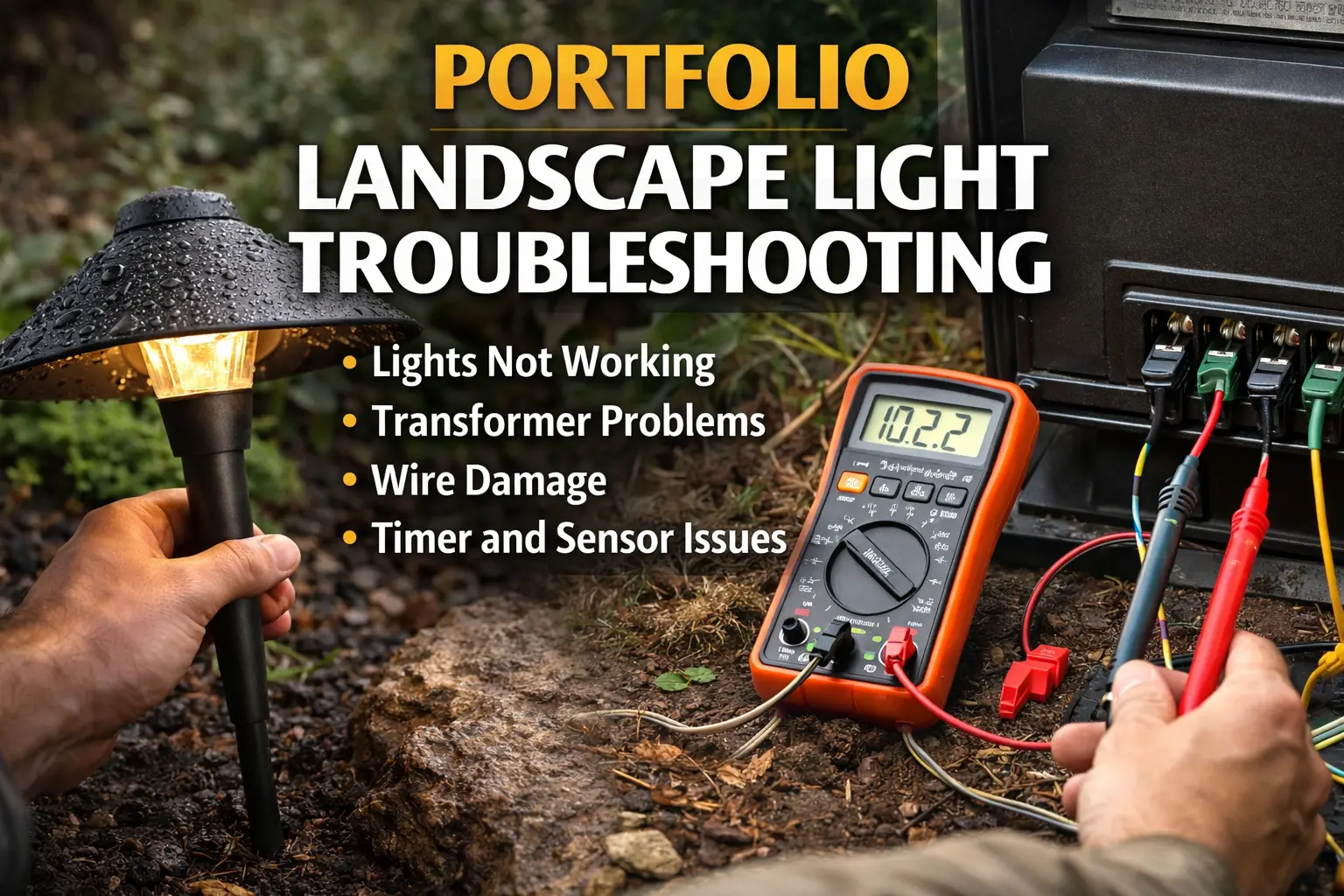
Why Is My Lighting Transformer Not Working? (My 7-Step Field Check)
After spending more than two decades troubleshooting low-voltage landscape networks, I’ve learned that a dark yard rarely means your transformer is completely dead. More often than not, the system has simply tripped an emergency safety feature or dropped voltage along an uncalculated line run.
Before you run out and spend hundreds on a replacement power pack, walk through my personal 7-step electrical diagnostic sequence to isolate the exact fault point:
- 1. Inspect the 120V Primary Input: I always check the upstream outdoor GFCI outlet first; weather-induced moisture trips these breakers constantly, completely cutting off input current.
- 2. Test the Internal Motherboard Fuses: If the digital control display panel is totally blank but the main outlet has live power, I pull and check the small glass cartridge fuse buried inside the transformer casing.
- 3. Force a Manual Logic Bypass: I flip the unit out of its automated schedule and into continuous manual "ON" mode; if the loop fires up, I know the core transformer is fine and the failure sits entirely in the photo eye or timer pins.
- 4. Audit for Terminal Short Circuits: If the unit hums loudly but output sits at zero, I look for direct copper-to-soil wire contact caused by a shovel slice or standard root shift along the direct-burial run.
- 5. Calculate the 80% System Capacity Threshold: I add up every single fixture's cumulative wattage across the circuit loop; exceeding 80% of the transformer's maximum magnetic core rating will trigger instant automated shutoffs.
- 6. Monitor for Voltage Drop Flickering: Using my multimeter, I track the line values at the furthest fixture; drop-offs sliding below 10.8V indicate high terminal resistance or under-gauged 16-gauge wire runs.
- 7. Isolate Thermal Overload Instability: If the lights run fine at dawn but cut out during blistering summer afternoons, I check for restricted housing ventilation or direct solar radiation overheating the internal relays.
⚠️ MY CRITICAL WARNING: If you attempt to force-reset a transformer that is actively short-circuiting without testing the secondary terminal block values first, you risk permanently fusing the internal relay contacts, ruining the main circuit board beyond repair.
My Golden Rule: If the transformer shows incoming power but zero terminal output, changing out individual path or spotlights will do absolutely nothing to solve the underlying failure.
Don't start digging up your lawn or tearing wires apart blindly. Follow along with my detailed layout diagrams, multimeter testing points, and model-specific reset sequences that I have mapped out step-by-step below.
Transformer Diagnosis Guide
A landscape power pack failure rarely stems from the individual fixtures themselves. System drops are almost always caused by an imbalance between input line limits and downstream resistance thresholds.
⚠️ CRITICAL SYSTEM RESET WARNING: Blindly resetting a transformer that is experiencing an active secondary short circuit will permanently warp the interior motherboards. This triggers three distinct architectural breakdowns detailed across our schematics below.
Many outdoor landscape issues stem back to faulty original setup boundaries rather than hardware failures. Review our comprehensive landscape lighting electrical code and safety guide to check your direct-burial cable depths, wiring paths, and proper multi-tap transformer grounding procedures.
Start Here: Is It the Transformer or Something Else?
- If ALL lights are off → likely transformer or power issue (stay on this page)
- If SOME lights are off → wiring or fixture issue
- If lights are dim → voltage drop or load issue
If your issue is not clearly a transformer problem, use the full system guide: Portfolio landscape lights not working.
A landscape lighting transformer does more than just plug into an outlet. It converts standard household power into the low voltage electricity your outdoor fixtures need to run safely and consistently.
When that transformer has a problem, the whole system can stop working, flicker, dim, or behave unpredictably. That is why transformer troubleshooting should usually come before replacing random bulbs or digging up wiring.
Most Common Transformer Problems
- Landscape lights not turning on at all
- Transformer has power but lights are off
- Lights flickering or dimming
- Timer not turning lights on
- Transformer clicking or shutting off
One of the most confusing landscape lighting and transformer issues is when the system turns on correctly and then shuts off shortly after. This usually indicates a system-level problem such as transformer overload, a faulty timer or photocell, or a wiring issue affecting the load. If you are seeing this delayed shutoff behavior, follow the step-by-step breakdown in why my landscape lights turn on then off to quickly narrow down the root cause.
How Portfolio Lighting Transformers Work
Portfolio landscape lighting systems are usually based on low voltage power. That means the transformer takes standard 120-volt household electricity and reduces it to around 12 volts so it can safely power landscape fixtures. Without that step, the outdoor lighting system would not function the way it is designed to.
Once the transformer has power, the electricity typically moves through a timer or photocell control, then out through low voltage cable, and finally to the landscape fixtures in the yard. If any one of those parts fails, the system can stop working.
| Component | Purpose |
|---|---|
| Transformer | Converts 120V to 12V |
| Timer or photocell | Controls light schedule |
| Low voltage cable | Carries power to fixtures |
| Landscape fixtures | Produce light outdoors |
Portfolio transformers commonly range from about 60 watts to 300 watts. The higher the wattage rating, the more fixture load the system can support. LED systems usually require much less wattage than older halogen systems, which makes them easier on the transformer over time. For a broader overview of this type of system, compare this page with Portfolio low voltage lighting.
Signs Your Transformer Has a Problem
A transformer can fail in a few different ways, and the symptoms can help you narrow down what is happening before you replace anything.
Lights Not Turning On
If none of your landscape lights turn on, the transformer is immediately one of the top suspects. But the transformer may not be the only problem. A dead outlet, timer issue, or tripped breaker can create the exact same symptom. If your main issue is total system failure, use Portfolio landscape lights not turning on alongside this guide.
Transformer Display Is Off
If the transformer has a digital display or indicator light and that display is blank, the problem may be that no power is reaching the unit. It can also point to a blown internal fuse or internal transformer failure.
Lights Flicker or Dim
Flickering and dim lights often point to overload, loose connections, unstable transformer output, or damaged cable. This does not always mean the transformer is completely dead, but it does mean something in the power delivery side of the system needs attention.
Only Some Lights Work
If only part of the lighting system works, the transformer may still be doing its job while a cable run, connector, or downstream wiring section has failed. Partial failure often means the system should be checked beyond the transformer itself.
If the system turns on but will not shut off when it should, use the landscape lights not turning off guide to troubleshoot timer settings, photocells, stuck controls, and other common shutoff problems.
Some landscape fixtures flicker, dim, or fail early because of voltage loss rather than defective parts. The low-voltage fixture performance troubleshooting guide explains how voltage drop changes LED startup behavior, brightness, and long-term driver reliability.
Step-by-Step Transformer Troubleshooting
The fastest way to diagnose a Portfolio transformer problem is to work from the power source outward instead of guessing. That gives you a cleaner picture of whether the issue is at the outlet, the controls, the transformer, or the wiring.
Step 1 – Check the Power Source
Start by confirming the outlet is working. Check that the breaker has not tripped, and if the transformer is plugged into a GFCI outlet, reset the GFCI. This is one of the most common reasons a landscape lighting transformer appears dead.
Step 2 – Inspect Timer Settings
Many Portfolio transformers use a dial timer, digital timer, or photocell to determine when the lights turn on. Incorrect settings can block the lights from activating even when the transformer itself is fine. Power outages can also reset timer settings. If you think the schedule or control is the issue, compare this page with Portfolio light timer not working.
Step 3 – Inspect Wiring Connections
Outdoor wiring connections deal with moisture, dirt, movement, and temperature swings. Over time, wire connectors can loosen or corrode. Check cable connectors, look for green or white corrosion, and inspect for loose or damaged wiring near the transformer and along the first part of the run.
Step 4 – Test Transformer Output Voltage
Use a voltage tester or multimeter to check the transformer’s output terminals. In many systems, you want to see approximately 12 volts. If there is no output even though the transformer has input power, the transformer may be defective.
Step 5 – Check for Overload
Too many lights can overload the transformer. Even if the system still runs, overload can shorten transformer life and create flickering or dimming problems.
One of the most overlooked Portfolio troubleshooting clues is wet-only operation. If the lights work during rain but shut down once the system dries, read this moisture bridge troubleshooting guide before assuming the transformer, timer, or photocell has failed.
| Transformer Size | Recommended Load |
|---|---|
| 60W | ~45W |
| 120W | ~90W |
| 300W | ~240W |
LED fixtures reduce total electrical load, which can make transformer performance more reliable over time. If you are still using older bulbs, compare them with Portfolio LED lighting.
If your landscape lighting system suddenly stops working or the transformer repeatedly trips its reset button, a wiring fault may be the cause. Damaged low-voltage cable, loose connectors, or water inside a fixture can create a short circuit that shuts down the entire lighting run. Our guide explains the most common causes of a Portfolio landscape lights short circuit and shows how homeowners can locate and repair the wiring problem safely.
Common Causes of Transformer Failure
Power Surges
Electrical surges and nearby lightning can damage transformers. Sometimes the failure is immediate. Other times the transformer becomes unreliable and starts failing gradually.
Water Damage
Outdoor transformers need to stay weather protected. If water gets into the housing, internal components can corrode or short out. This is especially important in low areas of the yard or near poor drainage.
Overloaded Systems
A transformer that is consistently running too many fixtures is under constant stress. That kind of overload can shorten the life of the unit and lead to inconsistent performance before full failure.
Aging Components
Most landscape lighting transformers eventually wear out. Heat, daily cycling, weather exposure, and simple age can all lead to failure after 5 to 10 years.
How to Reset a Portfolio Transformer
Sometimes the transformer does not need a full repair. A simple reset can clear a temporary issue, especially after a power interruption.
- Unplug the transformer
- Wait about 30 seconds
- Reset the GFCI outlet if needed
- Reconnect power
- Check the timer or photocell settings again
This will not fix a burned-out transformer, but it can solve control-related or power-related interruptions.
When to Replace a Transformer
Sometimes repair is not worth the effort. If the transformer produces no output voltage, repeatedly blows an internal fuse, overheats, smells burnt, or shows visible damage, replacement is usually the better move. The same is true if the unit is older and has become unreliable enough that you keep coming back to the same problem.
Replacing the transformer can also make sense if you are updating the lighting system to LED fixtures and want a cleaner, better-matched power setup.
Replacement Transformers for Portfolio Lighting
If your existing transformer cannot be repaired, the next step is finding a compatible replacement that will work with your low voltage cables, landscape fixtures, and control setup. Many homeowners replace the transformer first before deciding whether the rest of the system also needs updating.
Compatibility matters most in three areas: total wattage load, low voltage output, and physical durability outdoors. If you are keeping your existing fixtures but replacing the transformer, make sure the new unit has enough capacity without being overloaded by the system.
Many homeowners search online when older Portfolio components are difficult to find. You can often find replacement components and compatible parts through listings like Portfolio lighting replacement parts on eBay. For a broader support page, use Portfolio lighting parts and accessories.
Preventing Transformer Problems
A lot of transformer trouble can be reduced with basic maintenance and better planning. Landscape lighting systems usually last longer when the transformer is protected, the system is not overloaded, and the wiring is checked now and then instead of ignored for years.
- Avoid overloading the transformer
- Inspect wiring and connectors annually
- Keep the transformer elevated above ground
- Protect it from standing water and runoff
- Check timer settings after power outages
- Upgrade older high-wattage lamps to LEDs when practical
When to Call an Electrician
Some transformer problems are straightforward. Others are not. If the breaker repeatedly trips, the outlet has no power, the wiring damage is extensive, or you see signs of melting, overheating, or unsafe moisture exposure, it is time to bring in an electrician. The same goes for any situation where you are not comfortable testing voltage or handling the system safely.
Final Thoughts on Portfolio Lighting Transformer Troubleshooting
When a Portfolio transformer stops working properly, the whole lighting system can feel like it failed all at once. But in many cases, the actual cause comes back to a short list: no input power, a timer or photocell issue, damaged wiring, overload, or a transformer that has simply reached the end of its life.
The key is to troubleshoot in order. Start with the outlet and breaker, then the timer, then the wiring, then the transformer output. Once you know which part of the chain has actually failed, the repair becomes much easier to handle.
Outdoor lighting systems can fail for several reasons, especially when fixtures are exposed to moisture and underground wiring conditions. In-ground fixtures like well lights often experience water intrusion, clogged drainage, or wiring damage that can cause them to stop working. If you're diagnosing a buried fixture, read our detailed guide on troubleshooting Portfolio well lights. Heavy rain can also expose damaged cable connections or create a short circuit in the system, which is covered in our guide on Portfolio lights not working after rain.
For problems tied to seasonal displays, permanent lighting scenes, or holiday setup changes, see the holiday lighting guide for troubleshooting logic, power planning, and display ideas.
Portfolio Lighting Transformer Troubleshooting FAQ
Why is my landscape lighting transformer not working?
Common causes include tripped breakers, faulty timers, overloaded circuits, or damaged transformers.
How do I test a landscape transformer?
Use a voltage tester to measure output voltage at the transformer terminals.
How long do landscape lighting transformers last?
Most transformers last 5 to 10 years depending on usage and weather exposure.
Can a bad transformer cause lights to flicker?
Yes. Transformers that are overloaded or failing may produce unstable voltage.