Portfolio Transformer Not Working
Use this page when testing suggests the transformer itself is the likely source of the problem and you need full troubleshooting next steps.
Read the guide
Testing a landscape lighting transformer is one of the fastest ways to figure out whether your lighting problem begins at the power source, inside the transformer, or somewhere farther down the wiring system. If the transformer is not receiving power, the rest of the system cannot work. If it is receiving power but not sending usable output, the transformer itself becomes the main suspect. If it has both input and output, the problem is often farther downstream in the wiring, connectors, fixtures, or voltage delivery.
The good news is that you can check most of this with basic tools, a careful step-by-step approach, and a digital multimeter. You do not need to guess at the problem if you test the transformer in the right order.
This page is designed to walk you through that process clearly. You will learn what tools to use, how to test the transformer safely, how to check both input and output voltage, what the readings mean, and what to do next if the transformer is not actually the part causing the lighting failure.
Most people replace the transformer without testing it first. That leads to wasted money and the same problem still not being fixed. Testing first tells you exactly where the issue is so you can fix it once.
If testing shows the transformer is bad, the best next pages are Portfolio transformer not working and Portfolio lighting parts and accessories. If the transformer tests fine, continue into wiring and system troubleshooting from landscape lights not working.
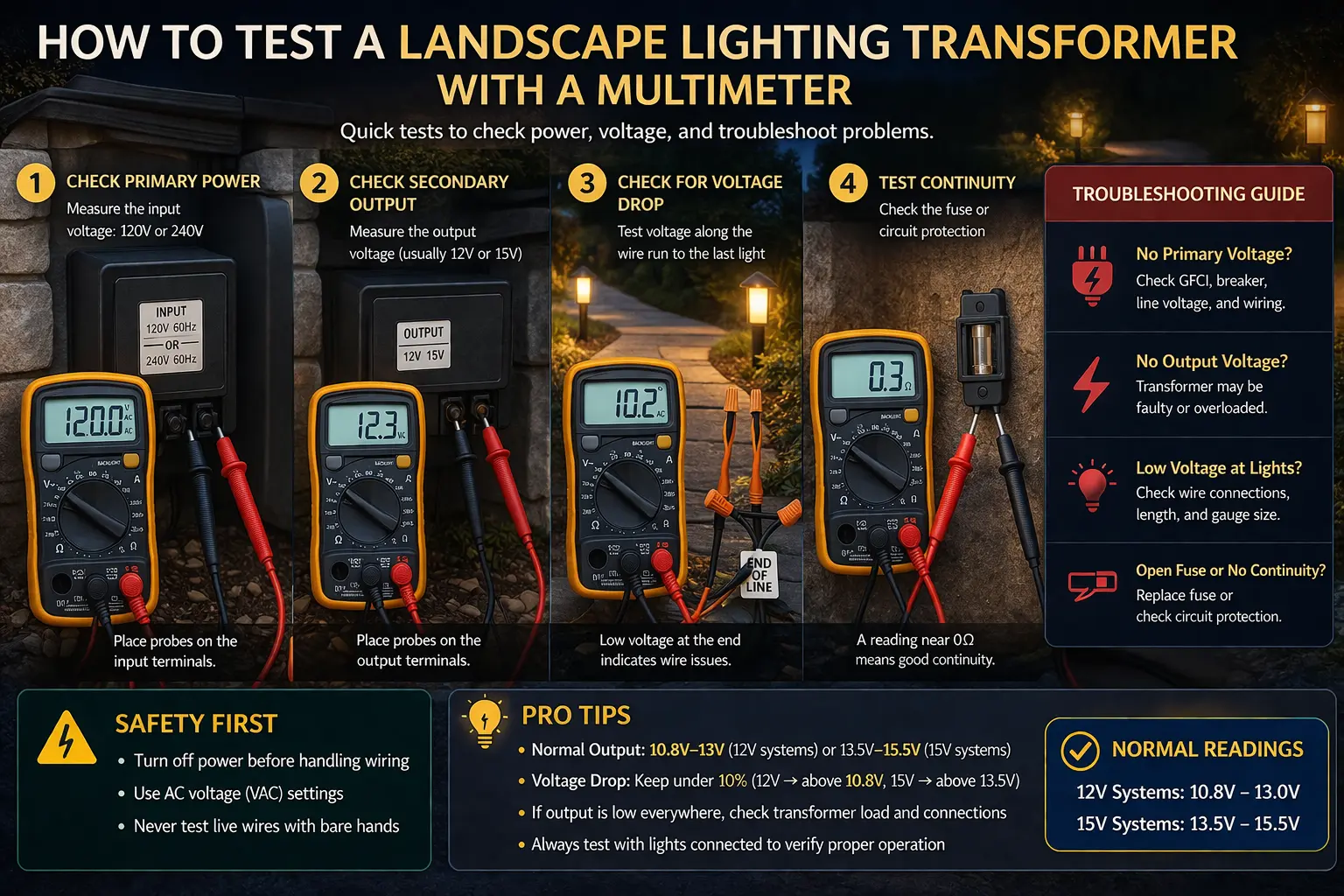
See Transformer TroubleshootingTo test a landscape lighting transformer, use a multimeter to check three things:
If the transformer has input power but no output, it is likely bad. If both input and output are normal, the problem is usually in the wiring or fixtures.
| What You See | What It Means |
|---|---|
| No power at transformer | Outlet, breaker, or GFCI problem |
| Power in, no output | Transformer is bad |
| Low voltage output | Overload or wiring issue |
| Voltage drops under load | Transformer weak or system overloaded |
A transformer test tells you three very important things. First, it tells you whether power is actually reaching the transformer. Second, it tells you whether the transformer is sending output voltage to the lighting system. Third, it helps you separate transformer failure from wiring, connector, and fixture problems farther out in the system.
This matters because many landscape lighting problems look similar at first. No lights turning on, weak output, only part of the yard working, or lights failing after rain can all make the transformer look suspicious. Testing removes the guesswork and gives you a stronger starting point for the rest of the diagnosis.
You do not need a large set of specialized tools to test a transformer. In most cases, these basics are enough:
The multimeter is the most important tool because it lets you measure electrical voltage. That is what tells you whether power is reaching the transformer and whether the transformer is sending power out correctly.
A screwdriver may be needed to open the transformer cover or access terminals, and gloves add an extra layer of protection while working carefully around outdoor electrical components.
A landscape lighting transformer converts standard 120-volt household power into the 12-volt power most low-voltage outdoor lighting systems use. It acts as the bridge between your home’s electrical supply and the lower-voltage cable that feeds the landscape fixtures.
That is why testing matters so much. If the transformer is not receiving input power, not converting voltage correctly, or not sending output through the wiring system, the rest of the lights cannot work properly.
For the broader system explanation, read how landscape lighting works.
Safety matters more than speed when testing electrical equipment outdoors. Before opening the transformer or touching any terminals, take these precautions seriously:
Outdoor electrical equipment deserves extra caution because moisture, weather exposure, and grounding conditions can make the environment less forgiving than indoor work.
Before measuring any voltage at the transformer, confirm the transformer is actually being supplied with power. This is one of the easiest and most important parts of the entire process.
If the transformer you are testing is a Malibu 8100-9120-01, you may also want the model-specific Malibu 8100-9120-01 troubleshooting guide. It explains the digital settings, photocell test method, and blank-display checks that are especially common on this 120W unit.
Make sure the outlet feeding the transformer is live. If the outlet is dead, the transformer may appear to be bad even though it has simply lost supply power.
Go to the electrical panel and confirm the breaker serving the transformer or outdoor outlet has not tripped.
Outdoor outlets are commonly GFCI-protected. A tripped GFCI can shut down the transformer instantly until it is reset.
Once you know the outlet and breaker appear normal, the next step is to confirm that power is actually entering the transformer.
Since you are testing incoming household power, the meter should be set to measure AC voltage.
Place the probes on the transformer input points according to the design of the unit. You are looking for a normal input reading in the range expected for household current.
If there is no input voltage, the transformer cannot do its job, and the problem is likely upstream at the outlet, breaker, GFCI, or supply wiring.
After confirming that the transformer is receiving input power, the next question is whether it is sending output voltage to the lighting system.
Most low-voltage landscape systems use AC output, so the multimeter should still be set correctly for that type of reading.
Place the probes across the output terminals. In most systems, you should expect a reading around 12 volts AC, though exact values can vary slightly by model and load.
If there is no output even though input power is present, the transformer becomes the main suspect.
If your transformer fails this test, go to the transformer troubleshooting guide to confirm before replacing it.
Testing under load is important because some transformers appear normal until they are actually asked to power the lighting system.
With the load connected, you can see whether output stays stable when the transformer is doing real work. If the reading drops heavily under load, the system may be overloaded, the transformer may be weak, or there may be a downstream issue affecting the output.
In some cases, it helps to disconnect the low-voltage wires and test the transformer by itself. This separates the transformer from the rest of the system.
If the transformer tests correctly with no load but performs poorly with the wiring connected, the problem may actually be downstream in the wiring, connectors, or total fixture load rather than inside the transformer.
Once you confirm your transformer is working, the next step is improving how it is controlled. The AI outdoor lighting systems guide explains how modern control systems replace basic timers, and the AI automated lighting guide shows how these systems operate day to day.
This usually points to an outlet, breaker, GFCI, or supply-side problem rather than transformer failure.
This is one of the strongest signs that the transformer itself has likely failed or is no longer converting power correctly.
Low output may point toward overload, wiring issues, or system stress rather than immediate total transformer failure.
Fluctuating readings may suggest loose connections, unstable output, or a transformer beginning to fail intermittently.
Transformer testing often reveals a pattern rather than just one simple answer. Common problems uncovered during testing include:
For the broader transformer diagnosis page, read Portfolio transformer not working. If overheating is part of the symptom pattern, use portfolio transformer getting hot.
If voltage is present but lights still do not work, inspect the output connection using our terminal block troubleshooting guide.
If your transformer includes a digital display, it may show an error code instead of failing silently. The Hampton Bay error code guide explains what E1, E2, and E3 mean and how to diagnose the issue quickly.
The multimeter is only helpful if it is used correctly. Set the meter to AC voltage, confirm the probes are in the proper ports, and place the probes steadily on the input or output points you are testing. The goal is a clean reading, not a rushed one.
If the reading jumps wildly or seems unclear, stop and retest carefully. Good probe placement matters. So does isolating whether you are measuring input or output, and whether the system is connected under load or disconnected for isolated testing.
One of the most useful outcomes of testing is proving the transformer is actually fine. If the transformer has proper input and output voltage, the problem is likely farther down the system.
Common downstream causes include wiring damage, loose connectors, failed bulbs or fixtures, and voltage drop that weakens power before it reaches the end of the line.
For those issues, continue with how to wire landscape lighting, landscape lighting voltage drop, and landscape lights not working.
Once the transformer is confirmed good, the next step is often checking the low-voltage line itself. This may include continuity checks, voltage checks farther down the line, and comparing readings near the transformer versus near the fixtures.
The goal is to find where the power is being lost or weakened after it leaves the transformer.
Replacement is often the right decision when the transformer shows no output, inconsistent voltage, overheating, repeated shutdown, or visible internal damage. If testing keeps pointing back to the transformer after you have ruled out the outlet, breaker, GFCI, and obvious wiring issues, replacement becomes a practical next step.
For parts help, use Portfolio lighting parts and accessories.
The best transformer prevention habits are simple:
Many transformer failures come from ongoing stress, not from one sudden event.
If testing shows the transformer is working but your lights still have issues, visit our landscape lighting troubleshooting guide to diagnose wiring, connectors, timers, and fixture problems.
Use this page when testing suggests the transformer itself is the likely source of the problem and you need full troubleshooting next steps.
Read the guideHelpful when you want to understand the system path from outlet to transformer to wiring and fixtures before continuing deeper.
Read the guideBest when the transformer passes testing and the real problem appears to be somewhere else in the landscape lighting system.
Read the guideUse this page when connector quality, damaged cable, or downstream wiring issues appear more likely than transformer failure.
Read the guideRead this when the transformer tests fine but the far end of the system is still weak, dim, or failing under load.
Read the guideHelpful when your testing is connected to overheating, overload signs, or a transformer that seems stressed during operation.
Read the guideUse this page when your test results point to replacement rather than continued diagnosis of the existing transformer.
Read the guideTest the outlet and breaker first, then use a multimeter to check the transformer's input voltage and output voltage at the terminals. You can also test the transformer with the load connected and disconnected to narrow down the problem.
Most low-voltage landscape lighting transformers output around 12 volts AC, although the exact reading may vary slightly depending on the model and load.
A transformer may be bad if it has proper input power but no usable output, inconsistent voltage, overheating, repeated shutdown, or unstable performance under load.
Yes. A transformer can receive input power but still fail internally and produce little, no, or unstable output voltage.
The main tool you need is a digital multimeter. A screwdriver and safety gloves are also helpful.
Common reasons include no input power, overload, timer problems, wiring issues, bad output terminals, or internal transformer failure.
This page is designed to be the technical testing guide for landscape lighting transformers, helping you move from basic voltage checks into deeper transformer, wiring, voltage drop, overheating, and replacement diagnosis as needed.