
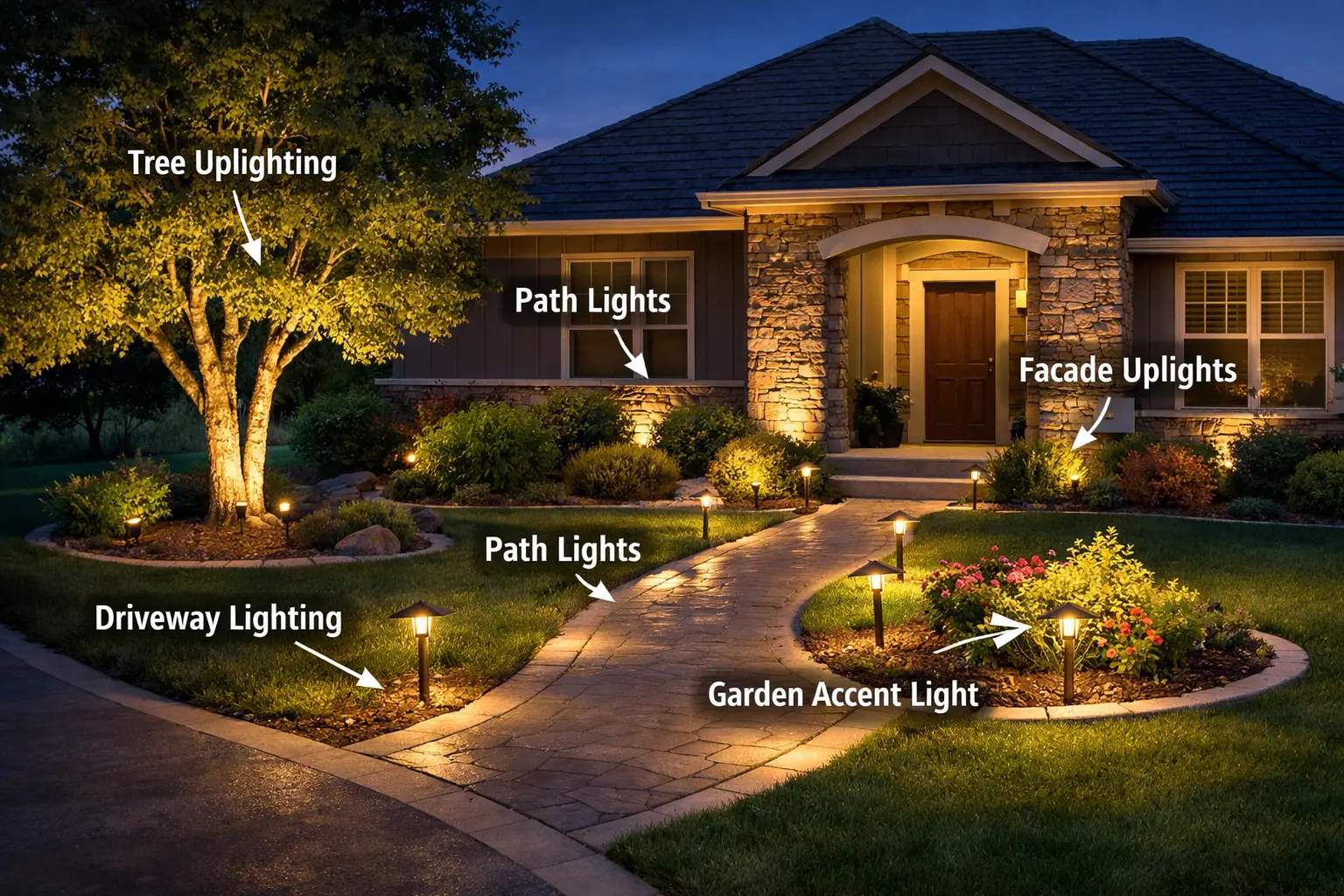
Quick Answer: My 7-Point Front Yard Curb Appeal & Structural Placement Framework
Designing a front yard lighting layout requires painting your home's exterior with soft layers of light and shadow, not just setting up bright floodlights to blast the turf. A high-end setup frames your front door, highlights your best trees, and makes walking paths safe without exposing bare, blinding light bulbs to the street.
Whenever I pull up to a house to sketch a custom front yard lighting plan, I map out the placement locations using these seven real-world field rules:
- 1. Staggering the Walkway Path: I never space path fixtures symmetrically across from each other. I stagger them along the path edges every 6 to 8 feet, creating a natural, alternating zigzag of illumination that guides your feet safely.
- 2. Framing the Front Entryway: The front door is the focal point of the house. I place soft, low-glare accent lights at the base of your entryway pillars or steps to warmly invite guests toward the threshold.
- 3. Bulleting Your Anchor Trees: To give the front yard vertical scale, I place one or two uplight bullets at the base of mature trees, angling the beam straight up through the trunk and internal branch structures.
- 4. Washing Texture Walls: If your home features brick, stone, or deep siding, I pull small fixtures about one foot away from the foundation and point them upward to cast dramatic shadows across the architectural textures.
- 5. Avoiding the Window Blasting Trap: I never put a spotlight directly under a bedroom or living room window; instead, I position bullet fixtures on the solid stone sections between windows to prevent raw light from leaking indoors.
- 6. Tucking the Glare Away: You should see the beautiful glow, never the bare bulb. I shield fixture caps and tuck them behind low boxwoods, ground covers, or small landscaping stones to completely hide the light sources.
- 7. Separating the Electrical Runs: I group the front layout onto distinct wire branches. Keeping your essential path safety lights on a separate run from your ornamental tree uplights makes it simple to manage your power limits.
⚠️ CRITICAL PLACEMENT RISK: Jamming low-voltage fixtures too close together or using the wrong beam angles will cause intense hot spots, ruin your home's nighttime look, and trigger heavy voltage drops along your cable lines. Ignoring these structural boundaries triggers three major layout failures that I break down inside our wire sizing guides below.
Most front yard design struggles stem directly from layout crowding and poor spacing—not the quality of the fixtures themselves. I always tell homeowners that buying a few premium Portfolio path lights and placing them intentionally beats scattering a dozen cheap, flimsy stakes across the lawn every single time.
Don't guess where to bury your wires or throw your accent lights out into the middle of open grass blindly. Use my step-by-step foundation wash blueprints, tree canopy uplighting layout maps, and voltage drop spacing grids detailed further down this page to build a clean, professional display.
Front Yard Lighting Layout Logic Summary
Most front yard lighting problems come from layout decisions, not fixture quality. Use this quick summary to see what the yard is telling you.
Too dark usually means not enough coverage. Too bright usually means too many fixtures. Uneven lighting usually means poor spacing. Flat lighting usually means there are no strong focal points.
| If Your Yard Looks Like This | What It Usually Means | What To Fix |
|---|---|---|
| Too dark | Not enough coverage | Add fixtures or reduce spacing |
| Too bright | Too many fixtures | Increase spacing or remove lights |
| Uneven lighting | Inconsistent placement | Reposition lights more evenly |
| Flat look | No focal lighting | Add spotlights or accent fixtures |
| Dim areas at the far end | Voltage drop or weak layout planning | Adjust wiring or review fixture placement |
If spacing is the issue, go deeper with the full landscape lighting spacing guide. If the problem is broader placement strategy, use landscape lighting layout design.
Start With a Simple Front Yard Lighting Plan
The easiest way to plan front yard landscape lighting is to break the yard into zones. Start with the walkway, then the entry, then one or two focal points such as a tree, planting bed, or section of the facade.
- Walkways: use evenly spaced path lights
- Entry: combine path lighting with subtle accent lighting
- Trees: use spotlights for height and depth
- House: highlight only the strongest features
Most homeowners get better results by lighting a few important areas well instead of trying to light every edge, bed, and wall.
Front yard landscape lighting is one of the most effective ways to improve the look of a home after dark, but the best designs are rarely the brightest ones. Good outdoor lighting balances safety, curb appeal, and visual focus. It helps guide visitors toward the front entry, makes walkways and steps easier to see, highlights important trees or landscaping features, and adds depth and character to the front of the house at night.
This page focuses on the design side of landscape lighting. Instead of simply listing fixtures, it walks through how to plan a front yard lighting layout, where lights should typically be placed, how to space fixtures along paths and garden beds, and how to highlight the architectural features of a home. It also connects the design ideas here with the more detailed technical topics on wiring, layout planning, voltage drop, and transformers that are covered throughout the site.
If you are new to outdoor lighting systems, it may also help to start with the broader Landscape Lighting Guide. That page explains how landscape lighting systems work and provides a strong foundation before planning a full front yard lighting design.
For complete planning, see: layout design, spacing guide, and how landscape lighting works.
Why Front Yard Landscape Lighting Matters
Front yard lighting has a bigger effect on the overall property than many homeowners expect. During the day, landscaping, pathways, and architectural details are easy to see. At night, all of that can disappear unless the lighting plan restores some of that structure and visibility.
Good front yard lighting helps with curb appeal because it gives the home a more polished nighttime look. It helps with safety because walkways, driveways, and entry areas are easier to see. It also helps highlight landscaping so trees, planting beds, and front-yard focal points still contribute to the look of the property after dark.
The areas that most often benefit from front yard lighting include driveways, sidewalks, entry paths, steps, garden beds, accent trees, shrubs, and the front facade of the house. If you want the broader category overview first, go to Portfolio landscape lighting.
The Basic Principles of Landscape Lighting Design
Balance
One of the most important design principles is balance. The goal is not to light everything equally. When every feature is lit the same way, the yard loses contrast and stops feeling intentional. Good front yard lighting gives more emphasis to the areas that matter most.
Layered lighting
Strong designs usually combine different fixture types. Path lights may guide the walkway. Spotlights may highlight trees or architectural features. Accent fixtures may bring attention to planting beds or entry details. This layered approach feels more natural than trying to solve every design need with one type of fixture.
Focus points
Most yards have a few natural focus points. These may include the front entry, a large tree, a stone column, a front porch, or a planting bed near the house. Good design directs attention to those areas first.
Avoid overlighting
Too much light makes the yard look washed out and uncomfortable. Instead of creating beauty, it creates glare. This is one of the biggest reasons homeowners are happier with a smaller number of well-placed lights than with a yard full of fixtures.
The Most Common Front Yard Landscape Lighting Fixtures
Path lights
Path lights are used along walkways, entry paths, and garden edges. They provide low-level guidance and help visitors move through the front yard safely without needing the effect of strong flood lighting. For more on layout and spacing, visit landscape lighting spacing.
Spotlights
Spotlights are one of the most useful front yard fixtures because they can highlight trees, columns, stonework, architectural accents, and other focal points. They are especially helpful when the front yard has one or two strong visual features worth emphasizing.
Flood lights
Flood lights are broader than spotlights and are usually used when a larger tree, wider facade, or broader area needs illumination. They should be used carefully in front yard designs because too much broad light can quickly overpower the scene.
Well lights
Well lights sit lower in the ground and can create more subtle uplighting. They are often used where the fixture itself should stay visually quiet while the lighting effect remains noticeable.
Where to Place Landscape Lights in a Front Yard
Pathways
Walkways are one of the most common lighting zones in the front yard because they guide visitors toward the entry. Path lights may be installed on both sides of the walkway or staggered along alternating sides depending on space and the desired look.
Entryways
The path leading to the front door is a natural design priority. Entry lighting helps with safety, but it also helps the house feel more welcoming from the curb. This is often one of the first areas to light well.
Trees
Trees are often the best front yard feature to uplight because they bring vertical interest and give the yard more structure at night. A strong tree uplighting effect can make even a simple front yard design feel more intentional.
Garden beds
Accent lighting in flower beds or foundation beds helps the landscaping stay visible after dark. This can be especially useful near the entry or in front of architectural features that would otherwise disappear at night.
House facade
Columns, stonework, entry surrounds, and selected sections of the front facade often benefit from careful accent lighting. This is where design choices should feel selective instead of excessive. If you want more help planning which features deserve lighting emphasis, visit landscape lighting layout design.
Landscape Lighting Spacing Guidelines
Spacing affects whether the yard looks natural and well planned or uneven and cluttered. The right spacing depends on fixture type, beam spread, brightness, and the specific yard features being lit.
| Fixture Type | Common Starting Point | What Affects the Final Decision |
|---|---|---|
| Path lights | About 6 to 8 feet apart | Brightness, walkway width, beam spread, and whether lights are staggered or mirrored |
| Spotlights | Based on the feature being lit | Tree height, beam angle, plant size, and distance from the target |
| Flood lights | Based on area coverage | Beam width, fixture strength, and how much facade or yard area needs light |
| Well lights | Placed near selected focal features | Ground location, drainage, and how subtle or dramatic the uplight effect should be |
For the deeper spacing page, see landscape lighting spacing.
Creating a Simple Front Yard Landscape Lighting Layout
One of the easiest ways to design a front yard lighting plan is to think in small layers instead of trying to create the whole system at once. A simple example might include path lights along the main walkway, one spotlight on a tree, one uplight on the front facade, and one accent light in a planting bed near the entry.
That kind of layout works well because each light has a clear job. The path lights guide movement. The tree lighting adds height and depth. The facade lighting gives the house more nighttime structure. The planting bed accent keeps the landscaping from disappearing after dark.
This is also a good example of why more fixtures are not always better. A front yard with a few carefully chosen lighting zones often looks much stronger than one filled with too many scattered lights.
A strong front yard lighting design typically includes a combination of fixture types to balance function and aesthetics. Proper spacing of Portfolio path lights along walkways, combined with accent lighting for trees and architectural features, creates a clean and inviting nighttime appearance.
If you want to plan a more detailed layout around your specific property, go to landscape lighting layout design.
Choosing the Right Brightness for Front Yard Lighting
It is easier to design a front yard lighting system when you think in lumens instead of watts. Lumens tell you how much visible light the fixture produces, which makes it easier to compare path lights, spotlights, and accent fixtures.
Typical front yard ranges
- Path lights: about 100 to 200 lumens
- Spotlights: about 200 to 500 lumens
- Large tree lighting: about 500 to 800 lumens
These ranges are not hard rules, but they are helpful starting points. The final decision still depends on fixture design, beam spread, and how bold or subtle you want the yard to look at night. The most important thing is that the brightness feels intentional rather than overly aggressive.
Low Voltage Landscape Lighting Systems
Most front yard landscape lighting systems operate on low voltage. That means a transformer reduces standard household power to a lower voltage before the electricity reaches the fixtures. This is one reason low-voltage systems are so common in residential front yard lighting. They are flexible, practical, and well suited to pathway and accent fixture layouts.
If you are new to how that works, the best page to read next is how landscape lighting works. You can also visit Portfolio low voltage lighting for the broader category page.
Landscape Lighting Wiring Basics
You do not have to become an electrical expert to design a front yard system well, but it helps to understand that wiring layout matters. Long cable runs, too many fixtures on one line, and poor planning can all affect how evenly the lights perform. This is especially important when your front yard includes path lighting plus accent fixtures spread across several areas.
Two of the best supporting technical pages for this design guide are how to wire landscape lighting and landscape lighting voltage drop. Those pages help explain why system design decisions directly affect the finished look at night.
Common Front Yard Lighting Layout Mistakes
Using too many lights
The most common mistake is adding more fixtures than the yard actually needs. Too much light creates glare, removes contrast, and makes the front yard look flat instead of inviting.
Spacing path lights too close together
When path lights are packed too tightly, the walkway looks crowded and overly bright. For most homes, wider spacing creates a cleaner and more natural effect. For deeper help, see landscape lighting spacing.
Trying to light every feature
A stronger design highlights the best parts of the yard, not every shrub, wall edge, and planting bed. Selective lighting almost always looks better than uniform lighting.
Ignoring wiring and voltage drop
Even a good-looking layout can fail if cable runs are too long or too many fixtures are loaded onto one line. If far fixtures look dim, review how to wire landscape lighting and landscape lighting voltage drop.
Related Front Yard Lighting Guides
Portfolio Landscape Lighting
The broader landscape lighting hub for fixtures, planning ideas, system basics, and homeowner guidance.
Read the guideLandscape Lighting Layout Design
Use this page when you want to build a more detailed placement strategy around the shape and features of the property.
Read the guideHow Landscape Lighting Works
Understand how transformers, wiring, fixtures, and system design all work together before installation begins.
Read the guideLandscape Lighting Spacing Guide
Helpful for path lights, accent fixtures, and the spacing decisions that shape the final nighttime look.
Read the guideHow to Wire Landscape Lighting
See how wiring layouts, cable runs, and connections affect system performance and reliability.
Read the guideLandscape Lighting Voltage Drop
Learn why far fixtures get dim and how stronger planning decisions can prevent uneven system performance.
Read the guideFront Yard Landscape Lighting Design FAQ
How many landscape lights should be in a front yard?
The right number depends on yard size, what you want to highlight, and how much walkway or driveway needs guidance. Most good designs focus on a few important areas instead of trying to light everything.
Where should landscape lights be placed in a front yard?
Common placement areas include walkways, entry paths, driveways, trees, garden beds, and house features such as columns, stonework, or architectural accents.
What color light is best for landscape lighting?
Many homeowners prefer warm white light for front yards because it feels welcoming and attractive without looking harsh.
How far apart should front yard path lights be?
A common starting range is about 6 to 8 feet apart, but spacing still depends on fixture brightness, beam spread, and the effect you want.
Can landscape lighting run all night?
Yes, but many homeowners use timers, photocells, or smart controls so the lights run only when needed.
Do landscape lights increase home value?
Good front yard lighting can improve curb appeal, nighttime visibility, and the overall impression of the home, which may support perceived value and buyer appeal.
This front yard design page is built to help you plan lighting that improves safety, highlights landscaping, supports curb appeal, and connects naturally to the deeper layout, spacing, wiring, and transformer pages in the landscape lighting cluster.