
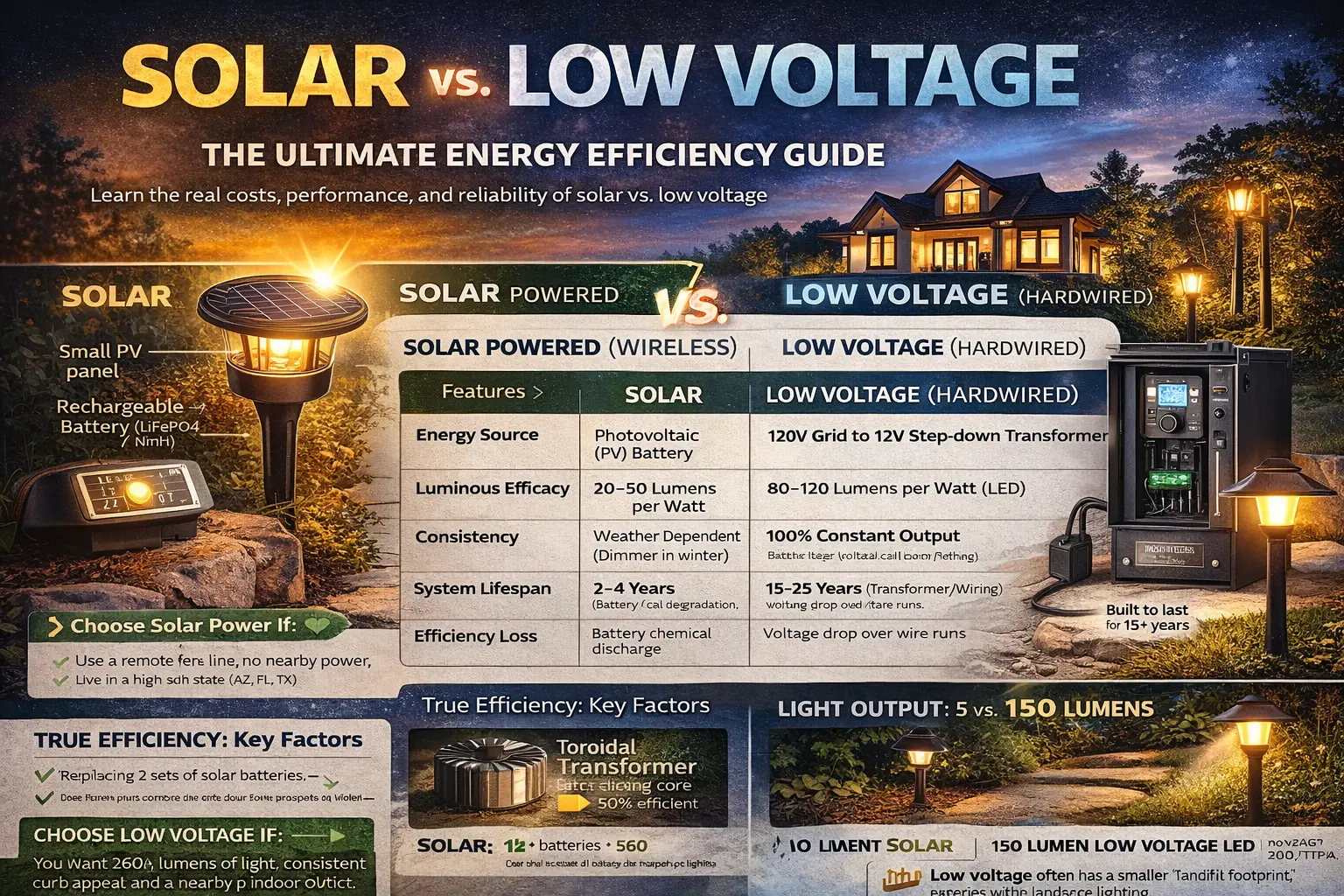
Quick Answer
Low-voltage LED landscape lighting is usually more efficient at producing usable light (lumens per watt) and delivers stronger, more consistent brightness. Solar lighting is more efficient at eliminating electricity costs because it generates its own power, but it often sacrifices brightness, runtime, and long-term reliability.
If you want a broader overview of how wired systems work before deciding between the two, start with low-voltage landscape lighting to understand the main advantages, system basics, and where low-voltage setups usually outperform self-contained solar fixtures.
Quick Decision: Solar vs Low Voltage
- Best brightness: Low voltage
- Most consistent performance: Low voltage
- No electricity cost: Solar
- Best for remote areas: Solar
- Best long-term system: Low voltage
Quick Logic Summary
- If you want the most light per watt, low-voltage LED usually wins.
- If you want zero utility draw, solar wins.
- If you want steady brightness all year, low voltage is usually more consistent.
- If you have no nearby power source, solar may be the practical answer even if it is dimmer.
The Efficiency Paradox
Here is the part most pages miss: solar is not automatically the more efficient lighting system. Solar simply produces and stores its own energy in a self-contained housing. Low-voltage LED systems usually produce more usable light from each watt consumed.
If you are specifically researching self-contained fixtures instead of wired systems, see Portfolio solar lighting for a closer look at where solar works best and where its brightness and runtime limits start to show.
That means a low-voltage system can be the more efficient lighting system in terms of light output, while a solar fixture can be the better choice when you want zero grid draw and no trenching.
Solar vs. Low Voltage Energy Comparison
| Feature | Solar Powered (Wireless) | Low Voltage (Hardwired) |
|---|---|---|
| Energy Source | Photovoltaic panel and battery | 120V grid power converted through a 12V step-down transformer |
| Luminous Efficacy | 20–50 lumens per watt | 80–120 lumens per watt with LED fixtures |
| Consistency | Weather dependent and often weaker during winter or cloudy periods | Stable output when the transformer, wiring, and fixture layout are properly designed |
| System Lifespan | Usually shorter because batteries and solar panels degrade over time | Long service life with quality transformers, cable, and fixtures |
| Efficiency Loss | Battery charging losses and chemical discharge reduce available energy | Transformer losses and voltage drop across longer cable runs |
Real-World Example
A typical solar path light may produce 10–30 lumens after a full charge. A comparable low-voltage LED fixture can produce 150–300 lumens with consistent output every night.
That difference becomes obvious in winter or shaded areas, where solar output drops significantly while low-voltage systems continue operating at full brightness.
The True Efficiency Breakdown
The transformer factor
A high-quality transformer matters more than most buyers realize. Better transformer designs waste less energy as heat and deliver cleaner power to the fixtures. That matters for both brightness and long-term operating efficiency.
Battery cycle life
Solar performance depends heavily on the battery. When the battery begins to weaken, the system may still technically work, but output and runtime drop fast. At that point, the fixture is no longer delivering dependable light even if the panel is still charging.
Voltage drop vs. solar shading
Long wire runs can reduce voltage in a low-voltage system, but at least the loss is measurable and fixable. Solar systems lose performance in a different way: partial shading, dirty panels, winter sun angle, and poor placement can all quietly cut charging performance before the light visibly fails.
If you want to see how wire length and system design affect wired performance, review landscape lighting voltage drop to understand how measurable power loss can be corrected in a properly designed low-voltage system.
If your low-voltage lights are dim at the far end of the run, use the landscape lighting voltage tap calculator to estimate the best transformer tap and improve real-world system efficiency.
For a deeper look at how transformer efficiency and system design impact performance, see the Portfolio lighting transformer master guide.
A low-voltage system only performs efficiently when the transformer matches the connected load. Use the Portfolio lighting transformer wattage guide to avoid oversizing, undersizing, and wasted system capacity.
If you want to compare solar savings against a wired transformer system, use the landscape lighting energy cost calculator to estimate wattage, nightly runtime, monthly kWh use, and yearly operating cost before choosing a system.
Why I Rarely Use Solar for Security
Solar has its place, especially for remote accents, fence lines, and locations where running cable makes no sense. But for security or dependable everyday lighting, a dead battery is still a dead light.
That is why low-voltage LED with a proper transformer and timer is usually the better professional choice when brightness and reliability matter. You get more consistent output, better lumen performance, and fewer surprises when the weather changes.
5-Year Cost and Environmental Reality Check
Low voltage uses grid power, but modern LED systems consume very little electricity. Ten 3W fixtures running six hours a night still use surprisingly little energy over a year.
Solar avoids those utility costs, but the system pays for that with battery replacement, shorter fixture life, and more material waste over time. In many real yards, the low-voltage system ends up producing a smaller landfill footprint because the transformer and wiring last so much longer than repeated solar fixture replacements.
Where Each System Loses Energy
| System | Main Energy Loss | How to Reduce It |
|---|---|---|
| Solar | Charging loss, battery discharge, shading, and dirty panel surfaces | Use full-sun placement, keep panels clean, choose better battery chemistry, and set realistic lumen expectations |
| Low Voltage | Transformer heat loss and voltage drop across longer cable runs | Use a quality transformer, correct wire gauge, and proper system layout |
Wire size has a major effect on low-voltage efficiency over distance. See landscape lighting wire gauge to understand how thicker cable can reduce power loss and help fixtures maintain stronger brightness farther from the transformer.
Efficiency Finder: Which One Fits Your Yard?
Choose solar if:
- you have a remote fence line or bed with no nearby power
- you want a quick install with no trenching
- you live in a strong-sun climate and only need accent brightness
Choose low voltage if:
- you want higher lumens and better curb appeal
- you care about consistent brightness through the year
- you have access to a nearby outlet and want a longer-lasting system
Better Control Makes Low Voltage Even More Efficient
A low-voltage system becomes even more compelling when you pair it with better controls. A good transformer, a well-sized LED load, and smarter scheduling can reduce wasted run time without sacrificing brightness when you actually need it.
If you are planning a wired system from scratch, the Portfolio lighting transformer sizing guide can help you choose a transformer size that supports efficient operation without unnecessary load stress or wasted capacity.
To reduce wasted runtime even further, see smart outdoor lighting controls for practical ways to combine efficient fixtures with better scheduling, timers, sensors, and smarter evening operation.
To go further with that side of the system, see AI outdoor lighting systems and smart outdoor lighting controls.
Energy efficiency should be evaluated alongside service life. A low-watt fixture that requires frequent bulb replacement, battery changes, or socket repair may not be the lowest-maintenance option over several seasons. Integrated LED designs and socketed replacement-bulb systems each have different tradeoffs for lifespan, field serviceability, and reliability. Use the integrated LED vs. socketed lifespan data guide as a companion when comparing solar, low-voltage, and modern LED fixture choices.
Energy consumption is only one component of long-term system efficiency. Battery replacement schedules, fixture lifespan, maintenance demands, driver reliability, and replacement cycles can significantly influence the total ownership cost of both solar and low-voltage lighting systems. Our lighting life-cycle cost analysis guide examines the broader financial and environmental impact of different lighting technologies beyond simple wattage comparisons.
Common Problems With Solar vs Low Voltage
- Solar lights dim quickly: Battery degradation or poor sunlight
- Solar lights stop working in winter: Short daylight hours reduce charge
- Low voltage lights dim: Voltage drop or undersized transformer
- Uneven lighting: Poor layout or inconsistent fixture spacing
Solar and wired low-voltage lighting respond differently to climate. High heat accelerates solar battery aging, snow cover reduces panel charging, humidity attacks small battery contacts, and coastal salt can damage both panel frames and fixture hardware. Wired systems avoid battery replacement but remain vulnerable to buried splice corrosion, transformer heat, and saturated connectors. The Outdoor Lighting Climate Performance Guide compares the environmental failure patterns that should be included alongside energy use when deciding between solar and low-voltage lighting.
Solar vs. Low Voltage FAQ
Is solar lighting more efficient than low voltage LED?
Not in pure light output per watt. Low-voltage LED systems usually create more usable light for the energy consumed. Solar wins when your priority is avoiding utility draw entirely.
Why do solar lights get dim in winter?
Because shorter days, weaker sun angle, cloud cover, dirt on the panel, and battery wear all reduce how much energy the fixture stores and uses at night.
What is the main efficiency loss in low-voltage lighting?
The main losses come from transformer inefficiency and voltage drop on long cable runs, especially if the system is undersized or wired poorly.
Which is better for security lighting?
Low voltage is usually better because it produces stronger, more dependable light and does not rely on a small onboard battery that can weaken over time.
Final Verdict
Solar is self-contained. Low voltage is usually more capable. That is the simplest honest summary.
If you want reliable brightness, stronger light output, and better long-term system value, low voltage usually wins. If you need a quick wireless accent where no power is nearby, solar can still make sense.
If you are also trying to reduce unnecessary nighttime brightness while improving system performance, continue with the dark sky compliance guide to balance efficiency, visibility, and responsible outdoor lighting design.