
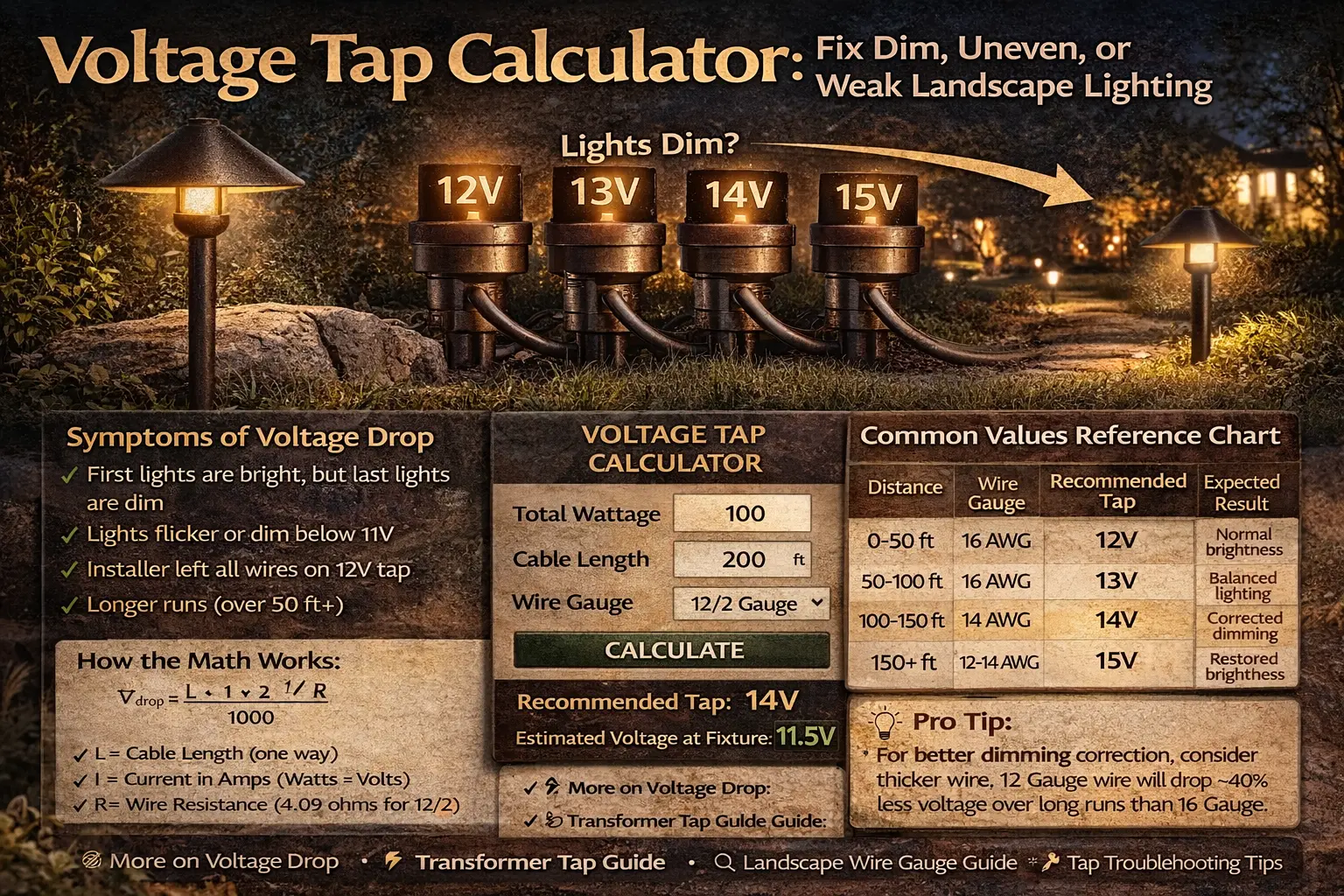
Quick Answer: What Voltage Tap Should You Use?
Use a higher voltage tap when lights are far from the transformer or appear dim. Most systems start at 12V, but longer runs often require 13V–15V to compensate for voltage drop.
- 12V: Short runs under 50 ft
- 13V: Medium runs or slight dimming
- 14V: Long runs or heavier load
- 15V: Very long runs or measured voltage under 10.5V
If only part of the run is dim or inconsistent, the problem may be a poor connection rather than the wrong tap. Review landscape lighting connectors to check for weak, corroded, or poorly seated connections before changing transformer output.
Quick Calculation Logic:
- The Goal: Maintain between 10.5V and 12V at the last fixture.
- The Problem: Long cable runs and higher wattage cause voltage drop.
- The Solution: Use a multi-tap transformer (13V–15V) to boost the starting voltage.
Voltage Tap Decision Guide
Follow this to choose the right tap quickly:
- If your last lights are dim → increase voltage tap
- If lights are bright near transformer but dim far away → increase tap
- If all lights are dim → check transformer or wiring first
- If lights are too bright or burning out → reduce tap
Landscape Lighting Voltage Tap Calculator
Enter your total wattage, one-way cable length, and wire gauge. The calculator estimates voltage drop, predicted voltage at the fixture, and the tap you should test first.
- Set your transformer to the recommended tap
- Test voltage at the last fixture
- Adjust up or down for balance
The calculator will estimate voltage drop and recommend a 12V, 13V, 14V, or 15V tap.
What Voltage Should You Measure at Your Lights?
The ideal voltage at the fixture is between 10.5V and 12V.
- Below 10.5V → lights will appear dim
- 11V–12V → optimal brightness and lifespan
- Above 12.5V → may shorten bulb or LED life
Voltage drop calculations become much more accurate when hidden resistance problems are also considered. Oxidized copper, damaged connectors, moisture intrusion, and partially severed cable strands can create real-world voltage loss far beyond what a simple calculator predicts. The low-voltage landscape lighting failure points guide explains the hidden causes of electrical resistance inside aging outdoor lighting systems.
Voltage drop calculations explain how much voltage reaches the fixtures, but transformer efficiency determines how much electricity is required to deliver that power. After calculating cable losses, compare transformer operating efficiency using our Landscape Transformer Efficiency & Load Loss Benchmarks to evaluate total system performance rather than wire losses alone.
- Longer wire = more voltage drop
- More fixtures = higher load
- Dim lights = increase voltage tap
- Too bright or short lifespan = reduce tap
- Goal: about 11V–12.5V at the fixture
Which Voltage Tap Should You Use?
Voltage Tap Selection Guide
- Use 12V: Lights within 50 ft and system under light load
- Use 13V: Lights 50–100 ft away or slightly dim
- Use 14V: Lights 100–150 ft away or multiple fixtures
- Use 15V: Runs over 150 ft or measured voltage under 10.5V
Voltage taps exist to compensate for line loss so the fixture actually receives the voltage it needs. If your last fixture is starving for power, moving to a higher tap can restore normal brightness without replacing the fixture itself.
If you are still not sure where each cable should land after choosing a tap, compare your setup to the Portfolio lighting transformer wiring diagram so you can match the common terminal and selected voltage tap correctly.
Common Values Table
| Distance | Wire Gauge | Recommended Tap | Expected Result |
|---|---|---|---|
| 0–50 ft | 16 AWG | 12V | Normal brightness |
| 50–100 ft | 16 AWG | 13V | Balanced lighting |
| 100–150 ft | 14 AWG | 14V | Corrected dimming |
| 150+ ft | 12–14 AWG | 15V | Restored brightness |
If the transformer is a Portfolio GLA-200-12WF-1, a low reading at the final fixture does not automatically mean the 200-watt power pack is weak. The loss may be in 14- or 16-gauge cable, a long daisy-chain layout, corroded connectors, or an overloaded branch. The GLA-200-12WF-1 wiring and voltage-drop guide compares 12-, 14-, and 16-gauge cable and explains when to split the system into shorter zones instead of replacing the transformer.
Real-World Voltage Tap Examples
| Setup | Problem | Fix |
|---|---|---|
| 100 ft run, 16 AWG | Lights dim at end | Switch to 13V or 14V tap |
| 150 ft run, 14 AWG | Very weak brightness | Use 14V or 15V tap |
| Short run, 12V tap | Lights too bright | Lower tap or reduce load |
Incorrect transformer tap selection can cause more than voltage problems — it can also create loud transformer buzz, excessive heat, and unstable electrical behavior during startup. The landscape lights buzzing guide explains how high voltage taps and overloaded runs place additional magnetic stress on low-voltage transformers.
Transformer voltage taps should always be adjusted with NEC voltage-drop limits and system load behavior in mind. Our landscape lighting voltage-drop code compliance guide explains how excessive tap compensation, long cable runs, startup surge behavior, and conductor resistance can unintentionally overdrive fixtures and shorten LED driver lifespan over time.
How the Math Works
Where:
- L = one-way length of the cable in feet
- I = current in amps, calculated as total watts ÷ voltage
- R = wire resistance in ohms per 1000 feet, based on wire gauge
The goal is not more voltage everywhere. The goal is the right voltage at the last fixture. If you start too low, the far-end lights go dim. If you start too high, nearby fixtures can run too hot or too bright. The practical target is usually around 10.5V–12V at the farthest fixture.
If you want to see how the transformer, cable runs, and fixtures work together as a complete system, review the low-voltage landscape lighting system diagram before making tap changes across multiple runs.
Adjusting voltage taps can improve brightness, but it does not eliminate underlying energy loss. For a deeper explanation, see how voltage drop wastes energy and how to fix it.
What Most People Get Wrong
- Leaving all wires on 12V regardless of distance
- Assuming dim lights mean bad fixtures
- Using thin wire on long runs
- Not measuring voltage at the fixture
- Ignoring total wattage on the run
If all of your fixtures are weak or inconsistent, the issue may not be tap selection at all. Check landscape transformer not working before increasing voltage if the transformer itself may be failing under load.
Use These Guides With the Calculator
This page works best when you use it with the rest of the site’s wiring and transformer cluster:
If your system uses separate cable runs for different areas of the yard, see low-voltage landscape lighting zones to understand how dividing fixtures into zones can improve voltage balance and make tap selection more effective.
If you want a broader understanding of why some transformers include multiple taps and others do not, start with the landscape lighting transformer guide to compare transformer types, sizing, and common low-voltage setup mistakes.
- Landscape Lighting Voltage Drop
- Landscape Lighting Wire Gauge
- Portfolio 200W Multi-Tap Transformer Wiring and Manual
- How to Wire Landscape Lighting
- Portfolio Lighting Transformer Sizing Guide
- Portfolio Lighting Transformer Wattage Guide
- Landscape Transformer Overload
- How to Test a Landscape Lighting Transformer
- Portfolio Lighting Transformer Troubleshooting
- Landscape Lights Not Working
- Portfolio Low Voltage Lighting
- Portfolio Lighting Troubleshooting
Voltage Tap Calculator FAQ
What tap should I use if my last fixtures are dim?
Start by calculating the run. If the farthest fixtures are seeing too much drop, move from 12V to 13V or 14V before replacing the fixtures.
When should I use the 15V tap?
Usually only on very long runs, heavier loads, or situations where measured voltage at the fixture is still below about 10.5V after trying lower taps.
Can the wrong tap damage my lights?
An excessively high tap on a short run can overdrive nearby fixtures, so you want the lowest tap that still delivers proper voltage at the farthest light.
Do LED systems still need tap calculations?
Yes. LEDs often use less wattage, but long runs and poor wire sizing can still create noticeable voltage drop and uneven brightness.