
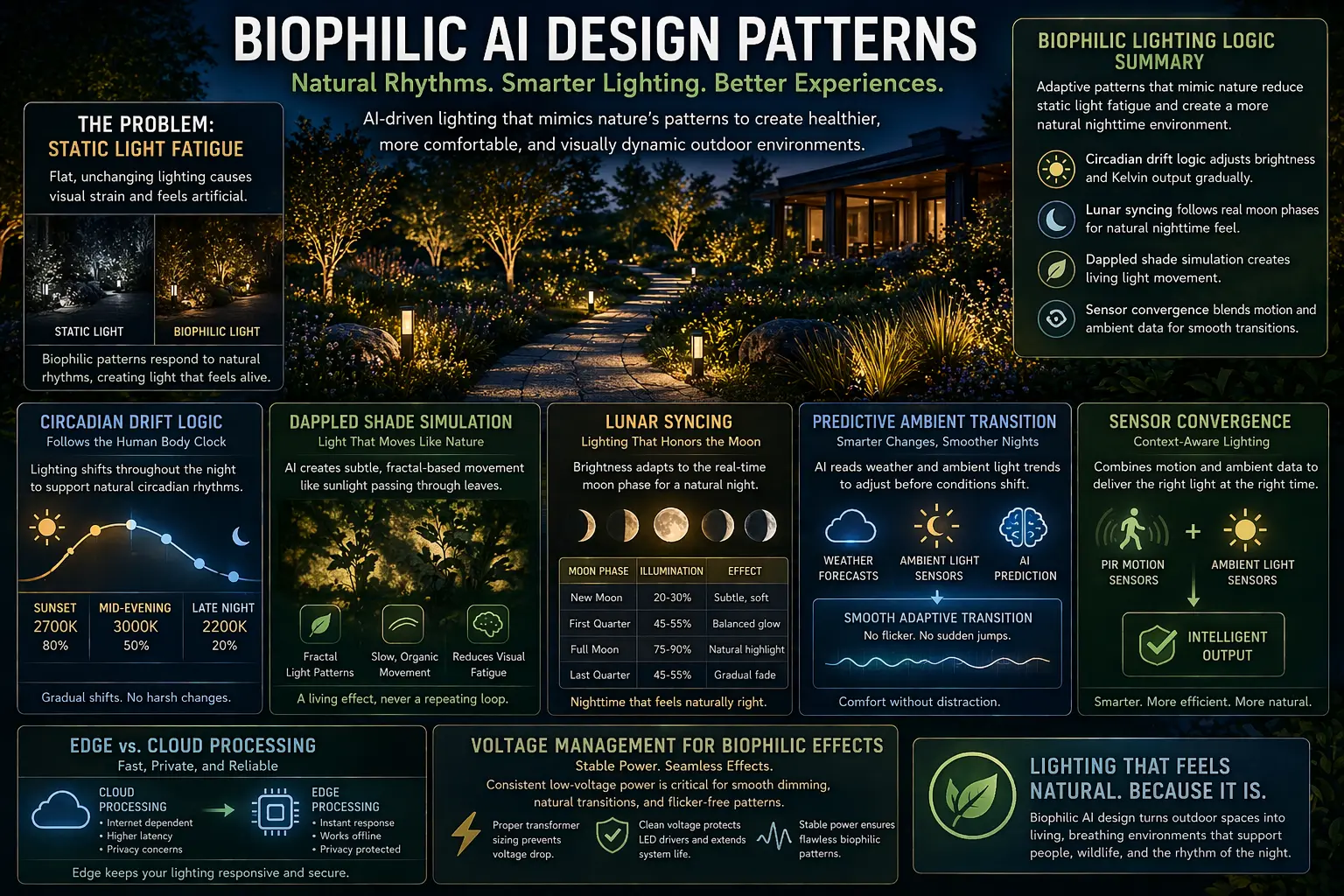
Quick Answer: My 7-Point Environmental Light Integration & Shift Framework
Designing biophilic outdoor lighting means syncing your yard's glow with the shifting rhythms of nature rather than locking it into a stiff, artificial timeline. By mirroring things like changing moon phases, natural evening color shifts, and the movement of leaves, I build outdoor spaces that truly feel like an extension of the wild world around us.
Whenever I design a living layout or program automation loops to blend seamlessly with the night, I follow these seven core principles to eliminate stark, exhausting glare:
- 1. Easing Into the Evening (Circadian Drift): I don't let systems snap to full brightness at dusk; I program the fixtures to slowly warm up in tone and ease in power as the sun dips, matching our bodies' natural winding-down rhythms.
- 2. Syncing With the Moon (Lunar Tracking): I program the core zones to dim down during a bright full moon and glow a bit deeper during a new moon, allowing the actual night sky to direct the brightness of the yard.
- 3. Creating Dappled Shade Movements: Flat lighting feels sterile; I place fixtures high up in full branches so that gentle evening breezes naturally throw moving, dancing tree-leaf shadows across your stone paths.
- 4. Tuning Out Harsh Blue Tones: High-Kelvin, blue-white light bugs our eyes after dark; I lock the system into deep, ultra-warm tones (under 2700K) to keep the atmosphere calm, peaceful, and restorative.
- 5. Blending Ambient Sensor Data: Instead of relying on a simple clock timer, I use smart weather and light sensors that adapt to real-time dark storms or low fog, smoothing out the transition points.
- 6. Softening Motion Triggers: Sudden, blinding floodlights destroy a nighttime mood; I set security paths to slowly fade up to a soft glow when movement is detected, keeping it welcoming rather than jarring.
- 7. Protecting Dark Sky Spaces: I direct light down toward the ground and shroud every single bulb casing, keeping the open sky dark so you can actually see the stars above your property.
⚠️ CRITICAL PERFORMANCE RISK: Forcing fixtures to stay at maximum brightness all night long creates intense visual fatigue and rapidly exhausts the lifespan of your LED modules. Ignoring these natural shifting intervals triggers three distinct system bugs that I walk you through inside my programming guides below.
Don't guess at your controller settings or buy rigid digital timers blindly. Use my step-by-step fading templates, seasonal Kelvin charts, and natural automation layout guides detailed further down this page to build a perfectly balanced, living system.
This page is not about basic mood lighting. It explains a more advanced outdoor lighting approach that creates a natural look by changing brightness and color over time.
Natural-looking outdoor lighting depends on good pattern design, proper timing, environmental awareness, and stable low-voltage power. While the result feels softer and more organic, it is built on consistent system performance and thoughtful lighting control.
If you want outdoor lighting that feels more natural and less harsh, see how to reduce light pollution with smart outdoor lighting control. That guide explains how timing, dimming, warm color temperature, and motion-based brightness can improve comfort while protecting the night sky.
Lighting that reacts naturally also depends on understanding real activity. Our guide to camera-based outdoor lighting explains how systems can respond differently to people, vehicles, and background movement for a more balanced result.
What Biophilic AI Means in Outdoor Lighting
Biophilic AI design patterns use adaptive control logic to shape light the way nature shapes light. Instead of one fixed output level, the system uses changing intensity, color temperature, timing, and subtle movement to create an outdoor environment that feels more alive.
That is what separates this topic from generic smart lighting. The goal is not simply convenience. The goal is environmental rhythm, visual comfort, and reduced fatigue.
This design layer works best when it is tied to real outdoor systems like landscape lighting layouts, layout design, and well-defined lighting zones.
Static Light Fatigue: The Problem Biophilic Patterns Solve
Static light fatigue happens when outdoor lighting stays at one intensity and one color profile all evening. The result can feel artificial, visually tiring, and emotionally flat.
Biophilic patterns solve that by introducing slow, controlled change. The system becomes less like a fixed lamp and more like a managed environmental layer.
Circadian Drift Logic and Biological Dimming Curves
Circadian drift logic gradually changes brightness and color temperature over time instead of relying on abrupt timer events. This is where circadian entrainment and biological dimming curves become practical design concepts rather than abstract wellness language.
In a strong outdoor system, the early evening may begin brighter and slightly cooler, then shift toward warmer, lower-output lighting as the night progresses. That creates a more natural visual rhythm than a single static scene.
This section connects directly to circadian outdoor lighting and also depends on stable output from pages like outdoor transformer lighting.
Natural-looking lighting patterns depend on more than design intent. They also require a network that can deliver smooth, low-latency transitions. See Matter and Thread connectivity for outdoor lighting to understand why reliable mesh communication matters for biophilic lighting effects.
Smart lighting should not only change brightness and color; it also needs stable dimming. I explain why in voltage stability and melatonin, especially for evening scenes and sleep-friendly automation.
A basement is a perfect test case for biophilic automation because the room often has little or no real daylight. The biophilic basement lighting guide covers false windows, wall-washing, daylight schedules, plant lighting, and smart controls for simulating natural cycles underground.
Biophilic lighting design is not only about mimicking daylight aesthetics. Our detailed AI wellness schedule and circadian health guide explains how automation timing, evening brightness reduction, spectrum shifting, and glare management can help outdoor environments feel more biologically natural and visually calming after sunset.
Dappled Shade Simulation and Fractal Light Distribution
Dappled shade simulation creates subtle variation across zones so the landscape feels more like light moving through leaves than light pouring out of a fixed fixture. The pattern should never look theatrical or random. It should feel organic.
One useful way to think about this is fractal light distribution. Instead of perfectly even illumination everywhere, the system intentionally uses gentle irregularity to make the space feel more natural and layered.
That may involve low-level non-uniform dimming, soft zone variance, and tiny timing offsets that avoid robotic uniformity.
Lunar Syncing and Moon Phase Logic
Lunar syncing follows actual moon phases to maintain a more natural nighttime feel. On brighter moon nights, the system can reduce the sense of over-lighting. On darker nights, it can support visibility more actively.
This is one of the strongest differentiators on the page because it ties biophilic design to real environmental rhythm rather than aesthetic guesswork.
| Pattern Type | What Changes | Trigger Source | Visual Result |
|---|---|---|---|
| Circadian drift | Kelvin and brightness | Time-based biological dimming curves | Smoother evening progression |
| Lunar syncing | Night intensity bias | Moon phase data | More natural late-night feel |
| Atmospheric variation | Ambient transition speed | Ambient light and weather context | Less robotic scene behavior |
Predictive Ambient Transition
Predictive ambient transition means the system changes lighting gradually based on ambient conditions instead of waiting for a simple on-off threshold. The goal is to avoid robotic jumps and create smoother visual handoffs as dusk deepens, clouds move, or activity changes.
This is especially helpful in outdoor environments where light rarely changes in a perfectly clean step. The system should feel anticipatory, not mechanical.
Smooth outdoor lighting patterns depend on stable system performance. If the transformer overheats, even subtle lighting changes can become uneven or fail completely. Our thermal throttling protection guide explains how heat is managed before the system shuts down.
Sensor Convergence: Motion, Ambient Light, and Time Logic Working Together
Sensor convergence combines PIR motion, ambient-light sensing, and time-based pattern logic so the system has more than one way to interpret the environment. This is better than relying on any single trigger.
For example, a movement event late at night may trigger only a gentle rise if the ambient-light conditions and time logic suggest a sleep-supportive pattern, while an earlier evening event may trigger a more visible but still natural response.
That convergence fits well with smart hub compatibility and the broader control architecture in AI outdoor lighting systems.
Edge vs Cloud Processing for Natural-Looking Effects
Edge processing is usually better for biophilic lighting because it reduces latency. That matters more here than in a basic on-off lighting system. Even small delays can make subtle dimming and transition effects feel fake.
Cloud processing can still be useful for scheduling, updates, or analytics, but the most believable pattern work usually benefits from local execution.
Natural lighting transitions depend on smooth, instant response. See our edge vs cloud lighting guide to understand why local processing creates more fluid and realistic lighting behavior.
Voltage Management for Biophilic Effects
All of these patterns fail if the electrical foundation is unstable. Flicker ruins biophilic effects. Uneven 12V delivery ruins dimming curves. Voltage drop can turn a subtle scene into a distracting one.
That is why strong bridge pages like voltage drop, system diagrams, and transformer setup are not optional support pages. They are part of the pattern design stack.
High-CRI MR16 Support and Hardware Reality
The software pattern layer can only look natural if the hardware layer can render light naturally. High-CRI MR16 bulbs are especially useful because they produce richer, more convincing outdoor scenes than low-quality lamps.
High-CRI MR16 LED bulbs are the hardware foundation that makes these lighting patterns feel natural instead of flat. That is why the bridge to MR16 LED replacement bulbs matters on this page.
| Lighting Style | Behavior | Human Effect | Best Use |
|---|---|---|---|
| Static lighting | One intensity, one color profile | Higher visual fatigue | Basic utility areas |
| Biophilic patterned lighting | Adaptive rhythm, drift, and subtle variation | More natural and visually comfortable | Outdoor living, pathways, garden zones |
Biophilic AI Design Patterns FAQ
What is biophilic AI lighting?
Biophilic AI lighting uses adaptive lighting logic to mimic natural rhythms such as circadian change, moonlight variation, and shifting shade so outdoor lighting feels more natural and less static.
What is static light fatigue?
Static light fatigue is the visual strain and artificial feeling created when outdoor lighting stays at one intensity and one color profile all evening without subtle natural variation.
How does circadian drift logic work?
Circadian drift logic gradually adjusts brightness and color temperature over time using biological dimming curves instead of abrupt on-off changes or one fixed timer setting.
What is dappled shade simulation?
Dappled shade simulation creates subtle, non-uniform lighting movement and fractal light distribution that feels more like wind through trees than flat, static illumination.
Why is edge processing better for biophilic lighting?
Edge processing reduces latency and keeps transitions smooth, which matters because even small delays can make natural-looking lighting effects feel robotic.
Why does voltage quality matter for biophilic effects?
Biophilic lighting depends on stable low-voltage delivery because flicker, voltage drop, and uneven output ruin subtle dimming curves and natural-feeling transitions.
This page focuses specifically on biophilic outdoor lighting patterns and how to create more natural-looking lighting using timing, brightness changes, and environmental cues. It explains concepts like circadian shifts, moonlight variation, dappled shade effects, and smooth transitions, all supported by stable low-voltage system design to avoid common lighting issues.