
Quick Answer
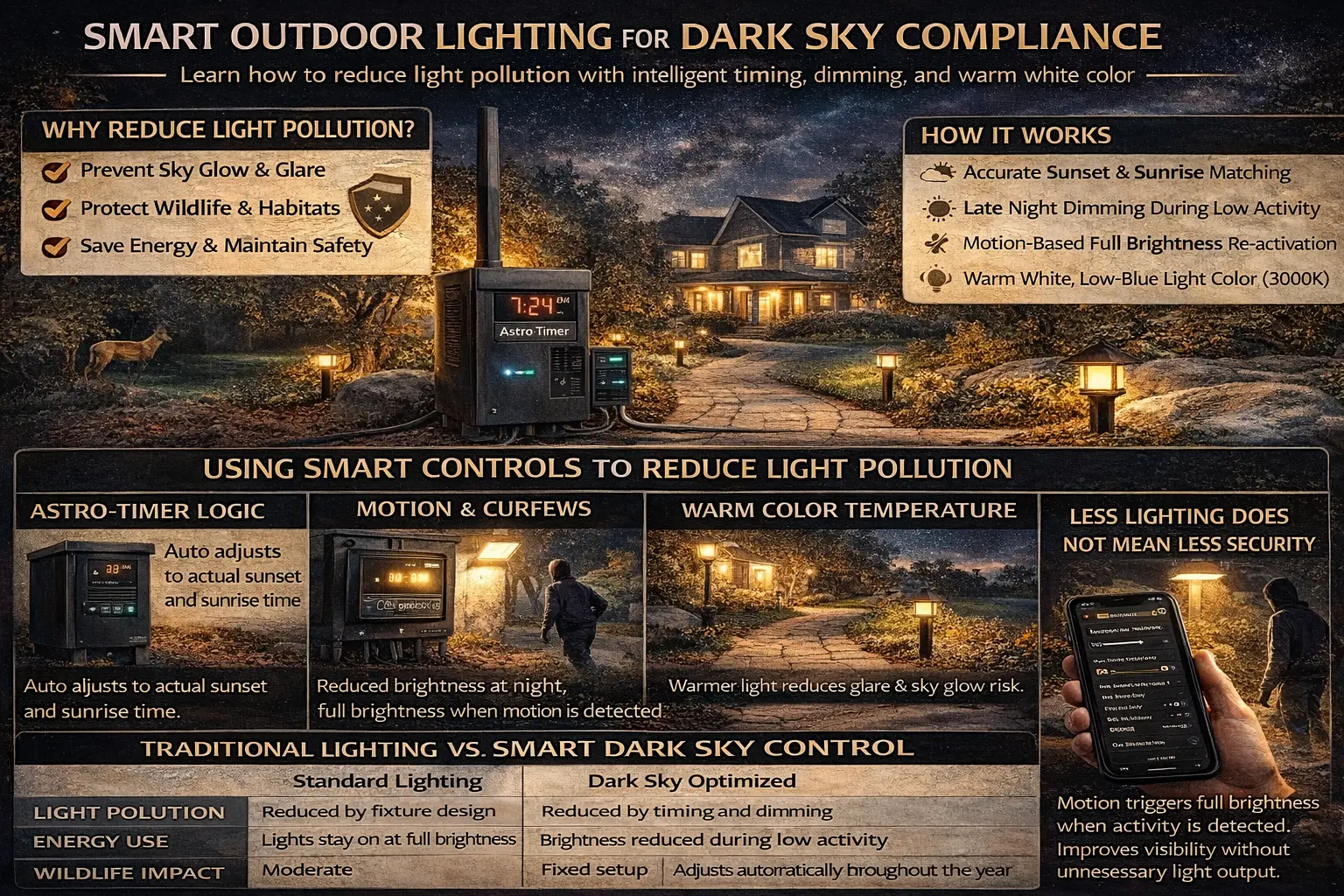
Dark Sky outdoor lighting reduces light pollution by dimming lights after peak hours, using warm color temperatures, and activating full brightness only when needed. This improves visibility, lowers energy use, and minimizes impact on neighbors, wildlife, and the night sky.
Dark Sky Lighting Logic Summary
Reducing light pollution is not just about fixture design. It also depends on when lights run, how bright they are, and how they respond to activity.
- Sunset triggers turn lights on at the correct time
- Late-night curfews reduce brightness automatically
- Motion detection restores full brightness when needed
- Warm color tones reduce glare and sky glow
How do you reduce outdoor light pollution without losing visibility?
You reduce outdoor light pollution by lowering brightness after peak hours, using warm light (3000K or less), and increasing output only when motion or activity is detected. This keeps your property visible and safe while avoiding unnecessary glare and all-night light waste.
- Turn lights on at sunset instead of fixed clock times
- Dim lights late at night when full brightness is not needed
- Use warm color temperatures to reduce glare and sky glow
- Increase brightness only when motion is detected
- Limit light to pathways, entries, and key areas
Good outdoor lighting is not about using more light—it’s about using the right amount at the right time. That is the foundation of reducing light pollution while still keeping your property safe and visible.
Many outdoor lighting systems still rely on fixed schedules and stay at full brightness all night, even when that level of light is not needed. Adjusting timing and brightness helps improve efficiency, reduce glare, and create a more comfortable nighttime environment.
Lower-impact lighting does not require a full system replacement. Our hybrid upgrade guide shows how to reduce glare and improve lighting quality using your existing setup.
Dark-sky automation becomes significantly more effective when it is paired with human-centered lighting schedules. The AI circadian wellness lighting guide explains how automated lumen reduction, adaptive warm-spectrum transitions, and late-night output tapering can simultaneously improve sleep-friendly environments while reducing unnecessary sky glow and visual harshness.
Using Sunset and Sunrise Timing for Better Lighting Control
Outdoor lighting works best when it follows actual sunset and sunrise times rather than fixed schedules. This allows lights to adjust automatically throughout the year without manual changes.
Late-night curfews can also be added to reduce brightness after a set time, keeping the system functional while minimizing unnecessary light output.
This logic fits naturally with arrival-based lighting and lighting control and connectivity, because smart timing works better when local control is reliable and responsive.
Late-night dimming works best when the system can respond instantly. Our edge vs cloud lighting guide explains why local control helps maintain consistent lighting without delays.
Automation can reduce dark-sky impact, but fixture spectrum still matters. For the science behind how outdoor light color affects sky glow, glare, wildlife, and people, see the biological impact of outdoor light color.
Why Warm Light Reduces Light Pollution
Warmer light (3000K or lower) produces less glare and reduces the amount of blue light that scatters into the night sky. This makes outdoor lighting more comfortable and less disruptive to surrounding areas.
Adjusting color temperature throughout the evening helps balance visibility and environmental impact.
This section also connects directly to biophilic lighting design, because both pages focus on how lighting can feel more natural, less harsh, and more responsive to time and context.
Traditional Lighting vs. Smart Dark Sky Control
| Feature | Standard Lighting | Dark Sky Optimized |
|---|---|---|
| Light Pollution | Reduced by fixture design | Reduced by timing and dimming |
| Energy Use | Lights stay on at full brightness | Brightness reduced during low activity |
| Wildlife Impact | Moderate | Lower due to reduced blue light |
| Compliance | Fixed setup | Adjusts automatically throughout the year |
Does Lower Lighting Reduce Security?
Lower lighting does not mean less security. Instead of keeping lights at full brightness all night, systems can increase brightness only when motion is detected.
This approach keeps lighting subtle most of the time while still providing full visibility when needed.
Energy Savings Without Sacrificing Function
One of the biggest advantages of dark sky automation is that energy savings come from better behavior, not from making the system useless. Lights still turn on when needed. They just do not stay brighter than necessary for hours with no activity.
This makes dark sky logic a strong bridge to voltage load balancing and thermal protection, because reduced late-night load also reduces stress on the electrical system.
Lower nighttime lighting works best when brightness increases only when needed. See how camera-triggered outdoor lighting allows systems to stay dim until real activity is detected.
Automation plays a major role in reducing light pollution by controlling when lights are active. The Smart Outdoor Lighting Controls Guide explains how these systems work in real-world setups.
Automated dark-sky controls become even more valuable when the goal is protecting birds, insects, and other nocturnal wildlife. Our wildlife-friendly outdoor lighting guide explains how warm light, shielding, and shorter runtime all work together in a more habitat-friendly outdoor system.
Can Existing Systems Be Retrofitted for Dark Sky Control?
Yes. Many existing low-voltage systems can be improved with smarter controllers, dimming schedules, motion-based activation, and warm-light strategies without full replacement.
This is why the page connects well to the retrofit guide, low-voltage lighting systems, and transformer setup. In many cases, the hardware can stay in place while the control logic gets smarter.
Low-impact lighting becomes more practical when the system can tell who is requesting a change. Our voice biometrics lighting guide explains how identity-based voice control can work alongside smarter nighttime lighting behavior.
If you want to see how dark-sky automation connects to actual HOA and city requirements, visit the Outdoor Lighting Ordinance Guide for a homeowner-focused compliance plan built around shielding, lumen limits, warm-color rules, and curfews.
Automation helps control timing and brightness, but the lamp itself still matters. The Landscape Lighting Color Temperature Guide explains why warm white lighting is a key part of a dark-sky-friendly outdoor lighting setup.
Exterior lighting directly influences how the body transitions into nighttime recovery mode. Our human health and outdoor lighting guide explains how glare exposure, reflected brightness, blue-spectrum LEDs, and poorly shielded fixtures can interfere with nighttime comfort, circadian rhythm, and sleep quality even when the lighting appears visually “soft” outdoors.
How This Page Fits into Your Outdoor Lighting System
Dark sky lighting is an important part of a well-designed outdoor system because it brings together reduced light pollution, better timing, improved efficiency, and real-world use. It helps homeowners balance visibility, safety, and energy use without relying on overly bright, all-night lighting.
Advanced automation allows outdoor lighting systems to automatically adjust brightness and run times based on real conditions. These features are especially useful when trying to reduce nighttime light output and align with dark sky compliant outdoor lighting practices.
- Outdoor lighting systems explains the broader architecture behind adaptive control.
- Arrival-based lighting supports motion and occupancy-driven brightness behavior.
- Lighting control and connectivity explains how local smart behavior actually reaches the system.
- Retrofit guide explains how older systems can still support smarter, lower-pollution behavior.
Together, these pages reinforce a simple truth: good outdoor lighting is not brighter — it’s smarter about when and how it’s used.
Dark Sky Lighting FAQ
What is Dark Sky outdoor lighting?
Dark Sky outdoor lighting reduces light pollution by using smarter timing, lower late-night brightness, warmer color temperatures, and targeted activation instead of leaving lights at full output all night.
Why does warm light reduce light pollution?
Warm light produces less blue-heavy scatter into the night sky, which reduces glare, sky glow, and visual harshness compared with cooler light.
Does lowering brightness reduce security?
No. A well-designed system can stay dim most of the time and raise brightness only when motion or activity is detected, keeping security visibility available without wasting light all night.
What does an astro-timer do?
An astro-timer follows actual sunset and sunrise times instead of fixed clock settings, so outdoor lighting adjusts automatically through the year without constant manual updates.
Can older systems be upgraded for Dark Sky control?
Yes. Older low-voltage systems can often be improved with smarter controllers, dimming logic, and better scheduling without replacing the full transformer and wiring system.
How does motion-based brightness help?
Motion-based brightness keeps the system subtle during low activity, then restores stronger output only when needed for arrival, movement, or security visibility.
This page focuses on reducing outdoor light pollution using better timing, dimming, warm color lighting, and motion-based brightness. It also explains how to improve existing systems and avoid unnecessary light without turning into a general environmental guide.