
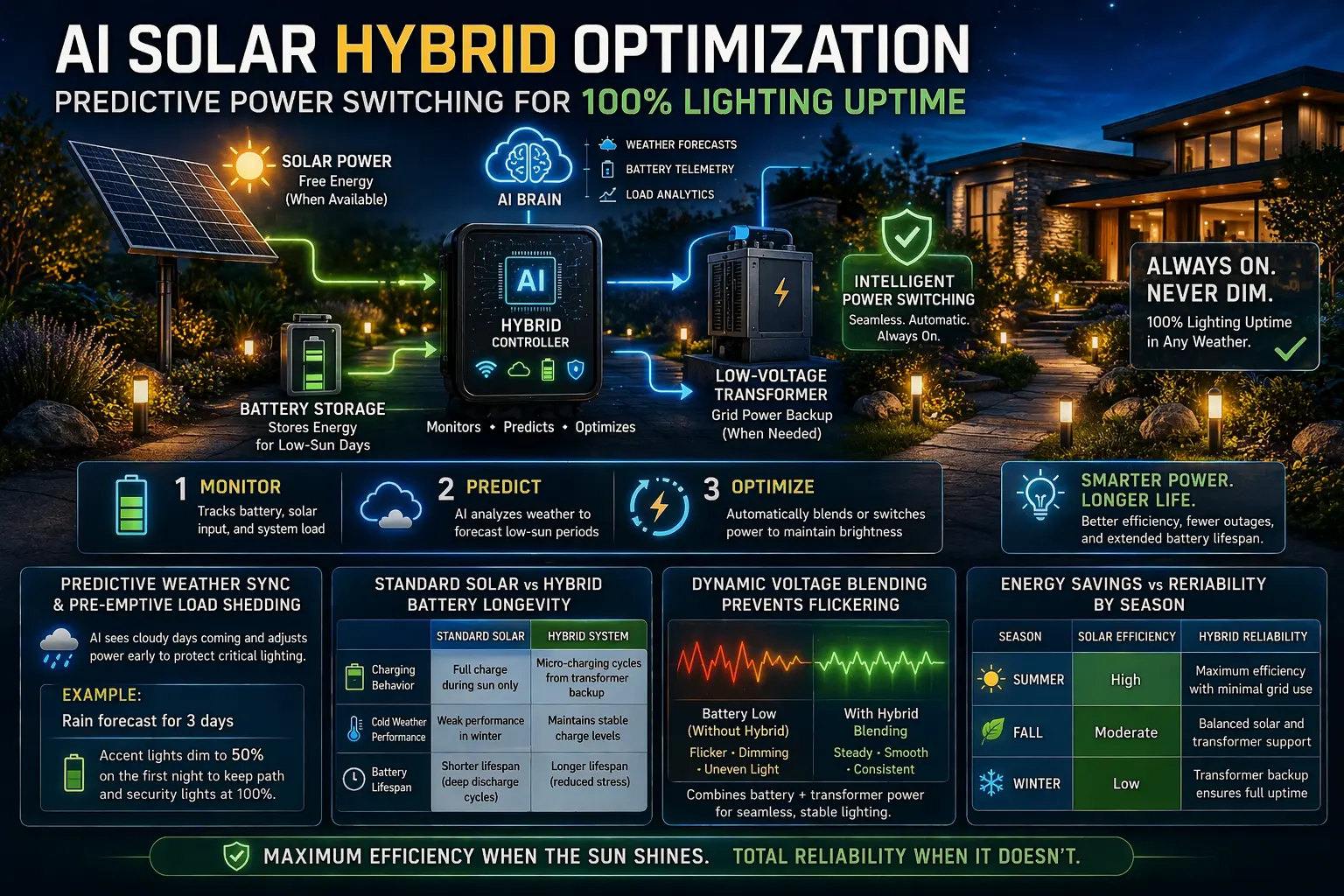
Solar Hybrid Optimization Logic Summary
AI solar hybrid optimization works by deciding how much of the lighting load should come from stored solar energy and how much should come from transformer backup. The goal is to keep critical zones bright, avoid battery abuse, and maintain steady performance when weather conditions reduce solar charging.
- Battery telemetry reveals when reserves are dropping too fast
- Weather forecasting helps the system prepare before low-sun periods begin
- Priority zones stay online while decorative zones can be reduced first
- Voltage blending keeps lights stable instead of flickering or shutting off
Quick Answer: How Hybrid Systems Prevent Dimming
Hybrid systems prevent dimming by blending battery output with transformer power or switching sources when charge levels drop. This keeps voltage stable across lighting zones, avoids deep battery discharge, and maintains consistent brightness during low-sun or high-demand conditions.
Hybrid lighting is not just solar with a backup cable attached. It is a power management strategy. The system works best when it can predict trouble before the lights actually dim, then shift behavior early enough to protect battery life and preserve visibility where it matters most.
That makes this page different from a simple solar-buying guide. The topic here is uptime, power switching, battery protection, and real-world outdoor reliability.
What is AI Solar Hybrid Optimization?
AI Solar Hybrid Optimization is an energy management system that uses real-time weather data and battery monitoring to switch between solar storage and low-voltage transformer power. Unlike standard solar lights, it predicts low-sun conditions, protects battery life, and keeps outdoor lighting running consistently during cloudy or low-charge periods.
How Does Hybrid Solar Lighting Switch Between Power Sources?
- Monitors battery charge level and solar input throughout the day
- Checks weather patterns to predict upcoming low-sun conditions
- Automatically blends or switches to transformer power when needed
That sequence matters because waiting until the battery is almost dead is too late. The best systems respond before visible dimming begins.
How Hybrid Optimization Fits Into Your Lighting System
Hybrid solar optimization works best when combined with proper system design, including transformer sizing, wire layout, and zone planning. It improves performance, but it does not replace good electrical design.
Predictive Weather Sync and Pre-Emptive Load Shedding
Hybrid systems do not wait for batteries to drain. They analyze upcoming weather patterns to adjust power usage ahead of time.
If multiple cloudy days are expected, the system can reduce power to decorative lighting zones early while keeping path and security lighting at full brightness.
Standard Solar vs Hybrid Battery Longevity
| System Type | Charging Behavior | Cold Weather Performance | Battery Lifespan |
|---|---|---|---|
| Standard Solar | Full charge during sun only | Weak performance in winter | Shorter lifespan due to deep discharge cycles |
| Hybrid System | Uses micro-charging cycles from transformer backup | Maintains stable charge levels | Longer lifespan with reduced battery stress |
The Science of Micro-Charging Cycles for Battery Health
One of the biggest hybrid advantages is micro-charging. Instead of waiting for a full solar recharge event, the system can use small transformer-assisted charging cycles to support healthier battery behavior.
That reduces deep discharge stress, smooths out weak-weather periods, and helps the battery stay better prepared for the next night without being pushed too hard. In cold weather, this type of top-off support can also reduce the cell damage that often shortens battery life in standard solar-only lighting systems.
Hybrid systems still rely on a properly sized transformer. If your system is undersized, even advanced switching will struggle to maintain performance. See how to choose the right transformer.
Even with hybrid support, proper system design still matters. Using the correct wire size helps reduce energy loss and improve overall performance. See landscape lighting wire gauge recommendations for guidance.
Hybrid solar lighting depends on reliable communication between controllers, sensors, and backup power devices. See Matter and Thread connectivity for outdoor lighting to learn how local mesh networking helps hybrid systems switch and respond more reliably.
Hybrid power improves uptime, but heat can still become a problem during long runtimes and hot weather. See thermal throttling protection for outdoor lighting systems to understand how staged dimming helps keep transformers and critical zones running safely under heat stress.
Dynamic Voltage Blending Prevents Flickering
When battery levels drop, hybrid systems do not shut off. Instead, they combine remaining battery output with low-voltage transformer power to maintain consistent brightness.
This prevents flickering, sudden dimming, and uneven lighting across zones, especially during long nights or poor solar conditions.
This type of hybrid correction works alongside traditional voltage drop solutions. If you need to understand the root electrical problem, see landscape lighting voltage drop causes and fixes.
Real-Time Wattage Efficiency Monitoring
A strong hybrid system does more than switch between power sources. It also monitors how efficiently power is being used across active lighting zones. That includes battery draw rate, transformer support level, and whether low-priority zones are using more power than conditions justify.
This kind of real-time wattage efficiency monitoring helps the system preserve battery health, maintain stable brightness, and avoid wasting transformer power during extended low-sun periods.
Energy Savings vs Reliability by Season
| Season | Solar Efficiency | Hybrid Reliability |
|---|---|---|
| Summer | High | Maximum efficiency with minimal grid use |
| Fall | Moderate | Balanced solar and transformer support |
| Winter | Low | Transformer backup ensures full uptime |
How This Connects to Real Outdoor Lighting Systems
In a real installation, hybrid optimization only works well when the transformer, cabling, and zone layout are sound. The AI layer can manage switching, battery protection, and load priorities, but it still depends on a stable low-voltage system underneath.
That is why pages like outdoor transformer lighting, transformer setup and planning, and low-voltage lighting systems remain essential support pages for this topic.
Reliable power is the foundation for better lighting design. See biophilic outdoor lighting design patterns to learn how natural lighting changes and smooth transitions improve the look and feel of outdoor lighting systems.
How Solar Hybrid Optimization Fits Into AI Lighting Systems
Solar hybrid optimization is one power-management layer inside a larger AI outdoor lighting system. It works alongside automation, hub logic, and zone control so the property can respond intelligently to weather, energy limits, and homeowner priorities.
- AI Outdoor Lighting Systems – overall architecture
- AI Landscape Lighting Automation – execution layer
- Smart Hub Compatibility Guide – system control layer
- Outdoor Transformer Lighting Guide – transformer foundation
- Lighting Zones Explained – priority logic for critical areas
This page focuses specifically on solar hybrid lighting performance and how to maintain consistent power in real-world conditions. It explains how systems switch between solar and transformer support, protect battery life, balance voltage, and keep critical lighting zones reliable without drifting into general solar product descriptions.
AI Solar Hybrid Optimization FAQ
What is AI Solar Hybrid Optimization?
AI Solar Hybrid Optimization is an energy management system that uses real-time weather data and battery monitoring to switch between solar storage and low-voltage transformer power so outdoor lighting stays reliable during low-sun periods.
How does hybrid solar lighting switch between power sources?
Hybrid systems monitor battery charge, track solar input, predict upcoming weather, and automatically switch or blend transformer power when solar storage will not support the required load.
What is pre-emptive load shedding?
Pre-emptive load shedding reduces power to lower-priority decorative zones before battery reserves become critical so essential lighting remains fully powered through poor weather.
What are micro-charging cycles?
Micro-charging cycles are small transformer-assisted charging events that help maintain healthier battery levels and reduce deep discharge stress in hybrid systems.
What does dynamic voltage blending do?
Dynamic voltage blending combines remaining battery output with low-voltage transformer power to keep brightness stable and prevent flickering or sudden dimming.
Why are hybrid systems more reliable in winter?
Hybrid systems are more reliable in winter because transformer backup supports the lighting load when short days, cold weather, and low solar charging reduce battery performance.