
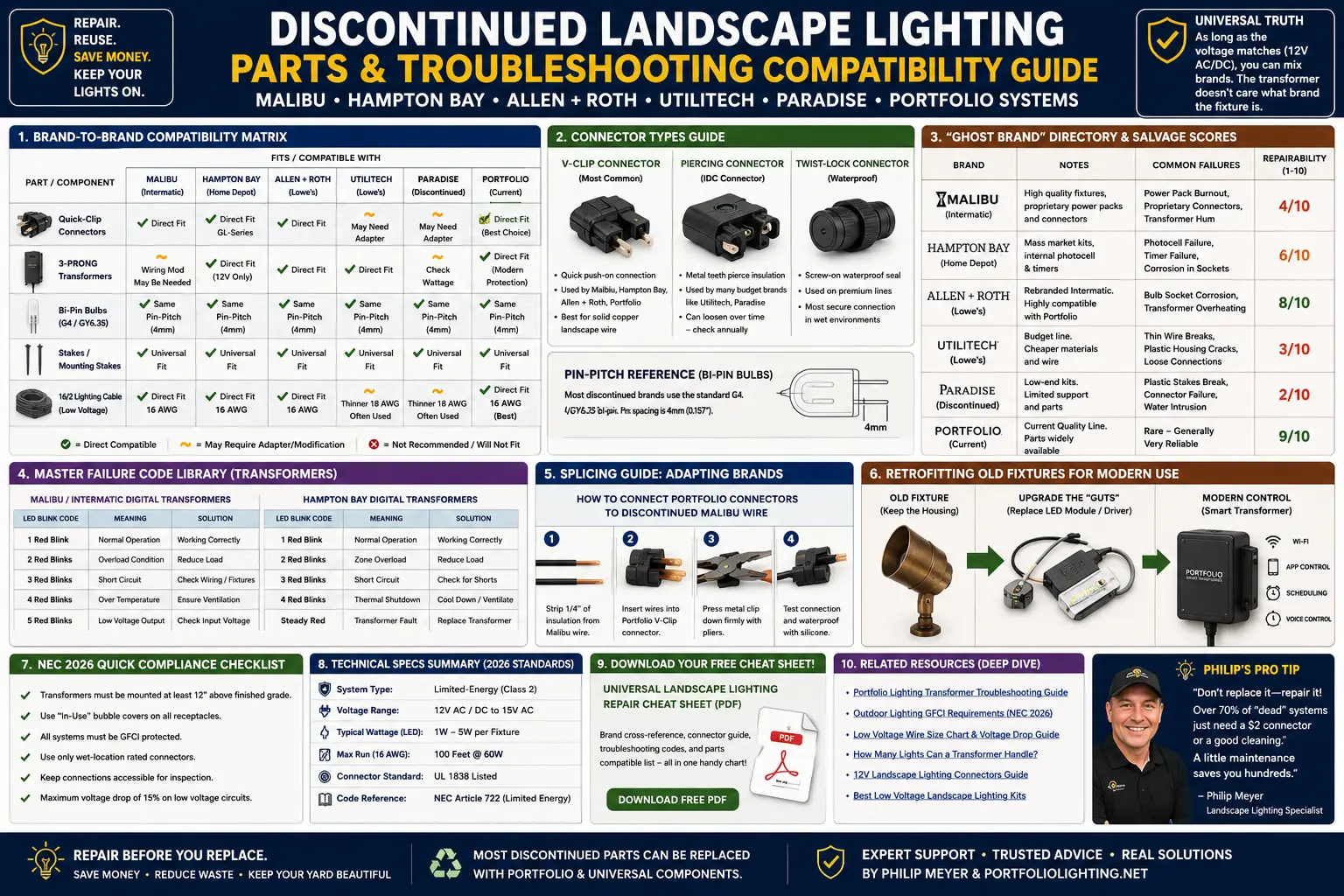
Quick Answer: My 7-Point Legacy Loop Integration & Load Balancer Protocol
You can absolutely mix different brands of discontinued landscape lighting on the same wire run, provided you match the physical voltage limits and eliminate weak factory connection points. Standard outdoor systems operate on a universal 12V to 15V Alternating Current (AC) foundation, meaning a Portfolio power hub will happily drive Malibu, Hampton Bay, Paradise, or allen + roth fixtures as long as your total wattage load doesn't overload the transformer circuit.
For the deeper framework behind these retrofits, my comprehensive Portfolio low-voltage lighting guide breaks down exactly how transformers, cables, voltage drops, and connector points pull together in older 12V yards.
Whenever I am out in the mud trying to splice an older, mixed-brand layout back together without causing a short circuit, I follow these seven strict field rules:
- 1. Inspecting the Socket Style: I always check the light source first. Fixtures with traditional screw-in or push-in pin sockets are incredibly easy to salvage because you can swap out the bulb forever. Integrated LED boards are much tougher—once the sealed chip dies, you usually have to replace the entire housing.
- 2. Cutting Out Failed Factory Clip Connectors: Old plastic quick-clips from retail kits are notorious for failing long before the metal fixture or transformer dies. When mixing brands, I skip the proprietary clips entirely, strip the copper bare, and twist the joints together using silicone-filled, waterproof wire nuts.
- 3. Tuning Old Magnetic Transformers: If you are swapping power-hungry legacy halogen fixtures for highly efficient modern LEDs on an old magnetic transformer box, the sudden massive drop in power draw can cause the line voltage to spike up. I always check the line with a voltmeter to ensure it stays below 15V AC so the new bulbs don't burn out prematurely.
- 4. Measuring Mechanical Stakes and Threads: Do not assume a ground stake from one brand will screw into the stem of another. Kichler, Portfolio, and Malibu all used different thread pitches and diameters (like 1/2-inch NPT vs proprietary sizes); I always test-fit the stem threads before buying replacement stakes.
- 5. Tracking Down the LED Driver Specs: For integrated lights that skip standard bulbs, the small internal driver board regulates power. If you hook up an incorrect voltage module, the light will strobe like a flashlight or stay completely dark.
- 6. Verifying Real-World Serviceability: Some old fixtures are worth saving, while others belong in the scrap bin. Before buying parts, I cross-reference the LED Lighting Repairability Score Database to see if a specific component family has a track record of easy parts matching.
- 7. Sizing Up Buried Cable Integrity: When tying new high-quality fixtures onto an old line, I check the thick trunk wire. If the original installers used thin 16-gauge wire instead of heavy-duty 12-gauge or 10-gauge cable, you will face severe voltage drops that dim the fixtures at the end of the line.
⚠️ CRITICAL RETROFIT RISK: Shoving random, high-wattage replacement bulbs onto a degraded, thin retail wire loop or ignoring a voltage spike on an old magnetic transformer will melt your buried insulation and ruin the circuit board. Disregarding these basic electrical limits triggers three major system failures that I map out step-by-step in our wiring schematics below.
Don't rip your yard apart or buy random retail box sets blindly. Use my step-by-step voltage drop calculators, cross-brand wire splicing layouts, and multi-tap transformer balancing guides detailed further down this page to build a rock-solid, mixed system that runs perfectly for decades.
Quick Specs: Discontinued System Compatibility
- Most common system voltage: 12V AC low-voltage landscape lighting.
- Most common old kit wire: 16-gauge or 18-gauge cable on cheaper kit systems; 12/2 or 14/2 on better permanent runs.
- Most common connector failure: insulation-piercing clip corrosion or loosened blade pressure.
- Most reliable repair path: replace failed proprietary clips with waterproof direct splices where service access allows.
- Best salvage candidates: brass, cast aluminum, glass-lens and socketed fixtures.
- Worst salvage candidates: sealed plastic integrated LED fixtures with cracked housings and unavailable drivers.
The Integrated LED Wall: When There Is No Bulb to Replace
One of the biggest surprises with discontinued Malibu, Hampton Bay, Portfolio, Paradise, Utilitech, and allen + roth fixtures is the difference between a socketed fixture and an integrated LED fixture.
| Fixture Type | What Fails | Can You Change the Bulb? | Best Repair Decision |
|---|---|---|---|
| Socketed lamp-ready fixture | Bulb, socket, connector, stake, lens, or wire lead | Usually yes | Replace lamp, connector, or socket before replacing the whole fixture. |
| Integrated LED fixture | LED board, sealed driver, internal wiring, lens seal, or entire light engine | No, not in most consumer fixtures | Replace the fixture, driver module, or LED module only if a compatible part exists. |
| Sealed plastic integrated LED kit fixture | Water intrusion, cracked housing, failed LED board, failed driver | No | Usually replace the full fixture instead of chasing unavailable parts. |
This is why older brass, cast aluminum, glass-lens, and socketed fixtures often score higher for repairability than newer sealed plastic integrated LED fixtures. Integrated LED can be efficient, but the light source is commonly built into the fixture instead of replaced like a normal bulb.
Brand-to-Brand Cross-Compatibility Matrix
This chart focuses on the parts and specifications that actually matter when repairing older landscape lighting systems: voltage, wire size, connector type, stake fitment, bulb base, transformer behavior, and the components that usually fail first.
| Original Brand | Common Legacy Part | Best Compatible Direction | Connector / Pin Detail | Primary Failure Point | Repair Notes |
|---|---|---|---|---|---|
| Portfolio | 12V transformers, path lights, deck lights, integrated LED fixtures | Portfolio, allen + roth, universal 12V landscape fixtures | Common 12V two-wire cable, screw terminals or quick connectors depending on era | Transformer lugs, photocell, timer, corroded quick connectors | Use model lookup before replacing integrated LED fixtures. |
| Malibu / Intermatic-era | Power packs, plastic path lights, wedge-base fixtures | Universal 12V transformers and waterproof splice conversions | Many used proprietary quick clips; socketed fixtures may accept common wedge or bi-pin lamps | Timer failure, photocell failure, cracked plastic, corroded clips | Best repair is often replacing connectors while keeping usable housings. |
| Hampton Bay | Home Depot legacy transformers and path/flood fixtures | Universal 12V fixtures, Portfolio-compatible transformers, modern LED modules | Often standard two-wire low-voltage cable but connector housings vary | Internal light sensor, timer logic, water intrusion, loose quick clips | Transformer controls often fail before the output winding fails. |
| allen + roth | Lowe’s-era path lights, wall lights, low-voltage fixtures | Portfolio and modern Lowe’s-compatible repair parts | High crossover with Portfolio-style parts on many low-voltage systems | Stakes, lenses, quick connectors, integrated LED boards | Usually one of the easiest discontinued brands to salvage. |
| Paradise | Plastic kit fixtures, solar/low-voltage hybrids, path lights | Universal 12V fixtures or waterproof splice retrofit | Kit connectors may be weak; cable is often thinner than permanent systems | Plastic housing cracks, water inside lens, cheap connector failure | Repair is worthwhile only if the housing and lens remain solid. |
| Utilitech | Budget low-voltage kits and integrated LED fixtures | Portfolio low-voltage, universal 12V fixtures, replacement transformer | Often light-duty cable; connector reuse is a common failure path | LED flicker, driver failure, corrosion, cracked stakes | Check voltage at fixture before blaming the LED board. |
Universal Voltage Drop Chart for Older Thin-Wire Kits
Discontinued kit systems often used thinner cable than permanent pro systems. That makes cross-brand compatibility look worse than it really is because the replacement fixture may be fine, but the old 16-gauge or 18-gauge run starves the far fixtures.
| Wire Gauge | Typical Old Kit Use | 50 ft Run | 100 ft Run | Repair Direction |
|---|---|---|---|---|
| 18 AWG | Small starter kits, short runs, low fixture count | Acceptable only for very low LED loads | High risk of dim final fixtures | Shorten run or upgrade cable |
| 16 AWG | Common discontinued kit cable | Usually acceptable for modest LED loads | Needs load reduction or better layout | Split run or use lower wattage LED fixtures |
| 14 AWG | Better DIY systems | Good for most small LED systems | Still check final fixture voltage | Use voltage testing before replacing fixtures |
| 12 AWG | Permanent landscape runs | Best repair platform | Best long-run option | Usually worth salvaging and expanding |
For deeper math, use the landscape lighting voltage drop calculator and the transformer wattage guide.
The Ghost Load Problem: When Old Transformers Hate New LEDs
Older magnetic transformers were often designed around halogen loads. If you replace ten 20-watt halogen lamps with ten 3-watt LEDs, the system load may drop from about 200 watts to about 30 watts. That can make an old transformer hum, run with higher no-load voltage, behave unpredictably, or fail to control the lights cleanly.
| Old Setup | New LED Setup | Possible Symptom | Best Fix |
|---|---|---|---|
| 10 halogen lamps × 20W = 200W | 10 LED lamps × 3W = 30W | Hum, flicker, odd timer behavior, high output voltage | Use an LED-optimized transformer or verify minimum-load requirements. |
| Old magnetic transformer near design load | Very low LED load after retrofit | Transformer feels oversized for the system | Replace with a smaller LED-rated transformer rather than wasting power on a dummy load. |
LED Retrofit Polarity Check: Why a New Bulb May Not Light
Older halogen landscape lighting systems were forgiving because incandescent lamps did not care about polarity. LED retrofit lamps can be different. Some drop-in LED lamps or modules are sensitive to how the internal electronics receive power, especially when mixed with older AC transformers, adapters, or inexpensive replacement bulbs.
Do this only after confirming the voltage is correct. If the fixture still does not work, check the connector, socket corrosion, lamp base, driver type, and whether the LED is rated for the transformer output.
If your fixture is socketed instead of sealed, start with the Portfolio lighting replacement bulbs guide before replacing the whole fixture. A correct bulb match is usually cheaper than replacing a salvageable housing.
Ghost Brand Directory: What Usually Failed and What to Do Next
If an older magnetic transformer hums, overpowers a low-wattage LED retrofit, or no longer matches the system load, compare replacement options in the landscape lighting transformer guide.
Malibu
Typical issue: Intermatic-era power packs, failed timers, proprietary clips, cracked plastic housings.
Repair direction: Test transformer output, replace failed clips with waterproof splices, keep metal/socketed fixtures when possible.
Many discontinued Malibu systems are still repairable using modern waterproof connectors, replacement transformers and universal stakes. The Malibu Top 40 Model Lookup Database helps identify ML, LX and 8100-series transformers, path lights, flood lights and legacy replacement parts commonly searched by homeowners trying to keep older low-voltage systems running.
Hampton Bay
Typical issue: Home Depot legacy transformers with internal light sensor or timer faults.
Repair direction: Separate transformer control failure from fixture failure before replacing the entire run.
allen + roth
Typical issue: Lowe’s-era parts overlap with Portfolio-style systems, but stakes, lenses, and quick connectors vary.
Repair direction: Strong salvage candidate when the fixture housing is intact.
Paradise and Utilitech
Typical issue: Budget plastic housings, light-duty cable, cheap quick connectors, flickering integrated LEDs.
Repair direction: Retrofit good locations with better 12V fixtures; do not keep brittle plastic just to preserve the brand.
Proprietary Connector Troubleshooting: V-Clip, Piercing Clip and Twist-Lock Logic
Connectors are the number one failure point in discontinued landscape lighting systems. The original transformer may still work and the fixture may still be good, but the connector no longer bites cleanly into the cable.
V-Clip Connectors
V-clip connectors pinch into the low-voltage cable. They are fast, but old ones lose pressure and corrode where the metal tooth meets copper. If the fixture flickers when you wiggle the connector, the connector is suspect.
Insulation-Piercing Connectors
These were common on Malibu, Portfolio, Paradise, Utilitech and Hampton Bay kits. They should not be reused over and over because the puncture point becomes a moisture path and the second bite is rarely as clean as the first.
Twist-Lock and Waterproof Splices
Twist-lock or waterproof splice conversions are usually better for permanent repairs. When converting a discontinued Malibu-style connector to a Portfolio-style run, cut out the failed quick clip, strip fresh copper, match polarity if marked, and use a gel-filled or direct-burial rated splice sized for the cable.
For connector-specific repair, use the low-voltage wire connectors guide and low-voltage plug and limited-energy connector guide.
Master Failure Code Library: Transformer Lights, Blinks and Silent Failures
Discontinued digital transformers often communicate failure with a tiny red light, flashing display, blank timer, clicking relay, or repeated reset cycle. Manuals are often missing, so use the behavior pattern first.
If a Malibu or Hampton Bay transformer flashes red after rain, disconnect the landscape cable from the transformer and test the transformer output alone. If the transformer works with the run disconnected, the problem is downstream: nicked cable, flooded connector, failed fixture, or water inside a splice.
Use the Portfolio transformer troubleshooting guide, transformer wiring diagram, and transformer tripping breaker guide to separate input, output and downstream faults.
Retrofitting “Dumb” Discontinued Fixtures for Smart Control
Many discontinued fixtures are not worth replacing if the housing is solid. Older brass, cast aluminum, glass-lens, and socketed fixtures can often be upgraded by replacing the lamp, connector, cable splice, or transformer control method.
The cleanest smart retrofit is usually not a “smart bulb” in every fixture. It is a reliable 12V lighting run controlled by a modern smart transformer, smart outdoor plug, or timer system with proper GFCI protection and weather-rated covers.
This is where sustainability through repair becomes a real technical advantage: keep the durable metal housing, remove the weak proprietary connector, improve the splice, reduce wattage with LED lamps, and use a safer modern control point.
For smart and automation planning, connect this page to AI outdoor lighting systems and replacement LED modules and drivers.
Photocell Bypass: Keeping a Good Transformer With a Broken Sensor
Many discontinued Malibu, Hampton Bay, Portfolio, and Intermatic-era transformers fail in the control side before the transformer winding fails. The unit may still produce 12V, but the photocell, timer, or light sensor no longer turns the system on correctly.
If the transformer works in manual mode but fails in dusk-to-dawn mode, the “brain” may be broken while the power section is still usable. Some systems can be run with the photocell covered by a blackout cap, set to manual-on, or bypassed according to the manufacturer wiring design, then controlled by a weather-rated smart outdoor plug or modern timer.
The logic is simple: if the transformer output is good but the sensor logic is bad, you may not need to throw away the whole unit. Move the scheduling job to a safer external control point and keep the transformer only if it is still electrically sound.
Technical Salvage Scores by Discontinued Brand
These scores are intentionally practical. They weigh how often parts can be adapted, how durable the fixtures are, how proprietary the connector ecosystem is, and whether the transformer failure usually destroys the whole system.
| Brand / System | Repairability Score | Why It Scores That Way | Best Next Step |
|---|---|---|---|
| allen + roth low-voltage | 8/10 | Good overlap with Lowe’s/Portfolio-style systems; many housings and connectors are adaptable. | Check fixture body, connector, and voltage before replacing. |
| Portfolio legacy systems | 8/10 | Strong model ecosystem, many compatible paths, and good transformer troubleshooting support. | Use model lookup and compatibility pages. |
| Hampton Bay landscape | 6/10 | Many fixtures are usable, but transformer sensors and controls can be frustrating. | Test transformer output separately from the lighting run. |
| Malibu / Intermatic-era | 4/10 | Proprietary parts and aging plastic lower the score, but socketed metal fixtures can still be saved. | Replace connectors and consider a modern transformer. |
| Paradise / Utilitech kit systems | 3/10 | Cheap housings, thinner wire, and integrated LED failures limit salvage value. | Salvage the cable route if good; replace brittle fixtures. |
How to Test a Discontinued Transformer With a Multimeter
- Unplug and inspect first. Look for melted plastic, burnt smells, loose lugs, water stains, and corroded plugs.
- Reset the GFCI and set the transformer to manual on. Do not test only in auto mode because a failed photocell can mimic a dead transformer.
- Set your meter to AC volts. Most traditional landscape transformers output 12V AC, not DC.
- Measure across the low-voltage output terminals. A healthy 12V unit may read above 12V with no load.
- Disconnect the field cable and test again. If voltage returns with the cable removed, the transformer is likely protecting itself from a downstream short.
- Test the first and last fixture under load. Low voltage at the far end means the repair path may be cable layout, not parts replacement.
Parts Swap Cheat Sheet: What Usually Crosses Over?
- Transformers: Brand usually does not matter if output voltage, capacity, plug style, GFCI protection, and installation method are correct.
- Fixtures: 12V fixtures can usually mix across brands when wattage and connector method are corrected.
- Stakes: Thread size and stem diameter matter more than brand.
- Lenses: Diameter, retaining ring style, gasket condition, and glass/plastic material matter more than model name.
- Bulbs: Match base type, voltage, wattage, beam angle, and fixture heat limits.
- Connectors: The safest universal repair is often removing proprietary clips and using waterproof direct splices.
Stake Thread and Stem Diameter Compatibility Table
Electrical compatibility does not guarantee mechanical compatibility. A replacement fixture may work on 12V power but fail to fit the old stake, riser, or stem. This is especially common when mixing discontinued Portfolio, Malibu, Hampton Bay, Kichler, Paradise, and allen + roth parts.
| Brand / System | Typical Thread Size | Typical Stem Diameter | Compatibility Note |
|---|---|---|---|
| Portfolio / allen + roth | Often 1/2-inch NPS style threads | About 0.8 inch to 1.0 inch | Often adaptable, but confirm stem diameter and thread engagement before reusing old stakes. |
| Malibu older systems | Often 1/2-inch NPS style threads | About 0.75 inch | Old plastic stakes crack easily; universal replacement stakes may be safer than reusing brittle originals. |
| Hampton Bay | Often 1/2-inch NPS style threads | Varies by fixture family | Electrical crossover is common, but stake and post fit can vary by kit generation. |
| Kichler / pro-grade fixtures | Often 1/2-inch NPS heavy-duty style threads | Often 1.0 inch or larger | Usually stronger mechanically, but may not fit lighter-duty kit stakes cleanly. |
Discontinued Landscape Lighting Troubleshooting Flowchart
This flowchart keeps the repair sequence simple: test power first, then connectors, then individual fixtures, then transformer controls. Most discontinued systems fail at the connector or control point before every fixture fails at once.
Brand Alternatives for Discontinued Landscape Lighting Systems
When an older Portfolio system is no longer supported, the best replacement is not always another Portfolio fixture. Start with the Portfolio lighting alternatives guide to compare compatible replacement paths across major low-voltage brands.
If you are trying to compare retail-grade systems with better repair support, the low-voltage landscape lighting brand comparison explains how brands differ in transformer quality, fixture durability, parts availability, and long-term repairability.
Discontinued Portfolio Model Repair Pages
Discontinued landscape lighting is not always impossible to repair. Many older Portfolio systems can be saved if the failed part is correctly identified and matched by function instead of exact retail availability.
For specific examples, see the SS9C-P5-BKT-CPK1 discontinued model guide, the 0378225 connector failure guide, the 0157561 flood light repair page, the 0062582 path light compatibility guide, the 0805200 transformer diagnostic guide, and the 7404280540 replacement parts page.
These pages help visitors repair discontinued systems by understanding sockets, seals, connectors, stakes, voltage behavior and transformer load instead of assuming every old Portfolio model must be replaced.
Most Recent Discontinued Portfolio Model Resources I Researched To Include On This Page
Many discontinued Portfolio flood lights continue operating for years after replacement parts disappear from retail stores. This Portfolio Lighting Model 0157561 flood-light technical guide helps homeowners identify compatible replacement parts and understand common long-term failure points.
Older low-voltage systems often become difficult to troubleshoot because original model documentation is no longer available online. This Portfolio Model 0062582 replacement-parts reference helps organize model-specific information for discontinued outdoor-lighting systems.
Discontinued lighting systems frequently develop hidden compatibility issues when newer LED hardware is mixed with older transformers or photocells. This Portfolio Lighting Model 0394866 troubleshooting guide explains how to evaluate replacement compatibility more carefully.
Some discontinued Portfolio fixtures used early-generation integrated LED systems that behave differently than modern low-voltage replacements. This Portfolio Model 0482436 repair and compatibility guide explains how to approach upgrades without damaging existing infrastructure.
Long-term outdoor exposure often destroys labels, manuals, and wiring diagrams, which makes older systems difficult to identify correctly. This Portfolio Lighting Model 17794-000 manual and parts guide helps preserve important technical information for aging landscape-lighting systems.
Real Examples of Discontinued Portfolio Part Matching
Discontinued landscape lighting becomes difficult to repair because many original Portfolio manuals, replacement charts and retailer records slowly disappear from the internet over time. That leaves homeowners trying to match parts from blurry listing photos instead of real fixture measurements and electrical specifications.
The 016107 WHCM432R8 lens replacement guide explains why gasket fit and retainer depth matter more than visual similarity, while the 0311569 kit replacement guide shows how complete fixture kits can create confusion when only one broken component actually needs replacement.
Many discontinued failures are mechanical instead of electrical. The 17945-000 shade replacement guide focuses on shade fitment and diffuser stability, while the 230132-145P replacement guide explains how damaged connectors and corroded low-voltage splices can mimic total fixture failure.
For older models with missing manuals, the FY09-003 0048184 manual guide, 18907-000 manual and parts guide, 25966-3 repair guide and 2851294 troubleshooting guide demonstrate how to rebuild missing installation data using transformer labels, fixture geometry and connector inspection instead of relying only on outdated manuals.
Discontinued Landscape Lighting FAQ
If you are replacing failed or discontinued fixtures, the Best LED Landscape Lighting Fixtures Guide helps compare modern replacements based on repairability, heat management, and compatibility with older low-voltage systems.
Many older landscape lighting systems can still be repaired instead of completely replaced. The landscape lighting legacy compatibility guide explains how discontinued transformers, connectors, stakes, MR16 lamps, and low-voltage fixtures can often work across different generations and brands.
Can I mix Malibu, Hampton Bay, Portfolio and allen + roth landscape lights?
Usually yes if the system is 12V, the transformer has enough capacity, the fixtures are rated for the same voltage, and the connectors are made safely. The biggest issue is not the brand name; it is connector compatibility, wattage load, cable gauge, voltage drop, and waterproof splicing.
What is the most common discontinued landscape lighting failure?
Corroded connector systems are the most common failure. Old quick clips lose pressure, pierce the cable poorly, wick water into the copper, and create intermittent failures that look like bad fixtures or bad transformers.
What does the red light on a Malibu transformer mean?
A red light or repeated blink usually means overload, short circuit, wet connector, downstream wiring fault, or a control board problem depending on the model. Disconnect the lighting run and test transformer output before replacing fixtures.
Are old brass or metal fixtures worth saving?
Often yes. Durable metal housings, glass lenses and socketed lamps are usually worth salvaging. Cheap sealed plastic integrated LED fixtures are less repairable if the housing, driver or lens has failed.
Can I change the bulb in an integrated LED landscape light?
Usually no. In most integrated LED landscape lights, the LED is built into the fixture instead of using a replaceable bulb. If the LED board, driver, or sealed light engine fails, the repair is usually a compatible module replacement or full fixture replacement.
Why did my new LED bulb not work in an old landscape light?
The fixture may have voltage at the socket, but the LED may be polarity-sensitive, incompatible with the old transformer, or not rated for the fixture. Try flipping the bulb or reversing the fixture leads only after confirming the voltage is correct.
Can I bypass a failed photocell on an old Malibu or Hampton Bay transformer?
Sometimes, but it depends on the transformer design. If the transformer works in manual mode, it may be safer to leave it in manual-on and control it with a weather-rated smart outdoor plug or timer instead of guessing on internal photocell wiring.
Electrical Safety Disclaimer
This guide is for homeowner education and repair planning. Always follow product labels, local electrical code, listing requirements, and safe work practices. Hire a licensed electrician for damaged line-voltage wiring, repeated GFCI trips, burned plugs, hardwired transformer replacement, buried cable faults, pool or spa zones, or any installation you are not comfortable diagnosing safely.