
Quick Answer: My 7-Point Component Wear & Circuit Continuity Protocol
Fixing a dead Hampton Bay light setup isn't about tossing out the whole system—it is about hunting down the single weak point that is cutting off your electrical current. These consumer-friendly systems rarely fail all at once; instead, a single corroded splice, a tripped internal thermal limiter, or a rotted plastic clip will bring down an entire section of lights.
Whenever I tackle a flickering track line, a dead landscape loop, or a broken ceiling fan light kit, I trace down the failed component using these seven field rules:
- 1. Testing the Core Transformer (Whole System Dead): If your entire outdoor loop goes completely dark, I skip the lights and go right to the transformer box. I check the built-in digital timer settings and test the multi-tap terminals to make sure the internal circuit breaker hasn't tripped.
- 2. Replacing Bad Trunk Connectors (One Section Dead): When a cluster of three or four lights mid-run suddenly stops working, the wire isn't broken. The issue is almost always Hampton Bay’s factory plastic pinch connectors rotting out under damp mulch; I cut them away and splice the wires directly.
- 3. Rebuilding Corroded Base Sockets (Single Light Dead): If a fresh bulb won't light up in a single fixture, I inspect the socket pins. Moisture or indoor heat often bends or corrodes the small brass contact tabs; I turn off the power and gently bend the tab back up or replace the porcelain socket sleeve.
- 4. Tracking Ceiling Fan Thermal Limiters (Lights Cut Out): If your Hampton Bay ceiling fan lights suddenly quit but the fan blades still spin, the government-mandated wattage limiter inside the fan housing has fried. I pull the switch cap off and wire in a universal replacement limiter to restore current.
- 5. Swapping Out Obsolete Glass Shades: If you drop a glass dome during a bulb change, finding the exact vintage collection name can be a nightmare. I measure the fitter collar's outer diameter lip—Hampton Bay heavily relies on standard 2-1/4 inch thumb-screw rings, letting you use universal replacement glass.
- 6. Taming Track Light Adapter Stutter: When indoor track heads flicker when touched, the copper contact tabs inside the track rail have spread too wide. I slide the light head out and use needle-nose pliers to flare the fixture's copper tabs out slightly for a tight electrical seat.
- 7. Sizing Up Your Wire Gauges: To stop mystery voltage drops across long outdoor yard runs, I ditch the thin 16-gauge wire packs that come inside retail kits and upgrade the trunk line to heavy-duty, direct-burial 12-gauge or 10-gauge copper wire.
⚠️ CRITICAL RUNNING RISK: Overloading a consumer-grade transformer or packing high-wattage incandescent bulbs into a ceiling fan with a sensitive thermal safety switch creates extreme heat that melts wiring insulation and poses a fire hazard. Ignoring these component boundaries triggers three common circuit failures that I break down step-by-step in our wiring blueprints down page.
Don't guess where your line resistance is hidden or buy random replacement kits blindly. Use my step-by-step landscape wire splicing guides, ceiling fan limiter bypass diagrams, and track light contact tuning instructions detailed further down this page to get your Hampton Bay setup working flawlessly and safely.
Start Here: What’s Happening With Your Lights?
- Nothing turns on → check transformer
- Part of yard is dark → check connector or cable
- One light is out → replace bulb
- Lights flicker → check connections
The easiest way to find the right Hampton Bay lighting replacement part is to start with the type of failure. If the whole low-voltage system is dead, you are usually looking at power, transformer, timer, or wiring. If one light is dark, you are usually looking at a bulb, socket, shade, connector, or fixture-specific part.
If you are comparing older lighting brands before buying anything, you may also want to review Portfolio lighting alternatives, Malibu lighting replacement parts, Kichler lighting replacement parts, and allen + roth lighting replacement parts. If you are mainly working on low-voltage outdoor lighting, our landscape lighting replacement parts guide can also help.
What Hampton Bay Lighting Replacement Parts Usually Fail First
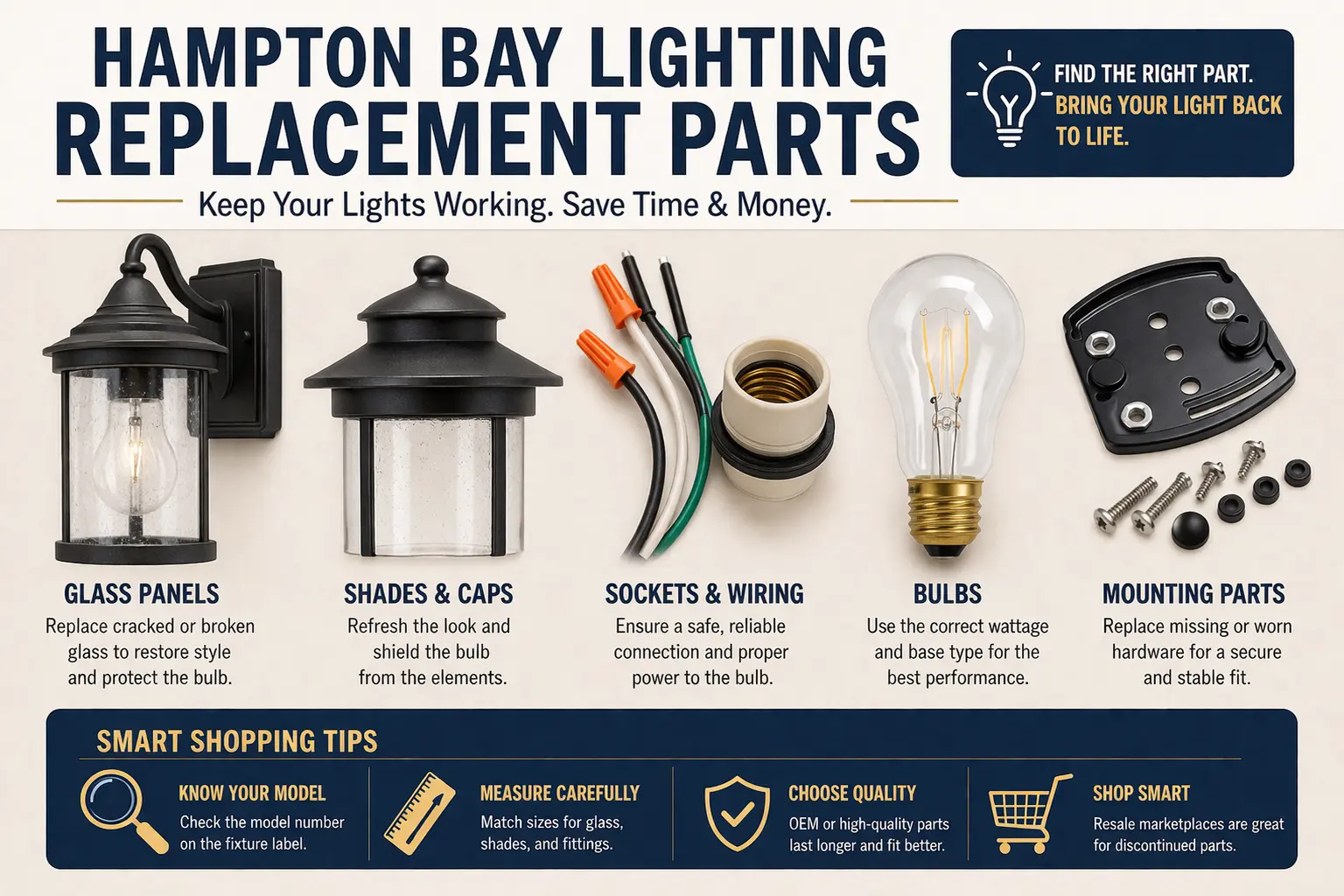
Hampton Bay covers enough product types that there is no single part that fails first across everything. The usual trouble spots depend on the kind of light you are dealing with. Outdoor landscape systems tend to fail at the transformer, connector, stake, bulb, or cable. Indoor decorative fixtures tend to fail at the glass shade, socket, canopy hardware, pull chain, or mounting bracket. Ceiling fan light kits often fail at the glass bowl, fitter hardware, remote receiver, or integrated LED component.
Transformers and Low-Voltage Power Components
On Hampton Bay landscape lighting, transformers are one of the most important replacement parts because they control power for the whole outdoor run. If every light is out, the transformer or its controls are one of the first places to look.
Glass Shades and Covers
One of the most searched Hampton Bay replacement categories is glass. Broken globes, cracked bell shades, frosted covers, seeded glass panels, and ceiling fan bowls are all common issues. These are also the parts that frustrate homeowners most because one broken shade can make a perfectly good fixture feel unrepairable.
Bulbs, Sockets, and Small Light Hardware
Burned-out bulbs are still the easy win, but the real problem can also be a worn socket, damaged wire lead, corroded outdoor connector, or missing retaining hardware. These smaller parts often matter more than the fixture body itself.
Exact Resources for Hampton Bay Lighting Replacement Parts
The best Hampton Bay replacement-part searches usually involve a mix of original support resources, old manuals, marketplace sellers, shade specialists, and compatible low-voltage parts. You usually get the best result when you use the right source for the right kind of part instead of searching everything the same way.
1. Home Depot and Hampton Bay Support History
Since Hampton Bay has long been tied to Home Depot distribution, the first useful clue is often the original product family, item number, or manual. If you still have packaging, installation instructions, or an old order confirmation, that can help narrow the fixture much faster than a generic search.
2. Old Manuals and Fixture Labels
Manuals remain one of the best resources because they tell you how the fixture was originally assembled and often show enough detail to match the part category correctly. This is especially useful for low-voltage transformers, pendant fixtures, ceiling fan light kits, and outdoor wall lanterns.
3. Replacement Shade Sellers and Measurement-Based Matching
For Hampton Bay glass shades, the exact product name matters less than measurements in many cases. If the original glass is broken, you often need to match the fitter size, bowl diameter, neck opening, glass style, and mounting method more than the brand label itself. That is why measurement-based glass replacement sellers are often one of the most practical resources for Hampton Bay repairs.
4. Marketplace Listings for Discontinued Parts
Used and new-old-stock marketplace listings are especially helpful for discontinued Hampton Bay parts such as transformer models, ceiling fan light bowls, canopy hardware, glass covers, and older path light components. This is often where the exact original shows up when normal retail channels no longer carry it.
5. Compatible Low-Voltage and Electrical Parts
For many outdoor repairs, compatible low-voltage parts are a better option than strict brand matching. Cable, connectors, bulbs, stakes, some transformers, and even certain fixture hardware can often be replaced successfully with equivalent parts as long as voltage, wattage, fit, and outdoor rating are confirmed.
| Resource Type | Best For | What to Verify First |
|---|---|---|
| Old manuals and installation sheets | Fixture identification, transformer ratings, assembly reference | Model number, wiring style, dimensions, hardware type |
| Home Depot or product history details | Original product family and item matching | Item number, fixture family, finish, style name |
| Replacement shade specialists | Glass bowls, bell shades, globes, covers | Fitter opening, diameter, glass shape, mounting method |
| Marketplace and NOS sellers | Discontinued parts, fan light bowls, old transformers, exact hardware | Condition, measurements, photos, seller notes |
| Compatible low-voltage parts | Cable, connectors, stakes, bulbs, some transformers | 12V compatibility, wattage, weather rating, fit |
Hampton Bay Transformer and Low-Voltage Replacement Help
If you are working on Hampton Bay landscape lighting, the transformer is often the most important replacement part in the system. It controls power delivery for the full outdoor run, so when it fails, every connected light can look dead at once.
A failed transformer usually shows up as no system power, repeated shutoffs, odd timer behavior, or a unit that hums, clicks, or stops holding settings. Before replacing it, make sure the outlet has power, the GFCI is reset, and the issue is not just a tripped breaker or control setting.
When an Exact Hampton Bay Transformer Matters
An exact replacement makes the most sense when you want the same mounting arrangement, the same timer style, or the same control layout. This can be especially helpful if the current system is stable and you just want to swap the failed power unit for something familiar.
When a Compatible Transformer Is Smarter
If the original Hampton Bay transformer is discontinued or overpriced, a compatible low-voltage transformer can be the better move. In many outdoor systems, the main thing that matters is correct voltage, enough wattage capacity, and a suitable outdoor-rated design.
If you are comparing low-voltage outdoor brands, you may also want to read Malibu lighting replacement parts, Paradise lighting replacement parts, and Volt landscape lighting review.
Glass Shades, Covers, and Decorative Hampton Bay Fixture Parts
Hampton Bay glass shades and covers are one of the biggest replacement-part categories because one broken piece of glass can make a perfectly good fixture unusable. This shows up a lot with pendants, vanity lights, chandeliers, porch fixtures, ceiling fan light kits, and decorative bowl lights.
Why Glass Matching Is Different
With glass, the most important information is usually physical measurement, not brand name alone. You want the fitter opening, overall width, overall height, neck shape, glass style, and how the glass attaches. A Hampton Bay label helps, but it is often the measurements that actually get you the right replacement.
Common Hampton Bay Glass Replacement Searches
Homeowners often search for bell shades, frosted shades, alabaster glass bowls, seeded glass panels, globes, and fan light covers. If your exact piece is gone, a close measurement match is often enough to restore the fixture cleanly.
When a Full Fixture Replacement Makes More Sense
If the shade is rare, the metal finish is damaged, and the fixture is already dated, replacing the full fixture may make more sense than chasing one decorative part. But if the fixture still fits your space well, a properly matched glass replacement is often the easiest and least expensive fix.
Bulbs, Stakes, Connectors, and Small Hampton Bay Hardware
Small parts are where many Hampton Bay repairs become easy wins. A burned-out bulb, failed socket, broken path light stake, missing canopy screw, corroded outdoor connector, or damaged wire lead can often be fixed quickly without replacing the whole fixture.
Replacement Bulbs and Lamp Types
Bulb matching is one of the simplest but most important parts of the process. You want the right base, voltage, shape, and output. Outdoor low-voltage fixtures especially need correct voltage matching, while indoor decorative fixtures may need the right bulb shape to fit under the shade correctly.
Stakes and Outdoor Fixture Supports
On Hampton Bay landscape lights, broken stakes are common. If the fixture leans, tilts, or will not stay secure in the ground, the stake may be the real problem instead of the light head itself.
Connectors and Low-Voltage Cable Pieces
Outdoor lighting systems often fail at the connector before the fixture. If one branch of the run is dark but the rest of the yard still lights up, inspect the connection point and wire run closely.
If you are comparing other budget and mid-range brands for small parts and compatibility, it may also help to review Utilitech lighting replacement parts, allen + roth lighting replacement parts, and Progress Lighting replacement parts.
What to Verify Before Ordering Hampton Bay Lighting Replacement Parts
This is the step that saves you the most money. Before you buy anything, stop and confirm exactly what failed and what must match.
- decide whether you are fixing a landscape light, indoor fixture, wall light, or ceiling fan light kit
- look for a model number, item number, or original manual
- measure shades, bowls, stakes, and covers carefully
- confirm bulb base, voltage, and overall size
- for low-voltage parts, verify 12V compatibility and total transformer load
- compare finish, mounting style, and attachment method if appearance matters
- use seller photos and dimensions closely for discontinued parts
If you are mainly deciding between repairing what you have or changing systems entirely, our Ring smart lighting alternatives page is useful for visitors thinking about smarter controls, while Lithonia lighting troubleshooting can help if your issue is more commercial or utility-style than decorative.
Before ordering a replacement receiver or remote, confirm the problem is actually related to the UC7067RC control system. Our step-by-step troubleshooting guide walks through receiver testing, pairing procedures, and the most common failure patterns.
Final Thoughts on Hampton Bay Lighting Replacement Parts
Hampton Bay lighting replacement parts are usually easier to find when you stop treating every repair the same. Glass shade problems need measurements. Landscape lighting problems need voltage and wiring checks. Decorative fixture repairs need the right fitter, socket, or mounting hardware. Ceiling fan light repairs often come down to bowls, remotes, or integrated kit components.
If the fixture still suits your space and the failed part is practical to replace, a repair often makes sense. If the missing part is rare, expensive, or harder to match than the full fixture is worth, replacement may be the smarter move. Either way, you will make better decisions when you identify the exact part category first and then use the right resource for that type of repair.
If you are ready to move out of basic store-brand fixtures and into something more durable, review the best VOLT landscape lighting fixtures page for a stronger upgrade path.
Landscape Lighting Brands Related to Hampton Bay Systems
Hampton Bay systems are commonly used as replacements for older Portfolio installations because both brands focus heavily on homeowner-friendly low-voltage landscape lighting. The Hampton Bay landscape lighting transformer replacement resource explains common replacement paths, wiring differences, and transformer sizing considerations.
Homeowners looking for more advanced lighting control systems frequently compare retail brands against commercial-grade options. The FX Luminaire and Portfolio landscape lighting comparison explains how professional systems differ in durability, zoning, dimming, and smart-control architecture.
Many transformer problems overlap across older landscape lighting brands, especially overheating and intermittent low-voltage output issues. The Paradise Lighting transformer troubleshooting article explains how to identify many of these common outdoor power failures.
If your focus is repairing fixtures rather than replacing the entire system, the Moonrays landscape lighting replacement parts guide explains how homeowners source compatible stakes, bulbs, lenses, and low-voltage accessories.
For broader brand-level comparison data, the landscape lighting brand comparison database evaluates major low-voltage systems across transformer reliability, fixture durability, and long-term support.
Hampton Bay Lighting Replacement Parts FAQ
Where can you find Hampton Bay lighting replacement parts?
Useful sources include old manuals, Home Depot product history, replacement shade specialists, marketplace listings, and compatible low-voltage parts depending on the fixture.
What Hampton Bay parts fail most often?
Common failures include transformers, glass shades, bulbs, stakes, connectors, sockets, and low-voltage cable components.
Can older Hampton Bay landscape lights still be repaired?
Yes. Many older systems can still be repaired with a replacement transformer, bulb, connector, stake, or other small part instead of replacing everything.
Do you need exact Hampton Bay parts?
Not always. Compatible parts often work for cable, connectors, bulbs, stakes, and some transformers, but measurements and electrical specs still need to be confirmed.
Hampton Bay lighting replacement parts, Hampton Bay transformer replacement, Hampton Bay glass shade replacement, Hampton Bay path light parts, and fixture repair help.