
Quick Answer: My 7-Point Hardware Sourcing & Fault Mapping Protocol
Tracking down the right landscape lighting replacement part isn't a guessing game—it requires systematically isolating the exact point of electrical failure across your yard loop. When a section of your lawn goes dark, the temptation is to blame the nearest bulb or throw away the whole fixture housing, but low-voltage systems are built in modular blocks. Isolating the break saves you hours of digging and keeps your hard-earned cash in your pocket.
Whenever I walk onto a property with a half-dead lighting setup or help someone source a matching replacement component, I pinpoint the issue using these seven practical field steps:
- 1. The Total System Blackout Rule: If every single light in the yard goes dark at once, I instantly bypass the lawn lines and head straight to the transformer box to check the main breaker toggle, internal fuses, or GFCI house wall outlet.
- 2. Isolating Single-Section Dropouts: When one branch of lights dies while the rest stay bright, I know I'm hunting a broken main run cable or a severed branch wire connector rather than a dead box or bulb.
- 3. Pinpointing Isolated Socket Failures: If only one solitary housing goes dark, I test a fresh bulb first; if that fails, I clean out the internal ceramic bi-pin socket base to remove green copper oxide corrosion.
- 4. Bypassing Factory Pierce Clips: Those cheap plastic clip-on connectors that come in retail kits are notorious for rotting out; I routinely clip them off and replace them with grease-filled, waterproof wire nuts to restore dead lines instantly.
- 5. Auditing Voltage Drops and Resistance: If your furthest lights look yellow or weak, the wire gauge is too thin for the distance; upgrading the copper cable run fixes this without needing a new power source.
- 6. Matching Universal Heavy-Duty Stakes: Snapped a plastic spike with the lawnmower? Don't look for discontinued brand names—I always swap them out using standard, heavy-duty 1/2-inch NPT threaded ABS replacement ground stakes.
- 7. Sourcing Discontinued Glass and Caps: For broken vintage glass or missing caps on legacy systems, I skip the retail stores completely and use physical collar measurement charts to find matching cross-brand fits.
⚠️ CRITICAL COMPONENT RISK: Blindly installing a higher-wattage bulb or oversized replacement fixture into a damaged, low-voltage line can cause severe voltage irregularities that will quickly burn out the rest of your solid-state LED chips. Ignoring these electrical boundaries triggers three primary system failures detailed inside my field guides below.
Don't start digging up your lawn or throwing away good hardware by guessing. Use my step-by-step diagnostic layout templates, universal parts cross-reference tables, and component-matching blueprints detailed further down this page to find your exact repair solution in minutes.
Best Replacement Parts (Quick Picks)
- Transformer issues: Replace transformer
- Section not working: Replace connectors or cable
- Single light out: Replace bulb or fixture head
Most Common Landscape Lighting Replacement Parts
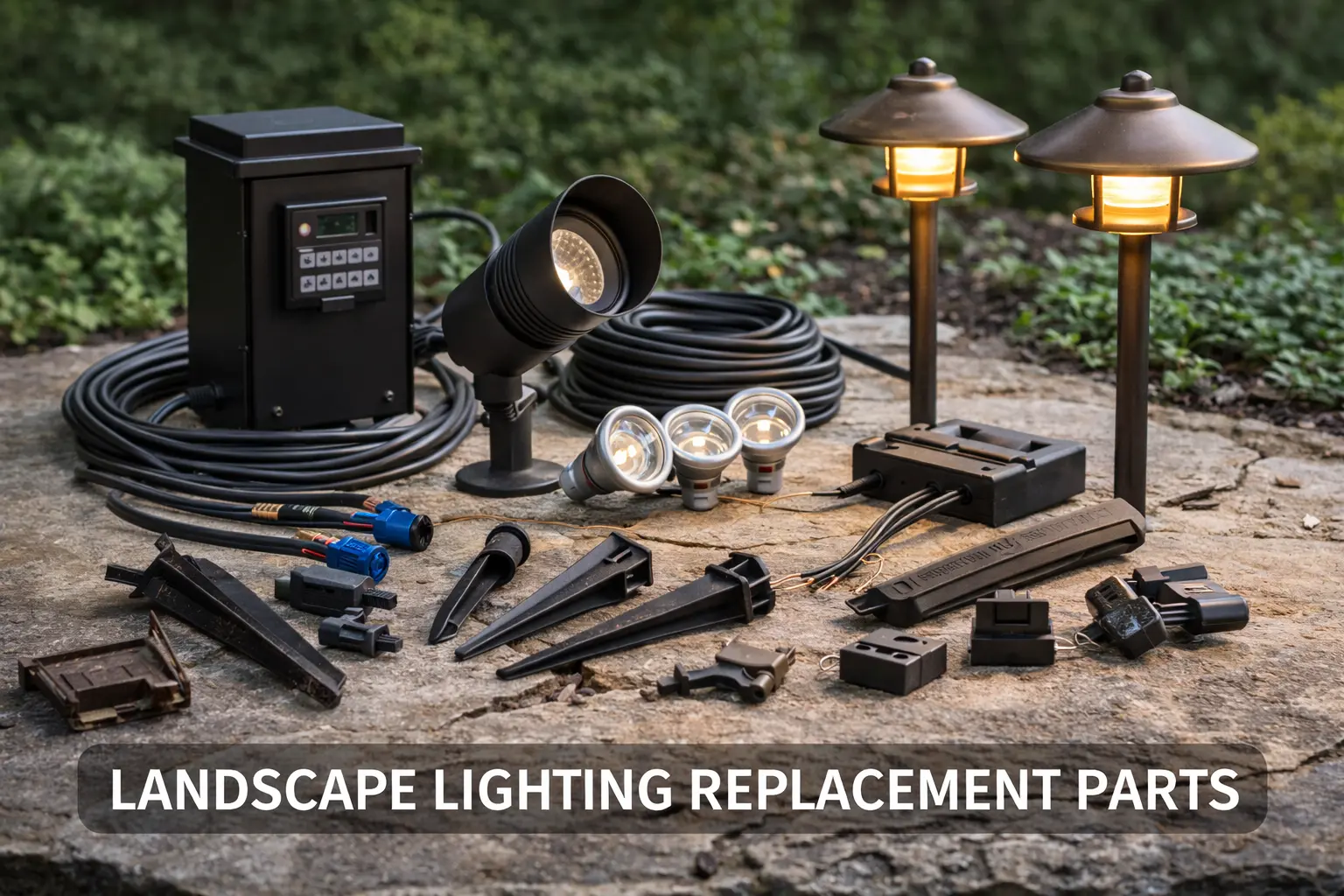
Outdoor lighting systems are exposed to weather, moisture, shifting soil, lawn equipment, and normal wear over time. Because of that, some parts tend to fail more often than others. The most common landscape lighting replacement parts usually include transformers, connectors, path light stakes, bulbs, wire runs, photocells, and fixture hardware.
When part of the system stops working, it helps to narrow the problem down before ordering anything. If every light is out, the issue may point to the transformer or power source. If only one section is out, the problem is often a connector, damaged cable, or failed fixture. If one single light is dark, the bulb, socket, or fixture body may be the real issue.
For buyers trying to replace only the failed component, it often helps to compare Portfolio landscape lighting parts rather than broad lighting searches.
| Replacement Part | What It Does | When It Usually Needs Replacement |
|---|---|---|
| Transformer | Supplies low voltage power to the lighting system | When all lights are out, buzzing, clicking, or shutting off |
| Connectors | Attach fixtures to the main low voltage cable | When some lights fail or connections become loose or corroded |
| Low voltage cable | Carries power from the transformer to the fixtures | When wire is cut, exposed, damaged, or no longer carrying power properly |
| Path light stakes | Hold outdoor path lights securely in the ground | When lights lean, shift, crack, or break near the base |
| Bulbs or LED components | Provide visible illumination at the fixture | When one light is dim, dark, or inconsistent |
| Fixture housings or heads | Protect the light source and direct the beam | When the fixture is cracked, rusted, wet inside, or badly worn |
If part of your outdoor lighting system stops working, the fix is often much smaller than it first appears. A bad connector, damaged cable, failed transformer, broken path light stake, or worn bulb can interrupt the whole look of a yard without meaning the entire system needs replacement.
If you're trying to repair an existing system, the most common items people replace are transformers, bulbs, fixture heads, stakes, wire connectors, and mounting hardware. Many homeowners start by comparing currently available landscape lighting replacement parts to find pieces that match their existing setup and voltage requirements.
This guide works as a practical replacement-parts page for Portfolio landscape lighting and also connects you to more targeted troubleshooting help like landscape lights not working, transformer troubleshooting, Portfolio path lights, and low voltage lighting.
If your system is not working at all, start with landscape lights not working to diagnose the issue before ordering parts.
Transformer Replacement Basics
The transformer is one of the most important parts in a low voltage landscape lighting system because it converts standard household electricity into the lower voltage used by path lights, spotlights, and garden fixtures. If the transformer fails, the entire system can stop working.
Signs that a transformer may need replacement include all lights going dark, buzzing sounds, clicking sounds, repeated shutoffs, a timer that no longer works correctly, or visible damage around the housing. Before replacing a transformer, it is smart to confirm the outlet has power and the issue is not just a GFCI, breaker, or timer setting problem. If replacement is needed, comparing Portfolio lighting transformers can be a practical next step.
When a Transformer Replacement Makes Sense
Replacing the transformer usually makes sense when the unit is no longer supplying power correctly, cannot handle the current fixture load, or has become unreliable after years of use. It also makes sense when you plan to expand the system and need more capacity than the current transformer can provide.
For more specific transformer help, also see Portfolio lighting transformer troubleshooting, Portfolio transformer not working, and Portfolio outdoor transformer lighting.
If your landscape fixture is an older Portfolio model, use the Portfolio technical archive to compare model numbers, stakes, bulbs, and connector compatibility.
Before Buying Universal Replacement Parts
Universal replacement parts can work, but only when the failure point and physical fit are understood first. A universal stake will not fix a cracked lamp housing, a new bulb will not fix a corroded socket, and a battery swap will not fix a failed solar panel. For practical examples, review the Portfolio Lighting Model 7133C replacement parts guide, the Portfolio DualBrite PF-4300-BK motion light manual, and the Portfolio Lighting Model SLL12BK solar light parts guide.
Path Light and Fixture Replacement Parts
Path lights are one of the most common parts of a landscape lighting system to need repair because they sit low to the ground and are exposed to foot traffic, lawn tools, weather, and shifting soil. In many cases, the light does not need to be fully replaced. A new stake, connector, bulb, or upper housing may be enough.
Other outdoor fixtures such as spotlights, deck lights, and garden lights can also often be repaired with a replacement part instead of a full new fixture. This is especially useful when the rest of the system still matches and only one piece has failed. If you are working on a walkway or garden path, it may help to browse Portfolio path lights or path light replacement parts before replacing the full section.
Searching for compatible glass, stakes, or transformers is much easier when you have the original part numbers. Our digital Portfolio Lighting Master Model & Replacement Handbook serves as a definitive resource for cross-referencing discontinued parts with modern alternatives to keep your system running.
Path Light Replacement Parts
Path lights may need new stakes, connectors, bulbs, or fixture tops after years of outdoor use.
See path lightsSpotlight and Accent Parts
Spotlights and accent fixtures may need replacement housings, bulbs, sockets, or wire connections.
See spotlightsDeck and Outdoor Fixture Parts
Deck lights, step lights, and patio fixtures may need updated connectors, bulbs, or weather-exposed hardware.
See landscape hubLow Voltage Cable and Connector Replacements
Cable and connector issues are among the most common reasons part of a landscape lighting system stops working. If one area of the yard goes dark while other lights still work, a bad connector or damaged cable is often the real cause.
Replacing connectors and small wiring components can restore power to a section of the system without replacing the transformer or every light on the line. This is one of the most practical repairs in an older Portfolio outdoor lighting layout. Homeowners comparing landscape lighting connectors or low voltage cable are often able to solve the issue without a much larger repair.
What to Check Before Ordering Landscape Lighting Replacement Parts
Before ordering a replacement part, it helps to confirm exactly which piece is causing the problem. Buying the wrong transformer, connector, or fixture part can waste time and money, especially when several outdoor components look similar at first glance.
- check whether the issue affects one light or the whole system
- confirm the fixture type such as path light, spotlight, or deck light
- look for model labels, part numbers, or transformer ratings
- inspect the connector, cable, bulb, and fixture body for visible damage
- verify whether the replacement part needs to match finish, size, or voltage
- compare whether repair makes more sense than replacing the full fixture
Planning tip: If the original Portfolio part is discontinued, start by matching function first, then size, finish, and system compatibility. For many outdoor repairs, a compatible replacement part works just as well as an exact original.
Repair or Replace the Whole Landscape Light?
Sometimes the best answer is a small repair. Other times, it makes more sense to replace the full light. If the fixture body is still in good condition and the problem is limited to a connector, bulb, stake, or transformer issue, replacing one part is usually the better value.
If the fixture is heavily corroded, cracked, full of moisture, or badly worn after years outside, replacing the full light may be the more practical option. The right choice depends on how much of the original system is still worth keeping. For buyers who decide replacement makes more sense, comparing Portfolio landscape lighting listings can help narrow down compatible options.
Common Landscape Lighting Repair Mistakes
- Replacing the entire system instead of one part
- Buying the wrong transformer size
- Ignoring connector and cable issues
- Not checking voltage compatibility
Landscape Lighting Replacement Parts FAQ
What are the most common landscape lighting replacement parts?
The most common replacement parts are transformers, connectors, cable, bulbs, path light stakes, and outdoor fixture hardware.
Do I need to replace the whole light if one fixture stops working?
Not always. In many cases, a bulb, connector, stake, socket, or small fixture part is all that needs to be replaced.
How do I know if the transformer needs replacement?
If all the lights are out, the transformer buzzes or clicks, or the unit repeatedly shuts off, the transformer is one of the first parts to inspect.
Can I still find replacement parts for older Portfolio landscape lights?
In many cases, yes. Some original parts are still available, and compatible replacement parts can often keep an older outdoor system working.
Final Thoughts on Landscape Lighting Replacement Parts
Landscape lighting replacement parts can extend the life of a Portfolio outdoor lighting system without forcing a complete rebuild. In many cases, replacing one worn component is enough to restore a path light, spotlight, deck light, or low voltage system to working order.
The key is figuring out which part has actually failed before ordering a replacement. Once you know whether the issue is the transformer, cable, connector, bulb, or fixture body, the repair process becomes much easier and more affordable. If you are ready to compare options, browsing replacement parts for landscape lighting can be a practical next step.
Portfolio Lighting Master Model & Replacement Handbook
Stop wasting time hunting for discontinued Portfolio parts. This premium PDF helps you identify legacy Portfolio Lighting models, understand common failures, and find compatible replacement options from brands like Malibu, VOLT, Hampton Bay, and Kichler.
Inside the PDF:
- 100+ model breakdown pages
- Transformer, path light, spotlight, and wall lantern specs
- Common failure patterns for discontinued models
- Compatible replacement brands and parts strategy
- What to check before buying the wrong part
If one wrong part costs you $20–$80, this $9.99 handbook can pay for itself before you make your first replacement purchase.
Disclosure: This page may contain affiliate links. If you buy through one of these links, the site may earn a commission at no extra cost to you.