
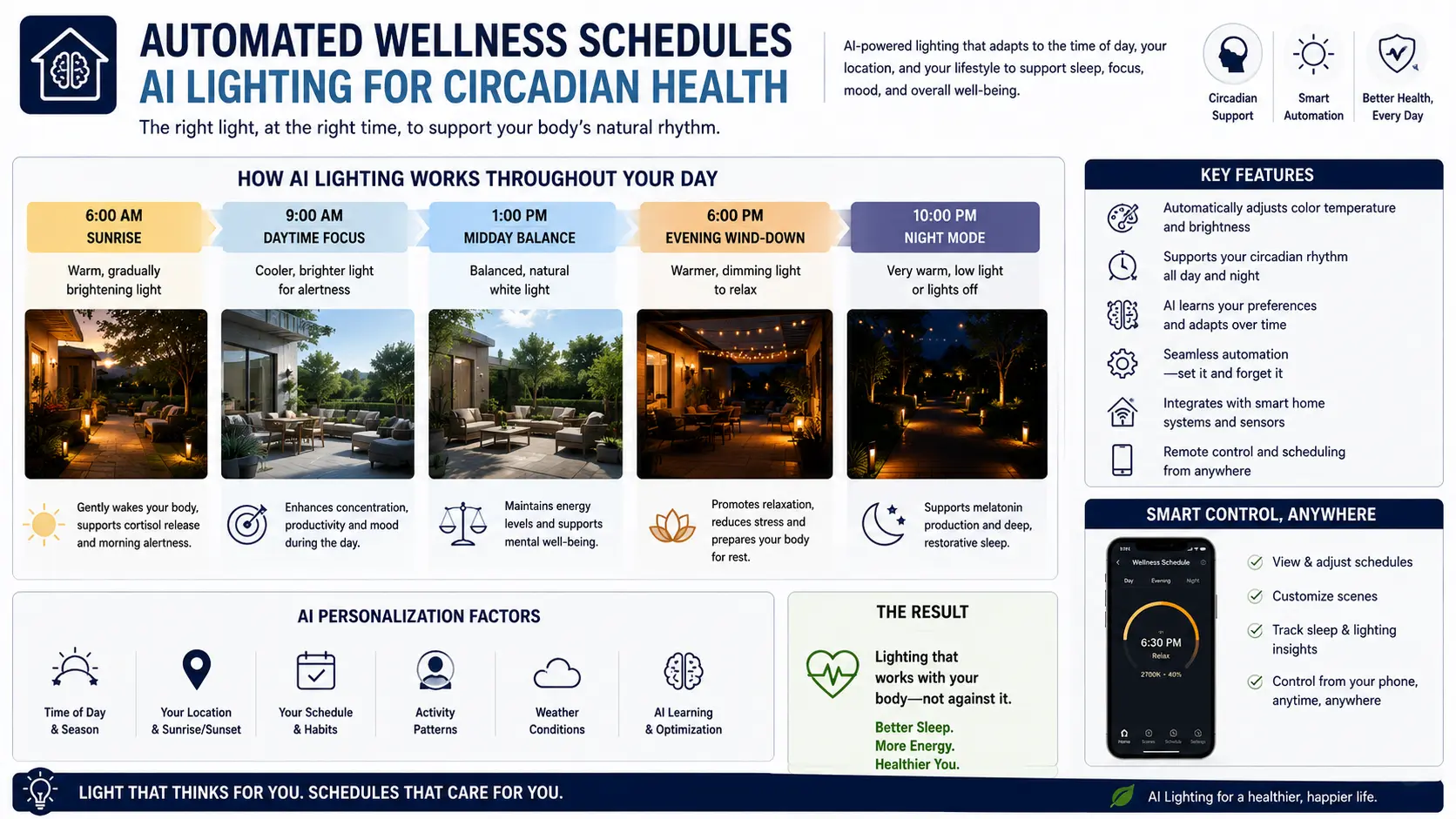
Why Outdoor Lighting Affects Indoor Circadian Health
Before building any wellness schedule, you need to understand the physical pathway by which outdoor landscape lights — even low-voltage 12V fixtures — influence circadian biology inside the home. Most homeowners assume landscape lighting is too dim or too exterior to matter. The research says otherwise.
The Two Pathways: Window Penetration and Sky Glow
Outdoor landscape light reaches indoor occupants through two mechanisms. Direct window penetration is the first and most significant: an uplight fixture aimed at a tree adjacent to a bedroom window, or a path light positioned below that window, can deliver measurable lux at eye level inside the room even with a standard curtain drawn. The second is sky glow — the aggregate brightening of the night sky from all outdoor sources in a neighborhood, which maintains a diffuse light level even in rooms with no direct line of sight to outdoor fixtures.
Harvard research established that as little as 8 lux of light at the eye — roughly twice the brightness of a standard nightlight — measurably suppresses melatonin production. A typical 4W pathway fixture produces 40–60 lux at 3 feet and can produce 8–20 lux through a thin curtain at a bedroom window 10–15 feet away. The math makes outdoor landscape lighting biologically relevant in a way that many homeowners underestimate.
The eye's circadian photoreceptors — intrinsically photosensitive retinal ganglion cells (ipRGCs) — contain the photopigment melanopsin, which peaks in sensitivity near 480nm in the blue-cyan range. At 600nm (orange-red) and above, melanopsin's sensitivity drops to roughly 5–10% of its peak. This spectral specificity is why color temperature matters more than lumens for circadian health. A 5000K LED at 10 lux stimulates the circadian system significantly more than a 2700K LED at the same 10 lux — not because the 5000K is brighter, but because far more of its photon output is at wavelengths where melanopsin actually responds. The melatonin suppression value (MSV) of cool-white 5000K LEDs is approximately 12.3% versus 3.6% for warm-white 2700K LEDs — a 3.4-fold difference at equal photopic illuminance (from the 52-lamp Scientific Reports 2025 study).
What "Biologically Inert" Outdoor Lighting Actually Looks Like
The good news: the threshold for biologically protective outdoor lighting is not exotic or expensive. Three conditions make landscape lighting approximately biologically inert for the household:
- 2700K or warmer color temperature — dramatically reduces the 480nm content that drives melanopsin activation. This is the AMA's ≤3000K recommendation applied to the optimal end of the compliant range.
- No direct window illumination — fully shielded downward-directed fixtures that don't send light horizontally into bedroom window planes. Uprights aimed at trees away from window positions are acceptable if the reflected light doesn't reach windows at meaningful lux levels.
- Lights off before 10–11 PM — extinguishing during the body's peak melatonin onset window (typically beginning around 9–10 PM for average sleep timing) eliminates the duration of exposure during the most sensitive circadian window.
These three conditions are achievable with existing consumer landscape lighting equipment — no smart system required — through color temperature choice, fixture positioning, and a properly set timer. The wellness scheduling principles in this guide build on these foundations, with smart and automated systems providing the precision and seasonal adaptability that manual settings cannot.
Melanopic EDI: The Scientific Metric Behind Wellness Scheduling
Understanding melanopic EDI transforms outdoor lighting decisions from aesthetic choices into measurable biological ones. You don't need to measure it directly to benefit from its principles — but understanding what it measures and what standards require clarifies exactly why certain schedule and hardware choices matter more than others.
What Melanopic EDI Measures
Melanopic Equivalent Daylight Illuminance (m-EDI), defined in the international standard CIE S 026:2018 published by the International Commission on Illumination, quantifies how much circadian stimulation a light source delivers by weighting its spectral power distribution with the melanopsin sensitivity function (which peaks near 490nm). The result is expressed in lux units, but referenced against a specific daylight standard (D65, approximately 6500K natural daylight) — so you can compare any light source's biological effectiveness directly against natural daylight.
A melanopic DER (Daylight Efficacy Ratio) of 1.0 means the source has the same circadian effectiveness per lux as natural daylight. Values below 1.0 mean it is less effective per lux. For warm-white 2700K LEDs, the melanopic DER is roughly 0.45–0.55 — about half the circadian effectiveness of daylight per visual lux. For cool-white 5000K LEDs, the melanopic DER is closer to 0.85–0.95 — nearly as effective per lux as full daylight. This is why switching from 5000K to 2700K LEDs at the same lumen output cuts circadian stimulation roughly in half.
Standards That Reference Melanopic EDI
| Standard / Organization | Melanopic Requirement | Context | Relevance to Outdoor Lighting |
|---|---|---|---|
| CIE S 026:2018 | Defines the m-EDI metric and measurement framework | International measurement standard | The foundational reference for all wellness lighting claims |
| WELL Building Standard v2 (Feature L03) | ≥250 m-EDI (at eye level, daytime, 4+ hrs); dimmable to low levels after 8 PM | Commercial / healthcare / residential WELL certification | Most rigorous public wellness lighting standard; "after 8 PM" rule directly applicable to outdoor schedules |
| IES RP-46 | References melanopic EDI for healthy lighting design | Illuminating Engineering Society guidelines | Professional lighting design standard now incorporating circadian metrics |
| AMA Policy H-135.927 (2016) | ≤3000K for outdoor lighting; proper shielding; consider dimming for off-peak periods | Medical association recommendation | Most actionable outdoor-specific guidance; directly applicable to landscape lighting CCT choice |
| UL Design Guideline 24480 | Promotes circadian entrainment via appropriate light exposure and spectral content | Product certification guidance | Circadian-certified products meet defined melanopic exposure thresholds |
The Practical Translation for Homeowners
You do not need a spectrometer or a CIE S 026 calculator to apply melanopic EDI principles to outdoor landscape lighting. The proxy is reliable:
- Use 2700K fixtures and bulbs — this puts the melanopic DER at ~0.5, cutting circadian stimulation by roughly half compared to standard outdoor LEDs
- Reduce brightness after 9 PM (if dimming is available) — melanopic stimulation scales linearly with intensity at constant CCT
- Turn lights off by 10–10:30 PM — duration is as important as intensity for cumulative melatonin suppression
- Shield light from bedroom windows — indirect or reflected light doesn't reach the ipRGCs and has no circadian effect
These four steps, implemented through an astronomical timer or smart schedule, constitute a practical melanopic-protective outdoor lighting strategy accessible to any homeowner with existing or new landscape lighting equipment.
The 5-Phase Wellness Schedule Framework for Outdoor Landscape Lighting
A wellness-optimized outdoor lighting schedule is not simply "on at sunset, off at 10 PM." It is a progression through distinct phases, each serving a different biological and functional purpose, with different lighting requirements at each phase. This framework maps what a health-protective outdoor schedule looks like across a full evening.
to
+1 hr
to
+2.5 hr
to
10 PM
to
10:30 PM
to
Dawn
Astronomical Timers: The Underappreciated Circadian Tool in Landscape Lighting
The astronomical timer — a scheduling controller that calculates precise local sunrise and sunset times from geographic coordinates — is both the most practically important and the most underappreciated wellness tool in residential landscape lighting. Every professional landscape lighting installer uses them. Almost no homeowner does. This section explains exactly what they do and why they matter for health.
What an Astronomical Timer Actually Does
An astronomical timer contains a perpetual algorithm that calculates the solar ephemeris — the precise angle of the sun below the horizon for any given latitude, longitude, and date — and derives the local sunset and sunrise times to within 1–2 minutes accuracy for any day of the year. Unlike a photocell (which reacts to ambient light levels and can be fooled by clouds, sensor dirt, or reflected light from street lamps), an astronomical timer knows the theoretically correct sunset regardless of actual sky conditions. And unlike a digital clock timer with fixed ON/OFF times, it adjusts automatically every day for the seasonal shift in daylight hours.
For landscape lighting wellness scheduling, the key capability is the offset function: most astronomical timers allow you to set ON at "sunset" and OFF at "sunset + X hours" (where X is 3.5–4 hours for a typical evening use window). This creates a schedule that always turns lights off at the same relationship to actual dusk — which is what the wellness schedule framework requires. The relationship between dusk timing and melatonin onset is biological, not clock-based.
How to Program an Astronomical Timer for Wellness Operation
- Enter your ZIP code or latitude/longitude during initial setup. This gives the timer all the geographic data needed for year-round sunset calculations.
- Set ON to "sunset" or "sunset -5 minutes" — lights activate right at dusk or just before, matching the visual trigger most homeowners expect.
- Set OFF to "sunset + 3.5 hours" for a typical household (sleeping around 11 PM). This extinguishes lights by approximately 10 PM in winter (sunset ~6:30 PM) and 10:30 PM in summer (sunset ~8:15 PM) — consistently before peak melatonin onset.
- Set any second OFF event to eliminate dawn-side operation if your timer has a second ON event for security lighting, ensure it is either motion-activated only or does not run near bedroom windows.
- Verify DST handling — quality astronomical timers (Intermatic, Grasslin, Total Light astronomical add-on) auto-adjust for Daylight Saving Time transitions. Confirm this feature is active.
Automation becomes significantly more effective when it is paired with real circadian lighting principles. Our detailed guide to outdoor lighting and human health explains how brightness timing, color temperature transitions, glare control, and evening dimming schedules influence relaxation, sleep readiness, visual comfort, and nighttime wellness around the home.
Astronomical Timer Limitations
Astronomical timers control ON/OFF timing but do not control color temperature or brightness. If you have a single zone of landscape lighting, the astronomical timer is all you need for timing-based wellness optimization. If you have multiple zones with different wellness priorities (path lights near the front bedroom vs security lights on the back fence), you need either a multi-zone transformer with independent astronomical scheduling per zone, or a smart system that can apply different schedules to different fixture groups.
- Calculates daily sunset/sunrise automatically for any location
- Set OFF time relative to sunset ("sunset +3.5 hrs") — adjusts seasonally
- No WiFi, no app, no cloud dependency — works indefinitely
- Battery backup maintains settings through power outages
- Cannot control brightness or CCT — timing only
- Ideal for fixed-CCT 2700K landscape systems
- Independent schedules per zone or fixture group
- Astronomical dusk/dawn function built into app (Hampton Bay Hubspace)
- Real-time manual override from anywhere via smartphone
- Wattage monitoring to prevent overload
- Requires WiFi; settings may reset after firmware updates
- Three-zone independent control (Hampton Bay HB-200-1215WIFI)
- Turns on when ambient light drops below threshold — unreliable
- Cannot set independent OFF time — runs dusk-to-dawn by default
- Susceptible to dirt, artificial light sources, cloud cover
- No seasonal adjustment for changing daylight hours
- Fine for security lighting where dusk-to-dawn is acceptable
- Never use as primary schedule for wellness-optimized system
- Fixed ON/OFF clock times require manual seasonal reprogramming
- 7:00 PM ON in June triggers too early (before sunset); fine in December
- If set to match June sunset, runs only ~1 hr before OFF — too short in winter
- Power outages reset most units to factory defaults
- Acceptable if owner reprograms quarterly for seasonal adjustment
- Worst option for households that skip seasonal reprogramming
Chronotype-Aware Scheduling: Why One OFF Time Doesn't Fit All
Chronotype — the natural biological timing of your sleep-wake cycle — varies by more than 4 hours across the population. A night-owl household with a natural 12:30 AM sleep time has a completely different melatonin onset window than a morning-lark household sleeping at 9:30 PM. A wellness outdoor lighting schedule that shuts off at 10 PM protects the morning larks and slightly over-restricts the night owls. Personalizing the OFF time to household chronotype closes this gap.
The Science of Chronotype Variation
Chronotype is measured by Dim Light Melatonin Onset (DLMO) — the time at which salivary melatonin begins rising in the absence of light. In morning-type individuals, DLMO may occur as early as 8:30–9 PM. In evening-type individuals, DLMO may occur at midnight or later. Research using the Munich ChronoType Questionnaire (MCTQ) across large populations shows the DLMO range spans roughly 4 hours between extreme morning and extreme evening types. This is not a preference or a habit — it reflects genetic variants in circadian clock genes (PER3, CLOCK, CRY1/2) that shift the phase of the biological clock.
Light exposure in the 60–90 minutes before DLMO is the most sensitive window for circadian disruption. Outdoor light reaching bedroom windows during this pre-DLMO window delays melatonin onset, increases sleep onset latency, and reduces total sleep duration. Protecting this window with outdoor darkness is the primary wellness scheduling goal — and the timing of that window depends on chronotype.
The pre-DLMO window begins early — around 7:30–8 PM. Outdoor lights running after 8:30 PM reach this household's critical melatonin onset window. The health-protective schedule for a morning lark household:
- ON: Sunset (astronomical timer)
- Dim to 30–40%: 7:30 PM (or sunset +1.5 hrs)
- OFF: 8:30–9 PM (or sunset +2 hrs)
- Path lights near bedroom windows: OFF by 8 PM
- Motion-only operation acceptable for security after 8:30 PM
Note: Morning larks are the majority of adults over 50. This schedule also benefits households with young children (earlier natural sleep times).
The pre-DLMO window doesn't begin until 9:30–10:30 PM. A 10 PM outdoor lights-off time is protective for this household's melatonin onset. The health-protective schedule for a night-owl household:
- ON: Sunset (astronomical timer)
- Dim to 50%: 9:30 PM
- OFF (path lights): 10:30–11 PM
- OFF (all systems): 11 PM–11:30 PM
- Critical: even night owls should extinguish lights before DLMO
Note: Night owls are disproportionately represented among teens and young adults. A household with teenagers may need to shift the schedule later. Research shows adolescent DLMO averages 60–90 minutes later than adult DLMO.
Mixed-Chronotype Households
Most real households contain people with different chronotypes — a morning-lark parent and an evening-type teenager, for example. The outdoor lighting schedule must protect the most sensitive member. In practice, this means scheduling to protect the earliest chronotype's melatonin onset window. The night owl is not harmed by being in darkness earlier than their DLMO — they simply won't be sleepy yet, but their melatonin is not being suppressed either. Protection from unwanted light suppression is asymmetric: earlier OFF times protect morning types without harming evening types. Later OFF times protect evening types at the expense of morning types.
Hardware That Supports Wellness Schedules in Consumer Landscape Lighting
Not all landscape lighting hardware supports the scheduling precision that wellness operation requires. Here is an honest assessment of what is actually available in the consumer landscape lighting market as of 2026, what each system can and cannot do for circadian health, and what to look for when selecting or upgrading.
Smart Transformers With Astronomical Scheduling
Three independently controlled zone outputs allow different OFF times for different fixture groups (e.g., path lights near bedroom windows off at 9 PM; back fence accent lights off at 10:30 PM). Built-in astronomical virtual photocell function calculates daily sunset without sensor. Hubspace app scheduling supports clock-based and dusk-based events. Wattage monitoring prevents overload. Alexa/Google compatible. The key wellness limitation: the transformer controls on/off timing only — no CCT or brightness dimming capability without smart fixtures. Requires 2700K fixed-CCT fixtures to be pre-selected. See the Hampton Bay transformer guide for installation details.
App-based scheduling for Kichler landscape lighting systems with astronomical sunrise/sunset tracking. Integrates with the Kichler Connects ecosystem for coordinated outdoor lighting control. Compatible with Kichler's landscape fixture lineup. Similar wellness capabilities to Hubspace: excellent timing control, no native CCT shifting at the landscape fixture level. Kichler's 2700K fixture lineup — including their brass and composite path lights and spotlights — makes this a complete 2700K system when fixtures are specified accordingly.
Intermatic's standalone and transformer-mount astronomical timers are the most reliable option for homeowners who don't want WiFi-dependent systems. They calculate local sunset from ZIP code or coordinates, handle DST automatically, have battery backup, and can be set to offset ON/OFF from sunset by hours or minutes. The Total Light astronomical timer (Touchstone Accent Lighting) mounts directly inside compatible transformers and is configured with zip code only. No app, no WiFi, no cloud — works perpetually. The wellness advantage: no connectivity failure modes.
Smart Fixtures With Color Temperature Control
Hampton Bay's Hubspace-powered smart landscape spotlights (available in 3-packs at Home Depot) offer color temperature adjustment from 3000K to 6000K via the Hubspace app, plus individual and group dimming and scheduling. For wellness purposes: these fixtures allow programming a 3000K evening operation that shifts the melanopic dose meaningfully compared to 5000K or 6000K. The 3000K lower limit is at the AMA's recommended ceiling for outdoor lighting — for full compliance, warm-white 2700K fixed-CCT fixtures are still preferable where tunable white isn't needed, since they deliver lower melanopic stimulation than these smart fixtures at their warmest setting.
True 2700K (or lower) outdoor smart fixtures with full app scheduling and dimming exist in the premium landscape market (VOLT, Unique Lighting, FX Luminaire) but are not available as consumer-grade DIY products at comparable price points. For the majority of homeowners, the wellness strategy is: choose 2700K fixed-CCT fixtures + astronomical timer or smart transformer = optimal circadian protection without any tunable-white hardware premium.
Motion-Activated Wellness Supplements
Motion sensors that activate landscape lighting only when triggered — rather than running continuously through the night — are the most biologically protective operating mode for Phase 4 and 5 operation. A motion-activated 2700K fixture activating for 30–60 seconds when someone approaches the front door at 11 PM does not meaningfully disrupt household melatonin: the exposure duration is too brief and intermittent to cause DLMO shift. Motion sensors can be added to existing landscape lighting circuits through the transformer's switched output or through inline motion sensor wiring. See the smart outdoor lighting controls guide for motion sensor integration options.
What Is Not Available in Consumer Landscape Lighting
Full circadian tuning — independent control of melanopic EDI (not just CCT) with sub-1% dimming resolution, real-time melanopic dose feedback, and personalized chronotype-adjusted scheduling — is available in professional-grade architectural lighting systems (Lutron Vive, DALI-2, WELL-certified commercial systems) but not in consumer landscape lighting. The claims made by some consumer smart lighting marketing about "AI circadian lighting" should be evaluated against this reality: at the landscape lighting consumer level, "circadian" features typically mean an app-adjustable CCT range and a sunset-based schedule — not genuine chronotype-adaptive spectral optimization. That gap is significant, and the honest answer is that 2700K fixed-CCT + astronomical timer + correct OFF time delivers more health benefit per dollar than any consumer "AI circadian" system that runs cool-white fixtures throughout the night on a "smart" schedule.
The Honest Truth About "AI Lighting" Claims and Circadian Health
The circadian rhythm lighting market is growing at 20% CAGR and was valued at $376 million in 2024. Marketing claims around "AI circadian lighting" are expanding proportionally. Here is an honest assessment of what consumer AI lighting systems actually do versus what the science would require for genuine circadian optimization — and where the real leverage points are for homeowners who don't want to be oversold.
What "AI" Actually Means in Consumer Lighting Systems
In most consumer smart lighting products marketed with AI or circadian features, "AI" refers to a rules-based scheduling algorithm — often just a lookup table of sunrise/sunset times for a given location combined with a temperature-shift curve from 6500K to 2700K across the evening. This is a timer with a CCT ramp, not machine learning. True AI in lighting would require: real-time spectral sensing at the user's eye level, integration with sleep tracker data to identify individual DLMO timing, adjustment based on seasonal light history, and feedback loops that modify the schedule based on measured circadian response. No consumer landscape lighting product does this as of 2026.
The Adherence Problem: Why AI Schedules Often Underperform Manual Ones
Research from the Lighting Research Center (LRC) found that users disable automatic AI lighting modes 63% of nights within 8 weeks of installation, citing "feels too dim," "conflicts with partner's preferences," or "doesn't match my schedule." An automated system that gets overridden regularly provides no health benefit. By contrast, a simple astronomical timer — once programmed correctly — runs silently without requiring any user interaction, and the OFF time is physically enforced rather than suggesting itself. For most households, a reliable, correctly-programmed astronomical timer delivering consistent 10 PM extinction is more protective in practice than a sophisticated AI system that users fight with and disable.
Where AI Scheduling Genuinely Helps
The real value of smart scheduling (as distinct from AI) in outdoor lighting is multi-zone independent control. A smart transformer like the Hampton Bay Hubspace unit can apply different schedules to three independent zone outputs — allowing path lights near the front bedroom to turn off at 9:30 PM while back fence accent lights and driveway security lights continue until 10:30 PM. This zone independence is genuinely useful and is not achievable with a single-zone astronomical timer. It also enables remote monitoring and override — if you're expecting guests late, you can extend one zone's operation from your phone without manually adjusting the transformer.
The Spectrum Recommendation That Doesn't Change Regardless of System
Whether you use an astronomical timer, a smart app, manual scheduling, or any AI system: if the outdoor fixtures are 4000K or 5000K, the schedule improvements are partially undermined by the spectrum. The spectrum choice — 2700K or warmer — delivers more circadian health benefit per dollar than any scheduling system upgrade. A $15 pack of 2700K MR16 LEDs replacing 5000K equivalents in your existing fixtures, paired with a properly set standard astronomical timer, outperforms a sophisticated AI scheduling system running 5000K cool-white fixtures. Spectrum first, timing second, hardware last — this is the correct priority order for wellness-optimized outdoor lighting investment.
After 25 years in landscape lighting, I have watched the marketing around outdoor lighting evolve from "motion-activated = smart" in the early 2000s, to "WiFi-connected = smart" in the 2010s, to "AI circadian = smart" now. In each era, the hardware kept getting more capable and the marketing more ambitious. And in each era, the single most effective change any homeowner could make was the one that cost nothing extra: choosing the right color temperature. Three clients this year have called me about expensive smart landscape systems that "support circadian health" — all of them running 4000K fixtures on a 7 PM to 7 AM schedule. The $10 answer was 2700K replacement bulbs and a timer off at 10 PM. The $800 app system was theater.
Seasonal Adjustments: The Fatal Flaw of Fixed-Clock Outdoor Schedules
At mid-latitudes in the United States (approximately 35°N–48°N, covering most of the continental US), sunset varies from approximately 4:30 PM in December to 8:30–9:00 PM in June — a swing of roughly 4–4.5 hours. A fixed-clock outdoor lighting schedule optimized for one season is systematically miscalibrated for the other. This section quantifies the problem and explains the correct solution.
The December-June Comparison at 40°N (Denver, Philadelphia, Indianapolis)
| Month | Approximate Sunset | Fixed 10 PM OFF | Astronomical 10 PM OFF (Sunset +X hrs) | Health Impact of Fixed Schedule |
|---|---|---|---|---|
| June (summer solstice) | ~8:30 PM | Lights on 1.5 hrs — too short for evening use | ON 8:30 PM, OFF 10 PM (1.5 hr window) | Under-serving household; but health risk is low since sunset is late and Off time is still 10 PM |
| September (equinox) | ~7:00 PM | Lights on 3 hrs — reasonable window | ON 7 PM, OFF 10 PM (3 hr window) | Fixed clock works well in September — calibrate here if reprogramming quarterly |
| December (winter solstice) | ~4:30 PM | Lights on 5.5 hrs — major health risk | ON 4:30 PM, OFF 8 PM (3.5 hr window) | Fixed 10 PM schedule runs lights through entire melatonin onset window in December |
| March (spring equinox) | ~7:15 PM | Lights on 2.75 hrs — OK | ON 7:15 PM, OFF 10:45 PM (3.5 hr window) | Fixed clock approximately correct in March if calibrated for September |
The Astronomical Timer Solution: Sunset + Offset
The correct programming for a wellness-optimized astronomical timer at a mid-latitude US location (for average chronotype household):
- Zone 1 (path lights, close to bedroom windows): ON at sunset, OFF at sunset + 2 hours
- Zone 2 (spotlights, uplights, not near bedroom windows): ON at sunset, OFF at sunset + 3.5 hours
- Zone 3 (security perimeter, driveway): ON at sunset, OFF at sunset + 4.5 hours OR motion-activated after sunset + 3 hours
This programming means Zone 1 (most health-sensitive) always extinguishes about 2 hours after dusk — at approximately 6:30 PM in December and 10:30 PM in June. Zone 2 (mid-priority) extinguishes about 3.5 hours after dusk — at 8 PM in December and midnight in June (the June case may be adjusted down to 11 PM maximum for health protection). Zone 3 (security) can run later but should still have an absolute maximum off time of midnight regardless of sunset time. This zone-differentiated astronomical scheduling is exactly what the Hampton Bay Hubspace three-zone smart transformer is designed to implement via app, without requiring a traditional astronomical timer module.
The Quarterly Manual Adjustment Protocol (For Fixed-Clock Timer Owners)
If you have a standard digital clock timer and cannot replace it with an astronomical unit, the minimum wellness intervention is quarterly reprogramming aligned to solstices and equinoxes:
- March 20 (spring equinox): Sunset ~7:15 PM → Set ON to 7:00 PM, OFF to 10:30 PM
- June 21 (summer solstice): Sunset ~8:30 PM → Set ON to 8:15 PM, OFF to 10:30 PM
- September 22 (fall equinox): Sunset ~7:00 PM → Set ON to 6:45 PM, OFF to 10:15 PM
- December 21 (winter solstice): Sunset ~4:30 PM → Set ON to 4:15 PM, OFF to 8:00 PM
This protocol requires four programming sessions per year and covers the worst seasonal misalignment. It is imperfect but substantially better than a single annual setting. See the timer setup guide for transformer-specific programming instructions.
Wellness Schedules for Outdoor Lighting FAQ
My landscape lights run dusk-to-dawn — how bad is this for health and what should I change first?
Dusk-to-dawn operation is the single most biologically disruptive outdoor lighting schedule — worse than any color temperature issue — because it actively illuminates the environment during the 3 AM peak melatonin window. The fix is immediate and free: change the timer's OFF time to 10–10:30 PM (or "sunset +3.5 hours" if you have an astronomical timer). If your transformer has only a photocell with no timer off, either add an astronomical timer, upgrade to a smart transformer, or at minimum insert a simple clock timer between the outlet and the transformer plug to force an OFF time. The color temperature of 2700K is the second priority; the OFF time is first. A 2700K system running dusk-to-dawn is worse than a 4000K system with a 10 PM off time. Fix the schedule before spending any money on hardware upgrades.
Can I use motion sensors to replace continuous overnight landscape lighting for health purposes?
Yes — motion-activated landscape lighting is the most biologically protective continuous-night operation mode available. Brief activations (30–60 seconds) from motion sensors at 2700K do not meaningfully disrupt household melatonin because the exposure duration is insufficient to cause DLMO shift. Research shows that melatonin suppression from brief light exposures is proportional to both intensity and duration — a 45-second 2700K activation at 11 PM is not biologically equivalent to 2 hours of continuous 2700K operation. Motion sensors can be integrated into landscape lighting circuits through the transformer's switched output or through inline motion-sensing wiring. The challenge is ensuring motion sensors cover necessary security perimeter without false activations from wind, animals, or neighbors, which would create recurring brief light exposures that, at high enough frequency, could accumulate circadian effect.
The Hubspace app has a "circadian" mode — does it actually change color temperature on landscape fixtures?
It depends on the fixture. The Hampton Bay Hubspace smart landscape spotlights (the 450-lumen 3-pack with adjustable CCT heads, separate from the standard fixed-CCT landscape fixtures) support color temperature adjustment from 3000K to 6000K through the app. The standard Hampton Bay landscape fixtures connected through the Hubspace smart transformer do not have CCT control — the transformer can only control on/off timing and wattage monitoring per zone. If you want automated color temperature shifting (e.g., shifting from 5000K to 3000K after 8 PM), you need the Hubspace smart fixtures specifically, not just the smart transformer. Note that 3000K — the warmest the smart fixtures support — is at the AMA's recommended ceiling rather than the optimal 2700K for health. For maximum circadian protection, fixed-CCT 2700K landscape LEDs (MR16, G4, or integrated) remain the better choice.
Do outdoor lights affect neighbors' health as well as my own household?
Yes, and this is an underappreciated dimension of landscape lighting decisions. Outdoor light doesn't stop at your property line. Light trespass — outdoor lighting reaching adjacent properties and their bedroom windows — is the mechanism by which individual homeowners' lighting choices affect neighborhood-level circadian health. The Nurses' Health Study II (109,672 participants, 24 years of follow-up) found that residential outdoor light-at-night exposure from the entire neighborhood environment was associated with increased breast cancer risk — not just the individual household's own lighting choices. NIH research found teens in higher-ALAN neighborhoods had 29-minute later bedtimes and associations with mood disorders. These were cumulative neighborhood-level effects. Choosing 2700K, shielding fixtures downward, and operating with a 10 PM OFF time reduces your contribution to the neighborhood's cumulative light-at-night burden — a genuine public health consideration, not just a personal one.
I have teenagers at home with late chronotypes — should I extend the outdoor lighting schedule later for them?
The answer depends on whether the late operation primarily serves them (they're outside or in active evening use areas) or merely illuminates their bedroom windows from outside. If they use the backyard or patio area at 11 PM, operating path lights in those specific areas until 11:30 PM with 2700K fixtures is reasonable — they are already in a wakeful, biologically awake state, and the light duration is relatively short. If the question is simply "should I leave the front yard lights on later because teenagers sleep late," the answer is no: the lights would be illuminating bedroom windows during a period when other household members are in deep sleep stages, imposing melatonin disruption on those members. Zone-independent scheduling — allowing only the actively-used evening zones to run later while extinguishing zones near early-chronotype bedrooms — is the correct multi-chronotype household solution, achievable with the Hubspace three-zone transformer.
Related Guides in This Cluster and Across the Site
- AI Outdoor Lighting Systems (Pillar)
- Outdoor Lighting & Human Health
- Color Temperature Guide
- Biological Impact of Light Color
- Dark Sky Compliance Guide
- Dark Sky Fixture Selection
- Fix Light Trespass Guide
- Light Pollution Guide
- Wildlife-Friendly Lighting
- Smart Outdoor Lighting Controls
- Carbon Footprint Guide
- Timer Setup & Programming Guide
- Timer Not Working Guide
- Photocell Not Working Guide
- Hampton Bay Transformer Guide
- Transformer Sizing Guide
- Transformer Replacement Guide
- LED vs Halogen Guide
- MR16 LED Replacement Guide
- Landscape Lighting Layout Guide
- Landscape Lighting Maintenance
- Voltage Drop Guide
- Brand Comparison Guide
- Portfolio Lighting Alternatives