
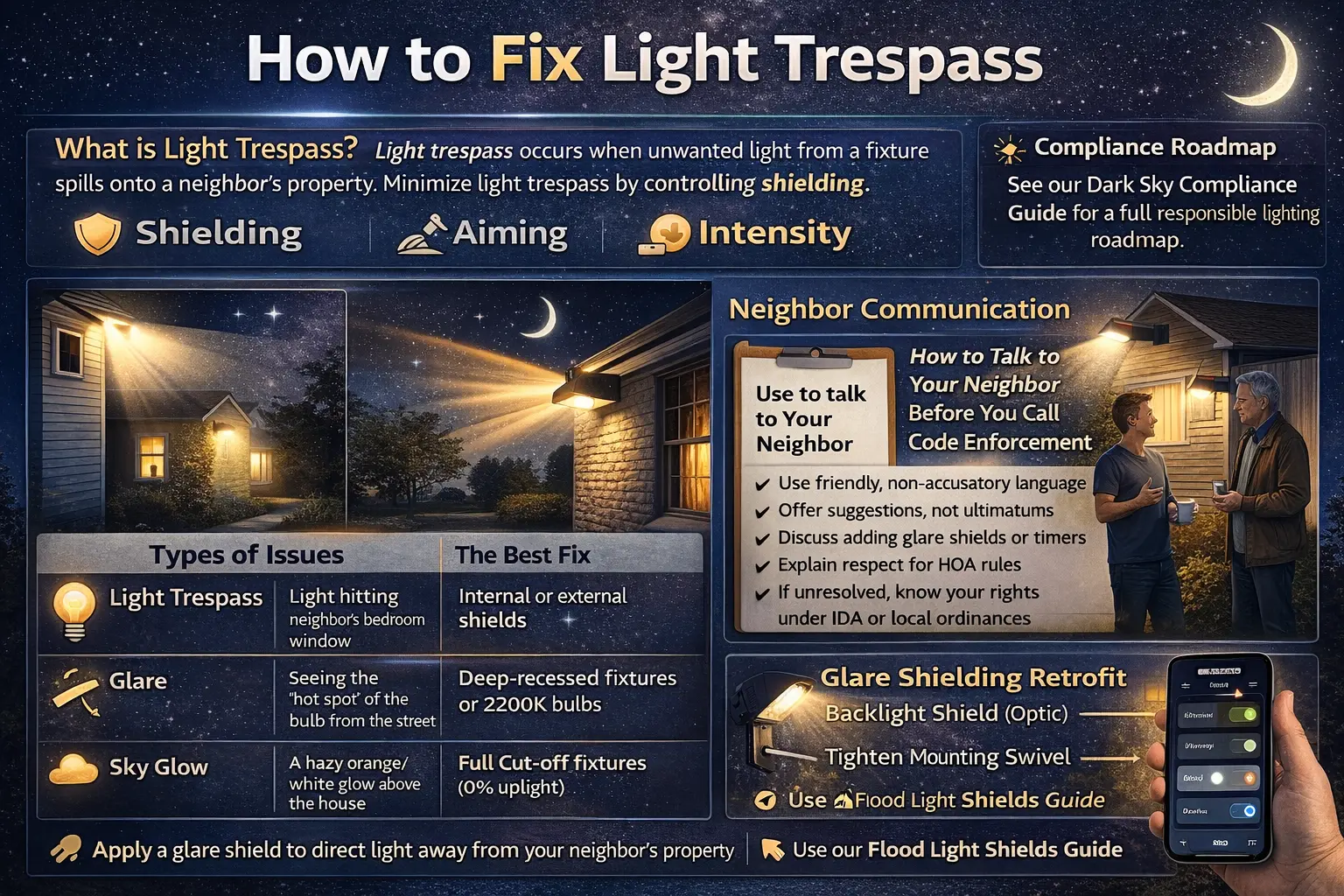
Immediate Answer: How to Fix Light Trespass
Light trespass happens when light crosses into an area that was not supposed to be illuminated. The fix is almost always a combination of shielding the source, aiming the beam down or inward, and reducing brightness so the light stays on your property.
- Shielding: block side spill with a hood, guard, shield, or a better cutoff fixture
- Aiming: rotate floodlights and spotlights away from windows, property lines, and the sky
- Intensity: lower lumens, dim the fixture, or shorten run time with timers and controls
If you want the short version, start by adjusting the fixture first. If that does not solve it, add shielding. If it is still too bright, lower the output. That order solves most residential light spillover complaints without a full system replacement.
If you want the broader standards behind shielding, color temperature, curfews, and fixture selection, review our dark sky compliance guide before making bigger changes to your system.
This is a problem-solving page, not a product roundup. If unwanted light is landing on a neighbor’s bedroom wall, shining across the sidewalk, or throwing glare into the street, your goal should be not to buy random new fixtures. The goal is to control the beam so the light is useful where you need it and nowhere else. This will save you money as well as assist in your lighting goals.
Light trespass problems are not always caused by design alone. Weak housings, failing hardware, and degraded shields can also make a fixture harder to control over time. The Durable Landscape Lighting Materials Guide explains why material quality matters for long-term light control.
Reducing light trespass improves lighting quality, but efficiency also depends on proper system design. See minimizing voltage drop and energy waste to improve both performance and control.
Light trespass often shows up in the same systems that also have glare, hot spots, or overly bright output. That is why homeowners dealing with this issue often benefit from reviewing why landscape lights are too bright, how color temperature affects nighttime comfort, and dark-sky AI automation concepts if they want smarter control after the basic fixes are done.
Many light trespass problems are caused by poor fixture selection rather than excessive wattage alone. The dark-sky-friendly outdoor fixture guide explains how shielding depth, beam direction, exposed optics, and fixture height influence glare spill, window intrusion, and neighborhood light pollution in residential lighting systems.
Light trespass can return months after a system is corrected if the fixture shifts in the ground or its adjustment hardware loosens. Clay-soil movement, frost heave, wind, landscaping work, irrigation erosion, and snow removal can all change fixture orientation without damaging the lamp itself. The Outdoor Lighting Climate Performance Guide shows which environmental conditions are most likely to move fixtures and how often aiming, stakes, brackets, and mounting hardware should be inspected.
How to Talk to Your Neighbor Before You Call Code Enforcement
Most light trespass complaints begin as a social problem before they become a code problem. If the light is bothering you, or if you suspect your fixture is bothering someone else, a calm conversation often solves the issue faster than a formal complaint.
Light trespass can create neighbor complaints and visibility problems when fixtures shine across property lines. The outdoor lighting liability and neighbor-risk guide explains how glare, trespass, and unsafe aiming can create avoidable problems.
Fixing light trespass is usually a two-part problem: where the light goes and how long it stays on. A fixture that spills into a bedroom window at midnight may be far more disruptive than the same fixture during early evening arrival hours, so the next step after aiming and shielding is reviewing outdoor lighting curfew requirements for your area. The same adjustments also matter for wildlife. Birds can be affected by bright, poorly aimed, or bluish nighttime lighting near trees, water, and nesting cover, which makes our bird-friendly outdoor lighting guide a useful companion when correcting light trespass around landscaped areas.
Neighbor Communication Checklist
- mention the exact time of night when the problem is worst
- describe the symptom clearly: window glare, bedroom spill, driveway beam, or street-facing glare
- offer to test changes together for five minutes while someone stands at the affected location
- focus on the beam direction, not blame
- take photos from the affected side only if needed for clarity
Homeowners often assume they need totally new fixtures when the actual fix is a small shield, a better aiming angle, or a curfew schedule. That is why this page pairs the human side of the issue with the technical fixes below.
In real residential situations, most light trespass is accidental. The homeowner usually does not realize how far the beam is carrying until someone stands at the affected window or property line. In many cases, the fix is a simple aiming adjustment or an inexpensive shield rather than a full fixture replacement.
If your lights stay on at full brightness all night, they are more likely to cause complaints. The Smart Outdoor Lighting Controls Guide explains how to reduce light levels and automate shutoff times for better results.
If the spillover problem led to an HOA complaint or a city warning, review our Outdoor Lighting Ordinance Guide to see how light trespass fits into wider rules on glare, shielding, brightness, and late-night lighting control.
Reducing light trespass also reduces wasted energy. Many outdoor systems consume far more electricity than necessary because fixtures are oversized, poorly aimed, or left operating long after they are needed. The landscape lighting carbon footprint guide explains how beam control, timer schedules, and lower-wattage LED systems help reduce both environmental impact and unnecessary nighttime glare.
Light Trespass vs Glare vs Sky Glow
These problems are related, but they are not the same. Knowing which one you are dealing with helps you choose the right fix faster.
Light trespass does not only affect neighbors. It can also disrupt birds, insects, and other nighttime species that depend on darker conditions. See our wildlife-friendly outdoor lighting guide for practical ways to reduce spill, glare, and unnecessary lighting hours.
Light trespass problems often get worse when fixtures use cooler, harsher light colors. For a deeper look at how light color affects glare, visibility, sleep, and environmental impact, see Biological Impact of Outdoor Light Color.
Seasonal displays can still create light trespass if they run too bright or flash too aggressively. The Patriotic July 4th Outdoor Lighting Guide includes neighbor-friendly brightness and timing recommendations for red, white, and blue outdoor scenes.
Reducing light trespass helps people, pets, and wildlife. For safer wire routing and animal-friendly fixture choices, review pet and wildlife landscape lighting safety.
Pool lighting should illuminate the water without creating excessive glare across patios, windows, or neighboring properties. Our Portfolio Swimming Pool Lighting Guide explains how beam spread, lens condition, and fixture placement affect nighttime pool visibility and light spill.
Shielding outdoor fixtures reduces both neighborhood light trespass and dangerous eye-level glare. The Senior Safety Lighting Guide explains how low-glare fixture design improves nighttime walking visibility for older adults.
Light trespass and sky glow are closely related, but they are not the same problem. A fixture that spills sideways into a neighbor’s window may also send light upward through glare, reflection, or poor shielding. After correcting property-line spill, it is worth checking whether the same fixtures are also contributing to neighborhood sky glow. Our home night-sky glow reduction guide explains how to reduce excess upward light while still keeping walkways, doors, and outdoor living areas usable.
| Type of Issue | Symptom | Best Fix |
|---|---|---|
| Light Trespass | Light reaches a neighbor’s bedroom window, sidewalk, or property line. | Use internal or external shields, snoots, side guards, better aiming, and lower light output. |
| Glare | The bulb or LED hot spot is directly visible from the street or normal viewing angles. | Choose deep-recessed fixtures, shielding, lower mounting angles, warm lamps, and low-glare optics. |
| Sky Glow | A hazy glow appears above the property because light escapes upward. | Install full-cutoff fixtures, use zero-uplight optics, reduce brightness, and add timers or dimming schedules. |
If your lighting space still feels harsh after reducing glare, the bulb’s color quality may be part of the problem. Compare CRI 95 vs CRI 80 lighting to improve visual comfort and color accuracy.
Light Trespass Problems Can Start With Repair Decisions
Fixing outdoor lighting is not only about making the light turn on again; it is also about making sure the fixture is aimed, shielded, and controlled properly after repair. Visitors working on Portfolio systems can use the Portfolio Lighting AI assistance page to identify fixture types, transformer issues, and compatible replacement paths before changing the system. If a dim or flickering fixture is caused by green connector corrosion, the green dust connector repair guide explains why restoring a clean low-resistance connection can make a fixture noticeably brighter again. After brightness is restored, the property-line foot-candle light trespass guide helps evaluate whether that repaired or upgraded light is spilling beyond the intended area.
Fixing light trespass is usually a two-part problem: where the light goes and how long it stays on. A fixture that spills into a bedroom window at midnight may be far more disruptive than the same fixture during early evening arrival hours, so the next step after aiming and shielding is reviewing outdoor lighting curfew requirements for your area. The same adjustments also matter for wildlife.
Bright Fixtures Can Create Glare Even When They Look Decorative
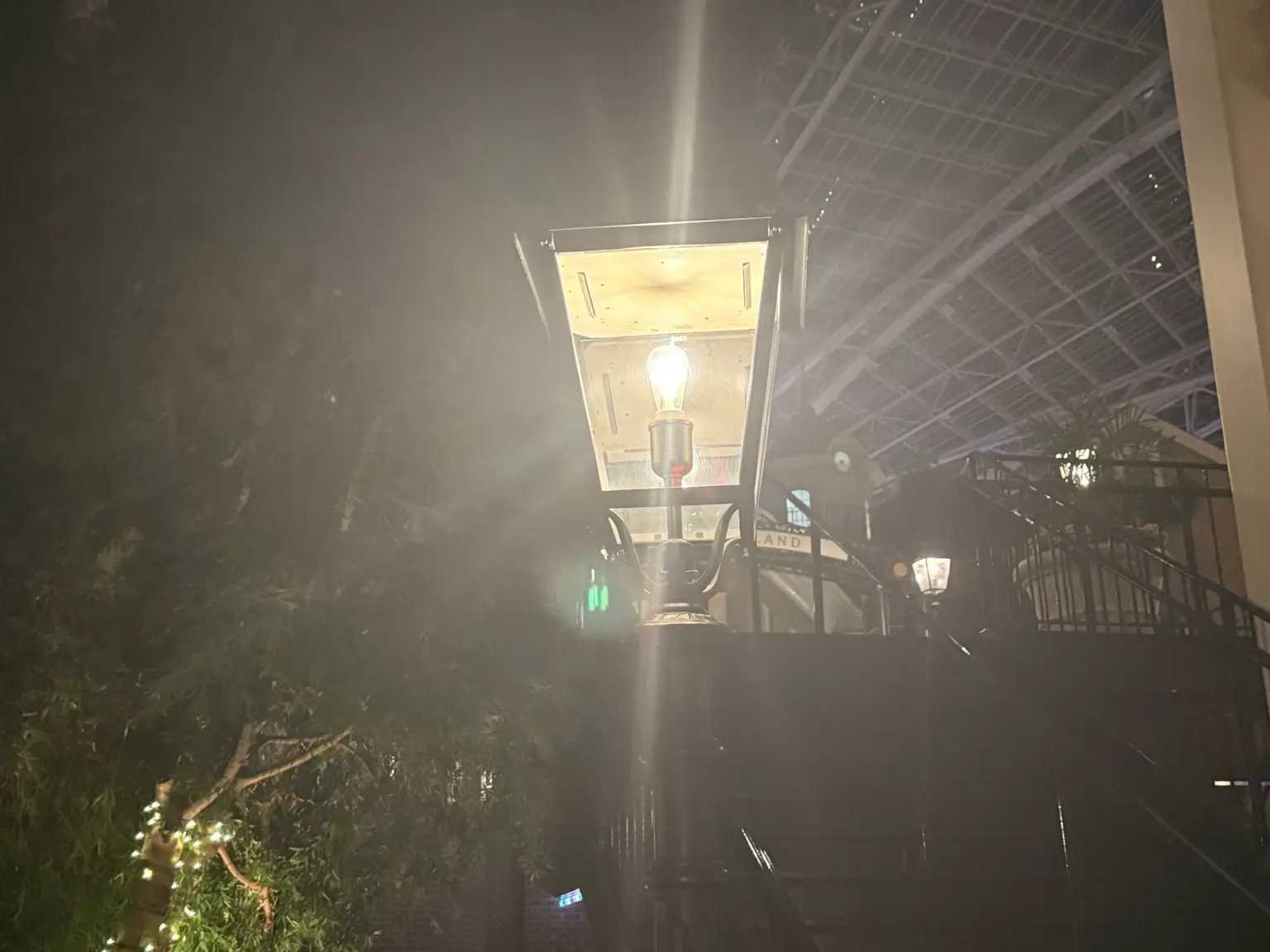
A fixture can be attractive and still cause glare. If the bulb is exposed, too bright, or aimed outward, the light may spill into neighboring areas, windows, walkways, or seating spaces.
To reduce light trespass, lower the lumen output, choose a warmer bulb, add shielding, or replace the fixture with one that directs light downward.
Light trespass is often caused by excessive lumen density rather than fixture placement alone. The over-lighting and lumen pollution explanation shows how too much brightness can spill beyond property lines even when fixtures technically point downward.
The Physical Shielding Retrofit
The most direct way to stop light spillover is to physically block the light that is escaping sideways or upward. This is where retrofits matter. A shield changes the shape of the beam without requiring a complete redesign of the lighting system.
What shielding actually does
Shields reduce visible side spill, soften glare, and keep more of the beam on the surface you are trying to light. Depending on the fixture, that may mean a visor, hood, louver, side shield, barn door, or a deeper fixture body that hides the bright source from off-angle views.
Cutoff levels matter
Older lighting language often describes fixtures as full-cutoff, semi-cutoff, or non-cutoff. In simple homeowner terms:
Light trespass is directly related to how a fixture controls its output. The BUG rating system explains how backlight and glare contribute to spillover and neighbor complaints.
- Full cutoff: best control, little to no uplight, better for dark-sky goals
- Semi-cutoff: better than exposed lamps, but still allows spill
- Non-cutoff: worst control, most likely to cause glare and trespass
If you are dealing with exposed floodlights or decorative fixtures that let the source shine sideways, the fixture style may be the core problem. Compare the beam control needs of your project with Portfolio flood lighting, Portfolio outdoor wall spotlights, and Portfolio post lighting so you can see which fixture families are naturally easier to control.
Homeowners upgrading older systems should also look at Portfolio lighting replacement parts, replacement globes and covers, and replacement lenses when the existing beam control accessories are missing or damaged.
Light trespass is often blamed on brightness, but fixture shape is usually just as important. A low-watt light can still become a problem if the lamp is exposed, aimed sideways, or mounted where the beam escapes toward a neighbor’s window. Before lowering wattage alone, compare the beam pattern in our shielded and unshielded outdoor lighting guide. It explains why cutoff, aiming, and fixture housing often solve spill problems more effectively than simply installing a dimmer bulb.
Quick Visual: Better vs Worse Beam Control
| Fixture Style | What Happens Above 90° | Result |
|---|---|---|
| Full cutoff | No visible light above horizontal | Best control for trespass and sky glow |
| Semi-cutoff | Some light escapes above horizontal | Better than exposed lamps, but still imperfect |
| Non-cutoff | Uncontrolled glow above horizontal | Highest risk of glare, spill, and neighbor complaints |
Optical Aiming & Backlight Control
Many light trespass problems are really aiming problems. A floodlight that is just a few degrees too high can carry far beyond the intended area. Re-aiming often fixes the issue faster than buying new equipment.
If certain fixtures are not working correctly or appear inconsistent, the issue may be damaged wiring rather than light direction. Use the Portfolio lighting wire replacement guide to inspect and repair cable issues before adjusting fixtures.
Start with aiming before replacement
- tilt the beam downward until it lights only the target surface
- rotate the fixture away from windows, sidewalks, and property lines
- stand at the neighboring view angle while adjusting
- check both the bright beam and the softer spill at the beam edge
What “backlight” means
Backlight is the light that escapes behind the fixture or past the area you intended to illuminate. On modern outdoor luminaires, manufacturers often describe this using BUG ratings, which stands for Backlight, Uplight, and Glare. Lower backlight and uplight generally mean better control for properties where spillover is a concern.
That matters because the worst light trespass complaints usually happen when a fixture is technically bright enough for the job, but the optic is sending part of the beam in the wrong direction. If you are trying to control light distribution more precisely, compare your layout with landscape lighting layout design, landscape lighting spacing, and path light placement.
Fixing Light Trespass Requires More Than Aiming the Fixture
Light trespass problems often come from a combination of output, placement, control behavior, and system performance. If a lighting system includes smart controls, cameras, or long low-voltage cable runs, the low-voltage EMI and signal interference guide helps identify electrical noise that may cause flicker, dimming, or control errors while corrections are being made. If the glare complaint comes from a spa or patio soaking area, the outdoor lighting around hot tubs guide explains how to preserve privacy and safety without overlighting wet surfaces. If fixture output changes after a repair, the voltage drop testing documentation guide helps verify whether brightness changes are caused by corrected voltage, wiring defects, or product failure. For bedroom-facing glare, the dark-sky bedroom design guide gives a room-first method for reducing window glow, direct glare, and reflected nighttime brightness.
Use the Right Fixture for the Right Job
A large share of residential light trespass comes from fixture mismatch. People use a floodlight where a shielded path light would work, or a decorative lantern where a more directional wall light would be easier to control. When the fixture type is wrong, you end up fighting the beam instead of benefiting from it.
Path and Walkway Lighting
Best when you need controlled low-level light close to the ground instead of broad high-output beams.
View path lightsFlood and Security Lighting
Best when you truly need broader coverage, but these are the fixtures most likely to create spillover if aimed poorly.
View flood lightingDeck and Step Lighting
Useful when you want visibility at a lower mounting height with less off-site glare.
View deck lightingLow Voltage Systems
Often easier to fine-tune because they support gentler light levels and more flexible layouts.
View low voltage lightingThe Automation Fix: Curfew Hours, Dimming, and Smarter Control
Not every light trespass problem comes from fixture shape alone. Sometimes the light is acceptable at 8 PM and completely excessive at midnight. That is where automation becomes the cleanest fix.
Why automation works
Smart controls allow you to keep the useful part of the lighting schedule while reducing output when full power is no longer needed. Instead of blasting a property at 100% all night, you can create curfew behavior that dims exterior lighting after a certain hour.
- full brightness during arrival hours
- reduced light level after 10 PM or another curfew point
- motion-based temporary brightening only when activity is detected
- automatic return to low level when the area is quiet again
This is where your automation cluster becomes a real bridge page. Homeowners who want to reduce complaints without losing nighttime usability can use AI outdoor lighting systems, smart hub compatibility guidance, and AI automated landscape lighting to create schedules that dim to a lower level late at night.
For example, predictive arrival logic can keep driveway and entry lights bright only when someone is expected, while a hub-based curfew can hold the rest of the property at a calmer level. If your outdoor system feels too bright or too active after dark, review predictive arrival lighting behavior patterns, AI security and ambient lighting, and circadian outdoor lighting for better nighttime balance.
If your goal is to reduce late-night spillover without losing useful light earlier in the evening, combine these control ideas with the broader dark sky compliance framework so your fixture choices, beam control, and nightly schedule all work together.
Light trespass problems are often made worse by bulbs that are too cool and visually harsh. The Landscape Lighting Color Temperature Guide explains why warmer 2700K to 3000K lighting usually creates a more comfortable and neighbor-friendly result.
Best Fix by Symptom
| Symptom | Most Likely Cause | Best First Fix | Best Next Step |
|---|---|---|---|
| Neighbor’s window is lit up | Beam spill or side spill | Re-aim the fixture downward and inward | Add a side shield or choose a tighter optic |
| You can see the bright source from the street | High glare and exposed lamp or LED | Use a deeper cutoff fixture or shield | Lower lumen output or warmer lamp color |
| Yard looks washed out late at night | Too much brightness for the hour | Set dimming curfew hours | Add smart controls or motion-based scenes |
| Entire run feels harsh and uneven | Fixture mismatch or layout problem | Check spacing and aiming | Review layout and replace the worst offenders first |
How Warm Color Temperature Helps Without Becoming the Whole Fix
A warmer lamp can make outdoor lighting feel softer and less intrusive, but it does not fix beam control by itself. A badly aimed 3000K or 2700K floodlight can still trespass into a neighbor’s window. Warm color helps with visual comfort. Shielding and aiming solve the physical spill.
If your current lighting feels harsh, compare the comfort side of the problem with landscape lighting color temperature guidance and Portfolio LED landscape lighting. That is especially helpful when you are balancing visibility, neighbor comfort, and a more natural nighttime look.
When to Replace Instead of Retrofit
Retrofitting works well when the fixture body is still sound and the problem is mainly beam control. Replacement makes more sense when the fixture is cracked, corroded, overheating, missing lenses, or simply designed in a way that cannot be controlled well.
- replace when the housing cannot accept a useful shield
- replace when the fixture always exposes the bright source from off-angle views
- replace when brightness is excessive even with lower-output lamps
- replace when maintenance parts are no longer available
Before replacing an entire run, review replacement hardware, landscape light housings, bulb replacement, and where to buy Portfolio replacement parts. That helps you separate a true fixture failure from a beam-control problem.
How to Fix Light Trespass FAQ
What is light trespass?
Light trespass is unwanted light that lands outside the area you meant to illuminate. In homes, that usually means spill onto a neighbor’s property, into a window, or into the sky.
What is the fastest way to reduce light spillover?
Start by aiming the fixture down and away from the problem area. If spill still remains, add shielding or reduce brightness.
Is glare the same thing as light trespass?
No. Glare is the visual discomfort of seeing a bright source. Light trespass is the light physically entering an area where it is not wanted. Many bad fixtures create both at once.
Do I need all new fixtures to solve this problem?
Not always. Many homeowners can fix the issue with better aiming, shielding, lower output, or automation. Replacement is usually needed only when the fixture design itself is the problem.
Reducing light trespass can also reduce unnecessary energy consumption and environmental impact. The landscape lighting carbon footprint guide explains how beam control, fixture aiming, runtime scheduling, and efficient LED systems help create cleaner and more sustainable outdoor lighting designs.
Final Thoughts
The best way to fix light trespass is to treat it like a beam-control problem, not just a brightness problem. When you combine shielding, aiming, and smarter intensity control, you can usually keep the safety and usability benefits of outdoor lighting without creating glare, obtrusive light, or conflict with nearby homes.
Start with the easiest change first: aim the fixture. Then add shielding if needed. Finally, reduce intensity or automate the schedule so the light behaves differently late at night than it does during active evening hours. That simple sequence solves most residential spillover complaints faster than a full replacement project.