
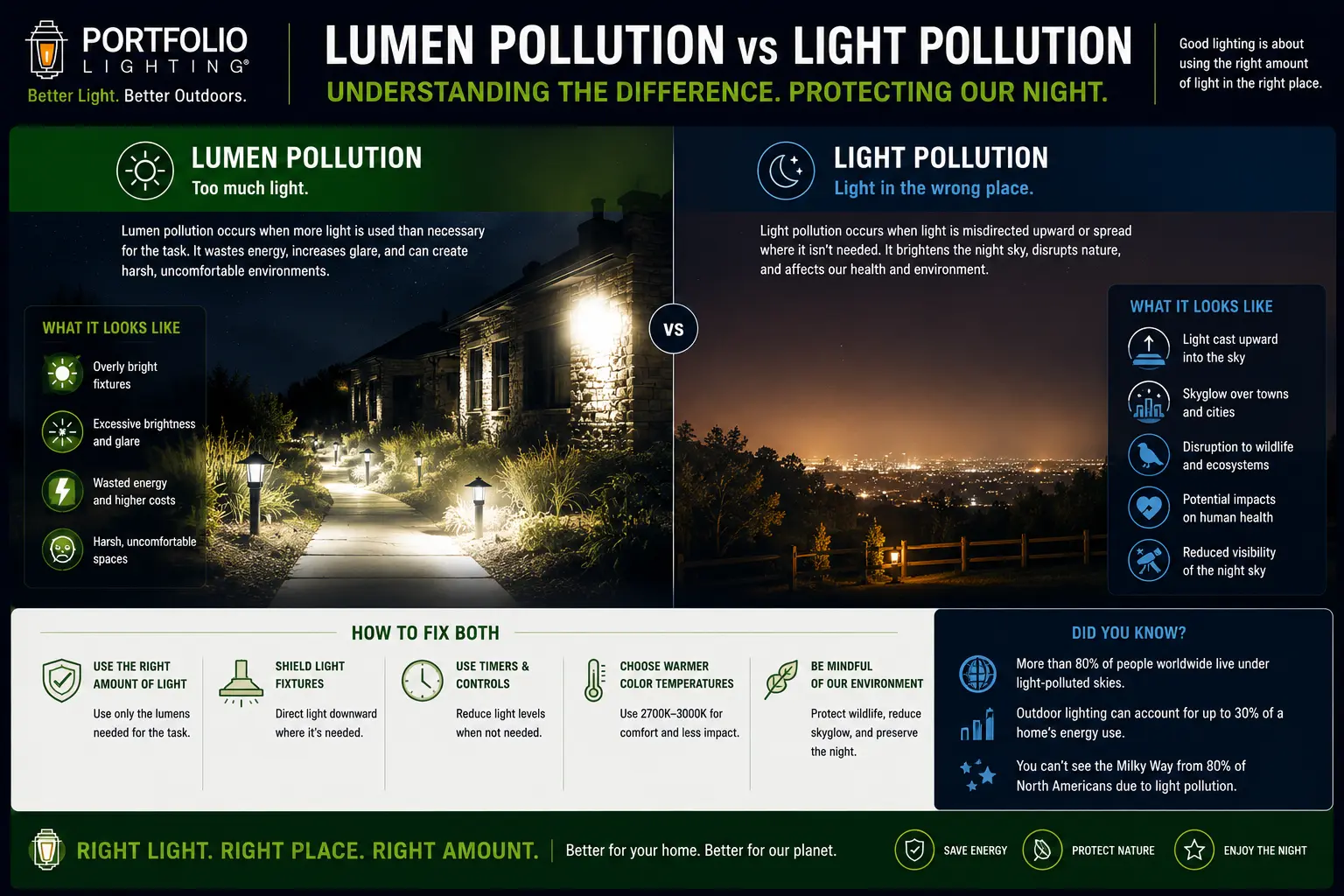
The Precise Difference Between Lumen Pollution and Light Pollution
The confusion between these terms is understandable — both describe outdoor lighting problems and both are associated with the dark sky movement. But they describe fundamentally different phenomena, affect different populations differently, and require different technical interventions to resolve.
| Characteristic | Lumen Pollution | Light Pollution |
|---|---|---|
| What it describes | Excessive total light output — too many lumens for the task | Light in the wrong place, at the wrong time, or the wrong spectrum — regardless of quantity |
| Primary measurement unit | Lumens (total light emitted by source) or lux (lumens per square meter at a surface) | Skyglow: magnitudes per arcsecond² (mpsas); Glare: candela per square meter (cd/m²); Trespass: lux at property boundary |
| Can occur with low-output fixtures | No — low output cannot produce lumen pollution by definition | Yes — a 50-lumen fixture aimed at a bedroom window causes light trespass regardless of low output |
| Can occur with shielded fixtures | Yes — a fully shielded 5,000-lumen fixture still over-illuminates a small path | Shielding eliminates uplight and trespass components but cannot fix glare from high luminance |
| Primary victims | Energy waste; over-illuminated surfaces that cause visual discomfort | Nocturnal wildlife, astronomers, neighbors, human circadian rhythms, and insects |
| Regulatory standard | IES recommended illuminance levels (footcandles or lux by application type) | IDA model lighting ordinances; local dark sky ordinances; BUG rating limits |
| Fix approach | Reduce fixture output (lower wattage, higher-efficacy LED, fewer fixtures) | Shield upward emission, redirect beam, reduce color temperature, add timer cutoffs |
| Can fixing one fix the other? | Reducing lumens helps light pollution indirectly but does not address beam direction | Redirecting beam helps lumen pollution indirectly but does not reduce total output |
In 25 years of landscape lighting installation, the most common scenario I encounter is a homeowner who replaced halogen path lights with LED to "reduce light pollution." They succeeded at reducing lumen pollution — their total system draw dropped from 240W to 48W. But the LED fixtures they chose were 4000K cool white with no shielding on the top of the globe. Their skyglow contribution actually increased relative to their old halogen system because the blue-rich 4000K spectrum scatters approximately 5 times more efficiently in the atmosphere than the warm amber halogen light did. Lower lumens, worse light pollution. Both problems must be addressed independently.
For the energy and cost dimension of lumen reduction specifically, the landscape lighting energy calculator computes exact annual kWh, electricity cost, and CO2 by fixture type. For the full biological impact of spectrum and color temperature choices beyond simple lumen counts, see the biological impact of outdoor light color guide.
The 4 Official Types of Light Pollution
The IDA (International Dark-Sky Association) and IES (Illuminating Engineering Society) define light pollution as encompassing four distinct problems. Understanding which type a specific fixture contributes to determines which technical intervention will actually solve it. Most homeowner outdoor lighting systems contribute to all four simultaneously.
Cause in landscape lighting Any light emitted above the horizontal plane from a fixture — whether from a bare globe, an unshielded path light top, a wall fixture without an opaque cap, or light reflected from a horizontal surface upward into the sky.
Why spectrum matters here Blue-rich light (4000K–6500K) scatters in the atmosphere at Rayleigh scattering rates approximately 5 times higher than warm amber light (2200K). A 4000K fixture contributes 5 times more to skyglow per lumen than a 2200K fixture at identical lumen output. See the color temperature guide.
Why this is counterintuitive Glare makes areas appear darker rather than brighter. A bright unshielded fixture on a path causes the eye to adapt to the high-luminance source, making the path surface appear darker by comparison. This is why high-output unshielded path lights are actually worse for navigating a walkway than properly aimed lower-output fixtures.
Measurement Luminance in candela per square meter (cd/m²). The G component of the BUG rating system addresses glare at high viewing angles.
Key characteristic Light trespass is the only type of light pollution that is almost universally regulated by ordinance. Most municipalities have maximum lux levels at property boundaries ranging from 0.1 to 0.5 lux depending on zone classification.
Common residential sources Flood lights aimed outward, wall lanterns without back shielding, pathway lights that direct significant light horizontally rather than downward, and motion-activated security lights with wide beam angles. See the light trespass fix guide.
Residential relevance Clutter is the least regulated of the four types in residential contexts but the most relevant to aesthetic quality. A yard with 20 path lights at 8-inch spacing, string lights across a pergola, three uplights on one tree, and flood lighting on the house produces clutter that makes the landscape appear busy and artificial rather than intentional.
The fix Spacing, restraint, and hierarchy — the design principles covered in the landscape lighting design guide and the spacing guide.
For wildlife-specific impacts of all four types — particularly their effects on nocturnal insects, birds, and mammals — see the wildlife-friendly outdoor lighting guide. For the astronomical impact of skyglow specifically, see the dark sky compliance guide.
How to Measure Lumen Pollution and Light Pollution
The three measurement units used in lighting standards are frequently confused — lumens, lux, and candela describe related but fundamentally different quantities. Understanding which unit applies to which type of problem is essential for reading ordinance language, comparing fixtures, and verifying compliance.
Why Color Temperature Is Part of the Light Pollution Problem
Color temperature is the variable most homeowners understand least in the context of light pollution — and arguably the most impactful one for skyglow after beam direction. Two fixtures at identical lumen output and identical shielding can have dramatically different effects on skyglow and wildlife disruption based solely on their color temperature.
Lumen pollution becomes easiest to understand when you look at where the light goes after it leaves the fixture. Lumens that bounce off pale walls, concrete, snow, water, or glossy hardscape can still contribute to visible night-sky glow even if the fixture itself points downward. Our reducing night-sky glow around homes guide explains how fixture direction, brightness, reflective surfaces, and operating hours combine to determine how much residential lighting escapes into the night environment.
The Physics of Blue Light Scatter
Rayleigh scattering — the same physical phenomenon that makes the daytime sky blue — means that shorter wavelengths of light (blue, 400–500nm) scatter in the atmosphere far more efficiently than longer wavelengths (amber, 580–700nm). The relationship is inverse fourth power of wavelength, which produces approximately 5 to 9 times more scattering for blue wavelengths than red wavelengths at the same intensity. This is why a 4000K LED landscape system with 500 total lumens contributes more to skyglow than a 2200K system with 800 lumens — despite the lower lumen output of the cool-white system.
The Biological Disruption Dimension
Blue-rich light above 2700K suppresses melatonin production in mammals — including humans — through the intrinsically photosensitive retinal ganglion cells (ipRGCs) that are maximally sensitive to approximately 480nm blue light. Nocturnal insects are strongly attracted to blue-rich and UV-rich light, which is why cool-white and daylight LED fixtures produce dramatically more insect mortality than warm amber LED fixtures at identical lumen outputs. For the detailed biological impact analysis, see the biological impact of outdoor light color guide and the wildlife-friendly outdoor lighting guide.
Practical Color Temperature Guidance for Residential Landscape Lighting
| Color Temp | Skyglow Impact | Wildlife Impact | Human Health Impact | IDA Compliance |
|---|---|---|---|---|
| 2200K Amber LED | Lowest — minimal blue scatter | Lowest — near-zero insect attraction increase vs dark | Minimal melatonin suppression | Fully compliant in all ordinances |
| 2700K Warm White | Low — acceptable scatter | Low — modest insect impact | Low melatonin suppression | Compliant in most ordinances |
| 3000K Soft White | Moderate — IDA maximum recommended | Moderate insect impact | Moderate at full brightness | Compliant at IDA threshold |
| 4000K Cool White | High — significantly elevated scatter | High insect attraction and mortality | Significant suppression in dark environments | Non-compliant in dark sky ordinance zones |
| 5000K–6500K Daylight | Very high — maximum scatter per lumen | Very high — severe nocturnal wildlife impact | Strong suppression — not suitable for evening outdoor use | Non-compliant in virtually all ordinances |
For the human circadian dimension of outdoor color temperature in landscape lighting, see the circadian landscape lighting guide. For the indoor wellness equivalent, see the voltage stability and melatonin guide.
Lumen pollution is not only about how many lumens a fixture produces. It is also about where those lumens go. A properly shielded fixture can use fewer lumens more effectively because the light is aimed at the walking surface, step, entry, or landscape feature instead of escaping into the sky or across the property line. The shielded vs. unshielded lighting guide explains why two fixtures with similar brightness can produce very different amounts of glare, skyglow, and wasted light.
The BUG Rating System: How Fixtures Are Evaluated for Light Pollution
BUG stands for Backlight, Uplight, and Glare — a standardized fixture classification system developed by the IES and adopted in the IDA Model Lighting Ordinance as the primary tool for evaluating whether a specific fixture is appropriate for dark sky compliance. Most residential landscape lighting fixtures are not BUG-rated — this is an important gap between commercial dark sky compliance tools and residential practice.
What Each Component Measures
- B — Backlight: Light emitted in the hemisphere behind the fixture mounting direction. For a wall-mounted fixture, backlight is light emitted toward the wall rather than away from it. For a path light, backlight is lateral emission. Rated 0 to 5, with B0 indicating no backlight emission and B5 indicating the maximum in that zone.
- U — Uplight: Light emitted above the horizontal plane of the fixture. U0 indicates a fully shielded fixture with no upward light emission whatsoever — the standard required for dark sky ordinance compliance in most jurisdictions. Any path light with a translucent globe top or any unshielded wall lantern will have a U rating above U0.
- G — Glare: Light emitted at high angles above horizontal that enters the visual field of nearby observers. The G rating is the most relevant for pedestrian comfort — high G values produce the "headlights in your eyes" sensation that makes a walkway harder to navigate despite being illuminated. G5 represents the maximum glare classification.
What a Compliant Fixture Looks Like
A fixture that achieves U0 — zero uplight — must have a fully opaque top and sides that direct all light emission below the horizontal plane. Standard Portfolio landscape path lights with clear or frosted globe tops are typically U2 to U4 — significant uplight emission. Replacing the globe with an opaque-top version, or replacing the fixture with a fully shielded design, eliminates the U component entirely.
For the full fixture selection guide optimized for dark sky compliance and BUG rating criteria, see the dark sky friendly fixture selection guide. For understanding bug ratings specifically as they relate to wildlife impact, see the BUG ratings guide. For ordinance compliance requirements and local lighting codes, see the outdoor lighting ordinance guide.
How Lumen Pollution and Light Pollution Affect Residential Landscape Lighting Specifically
The abstract definitions of lumen pollution and light pollution become concrete when applied to specific fixture types in a typical residential low-voltage landscape lighting system. Each fixture type has a characteristic pollution profile — understanding it determines which intervention to apply first.
Path Lights
Standard Portfolio and Malibu path lights with clear or frosted spherical globes are among the highest uplight contributors in residential landscape lighting — per lumen, they emit more upward light than almost any other fixture type because the globe top emits in all directions including directly upward. At 4W LED with a 2700K warm white globe, a typical path light emits approximately 15 to 25% of its total output upward. At 4000K cool white, that upward component contributes 5× more to skyglow per lumen due to scatter efficiency. The fix: opaque-top globe replacement, fully shielded path light head replacement, or lower color temperature. See Portfolio path lights for specific fixture options and the path light placement guide for spacing that reduces total fixture count while maintaining coverage.
Flood Lights and Spotlights
Flood lights and spotlights have the highest potential for light trespass of any residential fixture type because they combine high lumen output with directional beam patterns that can easily cross property boundaries. A 1500-lumen flood light aimed at a 45-degree angle will illuminate a significant portion of a neighboring property. The fix: aim adjustment, beam angle reduction, and glare shields. The Portfolio flood lighting guide covers beam angle selection. Voltage drop in long wire runs to spotlights also affects effective output — see the minimizing voltage drop energy waste guide.
Wall Lanterns and Post Lights
Traditional lantern-style fixtures — clear glass panels, no top shielding, omnidirectional emission — are the worst single fixture type for combined lumen pollution and light pollution. They emit significant uplight, backlight into the structure, and horizontal light in all directions. At 800 lumens a wall lantern may produce effective illuminance at a neighboring property's window of 2 to 5 lux — well above the 0.1 to 0.5 lux limits in most ordinances. The fix: fixture replacement with a fully shielded downlight style, or significant lumen reduction to a 200 to 400 lumen equivalent while accepting reduced illuminance at the fixture's intended target surface.
Step and Deck Lights
Properly installed step lights and deck lights — recessed into risers, facing downward or horizontally away from observers — are among the lowest-impact fixture types for all four pollution categories. They emit minimal upward light, stay within the property boundary, and have low enough output that glare is rarely an issue. The primary pollution concern is lumen density — too many step lights at short spacing can over-illuminate a small area. See Portfolio deck lighting for specific installation guidance.
For the complete overview of how outdoor lighting impacts human health beyond just sleep disruption — including immune function, stress response, and long-term health outcomes from nighttime light exposure — see the outdoor lighting and human health guide.
How to Fix Both Lumen Pollution and Light Pollution in Your Landscape System
Because the two problems require different technical interventions, the most effective approach addresses them in a specific sequence — starting with the highest-impact intervention for each problem before moving to refinements. The sequence below produces the most improvement per fixture change and per dollar spent.
Step 1 — Address Beam Direction First (Light Pollution Fix Priority 1)
- 1Identify every fixture in your system that emits any light above the horizontal plane. Walk the yard at night and look for visible globe glow directed upward, light emitting from the top of path light globes, or flood lights with significant upward spill. These are your highest-priority U-rating problems. Replacing globe tops with opaque versions or adding shielding caps eliminates uplight without requiring any electrical changes.
- 2Identify light trespass — walk to your property boundary at night and check whether your fixtures illuminate anything beyond the boundary. Check neighboring bedroom windows especially. Aim adjustment for flood lights and spotlights is the most immediate fix. Physical shielding (barn doors, glare shields) is the second option. See the fix light trespass guide for step-by-step techniques.
Step 2 — Reduce Color Temperature (Light Pollution Fix Priority 2)
- 2Replace any 4000K or higher LED bulbs with 2700K or 2200K equivalents. For MR16, G4, and E26 base fixtures this is a straightforward bulb swap. For integrated LED fixtures the color temperature cannot be changed without replacing the fixture. Prioritize replacing cool-white fixtures in the highest-visibility locations — path lights with globe tops (highest uplight emission) and flood lights (highest lumen output). See the color temperature guide.
Step 3 — Reduce Total Lumens (Lumen Pollution Fix)
- 3After beam direction and color temperature are corrected, assess whether illuminance levels on target surfaces are appropriate for the application. Use a smartphone lux meter app: path surfaces should measure 1 to 5 lux; driveways 5 to 10 lux; architectural features 20 to 50 lux depending on importance. Surfaces significantly over these values are lumen-polluted. Fix: replace fixtures with lower-output equivalents, reduce operating hours with the smart controls guide, or remove excess fixtures. Use the energy calculator to quantify annual savings from lumen reduction.
Step 4 — Add Timer Control (Reduces Both Problems)
- 4Operating hours are the most underused lever in outdoor lighting pollution reduction. A system that runs dusk to midnight produces half the annual pollution of a dusk-to-dawn system — with no fixture changes, no investment, and no reduction in the illumination available during the hours people actually use the yard. The smart outdoor controls guide covers timer integration, photocell options, and motion-sensor strategies for reducing effective operating hours without sacrificing security or aesthetics.
Ordinances, Compliance, and Where These Terms Appear in Local Law
Lumen pollution is not a legal term in most ordinances — it is a descriptive concept used in sustainability discussions. Light pollution, however, appears extensively in zoning codes, dark sky ordinances, and homeowner association rules, though the specific provisions address the four component types rather than "light pollution" as a unified concept.
Lumen pollution becomes easier to understand when you separate brightness from usefulness. A light can be efficient, modern, and low wattage while still sending unnecessary lumens into the sky, across a property line, or into habitat where they are not needed. That is why sustainable lighting design should include operating limits from an outdoor lighting curfew requirements guide, not just fixture upgrades. For landscape areas with trees, gardens, or water nearby, bird-friendly outdoor lighting is another practical way to reduce wasted nighttime exposure while keeping the useful light where people actually need it.
What Ordinances Actually Regulate
Most residential outdoor lighting ordinances regulate some combination of: maximum fixture lumens (typically 700 to 1,400 lumens per fixture in residential zones), maximum illuminance at property boundaries (typically 0.1 to 0.5 lux), maximum color temperature (typically 3000K maximum in dark sky overlay zones), shielding requirements (full cutoff or fully shielded downward for certain fixture types), and operating hours (some jurisdictions require lights-off after 11pm or midnight except for security applications). The outdoor lighting ordinance guide covers the most common ordinance structures and how to identify what applies in your jurisdiction.
The Dark Sky Movement and Residential Impact
The IDA (International Dark-Sky Association) model lighting ordinance has been adopted in modified form by hundreds of municipalities. The core requirements are: full cutoff shielding (U0 in BUG terminology), maximum 3000K color temperature, lumen limits by zone, and prohibition on certain fixture types. If your property is in or near an IDA-designated Dark Sky Place, or in a municipality with a dark sky overlay zone, these requirements have the force of law. For compliance assessment and the specific steps required, see the dark sky compliance guide and the NEC 2026 landscape lighting code updates.
HOA Rules and Neighborly Compliance
Even without municipal ordinances, light trespass that measurably illuminates a neighboring property — particularly bedroom windows — is increasingly the subject of HOA rules and neighbor disputes. The light trespass provisions are almost always the most locally enforced: a neighbor with a lux meter showing 2 lux at their bedroom window has a documentable case regardless of whether a formal ordinance exists. Addressing light trespass proactively — through aim adjustment, shielding, and output reduction — is the most practical approach before disputes escalate. The insurance and liability guide covers the liability dimension when light trespass causes demonstrable harm to a neighboring property.
Lumen Pollution vs Light Pollution FAQ
What is the difference between lumen pollution and light pollution?
Lumen pollution is excessive total light output — too many lumens for the illumination task. Light pollution covers four distinct problems: skyglow (upward scatter brightening the night sky), glare (excessive luminance contrast impairing vision), light trespass (light crossing property boundaries), and clutter (confusing groupings of light sources). A fixture can cause lumen pollution without significant light pollution if it is fully shielded downward. A low-output fixture can cause light trespass if aimed at a neighbor's window. They require different diagnoses and different fixes.
Does reducing lumen output fix light pollution?
Not necessarily — this is the most important practical takeaway from this page. Reducing lumens addresses lumen pollution directly but may do nothing for skyglow, glare, light trespass, or clutter. A 200-lumen fixture aimed upward contributes more to skyglow than a 2,000-lumen fully shielded downward fixture. The most effective approach addresses beam direction first, then color temperature, then total output — in that order. Reducing lumens last, after direction and spectrum are corrected, produces the best combined result.
What color temperature is best for reducing light pollution?
2200K amber LED is the most effective for minimizing all four types of light pollution — it produces the least atmospheric scatter, the least biological disruption to nocturnal wildlife and human circadian rhythms, and is fully compliant with all existing dark sky ordinances. 2700K warm white is the practical second choice and is broadly available across all fixture types. The IDA recommends a maximum of 3000K for all outdoor lighting. Anything above 3000K is non-compliant in dark sky ordinance zones and produces significantly higher environmental impact per lumen than warm alternatives. See the color temperature guide for specific fixture and bulb recommendations.
What is the BUG rating system?
BUG stands for Backlight, Uplight, and Glare — a fixture classification system from the IES used in dark sky ordinances to evaluate how much light a fixture emits in problematic directions. Each component is rated 0 to 5, with 0 indicating no emission in that zone. A fully shielded downward fixture has B0 U0. U0 — zero uplight — is the standard required for dark sky ordinance compliance in most jurisdictions. Most residential landscape fixtures do not carry BUG ratings on their packaging, making residential compliance a more approximate process than commercial compliance. See the BUG ratings guide for complete details.
How much does light pollution from my landscape lighting actually matter?
On the astronomical scale — one residential installation has negligible impact on dark sky darkness compared to a commercial parking lot or a highway interchange. On the local scale — your landscape lighting is likely the primary light source affecting your immediate neighbors' bedroom window illuminance, your local pollinators' nighttime behavior, and the insects and nocturnal birds within roughly 100 meters of your property. The IDA estimates that 35% of all outdoor lighting in the US is wasted — emitted where it serves no purpose. For a residential 12-fixture system, that waste represents approximately 40 to 100 kWh annually. The energy calculator quantifies your specific system's waste output.
Are there Portfolio landscape fixtures that are dark sky compliant?
Portfolio fixtures are not IDA-certified, as the IDA Fixture Seal of Approval program targets commercial and municipal fixtures rather than residential consumer products. However, Portfolio LED landscape fixtures can be made dark sky compliant through a combination of: replacing cool-white (4000K+) bulbs with 2700K warm white equivalents, replacing transparent globe tops with opaque versions that eliminate uplight, reducing output through lower-wattage bulbs where available, and adding timer controls to reduce operating hours. For fully-shielded dark sky compliant alternatives to Portfolio fixtures, see the dark sky friendly fixture selection guide and the Portfolio lighting alternatives guide.
Complete Sustainable Outdoor Lighting Guide Series
Related Landscape Lighting and Compliance Guides
- Electrical Code and Safety Guide
- NEC 2026 Code Updates
- Insurance and Liability Guide
- Contractor Licensing Requirements
- GFCI Requirements Guide
- Landscape Lighting Lumen Guide
- Beam Spread Guide
- Color Temperature Guide
- Landscape Lighting Design Guide
- Lighting Spacing Guide
- Path Light Placement Guide
- Tree Uplighting Guide
- Landscape Lighting Mistakes to Avoid
- Landscape Lighting Maintenance
- Surge Protection Guide
- Circadian Landscape Lighting
- Biological Lighting Infrastructure
- Flicker and Clean Power Guide
- Senior Safety Lighting
- Portfolio Landscape Lighting Hub
- Portfolio Path Lights
- Portfolio Flood Lighting
- Portfolio Low-Voltage Lighting
- Complete Lighting Guide