
BUG Ratings: The Complete Numerical Guide
The BUG rating system — developed jointly by the Illuminating Engineering Society (IES TM-15-11) and DarkSky International — is the most comprehensive numerical tool available for evaluating whether a specific fixture will contribute to light pollution, light trespass, or glare. It replaces the older, less precise cutoff classification system and measures light output in three specific angular zones.
Measures lumens emitted in the rearward hemisphere — behind the plane of the fixture. For wall-mounted fixtures, this is toward the building wall. For pole-mounted fixtures, this is opposite the intended direction of illumination. High backlight causes light trespass into adjacent properties. For residential landscape lighting near property lines, B0 or B1 is the target. B3 and above creates significant neighbor trespass issues.
Measures lumens emitted above the 90-degree horizontal plane — directly into the sky. This is the single most important component for dark-sky compliance. U0 is non-negotiable for any genuinely dark-sky fixture. Even U1 means some measurable portion of the fixture's output goes skyward. DarkSky certification requires U0. Any fixture with U1 or higher cannot receive the DarkSky Approved seal and should not be marketed as dark-sky compliant.
Measures lumens emitted at high angles (above roughly 60–80 degrees from nadir) that cause glare — the blinding effect when you look toward a fixture. High glare reduces visual comfort and can actually impair nighttime visibility by overwhelming the dark-adapted eye. G0–G1 is ideal for residential. G3 and above means the fixture is likely to cause disability glare — the kind that makes it harder, not easier, to see at night.
Reading a BUG Rating: What the Numbers Actually Mean
BUG ratings are expressed as B[n]-U[n]-G[n] where [n] is a value from 0 to 5. A rating of B1-U0-G1 is excellent — minimal backlight, zero uplight, low glare. A rating of B3-U2-G3 is non-compliant — significant backlight, measurable uplight, and disability glare potential. The ratings are calculated by comparing a fixture's measured zonal lumen output (from its IES photometric file) against maximum-allowed thresholds defined by lighting zone. Each zone (LZ0 through LZ4, from pristine dark areas to dense urban) has different allowable BUG thresholds.
| BUG Rating | Uplight (U) Meaning | Backlight (B) Meaning | Glare (G) Meaning | Dark Sky Compliant? |
|---|---|---|---|---|
| B0-U0-G0 | Zero uplight | Virtually no backlight | Virtually no glare | Yes — ideal |
| B1-U0-G1 | Zero uplight | Minimal backlight | Low glare | Yes — recommended target |
| B2-U0-G2 | Zero uplight | Moderate backlight | Moderate glare | Uplight: yes. Check backlight near property line. |
| B1-U1-G1 | Some uplight — sky glow | Minimal backlight | Low glare | No — U1 disqualifies DarkSky approval |
| B3-U2-G3 | Significant uplight | Significant backlight/trespass | Disability glare | No — significantly non-compliant |
| No BUG rating listed | Unknown | Unknown | Unknown | Demand the data before buying. Absence of BUG rating = no photometric accountability. |
Where to Find the BUG Rating on a Specific Fixture
BUG ratings are not printed on fixture packaging. They are found in the fixture's technical specification sheet (spec sheet) — typically downloadable from the manufacturer's website under "Downloads," "Specifications," or "Photometric Data." Look for a table labeled "Luminaire Classification System" or "BUG Rating" with the three-component rating format. If a manufacturer's spec sheet does not include a BUG rating, they have not had the fixture tested to this standard. Ask for it explicitly — some manufacturers have the data internally but do not publish it by default.
Cutoff Classifications: Full Cutoff vs Cutoff vs Non-Cutoff — What Each Means
Before the BUG rating system was developed (adopted into IES standards in 2009), outdoor lighting was classified using a simpler cutoff terminology based only on light emitted above 80 and 90 degrees. These older terms still appear on product listings and in local ordinances, so understanding them — and how they map to BUG ratings — is essential.
0% above 80° (any direction) ✓ DarkSky certifiable
<10% above 80° ✗ Not DarkSky certifiable
<20% above 80° ✗ Significant uplight
Why the Old System Was Replaced
The legacy cutoff classification system had a critical limitation: it only looked at light at specific elevation angles (80 and 90 degrees). It ignored how light was distributed in the backlight and glare zones, which are equally important for neighbor trespass and visual comfort. A fixture could be classified as "cutoff" under the old system while still sending significant light sideways across a property line — which the BUG system's Backlight rating specifically captures. The BUG system replaced cutoff terminology in professional lighting practice; however, many residential ordinances and product descriptions still use the older terms. When you see "full cutoff" in an ordinance, it maps to U0 in BUG terminology.
The Critical Gap: "Full Cutoff" Designation vs. Actual U0 Performance
A fixture marketed as "full cutoff" should be U0 by definition — but photometric testing sometimes reveals discrepancies. Some fixtures have small amounts of uplight from lens diffusion or internal reflections that don't show up in simplified marketing descriptions but do appear in the IES photometric data. This is why DarkSky certification requires submission of the actual IES photometric file for review rather than accepting a manufacturer's self-declaration of "full cutoff." If you want verified full-cutoff performance, use a DarkSky Approved fixture or verify the IES file yourself.
Selecting a dark-sky-friendly fixture involves more than reducing glare and sky glow. The long-term sustainability of a fixture is also influenced by service life, maintenance requirements, upgrade potential, and replacement frequency. Our lighting life-cycle cost analysis guide explores how fixture design decisions affect ownership costs, environmental impact, and overall system sustainability over many years of operation.
DarkSky Approved Program v3.0: What the March 2025 Update Changed
DarkSky International (formerly the International Dark-Sky Association, IDA) updated its luminaire certification program in March 2025 to version 3.0 of the DarkSky Approved Luminaires Program — the most significant update since the program launched as the Fixture Seal of Approval in 2002. Understanding what the program requires, what changed, and why the seal matters is essential context for fixture selection.
Program History: FSA → DarkSky Approved
The program launched in 2002 as the Fixture Seal of Approval (FSA). In January 2024, it was rebranded as DarkSky Approved. In March 2025, version 3.0 of the program guidelines was released, introducing refined criteria and a more accessible application process while strengthening alignment with DarkSky's Five Principles for Responsible Outdoor Lighting. The database search for approved products is publicly accessible at darksky.org — any consumer can verify whether a specific product is currently certified.
The Four Product Categories in v3.0
Version 3.0 of the program introduced four product categories:
- DarkSky Residential Luminaires: Outdoor fixtures primarily used on properties of single-family dwellings or residences up to four connected units. This is the relevant category for most homeowners.
- DarkSky Commercial Luminaires: Fixtures for commercial/industrial properties, schools, hotels, shopping areas, streets, and roadways.
- DarkSky Controls: Products that regulate light intensity — dimmers, timers, photocells, and programmed controls.
- DarkSky Retroreflective Systems: Products using retroreflection to replace illuminated signs.
The Core Technical Criteria (All Must Be Met for Certification)
For a residential luminaire to receive the DarkSky Approved seal, it must simultaneously meet all of the following requirements — partial compliance earns no seal:
- Fully shielded: No light emitted above the 90-degree horizontal plane from nadir. This is U0 in BUG terminology. No sag or drop lenses, side light panels, or uplight panels are permitted on certified fixtures.
- Color temperature ≤ 3000K: All certifiable fixtures must use warm-white sources (3000K or warmer), amber sources, or filtered LED sources. If a fixture is available in multiple CCT options, only the ≤3000K configuration is covered by the certification — the spec sheet must note this. A 4000K version of a certified fixture is not certified.
- Valid electrical safety certification: The fixture must carry a recognized electrical safety listing (UL, ETL, CSA, or equivalent). DarkSky does not certify electrically unsafe fixtures.
- No sag or drop lenses: Fixtures with a lens that extends below the fixture housing (sag lens) are excluded — these lenses create uplight by refraction even when the lamp appears to be pointing down.
- Fixed mount orientation: Adjustable-mount fixtures must specify that the approval applies only when mounted in the fixed downward position. If a certified fixture is mounted at an angle that creates uplight, the certification no longer applies to that installation.
The database verification step most homeowners skip: The DarkSky Approved database at darksky.org/what-we-do/darksky-approved/darksky-approved-luminaires-program/ is searchable by manufacturer, product name, and fixture type. Before purchasing any fixture marketed as DarkSky Approved, search its specific model name in the database. Certification lapses when manufacturers don't pay their annual renewal fee (due July 1, removed from registry after September 1 of non-payment years). A fixture that was certified in 2021 but whose manufacturer stopped paying renewal fees is no longer certified — but the packaging may still display the legacy FSA logo from when it was certified. The database shows current, active certifications only.
How to Identify the Seal and Legacy Logos
Products currently certified display the circular "DarkSky Approved" seal. Products that were certified under the older FSA program (before January 2024) may still display the legacy IDA Fixture Seal of Approval logo — a different design. Both represent genuinely certified products, but the older FSA logo may appear on packaging that predates the 2025 v3.0 criteria update. When evaluating older products carrying the legacy logo, verify currency in the database. Products that display no official seal but carry text like "dark sky friendly," "complies with dark sky requirements," or "dark sky ready" have not been independently certified by DarkSky International and should not be trusted to meet the technical criteria without independent verification of their BUG rating and photometric data.
IES Photometric Files: How to Verify Uplight Yourself Without Software
The most rigorous way to verify that a specific fixture truly has U0 — zero uplight — is to examine its IES photometric file. This is a standardized data file that contains the complete three-dimensional light distribution of the fixture as measured by a calibrated laboratory. Most homeowners never look at these files, but they contain the definitive technical truth about where every photon goes.
What an IES File Is and Where to Get One
An IES file (format .ies) is a plain text file following the ANSI/IES LM-63 standard. It was produced by a goniophotometric test — a laboratory procedure where the fixture is mounted on a rotating arm and its light output is measured at every combination of horizontal and vertical angle. The result is a table of candela values (light intensity) at every angle around the fixture. Manufacturers of quality outdoor fixtures provide IES files for download on their product pages under "Downloads," "Specifications," or "Photometrics." DarkSky International requires the IES file as part of the certification application — it is the basis for calculating BUG ratings.
Reading an IES File Without Specialized Software
You do not need professional lighting software to verify uplight from an IES file. The file can be opened in any text editor (Notepad, TextEdit). The most relevant section for dark-sky verification is the candela data table — a grid of numbers representing light intensity at every angle. For a fully shielded (U0) fixture, all candela values at vertical angles of 90 degrees and above should be 0 or extremely close to 0 (less than 0.1). If you see any significant non-zero values at 90 degrees or above, the fixture has uplight.
For a more visual experience without professional software, several free online IES viewers display the polar candela diagram directly from an uploaded file — search "free IES file viewer" to find current options. The polar diagram shows the fixture's light distribution as a shape around a center point. If the shape extends above the horizontal center line at all, the fixture has uplight. A truly U0 fixture has all its distribution below the horizontal center line — a half-circle or similar shape where nothing crosses the 12 o'clock position.
| What to Look For in the IES File | Compliant (U0) | Non-Compliant |
|---|---|---|
| Candela values at 90° vertical angle | 0 or <0.1 cd in all horizontal orientations | Any non-zero value above 90° |
| Candela values at 80–89° vertical | Can be non-zero (these are below horizontal) | Very high values here can still cause glare (G rating) |
| Polar candela diagram shape | All distribution below horizontal center line — no "lobe" crossing 90° | Any bulge or extension above the horizontal center line |
| ZONAL LUMEN SUMMARY (in some IES files) | 0 lumens in 90–180° zone | Any lumens listed in 90–180° range |
When Manufacturers Don't Provide IES Files
A manufacturer that does not provide IES photometric files for their fixtures has not had those fixtures properly photometrically tested at an accredited laboratory — or they are withholding data. This alone should disqualify a fixture from dark-sky consideration. Any professional lighting specification for dark-sky compliance requires an IES file. If a manufacturer claims DarkSky Approved status but cannot produce an IES file, they either have not submitted for certification or are misrepresenting their certification status. DarkSky's certification process explicitly requires IES file submission.
Fixture Selection by Application: The Decision Table
Different landscape lighting applications have fundamentally different dark-sky implications. Some fixture types are inherently compliant by design; others are inherently problematic regardless of how they are adjusted. This table maps every common residential outdoor lighting application to the appropriate fixture type, the compliance challenge, and the best selection criteria.
| Application | Compliant Fixture Type | Avoid | BUG Target | Key Selection Criteria |
|---|---|---|---|---|
| Path and walkway lighting | Downward-directed path light with opaque top cap; bollard with downward-only lens; mushroom-style with solid top | Globe path lights (non-cutoff); open-top pagoda lights; lantern-style with clear upper glass | B1-U0-G1 or better | Solid or opaque top cap that prevents upward light; low fixture height (12–18") to keep light on path, not in neighbors' eyes; 2700K LED; ≤150 lumens per fixture |
| Tree uplighting | Adjustable spotlights with shielding options; in-grade well lights (IP67) aimed at base of tree trunk | Spotlights aimed at upper canopy (most of output exits skyward through canopy); steep 80–90° aim angles | B1-U0-G1 when properly aimed | Aim at the lower 1/3 of the tree (trunk and branch base), not the canopy. A 15–30° aim angle from vertical minimizes skyward scatter. Add a louver or shield to cut off light at the top of the feature. Verify: can you see the LED source directly when looking from the horizontal plane? If yes, it needs a shield. |
| Wall washing and facade lighting | Ground-mounted narrow-beam spotlights aimed at base of wall; wall-mounted asymmetric downlights | Fixtures aimed steeply upward that overshoot the building top; exposed-bulb wall sconces (non-cutoff) | B0-U0-G1 | Ensure beam width matches wall height. A 15° beam on a 12-foot wall from 6 feet away illuminates the base only. A wide 60° beam from the same distance sends half the light skyward over the top of the wall. Narrow beams at close distance = more control = more compliance. |
| Step and deck lighting | In-deck or in-step recessed lights facing forward/downward; under-rail downlights; riser-mounted step lights | Upward-facing deck lights (light sources pointing skyward); post cap lights with clear upper lenses | B1-U0-G1 | Recessed step lights mounted in the riser face (vertical surface of the step) are inherently downward-directed and U0. Post cap lights with frosted full-sphere globes are non-cutoff — replace with downward-only post caps or solid upper-hemisphere caps. |
| Driveway and entry lighting | Low-mounted driveway bollards ≤24" height; recessed ground lights (IP67) in the driveway surface; covered porch pendant lights with shielded downward lens | High-mounted floodlights aimed at driveway (excessive backlight and glare); unshielded post lanterns | B1-U0-G1 (driveway); B0-U0-G0 (entry near neighbors) | Keep mounting heights low — the lower the fixture, the smaller the solid angle through which uplight can escape. A 12" bollard has limited uplight geometry even with a less-than-perfect shield; a 10-foot post with a globe fixture is a major sky glow contributor. |
| Security and perimeter lighting | Full-cutoff wall packs; shielded downlights with motion activation; downward-directed security floodlights with house-side shields | Unshielded barn lights or halogen-style floods; globe security lights (common low-cost option); any fixture aimed upward or outward without cutoff | B0-B1-U0-G1 (property line); motion activation reduces total light hours | The security lighting application is the most common source of non-compliant outdoor lighting in residential neighborhoods. Most "security" floodlights produce massive backlight and glare that exceed neighbors' tolerance long before they produce genuine security benefit. A properly aimed, motion-activated, full-cutoff fixture at 1500–2000 lumens provides better actual security than an always-on 5000-lumen globe floodlight flooding the neighborhood. |
| Garden and landscape accent lighting | Low-output spotlights (≤200 lumens) with shields; in-grade recessed well lights (IP67) for ground features; color-filtered amber or warm-amber fixtures for wildlife-sensitive areas | Any upward-facing decorative fixture; exposed-bulb Edison-style outdoor pendants; high-lumen uplights without shields | B0-U0-G0 or B1-U0-G1 | Less light, precisely aimed, is more effective aesthetically and more compliant. A 50-lumen fixture illuminating a garden feature from 18 inches produces better drama and better compliance than a 500-lumen fixture from 10 feet. See the landscape lighting layout guide for placement principles. |
The most consistent dark-sky compliance failure I see in residential landscape lighting is tree uplighting done with 45–60 degree beam spotlights aimed at the full canopy. The homeowner achieves a dramatic night effect — a glowing, illuminated tree — because the light exits the canopy and scatters in every direction. From an airplane, that house is a light source. From the neighbor's bedroom, it's a light pollution source. The fix is identical hardware, aimed differently: the spotlight at a near-vertical angle illuminating the trunk and lower branches, not the canopy. The tree reads beautifully, the canopy silhouette against the dark sky is visible, and the light stays below the tree rather than scattering from it. It's a better-looking effect AND a compliant one. No new fixtures needed.
Choosing a dark-sky-friendly fixture is only the first layer of responsible outdoor lighting. A fully shielded fixture can still create problems if it is too bright, too cool in color, aimed toward sensitive habitat, or left on long after people have stopped using the space. After selecting shielded, downward-facing fixtures, review lighting curfew requirements so the system operates only when needed. For properties with trees, shrubs, gardens, water features, or migration concerns, the bird-friendly lighting guide adds another layer by explaining how fixture placement, warmth, and runtime affect bird behavior at night.
Choosing a dark-sky-friendly fixture is the first step, but the final result depends on how that fixture is installed and operated. Mounting height, beam spread, lamp brightness, color temperature, wall reflection, and late-night runtime can all influence how much light leaves the property and contributes to sky glow. Use our guide to reducing night-sky glow around homes as a follow-up after selecting fixtures so the completed installation performs responsibly in real conditions.
Parking lots are one of the clearest examples of why glare control matters as much as raw light output. A very bright area light can raise measured illumination while still making pedestrians, curb ramps, signs, and pavement changes harder to see. Our Parking Lot Lighting ADA Guide explains how accessible routes and parking spaces should be coordinated with lower-glare fixture placement and nighttime visibility.
Shielding Accessories: Retrofit Dark Sky Compliance Without Replacing Fixtures
I've learned that if your existing landscape lighting is non-compliant in terms of uplight, backlight, or glare, replacement is not always the only option. A range of aftermarket shielding accessories — from simple slip-on visors to precision hexcell louvers — can dramatically improve compliance without fixture replacement. Understanding what each type does and which fixtures they work with makes retrofit compliance achievable.
A solid opaque material attached above the fixture's lens that blocks light from traveling above the horizontal plane. Visors are the most effective single accessory for achieving U0 on a fixture that was previously non-cutoff. They work by physically intercepting any light that would travel skyward. Most spotlight and bullet fixture manufacturers offer these as accessories — VOLT, Kichler, Progress Lighting, and FX Luminaire all sell visor kits. A properly sized visor on a previously non-cutoff spotlight can bring it to near-U0 performance.
A honeycomb-pattern grid placed in front of the fixture's lens that cuts off light at high angles. Unlike a visor (which blocks uplight), louvers primarily cut the glare zone — they prevent light from exiting at angles that cause disability glare when seen from the horizontal viewing angle. Kichler's hexcell louver shields (model 15679BK and others) fit specific fixture families. Progress Lighting's P8613-31 cube cell louver fits P5235/P5237 spotlights. Effective glare reduction without significant reduction in total output — about 10–15% lumen loss at installation, less than advertised by some as "virtually none."
A half-shield that blocks light on the fixture's "house side" — the direction facing back toward the building or property line. Used primarily on street lights, pole-mounted fixtures, and wall packs near property boundaries to prevent light trespass into adjacent properties. For residential landscape lighting, this is most relevant for spotlights or path lights positioned near fences or property lines where backlight would enter a neighbor's yard. Custom and standard house-side shields are available as accessories for many professional landscape fixture families.
A replacement or overlay lens that filters the fixture's LED output to remove short-wavelength blue content, shifting the effective spectrum toward amber (590–620nm). Primarily relevant for wildlife-sensitive areas (coastal turtle zones, wildlife corridors, dark sky preserves) where even warm-white 2700K LEDs may be insufficiently blue-free. Amber filter overlays are available for many fixture types and can be field-installed on existing MR16 landscape spotlights. See the wildlife-friendly lighting guide for amber fixture applications and the biological impact of light color guide.
Retrofit Priority Sequence
If you are retrofitting an existing system toward dark-sky compliance, address the highest-impact issues first:
- Replace bulbs with 2700K LEDs if current bulbs are halogen or higher-CCT LED. Free information gain: this also reduces energy consumption and melatonin suppression. Cost: $5–$15 per bulb.
- Add visors to any uplight-producing fixtures. Any spotlight aimed upward that you can see the LED source from the horizontal is a candidate. Cost: $8–$20 per fixture.
- Re-aim tree uplights from canopy-targeted to base-targeted. No cost.
- Add hexcell louvers to glare-producing spotlights along pathways or near seating areas. Cost: $10–$25 per fixture.
- Replace globe path lights with downward-directed alternatives. This is the one retrofit that typically requires fixture replacement — globes cannot be made U0 without structural modification that changes the product entirely.
Fixture selection starts with one simple question: can you see the light source from the side or above? If the answer is yes, the fixture may create more glare and uplight than the landscape actually needs. The shielded vs. unshielded fixture guide shows the practical difference between full-cutoff path lights, down-facing wall lights, shielded bollards, open globes, post-top lights, and exposed floodlights. Use it before buying replacements so the new fixture improves visibility without adding unnecessary skyglow or property-line spill.
Dark-sky-friendly fixture selection is only one part of responsible outdoor lighting. The surrounding nighttime environment, pedestrian task, glare, operating schedule, light level, and lighting zone also matter. Our ANSI/IES RP-43-25 Guide explains how these factors fit together in the current IES recommended practice for outdoor pedestrian applications.
7 Dark Sky Greenwashing Claims to Reject
DarkSky International's communications team has explicitly warned that "dark sky friendly" labeling is experiencing the same greenwashing problem that plagued "eco-friendly" claims in the auto and food industries. Here are the seven specific claims that appear on outdoor lighting products without technical basis — and what to demand instead.
The Five DarkSky Compliance Criteria: All Five Required
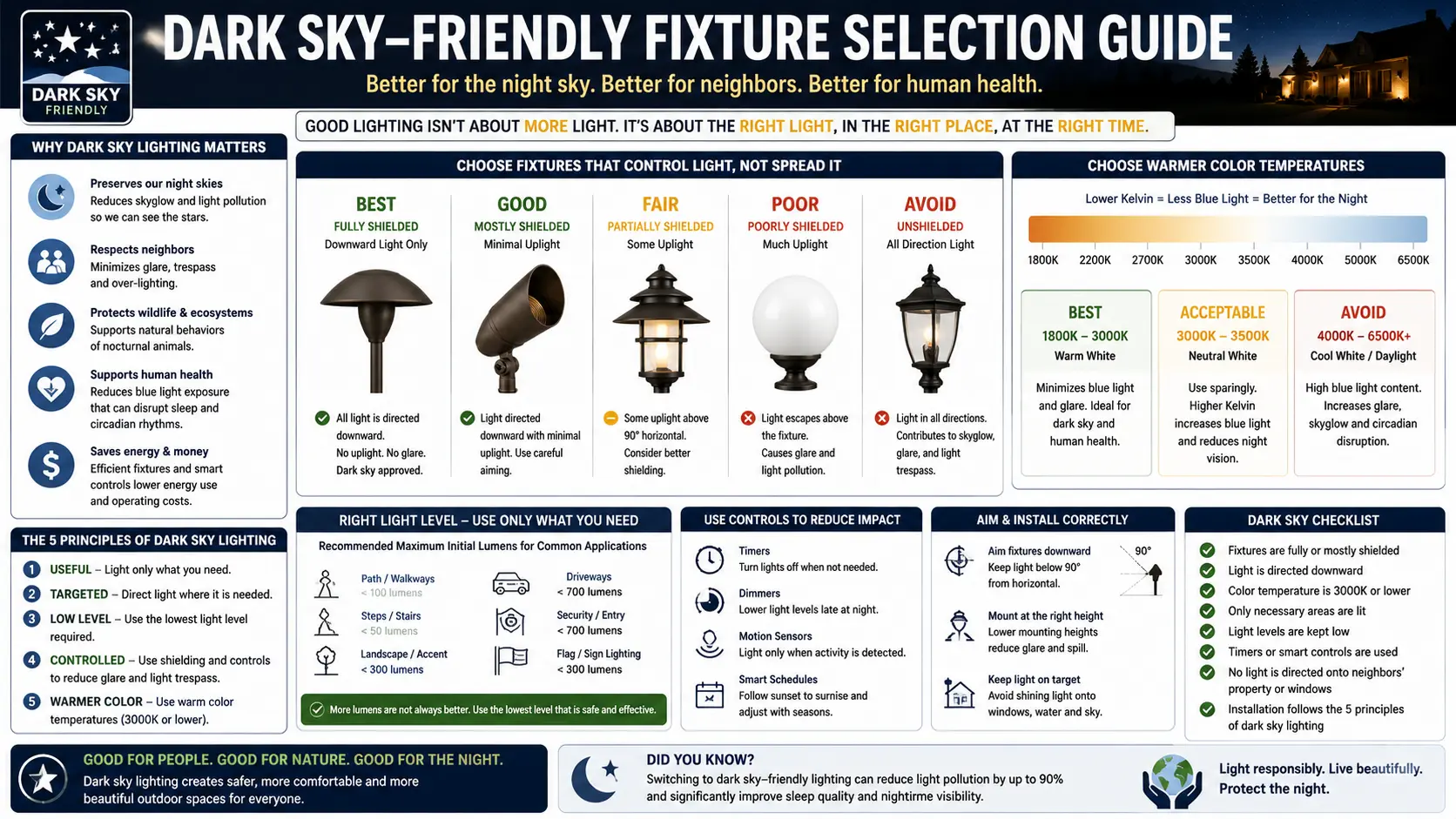
DarkSky International's Five Principles for Responsible Outdoor Lighting at Night are the framework behind all their certification criteria. Unlike the BUG rating system (which is a single technical metric for a single fixture), these five principles provide a complete system-level framework for how outdoor lighting should be designed, selected, and operated. All five must be satisfied for a lighting installation — not just a fixture in isolation — to be genuinely dark-sky responsible.
| Principle | What It Requires | Common Failure Mode | Selection / Design Implication |
|---|---|---|---|
| 1. Useful — Only light what needs lighting | Light only the intended target area. Every photon that misses the target is wasted. | Overlighting — too many fixtures, too high output, lighting areas that don't need illumination | Start with the minimum lumen count for visibility and safety. Add only if functionally necessary. Use narrow beam angles to target precisely. |
| 2. Targeted — Direct light where needed | Use fully shielded (U0) fixtures that direct light downward only, onto the intended surface | Using non-cutoff fixtures for applications that don't require upward light; aiming spotlights beyond the feature being lit | U0 BUG rating. Shielding accessories. Narrow beams aimed precisely. Louvers on glare-producing fixtures near sightlines. |
| 3. Low level — Use the minimum necessary | Be no brighter than necessary for the task. No over-illumination. | Installing 2000-lumen security lights when 300 lumens would provide adequate visibility; "security through brightness" thinking | Size fixtures for the specific task illuminance. A path needs 5–15 lux, not 200 lux. An architectural accent can use 50–150 lumens, not 500. |
| 4. Controlled — Light only when needed | Use timers, motion sensors, dimmers, and astronomical controls to limit operation hours | Dusk-to-dawn operation of high-output landscape lighting; no timer controls; always-on security lights | Astronomical timers (sunset-based ON, 10 PM OFF). Motion activation for security zones. Smart scheduling for multi-zone systems. See the timer setup guide. |
| 5. Warm colored — Use 3000K or warmer | Maximum 3000K CCT for all outdoor lighting; amber and filtered sources preferred near sensitive areas | Installing 4000K or 5000K fixtures outdoors; using "daylight" LEDs for landscape applications; cool-white security lighting | 2700K for all residential landscape fixtures. Amber (1800–2200K) near wildlife corridors, turtle nesting areas, or where bedroom window trespass is a concern. See the color temperature guide. |
Choose Fixtures That Are Reliable, Shielded and Properly Protected
A good outdoor fixture should do three things well: hold up electrically, survive outdoor conditions and control light responsibly. Older Portfolio fixtures with weak output should be inspected with this corroded socket cleaning and repair guide, transformer-fed systems should be protected using the Portfolio transformer surge protector installation guide, and fixture selection should be checked against this dark-sky compliance versus IDA certification guide before assuming a product is both environmentally responsible and quality-certified.
Dark Sky Fixture Selection FAQ
What is a BUG rating and what numbers should I look for?
BUG stands for Backlight, Uplight, and Glare — the three-dimensional IES TM-15-11 rating for outdoor fixture light distribution. Each letter gets a value from 0 to 5 (lower is better). For dark-sky-compliant residential landscape lighting, the target is U0 (zero uplight) as non-negotiable, B1 or lower, and G1 or lower. A rating of B1-U0-G1 is excellent. Any U value above 0 disqualifies a fixture from DarkSky certification. Find BUG ratings in the manufacturer's technical spec sheet under "Luminaire Classification System" — never printed on retail packaging.
Is "DarkSky Approved" the same as "dark sky friendly"?
No — they are completely different. DarkSky Approved is an independently verified certification from DarkSky International (darksky.org) requiring specific technical performance: full cutoff (U0), ≤3000K, valid electrical safety listing, no sag lens, and fixed mount orientation. It requires submission of IES photometric files for independent review. "Dark sky friendly" printed on retail packaging is unverified marketing language with no standardized definition or technical requirement. Any manufacturer can print "dark sky friendly" without meeting any standard. Only the DarkSky Approved seal, verifiable in the database at darksky.org, provides independent technical confirmation. Version 3.0 of the program was released March 2025.
Are globe path lights ever dark-sky compliant?
No — traditional globe path lights are inherently non-cutoff fixtures that send light in every direction including directly upward. They cannot be made U0 without structural modification that fundamentally changes the product. If you want dark-sky-compliant path lighting, replace globe fixtures with downward-directed alternatives: mushroom-cap path lights with opaque upper hemispheres, cylindrical fixtures with downward-only lens systems, or low bollards with shielded downward-facing apertures. The aesthetic of path lighting doesn't require a glowing sphere — small, warm, downward-directed fixtures provide effective wayfinding illumination with far better dark-sky performance.
Can I use 4000K LEDs if the fixture is fully shielded?
A fully shielded (U0) fixture at 4000K achieves zero uplight — meaning it does not contribute to sky glow from direct upward emission. However, it does not meet the DarkSky Approved certification requirement of ≤3000K, and it produces approximately 3× more biologically active blue light (near 480nm, the melanopsin peak) than the same fixture at 2700K. The AMA recommends ≤3000K for all outdoor lighting. For full dark-sky compliance and best human/wildlife health outcomes, use 2700K. A 4000K shielded fixture is better than a 4000K unshielded one — but "better than" is not the same as compliant or optimal. See the outdoor lighting and human health guide.
My municipality requires dark-sky compliance — do I need DarkSky Approved fixtures?
It depends on the specific ordinance language. Some ordinances explicitly require DarkSky Approved (or IDA-approved) fixtures. Others require "full cutoff" (which maps to U0) without requiring DarkSky certification. Others only specify color temperature (e.g., ≤3000K) with no shielding requirement. Before purchasing fixtures, read the actual ordinance text — or contact your local planning or building department. See the outdoor lighting ordinance guide for how to interpret common ordinance language. If your ordinance requires "full cutoff," any U0 fixture satisfies the technical requirement regardless of DarkSky Approved status.
Do I need to hire a lighting designer to achieve dark-sky compliance at home?
No — the principles are learnable and applicable by homeowners. The decision framework is: (1) Use only U0 (full cutoff) fixtures or add visors to make existing ones U0. (2) Choose 2700K LEDs. (3) Use the minimum lumen count that achieves the functional goal — for paths, 50–150 lumens per fixture; for accents, 50–200 lumens. (4) Install an astronomical timer set to turn off by 10–10:30 PM. (5) Aim spotlights at the base of features, not at canopies or into the sky. These five steps produce a significantly dark-sky-compliant installation for most residential landscapes. The dark sky compliance guide, the layout guide, and the timer setup guide cover the technical implementation details.
Related Sustainable Lighting and Selection Guides
- Dark Sky Compliance Guide
- Fix Light Trespass Guide
- Outdoor Lighting Ordinance Guide
- Color Temperature Guide
- Light Pollution Guide
- Wildlife-Friendly Lighting
- Biological Impact of Light Color
- Outdoor Lighting & Human Health
- Understanding BUG Ratings
- Carbon Footprint Guide
- Solar vs Low-Voltage Efficiency
- Smart Outdoor Lighting Controls
- Minimizing Energy Waste
- Landscape Lighting Layout Guide
- Timer Setup Guide
- LED vs Halogen Guide
- MR16 LED Replacement Guide
- Transformer Sizing Guide
- Voltage Drop Guide
- Brand Comparison Guide
- Landscape Lighting Maintenance
- Portfolio Lighting Alternatives
- Automated Wellness Schedules
- Landscape Lighting Cost Guide