
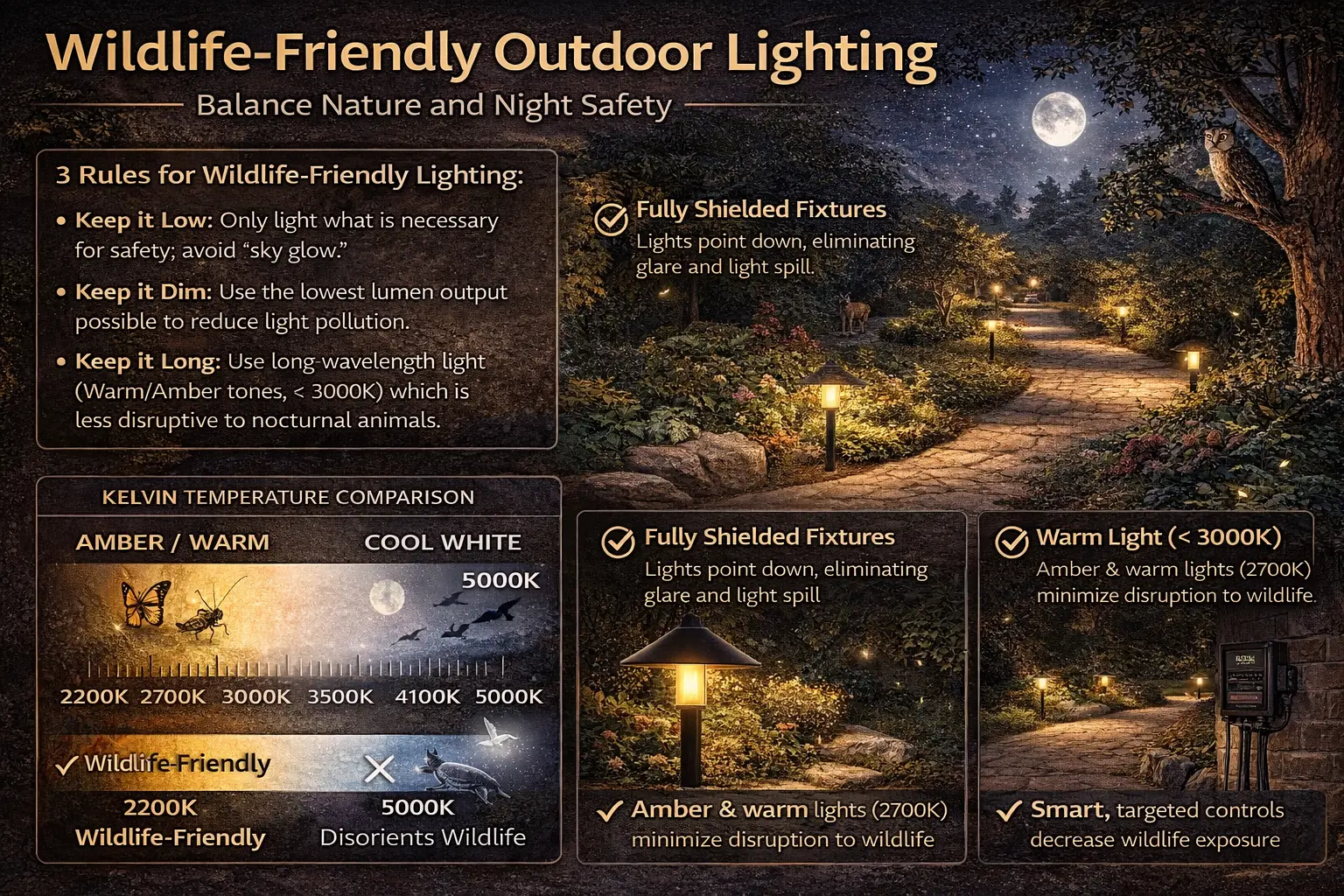
Quick Answer: My 7-Point Wildlife-Friendly Setup & Spectrum Matrix
Designing wildlife-friendly outdoor lighting isn't about leaving your home completely pitch black; it is about managing wavelength glare and beam direction so your property doesn't disrupt the local habitat. When you run unshielded, high-kelvin floodlights all night, you inadvertently create a massive wall of blue-white light pollution that disorients nesting birds, exhausts beneficial insects, and alters natural nocturnal foraging patterns.
Whenever I audit a backyard layout to make it ecologically responsible without sacrificing home security, I apply these seven foundational field rules:
- 1. Dropping the Color Spectrum (2700K or Lower): I swap out harsh, blue-rich bulbs for warm tones; birds and nocturnal animals are highly sensitive to blue light frequencies, whereas warm amber or soft yellow tones register as much less disruptive.
- 2. Absolute Downward Shielding: I make sure every single bulb is fully recessed or hooded; keeping light trapped below the horizontal plane ensures zero skyglow and keeps the beam focused exactly where human feet tread.
- 3. Strict Lumen Reduction Limits: I design around the absolute minimum brightness needed for safety; over-lamping paths with blinding, high-output bulbs creates harsh shadows and ruins natural night vision.
- 4. Transitioning to Active Motion Sensors: For high-use areas like side driveways or trash enclosures, I ditch steady-burning switches and install responsive motion eyes so light only strikes when a human is physically present.
- 5. Isolating Nesting and Foliage Zones: I keep my distance from mature tree lines, dense hedges, and water features; keeping glare away from these micro-habitats preserves critical nesting spaces.
- 6. Enforcing Mid-Night Shutoff Schedules: I configure automated timers or smart automation blocks to cut off purely decorative architectural uplighting by midnight, leaving only essential path safety illumination running.
- 7. Eliminating Window Glow Reflex: I ensure exterior fixtures don't angle directly back at house glass; reflection off windows amplifies stray light output and creates dangerous glare traps for migratory birds.
⚠️ CRITICAL HABITAT RISK: Leaving high-power 4000K commercial-grade LED floods running uninterrupted through the night will decimate local beneficial insect colonies and invite nesting pests. Mismatching your yard's color spectrum triggers three distinct ecological failures that I break down in our environmental data sets below.
In my years working on landscape designs, I’ve watched homeowners completely fix their insect and glare problems simply by making a few low-impact tweaks to their bulbs and angles. Taking ten minutes to check your kelvin ratings, cap your fixture hoods, and set up simple motion zones is what keeps your home safe while respecting the living habitat right outside your door.
Don't guess on your bulb types or install high-wattage floods blindly. Use my step-by-step wildlife-safe lighting mockups, wavelength breakdown charts, and dark-sky property templates linked further down this page to balance safety with nature perfectly.
What Most Homeowners Get Wrong
- Using bright white (5000K) lights thinking they are “safer”
- Leaving lights on all night instead of using timers
- Using exposed bulbs that create glare
- Lighting entire yards instead of walkways and entrances
3 Rules for Wildlife-Friendly Landscape Lighting
- Keep it low: Light only what is necessary for safety and avoid sending light upward into the sky.
- Keep it dim: Use the lowest lumen output that still lets people walk, enter, and see safely.
- Keep it long: Use long-wavelength, warm or amber-toned light, usually under 3000K, because it is less disruptive than blue-rich white light.
Wildlife-Friendly Lighting Logic Summary
- Warm light (2700K or lower) is safer than cool white
- Shielded fixtures prevent glare and sky glow
- Less light is usually better than more light
- Motion sensors reduce unnecessary lighting hours
- The goal is useful light, not maximum brightness
Homeowner Reality Check
You do not need to choose between protecting wildlife and avoiding a twisted ankle near the hose bib. The smartest lighting plans do both:
- light the path, not the whole yard
- keep fixtures shielded and low
- use warm lamps instead of blue-rich lamps
- turn lights down or off when nobody needs them
The biggest mistake homeowners make is assuming wildlife-friendly lighting means sacrificing usability. It does not. You can still light a walkway, patio edge, driveway, or step safely. The trick is using better aiming, lower output, warmer light, and smarter scheduling instead of just blasting a yard with bright cool-white fixtures.
If you want the broader rulebook behind this page, compare it with the Dark Sky Compliance Guide, Outdoor Lighting Ordinance Guide, and Landscape Lighting Color Temperature Guide.
If your current system feels too bright or harsh, start with the color temperature guide and then review how to fix light trespass to reduce glare and unnecessary spill.
Kelvin Comparison: Why Cool White Is the Problem
| Color Temperature | How It Looks | Wildlife Impact | Homeowner Takeaway |
|---|---|---|---|
| 2200K | Amber / very warm | Lowest short-wavelength content and generally the most night-friendly option | Excellent for highly sensitive areas and very low-impact pathway lighting |
| 2700K | Warm white | Strong homeowner-friendly balance of visibility and reduced nighttime disruption | Best overall target for many residential yards |
| 3000K | Warm white, slightly crisper | Often acceptable when well shielded and tightly controlled | Reasonable upper limit for many dark-sky-friendly installs |
| 5000K+ | Daylight / blue-white | Most disruptive because it is rich in short-wavelength blue light | Usually a compliance and wildlife red flag for residential yards |
2200K
How It Looks: Amber / very warm
Wildlife Impact: Lowest short-wavelength content and generally the most night-friendly option
Homeowner Takeaway: Excellent for highly sensitive areas and very low-impact pathway lighting
2700K
How It Looks: Warm white
Wildlife Impact: Strong homeowner-friendly balance of visibility and reduced nighttime disruption
Homeowner Takeaway: Best overall target for many residential yards
3000K
How It Looks: Warm white, slightly crisper
Wildlife Impact: Often acceptable when well shielded and tightly controlled
Homeowner Takeaway: Reasonable upper limit for many dark-sky-friendly installs
5000K+
How It Looks: Daylight / blue-white
Wildlife Impact: Most disruptive because it is rich in short-wavelength blue light
Homeowner Takeaway: Usually a compliance and wildlife red flag for residential yards
Wildlife-Friendly vs Harmful Outdoor Lighting
| Lighting Choice | Better Option | Avoid |
|---|---|---|
| Color Temperature | 2200K–2700K | 4000K–5000K (blue-white) |
| Fixture Style | Shielded downlights | Exposed bulbs / globe lights |
| Brightness | Low to moderate | High-output flood lighting |
| Control | Timers / motion sensors | Lights on all night |
Color Temperature
Better Option: 2200K–2700K
Avoid: 4000K–5000K (blue-white)
Fixture Style
Better Option: Shielded downlights
Avoid: Exposed bulbs / globe lights
Brightness
Better Option: Low to moderate
Avoid: High-output flood lighting
Control
Better Option: Timers / motion sensors
Avoid: Lights on all night
Why Long-Wavelength Light Matters
Blue-rich light behaves more like daylight and can disrupt nighttime behavior for wildlife. That is why warm light matters so much. Short-wavelength blue-white light is more likely to confuse nocturnal species, attract insects, and create visually harsh conditions. Long-wavelength amber, orange, and very warm white light is generally less disruptive.
If you want the homeowner version of this decision, use the color temperature guide and compare it with warm MR16 LED replacement bulbs and Portfolio LED landscape lighting.
Dark Sky and Wildlife-Friendly Lighting Audit Checklist
- Fully shielded fixtures: Light should point down, not out or up.
- Motion sensors: Lights that activate only when needed are often the most wildlife-friendly option.
- Timers and dimmers: Cut active light hours instead of leaving everything on until dawn.
- Warm color temperature: Stay at 3000K or lower, and aim for 2700K or lower when possible.
- No unnecessary accent spill: Decorative glow should not become uncontrolled glare or sky glow.
This is also where the site’s control pages become useful. Compare smart outdoor lighting controls, AI outdoor lighting systems, and dark sky AI automation if you want fewer active lighting hours without giving up convenience.
Many wildlife-lighting problems come from fixture spacing that is too tight rather than from a true lack of light. This landscape lighting spacing guide explains how to space fixtures more effectively so you get safer pathways without excessive brightness or spill.
Wildlife-friendly lighting depends on the fixture continuing to perform as designed. A corroded aiming bracket, heaved stake, clouded lens, or failed shield can change the beam direction and increase unintended light spill even though the lamp still operates. The Outdoor Lighting Climate Performance Guide identifies the environmental conditions that shift fixtures, degrade optics, damage seals, and shorten the life of low-impact outdoor lighting installations.
How Outdoor Lighting Affects Different Wildlife
Insects
Insects are especially vulnerable to poor nighttime lighting because many species are strongly attracted to bright, exposed light sources. That can create a “vacuum effect” around fixtures where pollinators and other insects circle lights, become exhausted, or become easy targets for predators.
Garden areas often need a lighter touch than walkways or entries. This garden landscape lighting guide can help you balance visibility and aesthetics without turning planting beds into overly bright insect-attracting zones.
Birds
Birds can be affected by upward and poorly controlled light, especially during migration. Reducing sky glow and unnecessary uplight is one of the simplest ways homeowners can make a property less disruptive.
Wildlife-friendly lighting becomes much stronger when it is specific. Birds, insects, turtles, mammals, and people do not respond to outdoor light in exactly the same way, so broad “eco-friendly” advice can miss important details. For bird habitat, migration, and nesting areas, start with the more focused bird-friendly outdoor lighting guide, which explains why shielded fixtures, warmer color temperatures, reduced brightness, and limited overnight lighting matter. Operating hours are just as important as fixture choice, so the outdoor lighting curfew guide can help connect wildlife protection with local rules, timers, dimming schedules, and smart controls.
Nocturnal mammals
Mammals that rely on darkness for movement, foraging, or mating can be pushed away by constant bright lighting. Lower, shielded lighting preserves more of the nighttime environment than flood-style lighting that spills across large areas.
How to Make a Safe Yard Without Over-Lighting It
Most homeowners do not need brighter lighting. They need better placement. A few well-placed warm path lights, downlights, or shielded step lights usually do more for safety than a yard full of glare.
- light walking surfaces instead of surrounding landscaping
- use fewer fixtures with better aiming
- reduce brightness after peak evening hours
- avoid exposed bulbs that create glare from normal eye level
If your current system feels too harsh, compare how to fix light trespass and the BUG ratings guide before replacing every fixture blindly.
If your goal is safer walking areas without unnecessary spill, use this path light placement guide to see how better fixture spacing and aiming can improve safety without flooding the entire yard with light.
For steps and elevation changes, targeted fixture placement usually works better than brighter general lighting. See outdoor stair lighting for ways to improve safety while keeping glare and unnecessary nighttime brightness under control.
Eco-Tech: The Smartest Way to Preserve Darkness
The most wildlife-friendly lighting system is not just warm and shielded. It is also smart enough to reduce active light hours. Astronomical timers, dimming schedules, motion response, and sunset/sunrise-based control are some of the strongest tools for light pollution mitigation and circadian rhythm preservation.
Long-term sustainability also depends on using fixtures that hold up outdoors instead of being replaced constantly. This durable landscape lighting materials guide explains which fixture materials tend to last longer in outdoor environments.
Wildlife-friendly lighting choices are closely tied to wavelength and color temperature. For a broader explanation of how outdoor light color affects animals, people, glare, and sky glow, visit Biological Impact of Outdoor Light Color.
That is why this topic bridges naturally into circadian outdoor lighting, smart hub compatibility, and smart control strategies.
Wildlife-Friendly Outdoor Lighting FAQ
What is the best color temperature for wildlife-friendly outdoor lighting?
For most residential homes, warm light at 2700K or lower is the strongest practical target. In especially sensitive habitats, amber or longer-wavelength light may be even better.
Does LED light hurt birds?
Outdoor lighting can affect birds when it is too bright, poorly aimed, or rich in short-wavelength blue-white light. Lower, warmer, better-controlled lighting is the safer general approach.
Are motion sensors better for wildlife than leaving lights on all night?
Yes. Motion sensors reduce the total number of active lighting hours, which is one of the easiest ways to make a yard less disruptive while still keeping it usable.
Can I keep my yard safe and still reduce wildlife impact?
Absolutely. The answer is not zero light. It is smarter light: lower, warmer, shielded, and active only when people actually need it.
Final Thoughts
Wildlife-friendly outdoor lighting is one of the easiest sustainability upgrades a homeowner can make because it usually improves the yard for people too. Warm, shielded, lower-output lighting is often more comfortable to look at, easier on neighbors, and more effective than bright, exposed lighting that spills in every direction.
If you want your property to be safer for birds, insects, and nighttime wildlife without stumbling over the garden hose, the winning formula is simple: keep the light low, keep it dim, keep it warm, and let smart controls do the rest.