
Quick Answer
Warmer outdoor lighting, especially 2700K and below, is generally easier on human sleep, night vision, and wildlife than cooler 4000K to 5000K lighting. The biggest reason is blue-light content. Shorter blue wavelengths are more disruptive biologically and scatter more in the atmosphere, which increases glare and sky glow.
Quick Logic Summary
- If the light source is 4000K or higher, it usually produces a stronger blue component that is harder on sleep and the night environment.
- If the light source is 2700K or lower, it usually creates less glare, less biological disruption, and less sky glow.
- If the fixture is shielded and dimmed late at night, the biological impact drops even further.
- If you care about true dark-sky behavior, light color and light direction both matter.
Best Outdoor Light Color by Situation
- Wildlife-sensitive areas: 2200K amber or long-wavelength amber/red
- Most residential landscape lighting: 2700K
- Selective outdoor task lighting: 3000K
- Avoid for general residential use: 4000K to 5000K+
For the most sensitive application of light spectrum control, see how 0% blue lighting is used in nursery environments to reduce biological disruption .
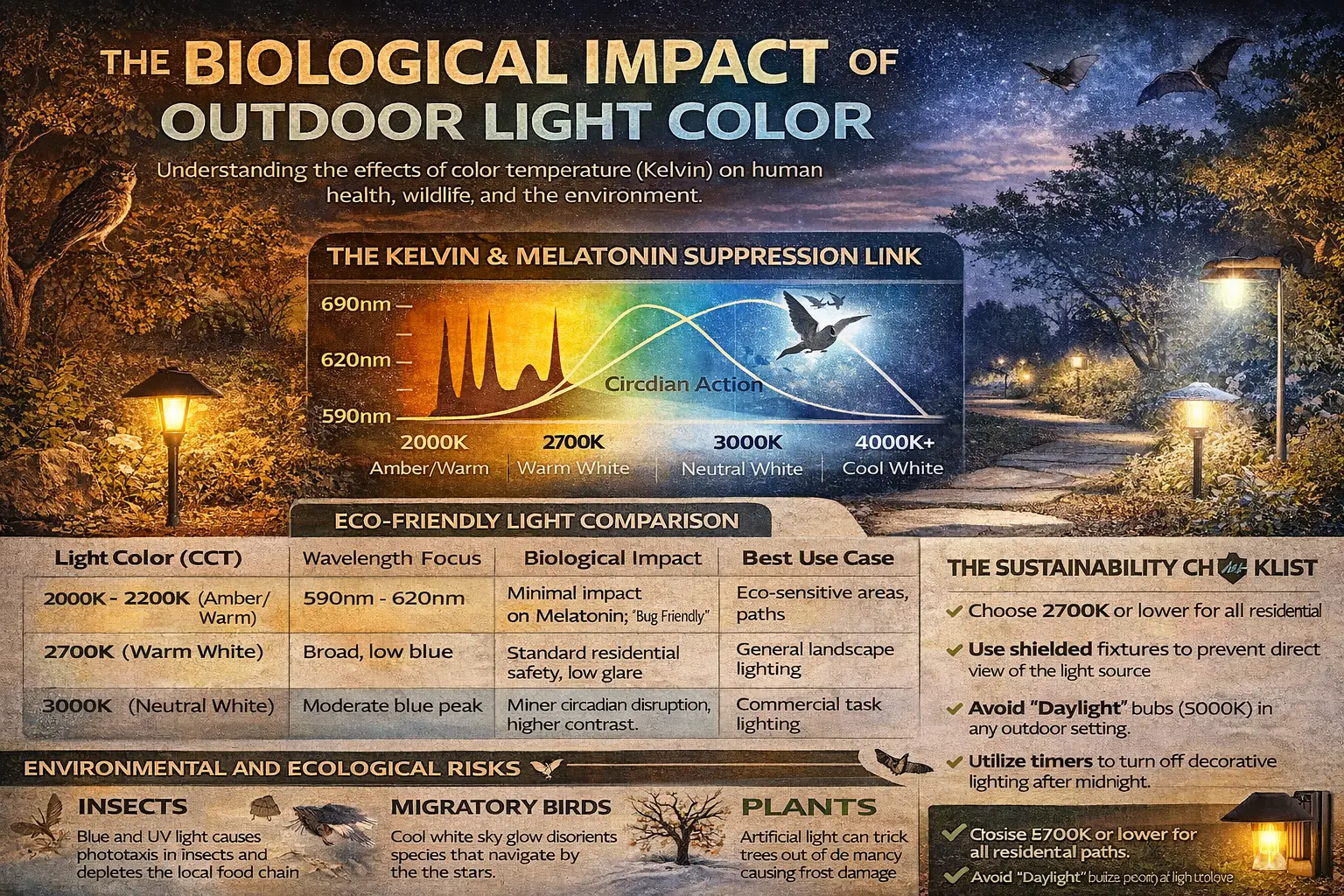
The Kelvin-Melatonin Link
Light color is not just a design choice. It acts like a signal to living systems. Outdoor lighting with a cooler color temperature can tell the body and the environment that the day is not really over yet.
That matters for people, because blue-heavy light is more associated with melatonin suppression, and it matters for wildlife because many nocturnal species are adapted to darker, warmer nighttime conditions. For a healthier outdoor lighting strategy, the goal is to move toward biological dark-sky behavior by using warmer, longer-wavelength light and limiting unnecessary exposure.
Spectral Comparison Table
| Light Color (CCT) | Wavelength Focus | Biological Impact | Best Use Case |
|---|---|---|---|
| 2000K - 2200K (Amber/Warm) | 590nm - 620nm | Minimal melatonin impact and more insect-friendly | Eco-sensitive areas and paths |
| 2700K (Warm White) | Broad spectrum with low blue output | Lower glare and lower nighttime disruption | General residential landscape lighting |
| 3000K (Neutral White) | Moderate blue contribution | Minor circadian disruption and stronger visual contrast | Selective task lighting outdoors |
| 4000K+ (Cool White) | 450nm - 480nm | Higher melatonin suppression potential and stronger glare | Security applications only, used sparingly |
How different outdoor light colors compare for sleep, wildlife, glare, and general residential use.
The 2700K Sweet Spot for Most Home Landscapes
While 2200K amber lighting is often the better biological choice for the environment, it can make green grass, shrubs, and foliage look duller or slightly muddy in some residential settings.
For many homeowners, 2700K is the practical middle ground. It still keeps blue-light content relatively low, but it usually renders plants, lawn edges, and garden textures in a way that feels fuller and more natural at night.
The Blue-Light Physics Behind Sky Glow
Cooler outdoor lighting creates more visible sky glow because shorter wavelengths scatter more easily in the atmosphere than longer amber and red wavelengths. That is why cool-white lighting of the same brightness often appears more intrusive at night than warmer lighting.
One reason blue-heavy outdoor lighting creates more haze is Rayleigh scattering. Shorter blue wavelengths are closer in size to the gas molecules in the atmosphere, so they scatter much more easily than longer amber and red wavelengths.
That extra scattering is why a cool 5000K security light can create a visible haze around the fixture and make it harder for the eye to see into darker areas beyond it. In practical terms, more blue light can actually reduce useful nighttime visibility by increasing disability glare.
Light color matters, but it is not the whole story. Dimming quality and voltage stability also affect nighttime comfort, which I explain in voltage stability and melatonin.
For Portfolio systems specifically, the Portfolio human-centric lighting retrofit guide explains how older fixtures can be modified toward lower-impact nighttime output using amber or red emitters instead of blue-pump warm-white LEDs.
This is also where night vision matters. Warmer light generally behaves better when you are trying to preserve a darker nighttime environment around the home. One useful concept here is the S/P ratio. In simple terms, warmer lights usually have a lower blue-heavy effect, which helps reduce environmental spill and keeps the night feeling more like night.
The biological impact of outdoor light is shaped by more than color alone. A warmer fixture can still cause disruption if it is too bright, aimed into habitat, or left on throughout the night. For a more practical application of these principles, see the bird-friendly outdoor lighting guide, which connects color temperature, shielding, brightness, and placement to bird movement and habitat use. Runtime matters too, which is why outdoor lighting should also be evaluated against curfew requirements and late-night dimming rules before choosing dusk-to-dawn operation.
How Outdoor Light Color Affects Wildlife
Insects
Many insects are drawn toward UV and blue-heavy light. Warmer amber-style LEDs tend to attract fewer insects, which helps reduce local phototaxis problems and the chain reaction that affects pollinators and food sources higher up the ecosystem.
If insect attraction is a major concern, see understanding bug ratings to compare how fixture design and light color affect insect activity.
Migratory birds
Birds that rely on nighttime sky cues can be affected by bright, blue-heavy sky glow. The more the night sky is brightened, the more natural navigation patterns can be disrupted.
Plants
Artificial light can also affect plants. When trees and shrubs receive too much light at the wrong time of year, their normal seasonal timing can be thrown off. That can interfere with dormancy cues and make some plants more vulnerable to cold stress.
Turtle-Safe Lighting in Coastal Areas
In coastal regions, truly wildlife-friendly lighting goes beyond choosing a warm bulb. Fixtures marketed as turtle-safe or wildlife-friendly often rely on long-wavelength lighting, typically above 560 nanometers, which means monochromatic amber or red light rather than standard warm white LEDs.
That distinction matters because even a 2700K LED still has a blue peak in its spectrum. A true turtle-safe fixture reduces that shorter-wavelength content much more aggressively, which helps lower disruption for sea turtles and other sensitive coastal wildlife.
From Theory to Better Outdoor Lighting
The filtering method
Using shielded fixtures, top hats, and brass shrouds helps keep light on the ground instead of sending it directly into eyes, windows, or the sky. That is important because even warm light becomes more intrusive if it is poorly aimed.
If glare and spill are part of the problem, see how to fix light trespass to reduce direct light in windows, neighboring yards, and the night sky.
Smart dimming
Color matters, but intensity matters too. A warmer light run at full blast all night can still be more disruptive than a well-dimmed system with a controlled schedule. Reducing output later at night is one of the most practical ways to cut biological impact without losing safety.
If you are trying to balance better lighting with local compliance, review the outdoor lighting ordinance guide for common rules on color, shielding, and nighttime operation.
Common Outdoor Light Color Mistakes
- Using 5000K security lights in a residential yard
- Assuming all warm LEDs are truly wildlife-safe
- Using warm color temperature without shielding the fixture
- Leaving decorative lighting on all night
- Choosing brightness first and biological impact second
Sustainability Checklist
- Choose 2700K or lower for residential paths and everyday landscape lighting.
- Use shielded fixtures so the light source is not directly visible.
- Avoid daylight-style 5000K bulbs in outdoor residential settings.
- Use timers or smart controls to turn decorative lighting off later at night.
Biological Impact of Outdoor Light Color FAQ
What is the best light color for nocturnal wildlife?
Warm light temperatures under 2700K, especially amber-style LEDs around 2200K, generally have the least impact on nocturnal insects and wildlife.
Does outdoor lighting affect human sleep?
Yes. Blue-heavy outdoor lighting, especially 4000K and higher, can contribute to melatonin suppression and make nighttime environments feel more like daytime than they should.
Why does cool white light create more sky glow?
Because shorter blue wavelengths scatter more easily in the atmosphere than longer amber and red wavelengths. That makes cool white lighting more visually expansive at night.
Final Thoughts
The right outdoor light color is not just about style. It is about what kind of night you are creating around the home. Warmer, shielded, properly timed lighting supports safer paths and better visibility without pushing the landscape closer to daylight.
When you choose lower Kelvin lighting and control where and when it operates, you reduce glare, reduce sky glow, and create a more biologically respectful outdoor system.
If you are also comparing system efficiency, see solar vs low-voltage energy efficiency to look beyond color temperature and consider the full outdoor lighting setup.
For a broader design perspective that connects lighting with healthier outdoor environments, see biophilic outdoor lighting design patterns.