
Quick Answer
You can upgrade Portfolio lighting without replacing the system by adding smart inline controllers, improving power delivery, and swapping key components like bulbs and fixtures. This allows older low-voltage systems to support automation, reduce energy use, and meet modern lighting standards.
- Add a smart relay between the transformer and lighting line
- Use hybrid power systems to reduce transformer load
- Upgrade bulbs to more efficient or amber options
- Improve fixtures to reduce glare and light pollution
- Fix flicker issues with voltage stabilization
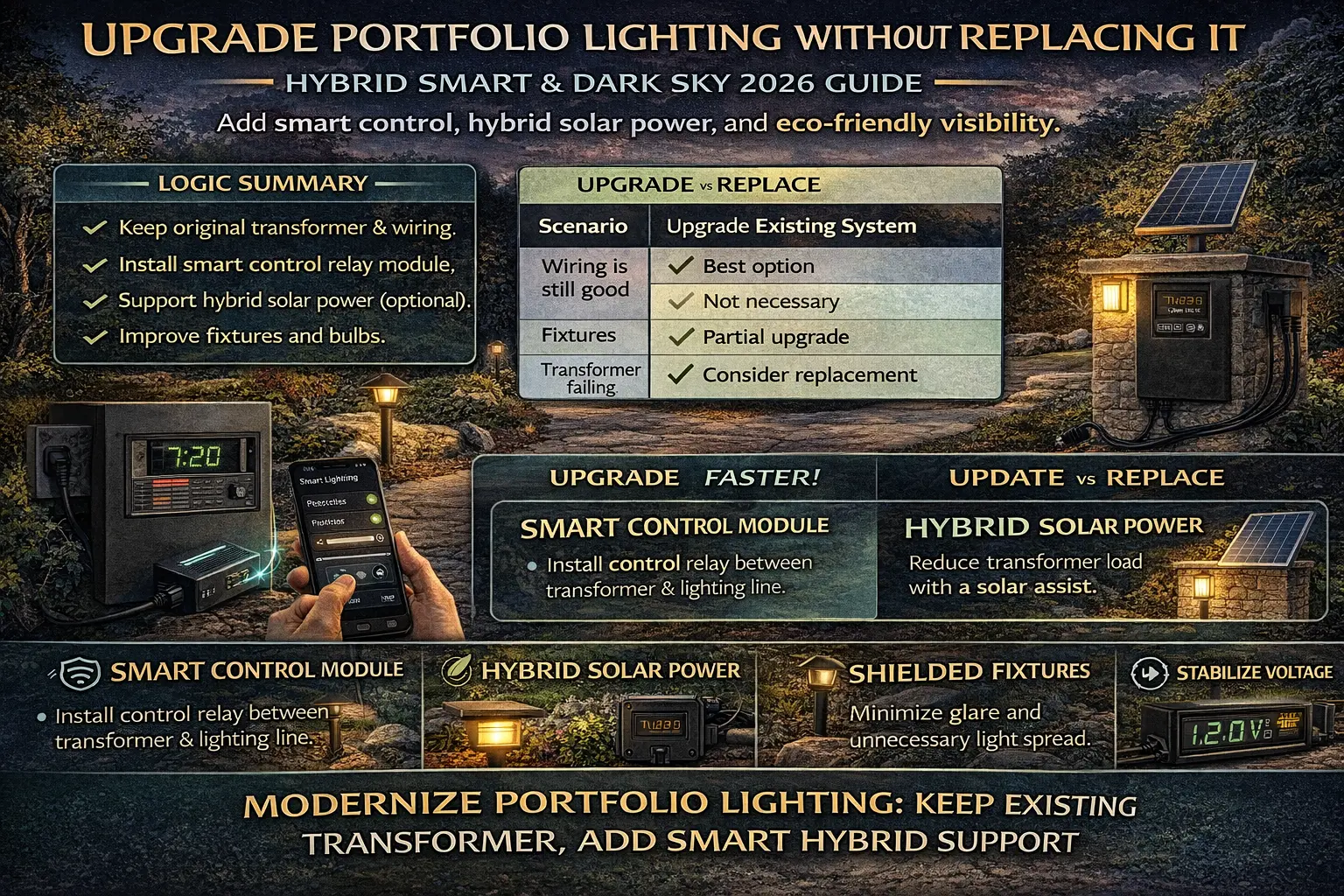
System Upgrade Logic Summary
- Keep existing transformer and wiring
- Add control layer with a smart relay or hub
- Improve power efficiency with hybrid support
- Upgrade visible fixtures and bulbs
- Stabilize voltage for modern components
This page focuses on upgrading what you already have instead of forcing you to choose between keeping an outdated system or replacing everything.
It walks through simple, step-by-step improvements to older low-voltage lighting so you can add better control, improve efficiency, and get better light quality without digging up your yard or starting over.
When upgrading a mixed holiday lighting setup, this troubleshooting guide for Christmas lights half out can help you diagnose strand-level failures before replacing compatible components.
Hybrid Power Upgrade: Reduce Load Without Replacing Your System
Older Portfolio systems rely fully on a transformer. A hybrid setup adds a secondary power source that reduces load during peak usage and improves overall efficiency.
This approach allows you to keep your existing system while lowering energy demand and extending transformer life.
Even with more efficient bulbs, it is still important to check total system load before adding new zones or smart features. A good rule is to keep the total connected wattage below roughly 80% of the transformer's rated capacity so the system remains stable and has room for reliable operation.
For a deeper technical upgrade path, see the Portfolio HCL retrofit guide. It shows how a hybrid smart upgrade can go beyond scheduling by adding circadian spectrum control, low-flicker drivers, amber/red night output, and thermal validation.
This upgrade path connects directly to solar hybrid optimization because the main goal is not to replace everything, but to reduce stress on the legacy system while improving runtime efficiency.
How to Make a Portfolio Transformer Smart
You can make an older Portfolio transformer smart by installing a control module between the transformer output and the lighting line.
This is one of the most practical bridge points to AI outdoor lighting systems and legacy transformer retrofitting, because it turns an older power core into something much more flexible without requiring a full rebuild.
Diagram reference: A smart retrofit wiring layout should show the order as transformer → smart relay or inline controller → main low-voltage run → upgraded fixtures or zones. If hybrid support is added, the secondary power source should be shown feeding the same line in a controlled way rather than bypassing the system.
Upgrade to Low-Impact Lighting Without Replacing Fixtures
Many older systems use bright white lighting that creates glare and unnecessary light spread. Simple upgrades can reduce this without changing the entire system.
- Use warmer or amber bulbs in sensitive areas
- Reduce brightness in late-night hours
- Upgrade fixtures to shielded designs
These changes improve visibility while reducing glare and light spill.
This section supports dark sky lighting because lower-impact upgrades do not have to start with a full system replacement. Many problems can be improved at the bulb, fixture, and control level.
Retrofitting older Portfolio systems with smart controls becomes far more useful when the schedules are designed around real circadian behavior instead of simple timers. The automated wellness lighting guide explains how adaptive AI schedules can create smoother nighttime transitions, reduce harsh brightness spikes, and improve outdoor comfort without requiring a complete fixture replacement.
Upgrade Fixtures Without Rewiring Your System
You do not need to replace wiring to improve lighting quality. Many upgrades can be done at the fixture level.
- Replace exposed fixtures with shielded designs
- Reduce glare by adjusting beam direction
- Upgrade visible lights for better appearance and performance
This is one reason Portfolio lighting parts and accessories and Portfolio lighting alternatives are strong support pages here. Some upgrades come from better parts. Others come from smarter replacement choices in key visible areas.
Fix Flickering When Upgrading to Smart Lighting
A common issue when upgrading older systems is flickering caused by mismatched power delivery.
One reason this happens is that many older transformers supply AC power, while some newer smart LEDs and control modules work best with cleaner and more stable DC-style output. When older AC behavior meets newer electronics, the result can be visible flicker, pulsing, or unstable dimming.
- Older transformers may not regulate voltage smoothly
- Modern bulbs require more stable power
- Long wire runs can amplify instability
Quick summary: older transformer behavior, long wire runs, and newer smart bulbs do not always work smoothly together. That mismatch is one of the most common causes of upgrade-related flicker in legacy Portfolio systems.
This is where voltage load balancing, thermal protection, and troubleshooting guide become especially useful. Most upgrade complaints are not caused by the idea of smart lighting. They are caused by old electrical behavior meeting newer components.
Upgrade vs Replace: What Makes More Sense?
If you are starting with a basic setup, this smart landscape lighting bridge guide explains the simplest way to connect an existing transformer to smart control before building a more advanced system.
| Scenario | Upgrade Existing System | Replace System |
|---|---|---|
| Wiring is still good | ✔ Best option | Not necessary |
| Fixtures are outdated | ✔ Replace fixtures only | Optional |
| Transformer failing | Partial upgrade | ✔ Consider replacement |
| Want full smart system | ✔ Hybrid upgrade | ✔ Full replacement |
When Upgrading Makes the Most Sense
Upgrading usually makes the most sense when the wiring is still intact, the layout still works, and the system mainly needs better control, better light quality, or better efficiency.
That is especially true for older Portfolio systems that still have a workable low-voltage foundation but feel outdated because of timer-only behavior, harsh bulbs, unstable performance, or limited flexibility.
Hybrid smart upgrades can work well with older Portfolio systems, but only if the transformer, dimmer, driver, wire gauge, and connector style are compatible. The legacy smart dimming compatibility guide explains the failure points to check before retrofitting older landscape lighting.
When Replacement Starts to Make More Sense
Replacement becomes easier to justify when the transformer is failing badly, the wiring is damaged, or too many visible fixtures need to be changed at once. In that situation, the cost and effort of patching the system may be close to a broader rebuild.
This is why the page naturally links to buy Portfolio lighting and Portfolio lighting alternatives. A strong upgrade page should also help visitors recognize when they have moved past upgrade value and into replacement value.
Common Questions About Upgrading Portfolio Lighting
Can I make my Portfolio lighting system smart?
Yes, you can add smart controls without replacing the entire system.
Do I need a new transformer?
Not always. Many systems can be upgraded with the existing transformer.
Why do lights flicker after upgrading?
Flicker is usually caused by unstable voltage or incompatible components.
Is it better to upgrade or replace?
If wiring is intact, upgrading is often the best option.
Upgrade Legacy Lighting the Smarter Way
This page focuses on helping you improve an existing Portfolio lighting system instead of replacing it. It brings together practical repair advice, upgrade options, and simple lighting improvements so you can get better performance, better efficiency, and better results from the system you already have.