
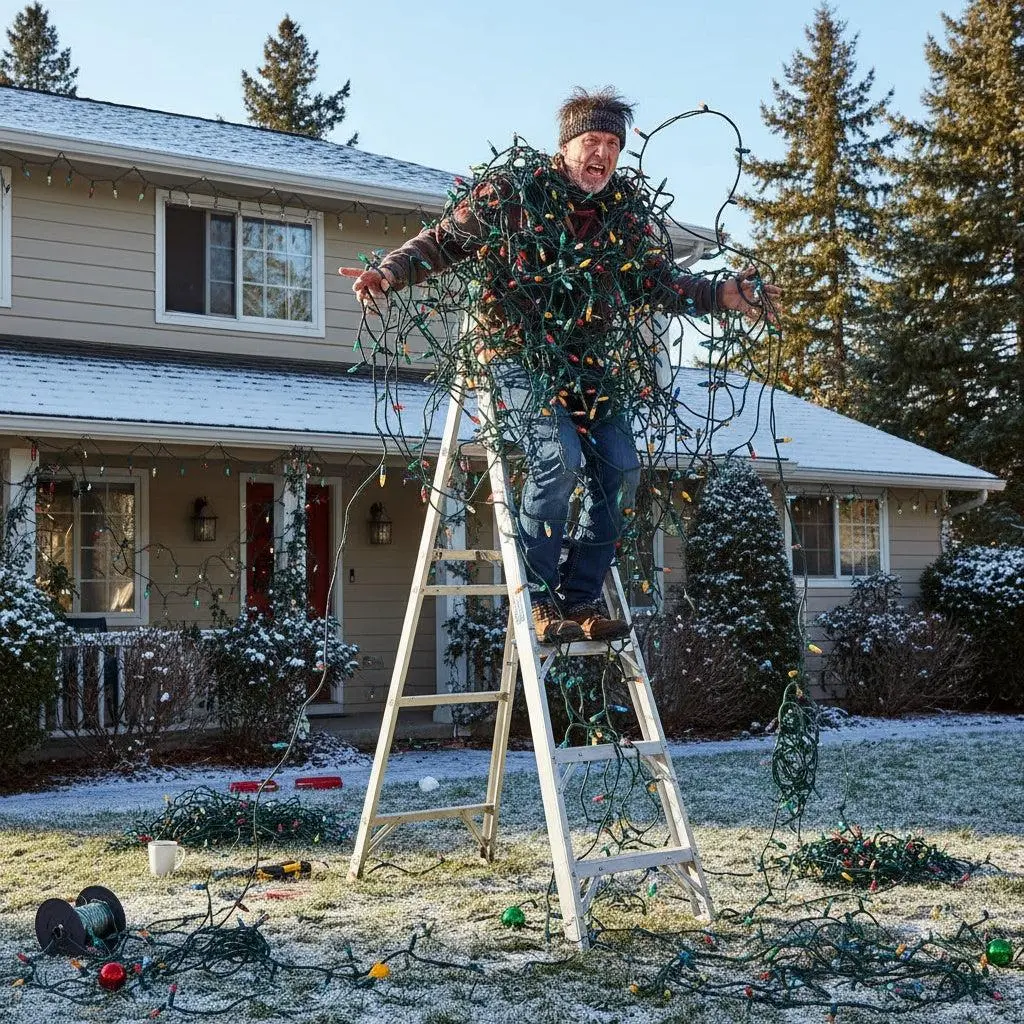
Quick Answer: My 7-Point Half-Strand Diagnostic & Circuit Isolation Protocol
When exactly half of a light strand dies, you aren't dealing with an electrical fire or a broken line—you have reached the end of a single series circuit block. Most holiday light strings are actually two or three separate circuits running along the same primary wires. If one single bulb loose wire breaks the flow inside its block, every bulb downstream in that specific loop goes dark while the other circuits stay perfectly bright.
Whenever I crawl up on a roof or untangle a dead strand of holiday lights on my workbench, I pinpoint the circuit break using these seven simple field steps:
- 1. Flipping the Plug Fuses: If the entire strand goes dark from end to end, I start at the source. Slide open the tiny plastic door on the male plug head and check the small glass fuses; if the inner filament wire is snapped, swap in a fresh spare fuse.
- 2. Locating the Divider Bulb: When half the line drops offline, I walk the wire to find the exact point where the lit bulbs end and the dead bulbs begin; the culprit is always the very first unlit bulb or the last working bulb in that line segment.
- 3. Performing the Socket Wiggle Test: I run down the dark section of the strand, gently pressing and twisting each bulb base into its plastic seat. If the lights flash on for a split second, you've found the loose connection point.
- 4. Straightening Copper Wire Filaments: When I pull out a problematic bulb, I inspect the two tiny copper wire legs bent flat against the outside of the plastic casing; if they are crushed, crooked, or missing, the light won't sit right against the socket contacts.
- 5. Overriding Internal Shunt Failures: Modern bulbs are designed with an internal bypass wire (a shunt) that keeps power flowing even if the main filament burns out. If that tiny backup wire fails to activate when a bulb pops, it kills the entire remaining line segment.
- 6. Tracing Corroded Socket Contacts: Outdoor moisture will quickly rust the tiny metal tabs hidden deep inside each plastic socket; scraping the green crust out with a small screwdriver blade fixes intermittent dead zones instantly.
- 7. Scanning Lines with a Circuit Tester: If an eye check fails, I plug the strand in and trace the line with a non-contact voltage tester tool; it will beep consistently down the live wire and suddenly go silent the exact inch you cross over the physical circuit break.
⚠️ CRITICAL REPAIR RISK: Jamming a random bulb from an old vintage set into a modern high-efficiency strand can overload the circuit branch, melting your plastic sockets or blowing your main plug fuses instantly. Mismatching your holiday hardware configurations triggers three distinct line failures that I walk you through in my wiring blueprints below.
An outdoor light strand that is half out may also flicker, pulse, or look dim before it fully fails. That usually points to a loose bulb contact, broken shunt, damaged wire section, failing fuse, or weak connection between light segments. If you are dealing with an LED strand that still lights up but looks unstable and shaky to look at, make sure to read my full guide to fixing flickering and dim LED Christmas lights where I show you how to inspect plugs, fuses, removable bulbs, connectors, and moisture-damaged lines before you replace the whole set.
Don't start pulling out random bulbs or untangling lines blindly. Use my step-by-step continuity layout maps, universal bulb replacement charts, and line testing blueprints detailed further down this page to get your holiday display working again safely.
Logic Summary: Fix the Easy Things First
| If this is happening | Most likely cause | Best first check |
|---|---|---|
| Only half the strand is dark | One failed bulb or broken continuity in that half | Check the first dead bulb and nearby sockets |
| The whole strand is dark | Plug fuse or full power failure | Open the male plug and inspect the fuse |
| The dead half flickers when moved | Loose socket or damaged wire | Do the wiggle test near the break point |
| Bulb swaps do nothing | Bad shunt, bad socket, or hidden wire damage | Use a repair tool or continuity test |
Why Half the Strand Goes Out: The Series-Parallel Explanation
Many modern Christmas light strands are not built as one long uninterrupted circuit. Instead, they are often divided into two sections wired in parallel. That means one section can fail while the other continues to work.
For a deeper comparison of how different light types behave, see Portfolio LED lighting to understand efficiency, lifespan, and failure patterns.
If multiple lighting issues are happening across your setup, see landscape lights not working for a broader troubleshooting approach.
A common example is a 100-light strand split into two 50-light sections. If something breaks continuity in one of those 50-light paths, only that half goes dark. This is why the “half-out” problem feels so specific compared with a full-strand failure.
If you are troubleshooting more than one seasonal display problem, see the holiday lighting guide for broader help with setup, power planning, and common holiday-light failures.
If you are also planning color scenes and seasonal changes across a larger display, see holiday lighting theming and color logic for ideas on how to organize colors and holiday-specific lighting themes.
For a breakdown of different strand types, bulb styles, and how they behave in real-world setups, see Portfolio string lights to understand how different designs affect reliability and troubleshooting.
If the whole strand is out or a new fuse blows immediately, check the plug fuse with our Christmas light fuse replacement guide before moving on to bulb-by-bulb troubleshooting.
If part of a strand goes out after connecting multiple strings, the problem may be overload or fuse damage. Check your total load with the holiday lighting power calculator before adding more lights.
Most Common Causes of Christmas Lights Half Out
- Blown plug fuse stopping power to the strand
- One failed bulb breaking continuity in that half
- Bad shunt inside a mini-light bulb base
- Loose bulb or socket near the break point
- Partially broken wire from storage or pulling damage
If your light strands keep failing or sections go out every season, it may be time to upgrade. Compare your options in our permanent vs temporary holiday lights guide.
If your lights fail after rain or keep tripping a GFCI, use our weatherproofing outdoor holiday lights guide before replacing the entire strand.
Bottom line: The problem is usually near the point where the working half changes to the dead half, not somewhere random in the strand.
Step-by-Step Diagnostic Logic
If the problem turns out to be bigger than one strand, continue with Portfolio lighting troubleshooting for broader repair help across indoor, outdoor, and seasonal lighting.
If you are replacing multiple bulbs or unsure which type to use, see Portfolio lighting bulb replacement for compatibility and correct replacement options.
For a deeper breakdown of how to isolate failures step by step, see lighting fault isolation logic for a structured troubleshooting approach.
Step 1: Check the Plug Fuse
This is the easiest place to start because it rules out a power-source problem immediately. Open the fuse compartment in the male plug and inspect the small glass or cartridge fuses. If one is blown, replace it with the correct match and test the strand again.
Step 2: Find the First Unlit Bulb
Once you know the plug is fine, move to the point where the strand changes from lit to unlit. The first dark bulb in the dead section is often the best place to start testing, especially if the rest of that half stays completely off.
If you suspect a bad bulb but are unsure what type to replace, use the LED holiday bulb replacement guide to identify the correct size, voltage, and base before swapping parts.
Step 3: The Wiggle Test
With the strand powered carefully for observation, gently wiggle suspect bulbs and sockets near the break point. If the dark half flickers on briefly, you likely have a loose bulb base, bent contacts, or a weak socket connection.
Step 4: Try a Known Working Spare
Replace the suspect bulb with a known good spare. If that restores the dead half, the original bulb or its shunt was the problem. If nothing changes, move outward through a few nearby bulbs before assuming the issue is in the wire.
Step 5: Use a Light Repair Tool
A Christmas light repair tool can help restore the internal shunt path or help isolate bad sockets faster than swapping random bulbs one by one. This is often more cost-effective than replacing a premium strand.
Step 6: Continuity Test for Advanced Users
If the strand still fails, use a multimeter to continuity-check the suspect section. This is the best path when you suspect hidden wire damage, a failed socket, or a bad section that simple bulb replacement is not solving.
The first dark position is not always caused by the bulb itself. On C7 and C9 strings, the lamp may be good while the socket has a flattened center tab, corroded threaded contact, cracked body, or failed connection to the flat cord. Perform the bulb-swap test first, then use the C7 and C9 holiday socket diagnostic guide to inspect the suspect socket without forcing the bulb, shorting the contacts, or installing an incompatible replacement socket.
Fast Diagnostic: Why Is Half the Strand Out?
- Did the whole strand go dark?
- Check the fuse in the male plug before touching bulbs or sockets.
- Is only one half dark?
- Find the point where the lit section changes to the dead section. The first bulb in the dark half is often the best place to start.
- Does the dead half flicker when moved?
- You may have a loose bulb base, bent socket contact, or weak wire section.
- Did a spare bulb not fix it?
- Use a repair tool or continuity test to check for a bad shunt, socket, or damaged wire.
Fix vs Replace: Is the Strand Worth Saving?
| Option | Typical Cost | Best For | Main Tradeoff |
|---|---|---|---|
| Repair tool + spare bulbs | Lower upfront cost | Single-strand failures and repeat troubleshooting | Takes patience and basic testing time |
| Replace one higher-end LED strand | Higher immediate cost | Old, brittle, or repeatedly failing sets | More expensive if only one bulb was bad |
In many cases, a small repair tool and a few spare bulbs are worth having because they can save more than one strand over time. But if the set is old, weather-damaged, or fails repeatedly in different sections, replacement may be the smarter long-term choice.
If you want a complete system that automates color changes, schedules, and seasonal scenes, see smart holiday lighting setup for step-by-step planning, wiring, and control options.
If you decide replacement is the better option, see Portfolio lighting replacement parts for compatible bulbs, sockets, and components.
When the Problem Is Not the Bulb
Not every half-out failure is caused by a single failed lamp. Sometimes the real problem is a damaged socket, a partially broken wire, or a weak crimp point hidden under the insulation. These failures often show up after storage damage, hard pulling, or repeated wrapping and unwrapping.
If several bulb swaps do nothing and the strand reacts only when bent or moved, you may be dealing with wire damage rather than a bulb issue. That is where continuity testing becomes much more useful than guesswork.
If you want broader setup, repair, and lighting advice beyond this one problem, see the lighting guide for additional troubleshooting and planning help.
If you suspect damage beyond a single socket, see Portfolio lighting wire replacement for guidance on identifying and fixing damaged sections.
Christmas Lights Half Out FAQ
Why is only half of my Christmas light strand out?
Many strands are divided into two parallel sections. If one side loses continuity because of a bad bulb, loose socket, broken shunt, or wire damage, only that half goes dark.
Can one bad bulb make half the strand go out?
Yes. On many light sets, one failed bulb or one failed shunt in the affected section can interrupt the circuit and darken that entire half.
Should I replace the whole strand if half is out?
Not immediately. It is often worth checking the fuse, replacing the first suspect bulb, and testing the dead section before throwing the strand away.